Showing posts with label 1936. Show all posts

Tuesday, May 22, 2012

Modern Times


Modern Times was the last of Charles Chaplin's "silent" movies, made after the silent era was over for everyone else, with pretty much only Chaplin hanging on — and Chaplin only able to hang on because of his special clout and fame. Like its predecessor City Lights, this isn't a true silent film, since it has a synchronized musical score (written by Chaplin himself) with sound effects and even, in this case, some actual speech. This is Chaplin's affectionate goodbye to the silent era, one last great masterpiece of silent aesthetics, with only a few small concessions to the sound pictures that had taken over the rest of Hollywood. Virtually all of the actual intelligible dialogue in the film is delivered through machines: the boss' voice barking orders over the intercom, a radio news report, a robot voice that delivers a sales pitch even as the salesmen stand silently nearby, miming along with the recorded voice. This suggests Chaplin's suspicion about the coming of sound in the movies, treating the voice as disconnected from the speaker, always with a mechanical layer between the source and the sound.

That suspicion of the modern and the mechanical runs through the film, which is a brilliant satire of modernity, with a jaundiced eye cast on the unemployment and misery of the Depression, as well as the supposed improvements of modern factories and technology. Chaplin plays a factory worker on an assembly line, unable to pause in his repetitive tasks for a moment without falling behind. This is a society that seeks to mechanize and automate everything, including even eating, thus eliminating one of the only breaks the workers get and turning it into just another step in the assembly line process. It's no wonder that this poor worker suffers a mental breakdown, unable to tolerate these oppressive conditions any longer. Chaplin, wrenches in hand, sees nuts everywhere, including in the buttons on the back of a secretary's skirt or across the breast of an older woman's suit; he's so compulsively locked into the rhythms of the assembly line that even his sexual responses are mechanical, a woman's body reduced to a series of machine parts to tighten and manipulate.

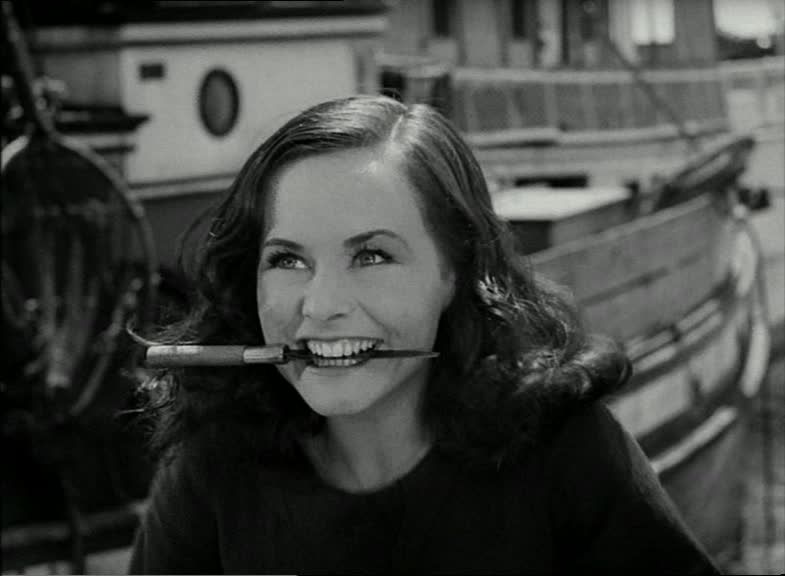
Now out of work, Chaplin's happier in jail, where he at least gets a comfortable place to sleep and some food — laced, in one outrageous scene, with cocaine from a drug dealer — than on the streets, where he's simply a poor bum. Once he gets out of jail, he's joined by Paulette Goddard's "gamin," a young orphan girl who remains a sprightly free spirit despite her life of poverty and deprivation. She is positively feral and ferocious from the moment she first appears on the screen, baring her teeth in a wild grin, a knife clamped between her jaws like a pirate as she steals bundles of bananas for the other poor kids of the waterfront. She's a magnetic and vivacious presence, with an electric smile that lights up the screen, and she's every bit Chaplin's equal, perhaps the only one of his leading ladies about whom that could be said.
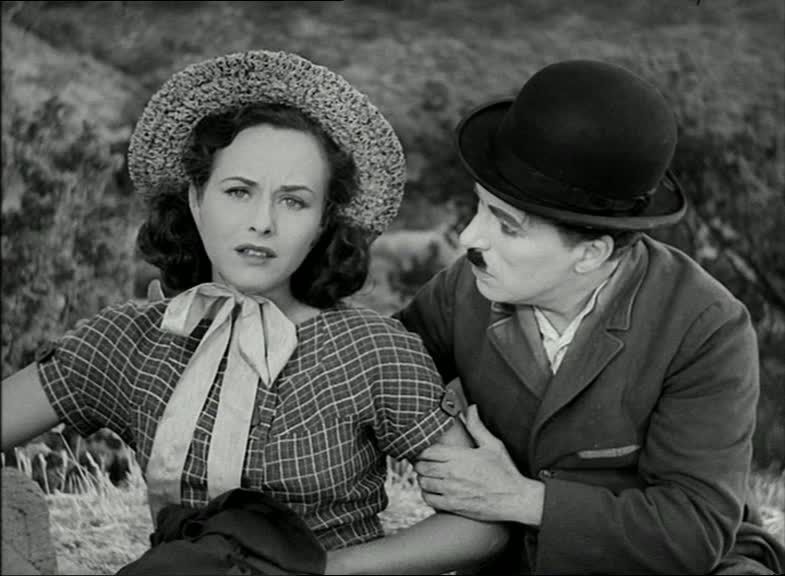
Together, Chaplin and Goddard embody the determined spirit of the Depression's poor, locked out of jobs, unable to provide for themselves, living on the streets and scratching together whatever scant food and shelter they can get. And yet they never give up, and their spirit is infectious, their enthusiasm and boundless optimism propelling the film forward into one inspired comic set piece after another, the humor always tinged with the harsh truths of poverty and struggle. Chaplin is continually bouncing in and out of jail and getting fired from one job after another despite his well-intentioned but bumbling attempts to get by. He stumbles into countless comic situations, at one point accidentally leading a Communist rally by picking up a red flag from a passing truck. The rally's quickly broken up by cops, as is a later strike by factory workers — in fact, there's very little that the cops don't break up, and the film is rather contemptuous of these authority figures who can only endlessly arrest and chase those who are just trying to ease their hunger in any way they can.

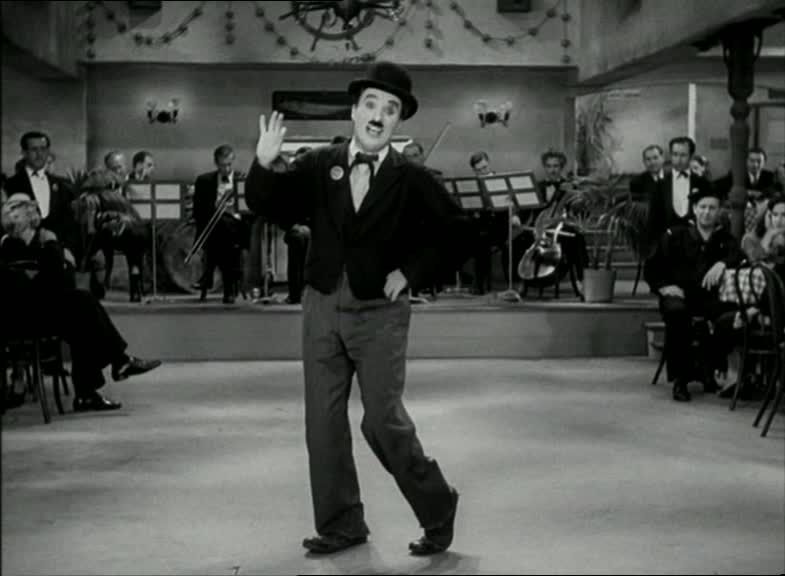
Towards the end of the film, Chaplin returns to tweaking the new talking pictures, with a sequence in which Goddard gets Chaplin a job as a singing waiter. Chaplin seems to be preparing for his entry into the sound era, teasing the audience with the prospect, at long last, of his voice being heard on film. He rehearses a number, having Goddard write out song lyrics on his cuffs, but he rehearses silently, mouthing the words and dancing, and when he finally does sing, he's forgotten the words, so he just makes up a nonsense song that's mostly pseudo-Italian dialect, gibberish and an occasional recognizable English phrase. It's a wonderful way of ushering Chaplin into the sound era without having him actually communicate anything intelligible, and the film as a whole provides one last visually, viscerally eloquent expression of Chaplin's privileging of image over sound.

The film's conclusion is justly famous, with a stunning final shot of Chaplin and Goddard walking off down a long road into the future, arm-in-arm, Chaplin duck-walking besides his beautiful partner. It's optimistic and exhilarating and utterly gorgeous, a perfect ending to a film that is often cynical about the mechanization of the modern age but is celebratory of the human ability to resist this dehumanization, to fight back with song and dance and silliness and determination and, perhaps most importantly, love. After all, this is undoubtedly a love story, one of the rare Chaplin films where the tramp doesn't give up his great love at the end; when he strolls away into the distance this time, for once he's not doing so by himself. Chaplin was in an off-screen relationship with Goddard at the time he was shooting this, and it's easy to see that romance in her onscreen radiance and the absolute adoration that's implicit every time Chaplin turns a camera on her. He's in love, and seems determined to communicate that love in every image of his costar; the result is that it's nearly impossible to watch the film without falling in love with her along with Chaplin. Romantic, hilarious, beautiful, and endlessly inventive, Modern Times is one of Chaplin's greatest works, an ode to the irrepressible human spirit and its capacity for love and invention.

Tuesday, July 5, 2011

Partie de campagne


Jean Renoir apparently left Partie de campagne unfinished, but to watch the film as it exists, assembled into a 38-minute short from the footage he shot before abandoning the project, one would never guess. Based on a Guy de Maupassant story, it is a sumptuous, sensual, subtly moving film that extracts great and surprising pathos from a simple situation. The family of the bourgeois shopkeeper Dufour (André Gabriello) takes a weekend trip to the country for a picnic, a day of relaxation for the women and fishing for the men. Dufour brings along his wife (Jeanne Marken), his daughter Henriette (Syvlia Bataille), his old, deaf mother-in-law (Gabrielle Fontan), and Henriette's fiancé Anatole (Paul Temps). While there, a pair of local young men decide to seduce the women in the party, setting their sights on Sylvia and her mother, while the shopkeeper and Anatole remain oblivious, concerned only with a day of fishing.

It's a comic set-up, and Renoir plays it as such for much of the film. Anatole especially is a comic figure, an utter dunce who looks and acts like a dim-witted Stan Laurel to Dufour's blustery Oliver Hardy. Dufour is constantly lambasting his future son-in-law for his stupidity, and the young man simply cringes and whimpers and accepts the verbal beatings. He's obviously a poor match for the pretty, dignified Henriette, who's sensitive and sweet and loves the sensual pleasures of the countryside. Renoir, for his part, is clearly aligned with Henriette's wide-eyed appreciation of the world around her. Renoir's filmmaking is dazzling and intoxicating, wrapping the viewer in the sunny, warm atmosphere of a country day. As the party arrives at a small country inn and begins setting up for their picnic, Renoir cuts away from the bourgeoisie to the country folk, the innkeeper and his employees and friends, as they prepare to serve the guests. The young boatmen Henri (Georges d'Arnoux) and Rodolphe (Jacques Brunius) sit inside, eating and talking, with the more outgoing and sexually voracious Rodolphe trying to convince his friend that they should pursue a dalliance with the women among the new arrivals.

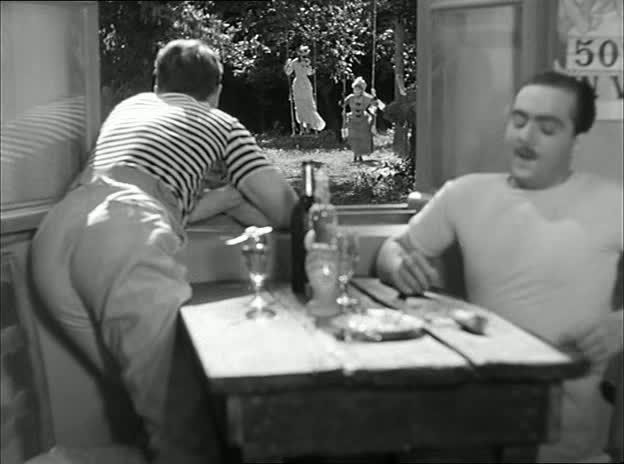
His chatter is unconvincing to Henri, who insists that his philandering days are behind him, but Rodolphe's point is made more emphatically when he throws open the window behind the two men, framing the idyllic scene outside as though it were a painting hanging on the wall. The two men in the foreground go out of focus as Renoir brilliantly frames the scene outside, a brightly lit rectangle of pure summer joy centered as a smaller frame within the film frame. Henriette and her mother swing back and forth outside, the sunlight filtering through the trees and dappling the ground with alternating spots of shadow and light. The exterior landscape is crisp and clear and invigorating in comparison to the gray fuzziness inside the inn; it's an invitation to languish in the sensual pleasures afforded by nature. Renoir's closeups of Henriette as she rides the swing are especially ravishing, as the girl smiles and laughs, her face rushing up towards the camera and towards the sky, towards the sun that beats down on her, bathing her in light.


The film meanders along in this way, lingering on scenes of beauty and peacefulness as the two young men begin their seduction against the backdrop of this natural splendor. The film is often light and funny, as the flirty, vivacious Madame Dufour instantly takes to her obvious counterpart, the predatory ladies' man Rodolphe, despite the latter's desire for the younger girl. Henriette is instead paired up with the sensitive, quiet, romantic Henri, and during a beautifully filmed boat trip, these two romances wind towards their inevitable conclusions. Henriette is especially attuned to nature, delighting in the details of life and vitality that she finds everywhere in the country. She admires a caterpillar and wonders at the richness of the tiny lives that scurry everywhere through the grass beneath her feet. Do these bugs also feel joy and sadness as people do, she wonders aloud; it is obvious that she is a girl who feels deeply and intensely, and it's hard to see what the oafish, oblivious Anatole, who virtually ignores her and wants only to go fishing, can have to offer her.

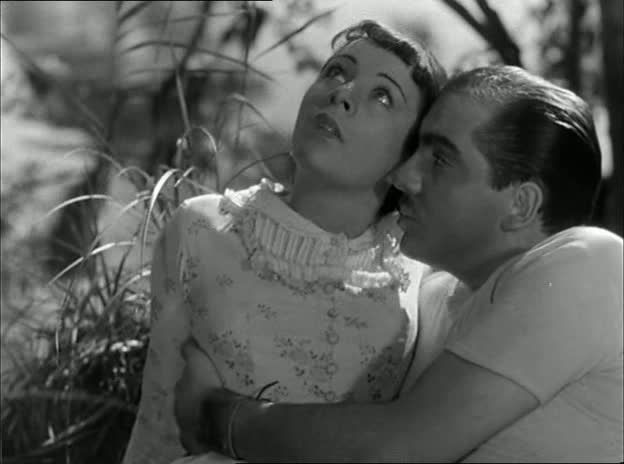
That's why, despite the film's rich humor and sensuous beauty, there's a strong undercurrent of sadness and despair running beneath its surface. Henri and Henriette spend a wonderful day on the river, as he rows her upstream towards a secluded spot where they sit together, listening to a nightingale's song, and inevitably wind up kissing amidst the reeds and tall grass. The sequence ends with a rainstorm that seems to portend the return of sadness after this brief respite of pleasure and holiday atmosphere. The wind begins to blow, shaking the trees and the reeds by the water, and the surface of the river ripples to life with tiny droplets of rain bouncing off the water, creating thousands of tiny pinprick splashes. Renoir's camera floats across the surface of the water, pulling back as though leaving this country idyll behind. This day of sunlight and celebration is over, the clouds have drifted in and the rain is falling. A title card announces that several years then pass, and that in the meantime Henriette has married Anatole.

It's possible that this sudden leap forward indicates the part of the film left unfinished, but if so the omission is only to the benefit of the film's effect. The passing over of several years of undoubted boredom and marital complacency suggests just how much was washed away by that storm, and just how fleeting the pleasure of that riverside dalliance was. After the text fills in the intervening years, Renoir returns without pause to the country river where the earlier picnic had taken place, as though no time at all had passed. The place is as beautiful as ever, and Henri still drifts along the river on his boat, but his reunion with Henriette after these missing years has a very different tone, poignant and regretful, infused with longing for what once was and might have been. It's a moving, mournful ending, cut with an undercurrent of dark humor as Henri watches his onetime lover row away, Henriette at the oars while her useless husband languishes in the boat's prow. It's the opposite of the way in which Henri once rowed her to this secluded spot to seduce her, and as he watches her row away, partially obscured by the leafy foliage overhanging the river, this last little comic touch becomes almost unbearably sad. What a wonderful, rich, warm, intelligent movie!

Wednesday, February 16, 2011

Fury


[This is a contribution to For the Love of Film (Noir), the second Film Preservation Blogathon hosted by Ferdy on Films and Self-Styled Siren. The blogathon has been organized for the benefit of the Film Noir Foundation, who do important work to restore and preserve the noir heritage. Please consider donating to the Foundation during this week. The blogathon will run from February 14-21, and during this time I'll be posting about some noirs to raise awareness of the blogathon and its worthy cause. The 1936 film I'm writing about today is based on the same story that later provided the impetus for Cy Endfield's 1950 The Sound of Fury, which is the film that is targeted for preservation by this particular blogathon.]

Fritz Lang's Fury is a harrowing film with a preachy but important message at its core. It was Lang's first Hollywood film, and it is obvious that he wanted his American debut to be a film that meant something, a film that, in a way, sent a message about what Lang saw as distinctively American values and vices. It's thus a film about justice and injustice, about goodness and corruption, about the loss of faith in the ideals upon which American democracy is built. Early on, in a scene in a barber shop, the customers discuss the American Constitution, with one right-wing man advocating for laws restricting the freedom of speech, suppressing those who say things that he disagrees with. The barber, an immigrant, speaks up, saying that the other man should read the Constitution, that such ideas run counter to the foundation of the country — he's read the Constitution, he says, because he had to in order to become a citizen, while those who are born here seldom bother. This seems like Lang's assertion of his own foreign perspective, his statement that, as an outsider, he's pointing out both what's best in this country and what threatens to destroy those great ideals, those noble concepts.

The film's central character, the ordinary working class guy Joe Wilson (Spencer Tracy), suffers the loss of faith in these ideals over the course of this film. When the film opens, he's planning to marry his sweetheart Katherine (Sylvia Sidney), although the happy couple are first forced to spend a year apart in order to save up enough money to get married. Joe's an honest, upright man, a man who tries to pass his values and ideals on to his two brothers, Charlie (Frank Albertson) and Tom (George Walcott). Charlie's caught up in some dishonest activities, running around with a mob outfit, and in many other noirs this would provide the central conflict: one can see Joe getting pulled into Charlie's criminal world, drawn by greed, forced to sacrifice his goodness and his honesty in the pursuit of enough money to reunite him with his woman. Instead, Joe pulls Charlie up into the light, convincing his brother that this flirtation with lawlessness is misguided. Lang intentionally inserts the gangster movie references as a red herring, a hint at a different kind of movie, and Joe's casual rejection of those clichés establishes him as seemingly incorruptible, unshakable in his faith and righteousness. So many noir antiheroes spiralled to their doom through this kind of temptation, but Joe is not swayed — and he spirals to his doom anyway.

Joe's sense of faith in goodness — the idea that a good life is its own reward — is eventually shattered, in the most dramatic way. The film's centerpiece is a jaw-dropping, heart-squeezing sequence of wrongful imprisonment and tragedy, as anxiety-inducing as any of Hitchcock's nightmarish "wrong man" scenarios. Joe gets mistakenly identified as being involved in a prominent kidnapping case, gets put into a small town jail, and while he's waiting for his innocence to be proven, he finds that the townspeople don't want to wait, that they want swift, brutal punishment for the man they believe to be a kidnapper. Lang's exaggerated vision of small town gossips and petty rabble-rousers transforming into a bloodthirsty lynch mob is patently artificial and stylized, but it's no less affecting for its contrivances. What matters is the impression that the institutions of civilization and democracy are horribly fragile, that at any moment the veneer of decency and justice can be peeled away, replaced by a mob mentality that overruns all of the values usually upheld in this country — or in any other country; after all, Lang had just left Germany in the early years of the Nazi government. What's striking about these sequences is that even in this nightmare vision of society run amok, Lang doesn't present the onset of hysteria and violence as inevitable: a few voices of reason do speak up and sway the crowd back from the brink, only to be overpowered again by other, less reasonable voices. And it's telling that the voice that finally does push the crowd fully over the edge is the voice of a strikebreaker, a man who'd just come from violently suppressing workers in a nearby town, and who now advocated similarly violent and horrible action in this town.


In the scene where the lynch mob starts gathering, pouring out into the streets towards the jail, a black man is nearly pushed aside by the swinging doors of a bar as the angry crowd races out. The man leaps up onto a table, hiding in the corner, out of the path of the enraged townspeople, and he remains in the back of the frame as the crowd rushes by. It's obvious that Lang is giving a little nod to this story's real subtext, to the real injustice that his film is, at root, really about. "Lynching" is a loaded word, a word with a real racial subtext to it in American history, and there's no escaping the obvious fact that all of this film's bold courtroom speeches about the prominence of lynchings in America are directed primarily at the lynchings of black men by white mobs. The film is, like many Hollywood films of the era, in code — it's quite possible that a film about a black man being lynched would have been impossible to make, and the enactment of a lynching story with a white innocent standing in for a black one allows Lang to make his observations about justice, revenge and the hatred and evil that can be so easily stirred up from petty motivations in otherwise normal people.

The lynching itself — the burning of the jail, with Joe inside, looking on in horror as law and order fall apart outside — is one of the most absolutely horrifying and sad sequences in cinema. Its impact is like slamming into a brick wall, as the fearsome, raw emotions of this sequence are unlike anything else in the film to that point. When Katherine arrives just in time to see the building engulfed in flames, with Joe at a barred window screaming, Lang holds a closeup on her stunned, horrified face, her eyes wide and glossy with tears, her mouth trembling open to murmur denials, as though she could wish away what she's seeing. These closeups are devastating, as is the hushed silence of the crowd as they watch the jail burn, stoically admiring the results of their actions, with Katherine's grief lost amidst the crowd, singled out only by Lang, who alternates closeups of Katherine with Joe at his barred window, even though the latter doesn't see his would-be bride and her horror.

The film's second half, after this pivotal event, chronicles the disruption of the American dream by this kind of hatred and violence. It is, inevitably, somewhat preachy and didactic, with plenty of courtroom speeches and showboating by the unnamed district attorney (Walter Abel), who often comes across as smug even though he's technically on the side of good. Compared to the bracing, darkly beautiful quality of Lang's images of the imprisonment and fire, it's of course a letdown when the film shifts almost entirely to courtroom theatrics, but the film's hammering sloganeering clearly comes from a place of real feeling. As a result, the film remains passionate and engrossing even when the courtroom scenes kill the momentum of the story. This is a fascinating film, a rumination on the justice system and the concept of revenge, but even when it threatens to become a wordy tract on these subjects, the film's strong emotional foundation prevents the speeches from overwhelming the characters.

Friday, December 4, 2009

Sabotage


Alfred Hitchcock's Sabotage is best known for a plot device that Hitch himself regretted using, a suspense sequence that the Master of Suspense later deemed a failure in his oeuvre. Indeed, the film is dominated by this particular set piece, a lengthy scene in which a young boy carries a package across London, not knowing that there's a bomb beneath the unassuming brown paper wrapping. The boy is Stevie (Desmond Tester), the younger brother of Sylvia (Sylvia Sidney), and he was given the deadly package by his sister's Eastern European emigré husband, Verloc (Oskar Homolka). Verloc is a saboteur, working against the British war effort at the behest of shadowy employers who urge him towards increasingly horrible crimes. When his initial acts of sabotage, like disrupting London's electrical power for a few hours, are deemed "laughable" by his superiors, Verloc is instructed to deliver a bomb instead.

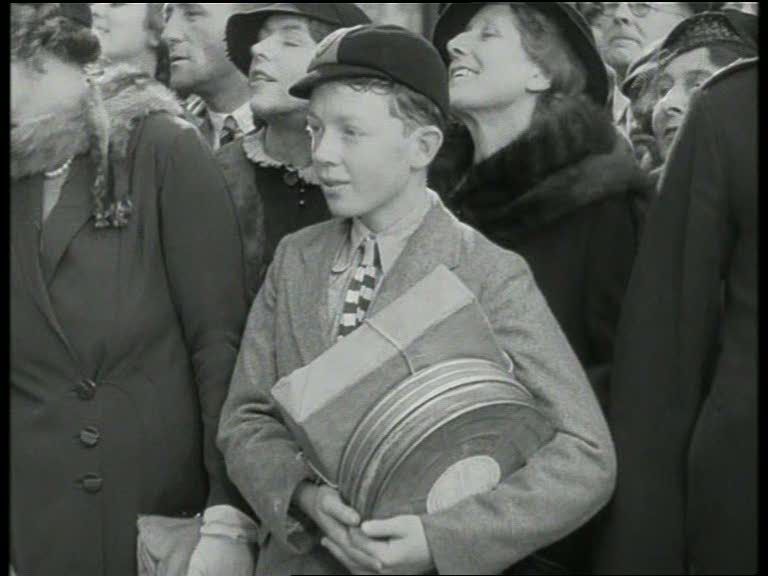
The sequence in which young Stevie carries this package across town for his sinister brother-in-law is a typically masterful Hitchcockian suspense set piece, despite Hitch's later disavowal of the scene. The tension builds steadily as Stevie is continually delayed in his journey. He was told to get his package to a cloak room by a certain time, but obviously not told why or what was inside, so he doesn't really feel the urgency of the mission. Instead, he dawdles along the way, admiring the goods at an open-air market, getting pressed into a toothpaste demonstration by an aggressive street hawker and stopping to watch a parade that prevents him from crossing a street. Throughout the sequence, Hitchcock frequently cuts back to the package that the audience knows carries a sinister cargo, and also inserts shots of clock faces to show the passage of time as the minute of the bomb's detonation ticks slowly closer. It's a harrowing scene, and by the end each stoplight, each delay that keeps the boy from his destination, only makes the pulse pounder harder and faster. As the final moment draws closer, the cutting accelerates, faster and faster, until the economical final montage: a few quick shots of the package in the boy's arms, followed by a shot of the tram he's on exploding.

This shocking denouement destroys the audience's expectation that a filmmaker would never kill off an adorable kid so callously — especially after really jerking on the audience's heartstrings by having a cute little puppy playing with the boy in his final moments. It's a startling and horrifying scene, and in fact Hitchcock was probably right to disown it despite its undeniable power; it unbalances the film, elevates its stakes to a level that it would be pretty much impossible for a light thriller to justify. In the aftermath of this scene, the film struggles to find its feet again, and never quite does. Actually, Hitchcock is never really able to conjure up much credible drama here at all. Verloc is being investigated by the Scotland Yard detective Ted Spencer (John Loder), who poses as a vegetable seller and constantly hangs around outside the cinema Verloc owns. Ted takes an interest in Sylvia, who's married to the older Verloc not out of love but because he's good to her brother and provides them with stability and security. It's a familiar 30s story, the romantic triangle of the young woman, the handsome man her own age, and the older man who she respects and feels indebted to, here given a twist by making the older husband a sinister, criminal figure.


The plot is relatively inert, since from the beginning the audience knows that Verloc is a saboteur working for a foreign power, that Ted is a detective, and that by the time the film is over Sylvia will have to realize what's going on with her seemingly harmless husband and switch her affections to the other man. With not much happening on the story level, Hitchcock gets as much as he can from the pure visual storytelling possibilities of the situation. In fact, at times the film seems to consist of little besides exchanges of charged glances and slowly tracking dramatic closeups. Hitchcock encodes the drama in alternating closeups, focusing on the eyes: Sylvia looking suspiciously at her husband, wondering what's going on with him as strange men meet with him in the cinema's back room; Verloc glaring, his heavy brows arched as he contemplates his next devious and desperate step.

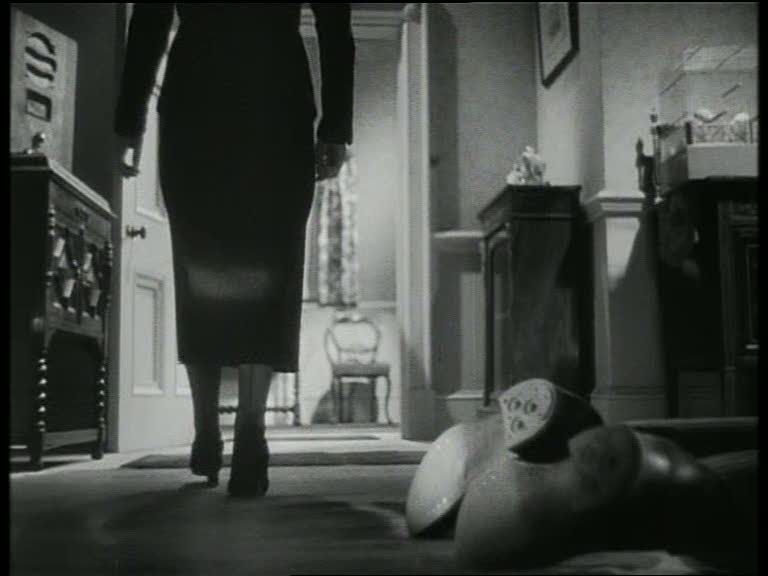
This approach reaches its apex in the climactic dinner scene after Stevie has been killed in the explosion. Sylvia knows what happened and about Verloc's role in it, and as Verloc cravenly tries to act as though everything is normal, Sylvia's eyes are burning holes in him. Hitchcock accentuates the tension by patiently drawing out the moment, capturing that look of hatred and rage in Sylvia's eyes, and honing in on the details that reveal what's going through her mind. Hitchcock's camera pinpoints her fingering her wedding ring, thinking about what it now represents, and eyeing the knife she's using to serve dinner, thinking about what other uses it could be put to.

Despite the dark material, Hitchcock also still finds some space for comic relief and humorous asides. Sometimes these diversions come in the form of offhand jokes, as when a couple walks by during Verloc's rendezvous with an enemy agent at an aquarium, and Hitchcock takes the opportunity to toss in a joke about oyster sex changes. But there's also the character of the bomb-maker A.F. Chatman (William Dewhurst), who disguises his real profession behind the front of a pet shop and quarrels with his bitter daughter (Martita Hunt), implicitly insulting her right to her face. It's deliciously funny, naughty material, and Dewhurst delivers a juicy performance in a small role, clearly having fun with this nebbishy terrorist. Indeed, the performances in general — excepting perhaps Loder's thankless role as the bland Ted — are strong, from Homolka's vaguely foreign evil to Sidney's wide-eyed innocence, reminiscent of fellow Hitchcock heroine Nova Pilbeam. The film falls apart after Stevie's death, struggling to find the proper tone and ultimately finding that there is no way to salvage a lightweight thriller after such a devastating event. But even so, Hitchcock's keen eye for entertaining performances and subtle visual storytelling keeps the film interesting even when it's not wholly satisfying.

Monday, May 4, 2009

Libeled Lady


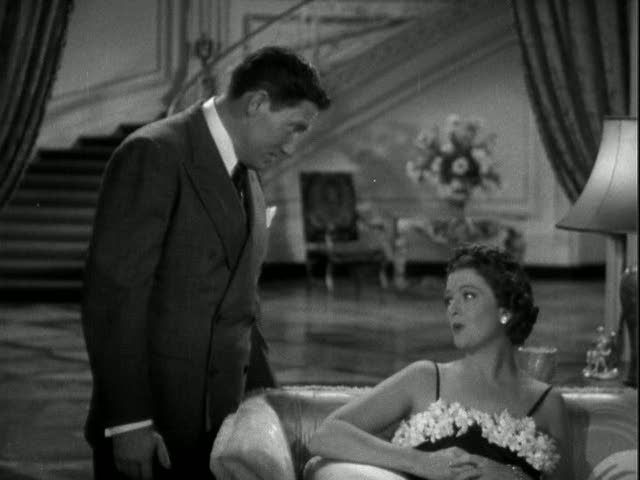
Libeled Lady provides an opportunity to see the unparalleled screen chemistry between William Powell and Myrna Loy outside of their six-film collaboration on the Thin Man films. This film, released two years after The Thin Man and just shortly before its first sequel After the Thin Man, offers a change from the comfort and wedded familiarity of Powell and Loy's Nick and Nora Charles. Here, the relationship between their characters is still in flux, still developing, and the film's greatest pleasure comes in watching them slowly work towards that easy interplay. When the film starts, there's a distance between them, a gap to be bridged by sheer charm and verbal seduction. Loy is Connie Allenbury, the globe-trotting daughter of a wealthy businessman and political hopeful (Walter Connolly). Allenbury had long been a rival of the newspaper the New York Evening Star, which accidentally prints a libelous and utterly untrue story about Connie, thus opening themselves up to a tremendous lawsuit. As a result, the paper's manic editor, Haggerty (Spencer Tracy), sends their best libel man to do anything he can to stop this lawsuit in its tracks, including compromising Connie so that her reputation really is ruined and the suit falls apart. This is, of course, Powell, as the compulsive and irresistible ladies' man Bill Chandler.

So the relationship between Connie and Chandler starts out as antagonistic. Connie suspects from the moment she meets him that Chandler is up to something — though her father adores this supposedly ace fisherman — and she maintains an icy remoteness that Chandler cannot crack. It's something to see the usually suave Powell utterly flummoxed, startled into silence by the mere fact that this woman will have nothing to do with him. She outsmarts him and steps neatly around his traps at every turn. From this hesitant beginning, though, the pair slowly begins developing towards their signature quick-witted repartee, with Powell's one-liners gliding effortlessly off of the ramp of Loy's pert, faux-wounded manners, her rolling eyes and puckered mouth. It's like watching the moment when Nick and Nora Charles first met and fell in love, when Nick's ragged charm and wit finally melted away the society ice queen's outer layers to find the playful girl inside.


Director Jack Conway doesn't have to do much with this pair besides get out of the way, and for the most part he does. The comic and romantic patter between Loy and Powell isn't particularly sharp or incisive — the script doesn't have the bounce or verve of the best Thin Man films — but the actors' warmth and obvious comfort with one another brings the characters to life. The film occasionally falters whenever it doesn't rely on the interplay of its leads, as in a lengthy and intermittently tedious sequence of fly fishing, with Chandler posing as a pro fisherman for the benefit of Connie and her father. To the extent that the scene relies on Powell's slapstick talents, it's a flop, because there's something deadening about seeing the dapper, self-possessed Powell trying to take a pratfall. He's not a physical comic, and it doesn't help that Conway's staging of Chandler's hapless attempts to catch a fish is flat and lifeless.

Thankfully, Powell and Loy do get admirable support from Tracy, and especially from Jean Harlow, as Haggerty's fiancée Gladys, who is used as a pawn in the plot to trip up Connie. Haggerty marries off Gladys to Chandler, keeping her hidden so that once Chandler compromises Connie, Gladys could appear to make it seem as though Connie were running around with a married man. Gladys provides comic relief throughout the film, a kind of crass, side-of-the-mouth counterpoint to Connie's prim sophistication. But in the final scene, she comes into her own, taking charge of the narrative by force. Her big moment is practically metafictional, a very self-conscious denial of the "happy ending" that seems to be developing in the final moments in the film; she sees the way this thing is heading, and she wants to make sure that she doesn't get left out of the Hollywood ending. As a result, the film seems to end twice: the narrative begins winding down and tying up loose ends only to be thrown into confusion again by Gladys at the last minute. The effect is sort of like those old Looney Tunes cartoons where the characters, conscious of their status in a fictional artifice, try desperately to exert some control over the direction of the story. Like Daffy in Duck Amuck, the cartoonish Gladys won't allow herself to be pushed around by some writer without putting up a fight, and her big speech winds up questioning not only the dictates of the story but the assumptions of the audience, who were probably only too willing to accept a "happy ending" for the charming, witty, upper-class characters while the vulgar, urban dame gets a raw deal. It's a great moment, subtly undercutting the assumptions about class underlying so many Hollywood romances and comedies. If the rest of the film is rarely so sophisticated or complex, though, it's still often funny and light and enjoyable, making this a fluffy entertainment that at the last moment hints at something more.

Sunday, February 22, 2009

After the Thin Man


The second film in the series of Nick and Nora Charles mysteries, After the Thin Man, closely follows the template established by the original film that started it all, The Thin Man. And why not? The formula was obviously a success: the couple's easygoing charm and humor, their comedic banter and good-natured sparring, provide a solid bedrock for the twisty murder mysteries they inevitably stumble across. Nick (William Powell) is a famous private detective, now retired after marrying the wealthy socialite Nora (Myrna Loy). But somehow cases continue to find the former gumshoe, who somewhat unwillingly embarks on the trail of some new mystery, all the while insisting that he just wants some sleep, a good tall drink and some time alone with his lovely wife. As in the first film, this sophomore effort takes its time setting up the mystery, leaving space for all the characters to get into place before the first murder happens, triggering the investigation (and leading eventually to several more corpses before it's all through). The pacing is even and patient, introducing the huge cast one by one and establishing the various motives, opportunities and potential alibis for all these players for what is obviously coming: the murder of the no-good Robert Landis (Alan Marshal), who has so many sharks circling the water around him that he can't help but turn up dead before too long.

Once he does, Nick and Nora are on the case, primarily because Robert was married to Nora's cousin Selma (Elissa Landi). Robert was planning to run off with nightclub singer Polly (Penny Singleton), even though Polly's "brother" Phil (Paul Fix) is lingering sinisterly in the shadows, along with nightclub owner Dancer (Joseph Calleia), his shifty-eyed Chinese partner Lum Kee (William Law, playing a possible inspiration for James Bond enemy Odd Job, complete with deadly hat-tossing skills), and even the society figure David Graham (an early role for James Stewart), who loved Selma and was paying Robert to finally get lost. There's no shortage of suspects, obviously, including even Selma herself, and it's up to Nick and Nora to sift through this increasingly complex mess.

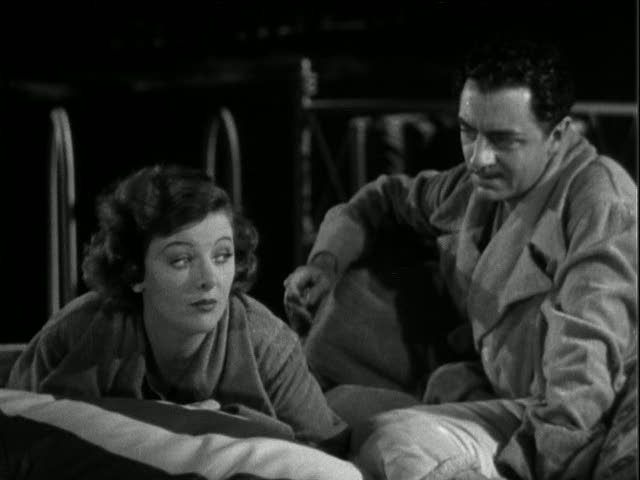
They do so, of course, with characteristic style and finesse. The film isn't quite as funny or sparkling as The Thin Man, possibly because Nick and Nora don't consume nearly the brain-melting quantities of liquor they did the first time around: slowing down already? But the unmatchable chemistry of Powell and Loy goes a long way, and there's plenty of great one-liners and witty exchanges, including Nick's attempt to figure out how many places he's been kicked out of (Nora's response: "Well, how many places were you in, Mr. Charles?"). The two of them have an enviable repartee, a back-and-forth battle of wits that only seems to deepen their love and respect for each other. Whenever the two of them are onscreen together, exchanging barbed lines and raised-eyebrow glances, it's hard for anything else in the film to compete. Best of all is a scene where Nick, trying to get some sleep, is gently taunted awake by Nora, who has a sudden craving for scrambled eggs. It's a quietly funny scene, subtly written, particularly Nora's coup de grace: after asking Nick if he can reach the water on the dresser, when he tries to give her some she shoots back, "Oh no, I didn't want any, I just wanted to make sure you could reach it."


The mystery in this film is less convoluted than the one in The Thin Man, and much easier to figure out, following as it does conventional murder mystery rules: it must be the person who the narrative conspicuously pays the least attention to and who everyone seems to dismiss instantly as a suspect. Thus, long before Nick's final parlor scene — gathering together all the suspects and letting the plot unravel as he alternates between narrating events and questioning people — it's obvious whodunnit. The fun is in watching Nick pull the pieces together and bounce off of the film's troupe of great character actors. There's plenty of funny business going on with the supporting players, particularly Jessie Ralph as Nora's snooty Aunt Katherine, who has a habit of beating newspaper photographers with her cane. In fact, Nora's whole family provides some memorable comic relief during an early scene where Nick gets dragged along to a family gathering. He ends the night sitting at a table with Nora's ancient uncles, attempting to moderate a "conversation" between the snoring old gentlemen. Even the couple's dog, Asta, has as much charm and personality as any of the human bit players. Asta has his own troubles in this installment, returning home from a long trip to find that Mrs. Asta has been running around with a black dog and has a little black puppy to prove it. It's a hilariously naughty subplot narrated entirely through the dogs' expressive pantomime performances.

If After the Thin Man doesn't quite recapture the magic of the first Powell/Loy pairing as Nick and Nora, it's still a worthy sequel with plenty of the same wit and vibrancy as the first installment in the series. Indeed, just putting Powell and Loy onscreen together is more than enough. This is another fun, funny entertainment from the duo and director W.S. Van Dyke, who returned for this second film and brings to it the same brisk, no-nonsense style that made the first a success.

Sunday, February 1, 2009

Secret Agent


Alfred Hitchcock's Secret Agent, one of his early British thrillers, is an odd, off-kilter World War I spy story, its tone largely light and carefree but with some very dark, macabre notes scattered throughout. It's the story of a British spy whose first cover story, as a novelist, is killed off with great ceremony so that he might assume a new identity as Ashenden (John Gielgud). He's sent on a mission to track down a certain enemy agent, whose identity is currently unknown; all that's known is that the man is carrying vital information and must be killed before he reaches Turkey. Ashenden is assisted by the cold-blooded ladies' man known as the General (Peter Lorre, in a hilariously caricatured turn), and by the British agent Elsa (Madeleine Carroll), who is posing as Mrs. Ashenden in order to assist in his cover.

It's thus a standard spy story in many ways, though there's a unique twist in that both Elsa and Ashenden come to be ambivalent about their job, reluctant to have a man's blood on their consciences. Elsa, who joined up for the excitement, finds that the spy novel adventure she was expecting is not quite as romantic or glamorous as she had hoped. It's never quite clear why Ashenden is involved in this work, but he too proves to have little stomach for the job's dirtier aspects, even if the slimy, cheerfully amoral General is the one who is designated to actually get his hands (and knife) dirty with the enemy agent's blood. This distaste for blood is certainly unusual in a spy thriller — imagine a James Bond with similar compunctions — but Hitchcock uses his hesitant hero in interesting ways. There is, about halfway through the film, a masterful sequence in which Ashenden and the General are leading along Caypor (Percy Marmont), a man who they believe to be the enemy they have been tracking. While the two agents walk through the mountains with the man, heading towards a quiet spot where they will be able to assassinate him, Elsa waits back at the hotel with the man's stern, taciturn German wife (Florence Kahn). Hitchcock methodically cuts back and forth, using parallel editing to draw out the suspense, to accentuate the increasingly awful waiting of Elsa as she knows that her companion's husband will not be returning.

The sequence is shot through with humor following the arrival of the flirtatious American tourist Marvin (the always cheerful Robert Young), but Hitchcock slowly escalates the tension. The condemned man's dog, as though aware of its master's impending fate, begins whining and scratching at the door, and the noise soon becomes unbearable for Elsa. Meanwhile, the General and Caypor have gone on alone into the mountains, leaving Ashenden to watch from a telescope as the murder takes place on a lonely ice shelf. The scene climaxes with the editing growing increasingly frantic and insistent, cutting rapidly back and forth from the hotel room to the mountains, everything accelerating towards the inevitable moment. It's a remarkable use of parallel editing, with Ashenden's horrified reaction to the murder he's set in motion taking place at the same moment that the growing tension in the hotel room finally breaks free into the new widow's horrified scream, the dog's plaintive moan and Elsa's own guilt-ridden reaction. It is as though the news of the murder was psychically communicated into the room, allowing for the scene's double climax.


This scene is harrowing, particularly since it should be entirely obvious to the audience that, movie conventions being what they are, Caypor is not actually the enemy agent they were sent to kill. He was indicted and sent to his death on the flimsiest of evidence to begin with, and it's quickly revealed afterward that he was not, in fact, the right man. The news inspires gales of laughter from the General, but only sends further feelings of depression coursing through Elsa and Ashenden. And yet the film doesn't go any further in developing this particular thread, letting it drop shortly afterward. It's curious that the film's climactic central scene, the scene that is certainly the one on which Hitchcock lavished the most elaborate technical attention, actually depicts an innocent man being murdered in cold blood by the supposed heroes. There's a real disjunction here, and it's perhaps for that reason that the film lets the incident drop from the narrative along with the widow. The General cavalierly explains how he faked his way through the inquest, getting the man's death declared an accident, and that's the end of it. The rest of the film is weighed down by this lack of moral inquiry, making the subsequent return of a comedic tone seem forced and awkward. And the final act is something of a tortured mess, leading towards a too convenient deus ex machina finale that allows the villain to be punished without the heroes getting any further blood on their hands — and, indeed, making one wonder why the heroes were needed to begin with.

If the film falls apart a bit by the end, it is before that often entertaining and thrilling, with a witty script and plenty of fine Hitchcockian set pieces. The banter among the leads is frequently fun and clever, with some great dialogue especially during the confrontations between Ashenden, Elsa and Marvin. Young, as the American tourist with an eye for the faux-married Elsa, has a sprightly manner and a gift for mannered gestural comedy. In one scene, he tries leading Elsa into a casino, rebuffed at every turn whenever he tries to put a hand on her shoulder or take her arm; he finally has to content himself with looping his arm through the dangling fabric of her dress. He steals the show whenever he's onscreen, especially when opposite Gielgud, who gets to come alive in the one or two scenes where's he's also allowed to play comic, but who otherwise seems dour and dull, his character only broadly defined by the script. Hitchcock also wrings equal parts comedy and suspense out of a sequence where Ashenden and the General go to a rendezvous with a German organist at a rural church. They light three candles, the pre-arranged signal, but the organ continues to drone unchangingly, and the two agents sit in front of the candles, their eyes shifting nervously about, while the organ's monotone chords fill the room with an aura of dread. It soon becomes obvious, to the audience if not the agents, exactly what has happened: the organist is dead, his hands locked onto the keys playing his final piece.

In wonderful scenes like this, scattered throughout the film, and in the diabolical wit of much of the dialogue, Hitchcock's touch is apparent. The film is not a total success, but there are enough moments of interest to justify its status as a fine, flawed early example of the master of suspense at work.

Friday, January 23, 2009

Come and Get It


[This is a contribution to the Early Hawks Blog-a-thon hosted right here at Only The Cinema. It will run from January 12 to January 23, 2009.]

Come and Get It is the result of Howard Hawks' second attempt, after the pleasant but totally uncharacteristic Barbary Coast, to work under producer Samuel Goldwyn at MGM. If in the previous film Hawks' style had been mostly subsumed by his producer's strong personality, Hawks is very much present in Come and Get It, although not for the entirety of the movie — in fact, Hawks either quit or was fired with about three-quarters of the picture done, leaving William Wyler to step in and complete it. Because of this, the finished film betrays the influence of two distinctly different directorial personalities, though with the basic narrative framework in place from the beginning, it is not nearly as disjointed as one would expect. Structurally, the film is a multi-generational tale, roughly divided in half, with a lengthy prologue set in 1884, before the action flashes forward to 1907. Both sequences center around the lumber baron Barney Glasgow (Edward Arnold), whose rise to power is accomplished at the cost of his happiness. Hawks' personal style is most evident in the raucous, bawdy humor and action of the first half, while the more sedate second half is more obviously suited to Wyler (though Hawks must have shot some of this more turgid material as well).

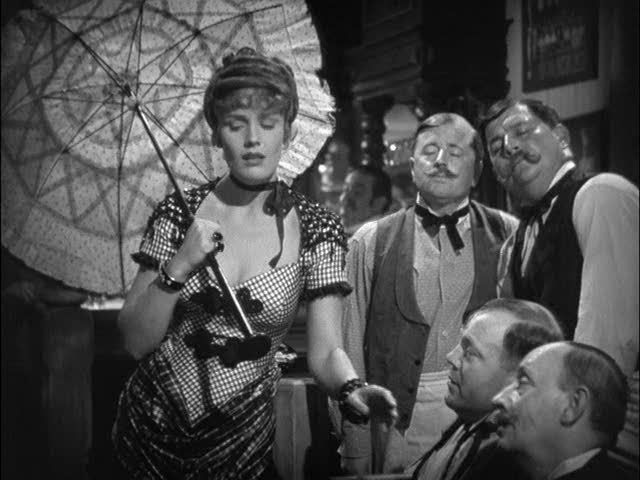
In the film's opening, Glasgow is just beginning his rise to wealth and power, working hard and shrewdly as an assistant to a logging company owner, but jockeying into position to become a full partner. With his plans set in motion — he need only marry his boss' daughter to consolidate his position — Glasgow takes a break after a successful logging run to celebrate with his friend, the gregarious Swede Swan Bostrom (Walter Brennan) and the other loggers. In the process, he meets and falls in love with the lovely bar singer Lotta (Frances Farmer), a tough, brassy girl who's obviously a true Hawksian heroine. The scenes in the bar between Glasgow, Lotta and Swan are where Hawks really comes alive, having a ball with the raucous setting and his sneering, self-possessed heroine. Farmer sings a pair of songs, packed into typically cluttered Hawks frames: this is perhaps the first appearance of the distinctive way the director would deal with musical breaks in his later films. There's more than a little resemblance here to the later use of Lauren Bacall's smoky torch ballads in To Have and Have Not, and Farmer has a similarly husky, deep voice. The bar sequence climaxes with a great brawl, lovingly staged to maximize the violence and destruction. By the end, the three of them, Lotta included, have fended off the entire bar full of attacking thugs, hurling metal trays like discuses to take down the men and shatter every glass surface in the room. Hawks seems to be reveling in this destruction, celebrating the collapse of the entire bar.


There is a similar energy and pleasure in the early scenes that depict the process of logging from start to finish, following the progression of the lumber: trees being chopped down, the ice cracked so that the logs can be shipped downstream, the wood finally being carved and crafted into marketable goods. Hawks farmed these scenes out to his regular collaborator Richard Rosson, who often handled the documentary sequences in his early films. Rosson, as usual, has a keen eye for process, for capturing the raw physicality and rugged determination of men working in demanding professions. These scenes are extraordinary, finding an abstract poetry in the way thick logs careen down the carved-out paths that lead down to the river: the logs shoot out over the water like missiles, sending up tremendous geysers in their wake. Hawks always liked to ground his stories in physical reality, in the milieu of his characters, and in his early films it was often Rosson who allowed him to do this, though never quite as spectacularly as here.

These scenes give the film's first half a loose, vital atmosphere, bolstered especially by the fine performances Hawks gets out of Brennan and Farmer. Once the film jumps forward in time, however, much of this momentum is dissipated, perhaps inevitably since the narrative itself is about a man who trades this pure, unfettered happiness for his business ambitions. The budding romance between Glasgow and Lotta is shattered when the former realizes that he must return and marry his boss' daughter, or else lose his chance to become a full partner in the logging business. Glasgow makes his choice regretfully, and the kindly older Swan marries the wounded Lotta instead, settling into a comfortable life with her to mend the gulf left by his friend's departure. Glasgow, meanwhile, has married the plain, nagging Emma Louise (Mary Nash), and fathered two children, Evvie (Andrea Leeds) and Richard (Joel McCrea). He has become gruff and cold, a far cry from the playful, expansive carouser and rabble-rouser of the film's opening scenes.


When the action picks up, Glasgow is preparing to visit with his old friend Swan again for the first time in the twenty-three years since he left Lotta behind. He does so at the urging of his daughter, with whom he has an odd relationship with a typically Hawksian undercurrent of incestuous closeness: Evvie calls him "Barney" or "darling" and walks with him arm in arm, doting on and playfully teasing him. She has more of a wifely relationship with him than his actual wife does; Emma Louise primly tells her son that she has never called her husband anything other than "Mr. Glasgow," in a scene that makes the cold, businesslike parameters of their marriage readily apparent. Meanwhile, Lotta has died in the intervening years, though not before leaving behind a daughter who bears a striking resemblance to her mother.

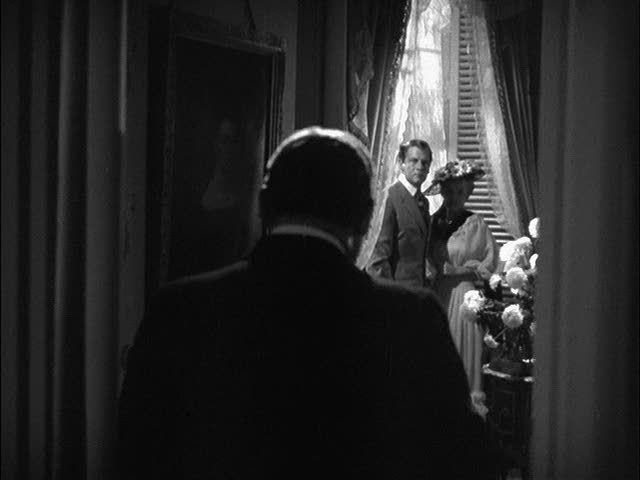
In fact, it is this girl — also named Lotta and also played, with a much softer, quieter attitude by Farmer — who excites Glasgow's interest when he goes to visit his old friend. He sees in her a vision of the powerful love he now regrets leaving behind, and he becomes lecherously attached to her, conspiring to keep her close to him under the guise of helping her father, his friend. The plot becomes increasingly mired in layers upon layers of melodrama, irretrievably so once Glasgow's son Richard also falls in love with this new Lotta. It's around this point that Wyler takes over, his mannered deep focus compositions signaling his presence. His style blends fluidly with Hawks' despite the difference in approaches, and he contributes some undeniably striking images: particularly one in which Glasgow's looming back takes up the foreground as he discovers the two young lovers clenching, glimpsed in the far background over his shoulder.

But by this point the film's narrative has become unredeemably dull and plodding, and Wyler's stately pacing and heavily stylized compositions do little to lighten up or aerate the material, as Hawks might have done with full control over an unpromising story like this. Even Farmer, so fun and free-spirited as the first Lotta, becomes just another weepy delicate flower as the second Lotta, possessing the same face but little of the same spirit as her mother. Brennan remains a breath of fresh air in all his scenes — though he was still much more fun in Barbary Coast and would be even better in later Hawks appearances — and Arnold is fine in conveying his character's transition from party animal to dirty old man. Ultimately, though, it's a misconceived, uneven film that, perhaps because of its troubled production or simply the inherent weaknesses of the material, never really comes together as more than the sum of its often entertaining parts.

Thursday, January 22, 2009

The Road To Glory (1936)


[This is a contribution to the Early Hawks Blog-a-thon hosted right here at Only The Cinema. It will run from January 12 to January 23, 2009.]

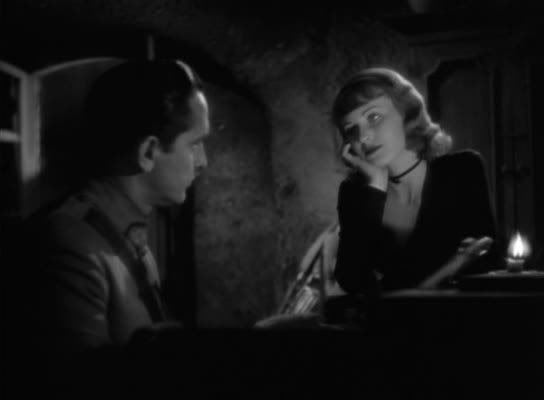
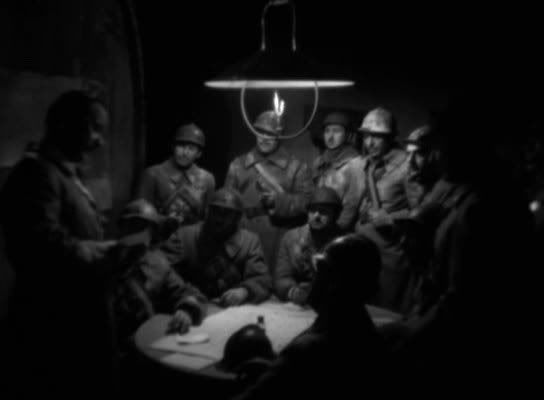
The Road To Glory is the culmination of Howard Hawks' early cycle of World War I military dramas, borrowing elements, for better or worse, from both The Dawn Patrol and Today We Live. The resulting film feels like something of a retread for those familiar with Hawks' early oeuvre, but taken on its own merits, it's a fine wartime action flick, hampered only by its abrupt turn into overwrought melodrama in its final act. The film concerns a particularly resilient company of French soldiers during the first World War, led by the brave but tormented Captain Paul La Roche (Warner Baxter), who is driven to drink and pills by his unit's inordinately high casualty rate and dangerous assignments. His only comfort is the companionship of a young local woman, Monique (June Lang), who doesn't love him but has a certain sympathy and warmth for the brave older man — not to mention gratitude for the way he has saved and taken care of her family. This dynamic is familiar, not from one of Hawks' war films, but from Tiger Shark, since it's virtually a repeat of the older man/younger woman relationship between Edward G. Robinson's crippled fisherman and the lovely Zita Johann. Naturally, as in the earlier film, a younger, more handsome man soon enough enters the picture to disrupt this comfortable but dispassionate romance. In this film, the role is taken by the newly transferred Lieutenant Michel Denet (Fredric March), who persistently pursues the beautiful Monique without knowing her importance to his superior officer.

This romantic triangle could quickly become tiresome — and its outcome is as predictable as in Tiger Shark or any of the countless other films of the era that exploited similar setups — but Hawks conspicuously downplays the romance. The scenes between Michel and Monique are subtle and moody, touching for the way the two young lovers find in each other a brief respite from the horrors of war all around them. This symbolic quality of their love is established right from the moment they meet, when Monique takes shelter in a basement from a German air raid, only to find Michel quietly playing an abandoned piano amid the rubble. Later, with their love developing, they return to this basement for a moving scene that Hawks ends with a discreet fade to black that says it all. Hawks keeps these scenes to a minimum, but he uses Lang strikingly as a figure of hope and beauty for both of these men, who desperately cling to her.

Monique, uncharacteristically for a Hawks character, has deep religious feelings — she even delivers a cloyingly earnest prayer for the men's safety at one point — but Hawks is much more interested in the way this woman has become a religion for the men who love her, a reason to live through the otherwise suffocating horrors they experience every day. Lang's natural beauty helps in this regard, but Hawks also lovingly photographs her, imparting a nearly spiritual quality into her closeups. The cinematography throughout the film is dark and atmospheric, tending towards heavy grays and blacks with very little traces of light or brightness (outside of the occasional explosion), but the scenes with Monique are as expressionist and stylized as anything in Hawks' oeuvre outside of Scarface. Her face is sculpted from the shadows, her bright white skin glowing in the dark, her porcelain features chiseled out of the blackness draped around her. In this way, Hawks is able to inject a subtle poetry into scenes that might otherwise have been token sops to the audience's desire for romance; Hawks delivers the romance, delivers the pretty girl, but he connects her appearances intimately to the film's wartime desolation.


And indeed, in many other ways this is a startlingly bleak film, perhaps even more so than Hawks' earlier The Dawn Patrol, with which it shares many similarities. Like the earlier film, The Road To Glory focuses on the repetitive, cyclical nature of military life, emphasizing the cycles of combat and downtime, the routine replacement of the dead with new recruits, the same speeches and ceremonies recurring with predictable regularity. As usual, Hawks finds room for generous helpings of humor, particularly in the character of the blustery drunken sergeant (Gregory Ratoff) who has memorized only two songs that he whistles compulsively, or in La Roche's expansive father (Lionel Barrymore), who lied about his age in order to be able to enlist. Barrymore and Ratoff get a great, hilarious scene together in which, without saying a word explicitly, they conspire to "lose" the orders that would send the eager-to-serve old Barrymore away from the front. Hawks is always conscious of the need to relieve the gloom — he even stages some dashed-off physical gags in the midst of an urgent air raid — but the film as a whole is a harrowing depiction of combat.

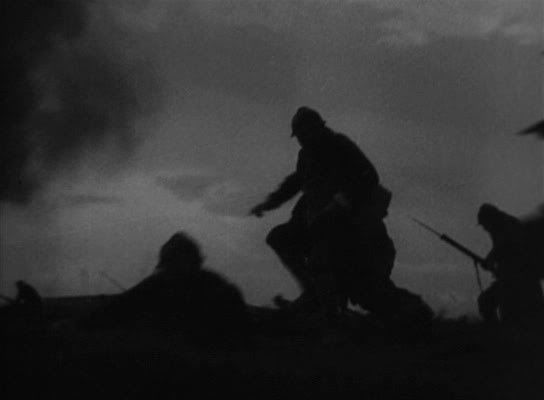
Most overpowering of all, in this regard, is the lengthy sequence with the company on the front lines, doing a rotation in the trenches under heavy artillery fire. When they arrive, they find that the troops they're relieving have left behind one of their men, who is trapped in the barbed wire outside the trenches, screaming and crying nonstop. The Germans have left him alive to lure men out, and those who try to reach the wounded man inevitably get machine-gunned to death. It is a blunt, grim introduction to trench warfare, and Hawks pulls no punches in dealing with the abject horror of the situation. Equally effective is the way the trench sequence becomes an exercise in clock-watching suspense once the troops hear telltale noises beneath their feet, signaling that the Germans are digging below the ground, planning to plant a mine to blow up the outpost. Unable to do anything about it, the soldiers must simply sit tight, listening to the continual tick of the shovels below the ground, waiting for their replacements to arrive. It's a nail-biting segment, made even more unnerving by the knowledge that the soldiers are essentially just waiting to pass the fate of near-certain death on to the platoons who are relieving them. They know that somebody has to die; they just don't want it to be them. This setup seems like questionable military logic — why wouldn't they just pass the news on and get ready for either an evacuation or an attack on the digging Germans? — but it's a typically Hawksian image of fatalist, stoic masculine bravery, not only facing death but implicitly accepting it, even welcoming it.


Hawks ends this sequence with a potent but simple image: the soldiers finally walking away from their post at the end of their tour of duty, only to hear the expected explosion behind them, turning to see a plume of black smoke rising into the air. "How many men?" La Roche asks, looking for a number to attach to this abstracted symbol of mortality, this rising smoke that stands like a tombstone over the impromptu graves of many men. Hawks' visual symbolism throughout this film is very pronounced, particularly for a director who so often favored more direct visual expression.

A central sequence dealing with religion, itself an unusual subject for the worldly Hawks, finds the director playfully toying with religious icons in several different ways. He first cuts directly from a battle scene to a mass in session at a church, a puzzling change of scenery until the camera pans across the congregation and the preacher, passing over a makeshift wooden divider into the hospital ward that's been set up in the other half of the church, with the injured lying in beds as nurses scurry among them. It's a striking image, uniting the treatment of the wounded with the spiritual exaltation happening just on the other side of a flimsy wooden fence. Hawks then cuts directly from this scene back to the battlefield, specifically to an image of a grave marker, a cross, turned on its side. He holds the static image for a moment, as though suggesting that religion itself has collapsed, lost its meaning in the middle of the wartime violence, and then a soldier's helmeted head begins to poke up from the bottom of the frame, slowly rising into view. It's a playful, irreverent image, and coming on the heels of Monique's earnest prayer that her two men should be kept safe (a prayer not entirely answered in the end), it suggests nothing so much as Hawks consciously undermining the religious sentiment of the preceding scene. Certainly, none of the soldiers ever pray or mention religion; Hawks heroes always know that death will come get them eventually anyway.

The film starts to unravel a bit in its final ten minutes, diverting into melodramatic distractions that directly recycle the worst elements of Today We Live: sudden blindness (in this case happening offscreen), the quest for redemption, a sacrificial mission, and of course the need to get one of these guys out of the way to resolve the romantic triangle. It's particularly out of place because Hawks had so assiduously avoided melodrama and overstatement throughout the rest of the film, which established its wartime atmosphere with such economy and blunt effectiveness. This soapy, contrived denouement is obviously a concession to give the film some sense of dramatic closure, however unsatisfying, because otherwise Hawks seemed to be driving at an anticlimactic non-ending that would emphasize the endless circularity of death and living. The final scene, basically a restaging of the final scene of The Dawn Patrol, gets at this theme anyway, ending the film on the note of ambivalence it clearly demanded: the war will continue, men will die in great numbers, many more will take their places, and any happy endings, for the two young lovers or for anyone else, are at best temporary respites from the certain approach of death.

Wednesday, January 21, 2009

Ceiling Zero


[This is a contribution to the Early Hawks Blog-a-thon hosted right here at Only The Cinema. It will run from January 12 to January 23, 2009.]

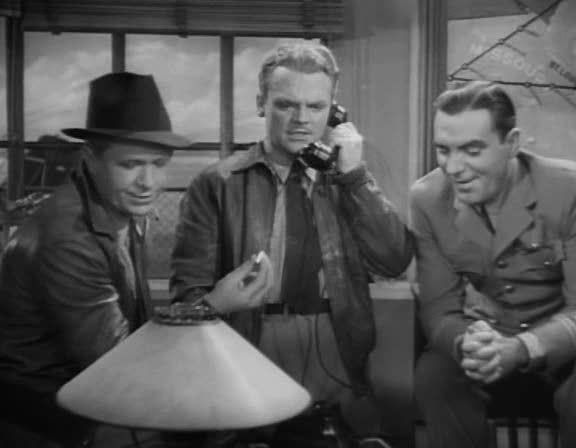
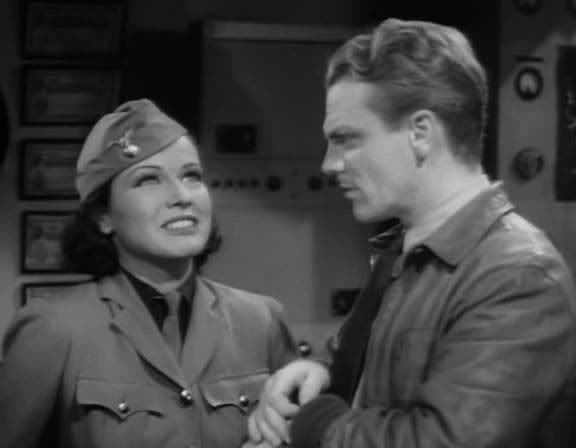
Throughout Howard Hawks' early work, it has consistently been apparent that the director's signature themes and concerns were fully formed at least by the time he began making sound films in 1930, and that many of these little-seen films laid the aesthetic groundwork for Hawks' more famous later successes. It is therefore not surprising that Ceiling Zero, one of several early Hawks pictures centered around aviation, is a prototypical Hawks film in many ways. What is surprising is that, although the film most obviously looks forward to the moody, mortality-obsessed Only Angels Have Wings, it also plays out like an early take on the screwball comedies that Hawks would come to master so completely in the next few years. In fact, despite the aviation setting, the first half of Ceiling Zero plays out more like His Girl Friday than any of Hawks' other flying pictures: the fast-paced dialogue flies by with much more zoom and pizazz than any of the airplanes. The film has the snap and energy of a classic screwball farce, as ace pilot Dizzy Davis (James Cagney) flies back into town to be reunited with his old friends Jake Lee (Pat O'Brien) and Tex Clarke (Stuart Erwin).

The three men were friends at the dawn of the aviation era, when there were no rules and daredevil pilots expanded the boundaries of the possible, often at the cost of their own lives. These three survived, and now Lee has settled in as the head of a small airline, running regular passenger and mail flights through treacherous weather, with Tex as one of his top pilots. Soon enough, Dizzy, who is mostly known these days as a wild womanizer with an uncontrollable urge to pull stunts both on the ground and high above it, joins the team as another pilot. The film's plot feels like a trial run for Only Angels Have Wings, with the pilots risking their lives and making time with girls, the constant threat of death hanging over their heads in the foul weather. And yet, the first half of the film has a jovial atmosphere, driven by the crackling, propulsive dialogue of the friends' joyful reunion. The writing doesn't quite have the sharp wit of later Hawks comedies, but the script is dotted with great one-liners, and Hawks gets the most out of his cast's natural talent for humor. All three actors are light on their feet, more than capable of handling the crackerjack pace. O'Brien especially has a manic intensity that gives each of his lines a certain irresistible urgency, as he barks out orders and then switches deftly to ribbing his buddies. Cagney keeps up well, and Erwin, as the relatively laconic, drawling Texan of the bunch, provides a slow but steady counterpoint, hilarious in his own way as the dim-witted, henpecked husband who nevertheless insists that he "wears the pants" in his house.


These early scenes are a blast to watch, as the rough-and-tumble Dizzy tries to incorporate himself into the regular routines of a commercial airline, as well as cozying up to cute flight trainee Tommy Thomas (a smiley, charming June Travis). Dizzy's banter with Tommy, their playful flirtation, would fit nicely into any of Hawks' later relationship comedies, with the clever trading of innuendos and the slow development of mutual respect through rapid patter. Like many a later Hawks heroine, Tommy proves to be Dizzy's equal in verbal sparring and playfully disguised come-ons. She may be 15 years his junior and less experienced than him as both a pilot and a lover, but she's able to stand up and trade quips with the best of them: and what better way to judge the quality of a Hawksian woman than by her verbal dexterity?

The film also features many scenes clustered around telephones, which have often played a decisive role in Hawks' films. The phones take on a more serious function later on in the film, but in the early stretches there are several brilliantly staged comedic sequences staged around the phone, an early incarnation of similar scenes in His Girl Friday and The Big Sleep. Both Tex and Dizzy take turns on the phone, trying to smooth things over with women on the other end as their wisecracking friends pass wry commentary back and forth, occasionally trying to sabotage the call with their barbs and jokes. It's great fun, establishing the men's typically Hawksian rivalry and camaraderie.

Ultimately, though, the vibrant humor of the film's first half is primarily a set-up for a startling midway shift into often harrowing drama. The light tone had minimized the dangers of this milieu, drawing attention away from the constant threat of death that otherwise hung over these men. This dark mood creeps slowly back in during an extended sequence that forms the film's centerpiece, in which one of the pilots is lost up in a foggy sky with zero visibility and a radio that's starting to malfunction. Trapped in the fog, with no contact with the airfield to help guide him down, the pilot must try to land on his own, while the frantic airport personnel wait in the darkness, desperately trying to make contact. It's a startlingly effective sequence, achieved with a minimalist, low-budget atmosphere that only adds to the scene's claustrophobic tension. Hawks was working with a tight budget and basically a single set: almost all of the film's action takes place within the starkly designed airport control room or in one of the plane cockpits against an equally minimal rear projection backdrop of smoke and dark clouds.


What's interesting is that the tragic subtext of this scene is rooted in the masculine codes of honor established by these men, the kind of codes that Hawks frequently glorified. One of the film's opening scenes establishes the price of cowardice when one pilot, frightened flying blind in the fog with no radio contact, bails out of the plane and parachutes to safety. His decision is seen as a loss of nerve, and he loses his spot as a pilot. This young pilot's moment of humiliation lingers, unmentioned but implicit in the similar staging of the two sequences, throughout the later scene, highlighting the impossibility of simply jumping to safety. It becomes a point of honor, of masculine pride, to land the plane or die trying.

This sequence, with its horrifying, fiery denouement — Hawks economically suggests the carnage by framing the control room staff in shadowy silhouettes at the windows, the flames licking up outside — is an irreparable gash in the surface of the film, cutting short the light comedy and buoyant romance of the earlier scenes. It's not a flippant switch in tone, either; the film's transition from comedy to drama doubles as an indictment of Dizzy, of his childish lack of responsibility and seriousness. The film sobers up at the same moment that he does, forcing the audience to recognize the more unpleasant qualities in the fun, lively guy who was such a lovable rogue not long before. Which is not to say that the switch to drama completely works, either, and some of the dramatic contrivances of the film's second half are as groan-inducing as they are predictable. Hawks would be able to handle the film's themes of sacrifice, redemption, friendship and loyalty much more naturally and poetically in Only Angels Have Wings, which is pretty much the pinnacle of this kind of film. Here, the film's messages sometimes come across with sledgehammer subtlety, and only Cagney's sympathetic, nuanced performance prevents the film from completely descending into a maudlin slopfest. Cagney is able to portray depths to Dizzy — particularly in terms of his feelings about Tommy — that simply aren't there in the script, and he keeps the film's second half taut and interesting even when the melodrama threatens to overwhelm him.

Still, despite this uneven second half, Ceiling Zero is a fine film as a whole, one whose disparate halves would provide the templates for several later Hawks films in many genres. The film is a much better low-key comedy than it is a drama, but it's often so much fun, and so crisply acted and directed, that it's very easy to overlook its comparatively mild weaknesses.