Showing posts with label 1922. Show all posts

Thursday, April 5, 2012

Phantom


Though F.W. Murnau immediately followed his iconic vampire tale Nosferatu with a film called Phantom, there is nothing supernatural about this dreamlike examination of desire and obsession. It's the story of Lorenz Lubota (Alfred Abel), a mild-mannered and honest city clerk who's lost in the "dream world" of books, a shy and quiet man who lives with his mother and siblings and says that, for him, books give him experiences that he could never have in his actual staid life. Lorenz is a boringly decent man, closed off from the world and from sensual experience; when he's not in his room reading, he's at his dull job, where he always shows up late because he's such a dreamer, or in the bookstore, where the owner's daughter Marie (Lil Dagover) shyly loves him from a distance without ever expressing her feelings for him. It's a routine and quiet life, abstracted and restrained, with Lorenz's biggest thrills coming from literature, his greatest ambitions contained in the poems that he secretly writes.

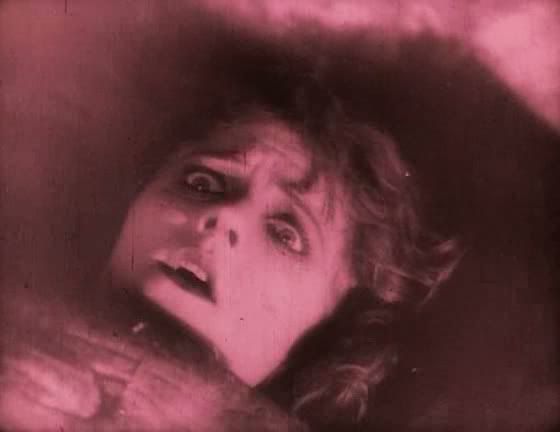
This all changes one day when he's run down in the street by a woman driving a carriage. She stops and stands over him, and as he comes to, he's hypnotized and enthralled by the sight of her face, and he becomes obsessed with her. It's sudden and utterly illogical, an abrupt break in the linear path of this man's solitary, predictable existence. In that moment, he loses all sense of perspective, and everything else in his life melts away into insignificance; all he can do from this point on is frantically pursue this woman, about whom he knows nothing beyond a brief glimpse of her face. He eventually finds out that she is Veronika (Lya de Putti), the daughter of a wealthy family, unattainable to a lowly and pathetic clerk. As he desperately chases her, he's fended off by her servants and her parents, and he begins making one terrible decision after another, totally losing control of himself and forsaking the morality that had once defined his life. He is now solely "a poet... a man with no luck... who chases a shadow... a phantom!"

It's a stock melodramatic narrative that Murnau treats as melancholy poetry. The melodrama is especially recognizable in the way that Lorenz's descent into madness and misery parallels his sister Melanie's (Aud Egede Nissen) similar path into decadence and sin, in her case motivated simply by boredom with a gray, workaday lower-class life — she didn't need Lorenz's excuse of a sudden, consciousness-erasing obsession to leave behind the safety of home for taverns and trashy hotels. The film is somewhat slow and plodding at times, its minimal incidents stretched out between long periods of sensuous stasis. In some ways, though, this quality only adds to the dreamlike, hypnotized nature of Lorenz's experiences.


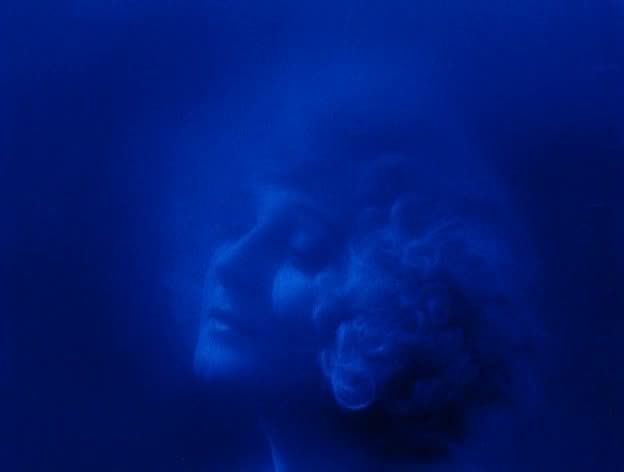
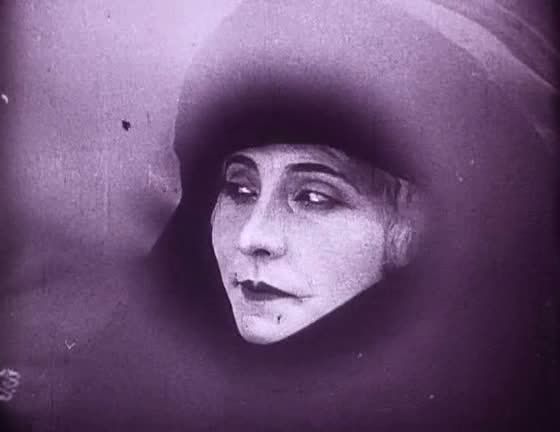
The film's best moments are Lorenz's periodic departures into daydreaming fantasy, signaled by shots that go slowly out of focus until the world is rendered as vaguely defined shapes and indistinct blurs, gradually losing tangibility so that dreamlike images of impossible love can take form, bright and brilliant, briefly seeming as real as the physical world, if not even more so. These images brilliantly convey Lorenz's disconnection from the world, the way he's sucked into this ephemeral world of dreams, the mere momentary sight of a woman's face destabilizing his world until it seems to be fading away, replaced by reveries and imaginings. He never sees the woman again, but he can't stop thinking about her. He imagines her carriage as a ghostly presence superimposed on the world, always just out of his reach. He imagines her face, surrounded by fog, a phantom, the ghost of a memory. He even finds her doppelganger, a woman (also played by de Putti) who looks just like his beloved but is far more worldly and accessible, as long as he can shower her with borrowed money and expensive goods, squandering his reputation and everything he has for some ephemeral pleasure with this woman who's only an echo of his real desire — although counter-intuitively, this echo is more material and tangible than the ghostly original for whom she's standing in.

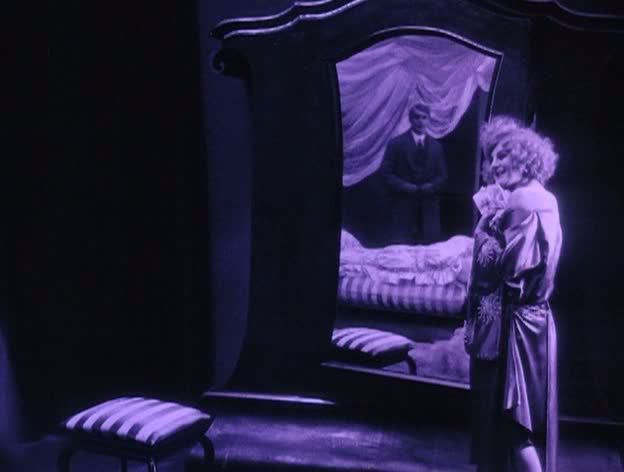
Phantom would be just another 1920s melodrama of corruption and redemption if not for Murnau's expressive, poetic aestheticization of Lorenz's logically inexplicable downfall. It's a gorgeous and rigorous film, with Lorenz continually framed by doorways and mirrors, which suggest separation from the world. His sister Melanie, too, is introduced doing her makeup in a cracked mirror, half her face missing as she mugs and purses her lips in the glass, foreshadowing her brokenness. The final few chapters are especially haunting, as Lorenz's world collapses around him, even literally collapsing in a sequence where the buildings of the town seem to tip over on him, the shadows of their spiked spires chasing him along the streets, an effective bit of trick photography that Murnau would then reuse for The Last Laugh.

Despite its formal beauty and dreamy qualities, Phantom isn't one of Murnau's strongest movies. Its appeal is in the way Murnau takes a melodramatic narrative and strips it down to a core of almost surreal, and certainly irrational, emotional breakdown.

Thursday, March 29, 2012

Foolish Wives


Erich von Stroheim's third film, Foolish Wives is anything but a modest effort from the always grand director. A film about excess, it takes excess as its guiding principle and its entire raison d'etre. The stories about the film's production are legion, as Von Stroheim was so concerned with realistically depicting a life of privilege and luxury onscreen that he made sure the cast lived a similar life offscreen, importing real, rare and very expensive caviar and champagne instead of faking the high-class meals that appear in the film. He constructed elaborate sets of Monte Carlo gambling palaces and mansions, and filled the sets with silks and furs. And he sent the whole bill to Universal, his studio, before turning in an impossible-to-screen eight-hour film that the studio promptly hacked apart into a far shorter cut. Thus the film, even restored to its current length of nearly two and a half hours, is unavoidably compromised, chopped down from its director's expansive, overblown vision into something much more manageable, though its ambition and its potency are still very much apparent.

The film concerns a trio of con artists, the self-proclaimed Count Wladislaw Sergius Karamzin (Von Stroheim) and his cousins, or "cousins," Olga (Maude George) and Vera (Mae Busch), at least one of whom is also one of his many lovers. Karamzin and the two "princesses" live a lavish life in decadent Monte Carlo, peddling counterfeit cash and using their grand personae and the Count's infamous way with women to ingratiate themselves into high society. It's an interesting bit of self-mythologization, because the Count is such a resonant echo of the actor who plays him, the writer/director behind this story. Von Stroheim was, much like Karamzin, a pretender, a role-player who carried over his performances as sinister aristocrats into his real life, passing himself off as an Austrian general and dignitary. He entered the United States claiming to be a count, and he added the aristocratic "von" to his name soon after becoming a director, effectively transforming himself into precisely the character he plays here, a man pretending to the aristocracy, adopting the fine manners and grand style of a European noble. In one of his signature displays of egoism, he even inserts a novel called Foolish Wives into the film, supposedly written by him, and the passage that he highlights extols the virtues of good, courtly upper-class manners.


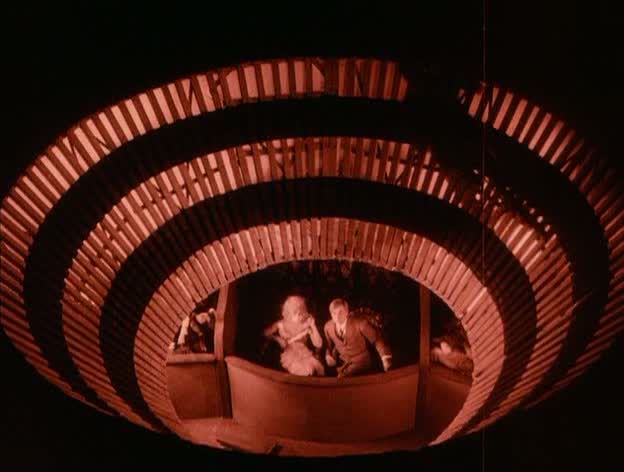
Karamzin sets his sights on Helen Hughes (Miss DuPont), the wife of the US ambassador Andrew Hughes (Rudolph Christians), though because of the film's patchwork structure, his motivations for pursuing the woman change without warning several times. His seduction of her is most ravishingly realized in the central sequence set during a violent rainstorm, in which Karamzin and Helen are trapped out in the rain during a walk. This is all part of his plan, though, allowing him to sweep her sodden body up in his arms, carrying her past sparks of lightning and rowing her across a lake in a small boat to the dilapidated cabin of a wizened hag (Louise Emmons). In one fantastic shot, Karamzin uses a hand mirror to spy on Helen as she undresses, her bare back glimpsed in the corner of the mirror as he leers in the foreground.

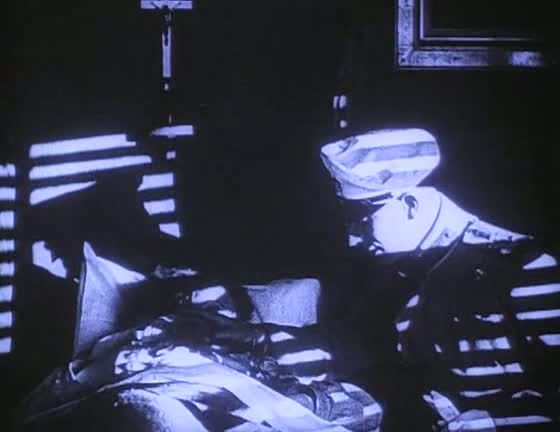
There's a real sensuality to this film, which seems to link sexuality to the decadent, expensive lifestyle of the main characters. Even as Karamzin seduces Helen, he also desires the mentally handicapped daughter (Malvina Polo) of the counterfeiter (Cesare Gravina) who keeps him supplied with fake bills. In a disturbing scene that sets the tone early on, she appears hugging a doll and gaping at Karamzin's dandified manners, but her obviously slack-jawed mental capacities and girlish immaturity don't stop the lecherous count from looking her up and down with blatant lust. Later, he looms over her bed while she sleeps, slatted shadows stretched across the room, the Count's shadow hanging over the girl and cast ominously on the wall above her. While all this is going on, the Count is also romancing his maid Maruschka (Dale Fuller), in a subplot that, in the extant versions of the film, abruptly pops up towards the end and has great significance for the climax.

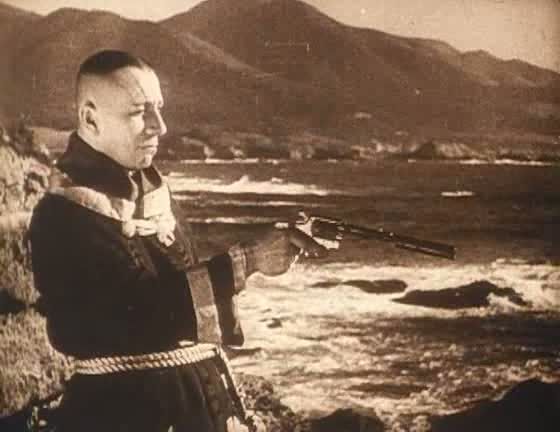
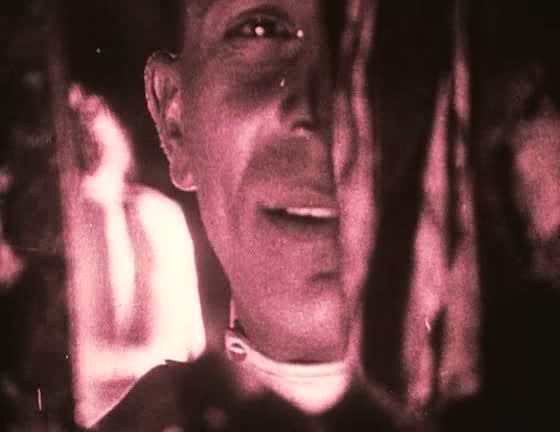
Von Stroheim's visual style is rapturous throughout, but especially at the frenzied climax, which abruptly becomes a suspenseful action sequence with the rapid cross-cutting that Von Stroheim presumably picked up during his time as an assistant for D.W. Griffith. His images have a hazy but iconic power: flames engulfing a cross; a woman standing on a rocky outcropping, framed against the waves crashing in the background; countless gauzy and ecstatic closeups of the film's women. Von Stroheim contrasts this visual extravagance against the comparatively straightforward and prosaically shot scenes between Helen and her husband, juxtaposing their comfortable, boring marriage against the lush, sumptuous wealth and corruption of Karamzin and his cousins. Karamzin is introduced in an especially memorable way, perched on a rock above the ocean, casually shooting at targets with a pistol as long as the cigarettes that he habitually smokes throughout the film. With his scarred forehead, his monocle, and his smug smirk, he cuts a distinctive figure, an absolutely magnetic screen presence that later in his career he'd bring to countless caricatured Teutonic villains. Here he's a more nuanced character, his exaggerated pride masking an elusive vein of insecurity that shows itself especially in the scene at the end of the film where Hughes confronts the Count, causing Karamzin to look around the room at the other officers, anxious to see what they think, anxious that he not lose face.


One interesting subtext in the film is the implicit comparison between Karamzin the false military officer and the real soldiers he's imitating. Early on in the film, he sees a number of soldiers passing by, and he salutes them each in turn — but pointedly fails to salute the wounded soldiers who are pushed by in wheelchairs, acting as though he doesn't even see them. Karamzin's glamorous vision of the military has little room for casualties or blood, and he seems subconsciously uncomfortable with the sight of these injured men, sporting their evidence of the real warfare that Karamzin has certainly never experienced. He projects a flashy, scrupulously clean image of military grandeur, all brass buttons and epaulets, surface rather than substance.

There's an intriguing scene where the Count looks down upon a military officer who doesn't pick up Helen's book for her, obliging the Count to do it himself while casting a disgusted glance at the other man; there is nothing that he finds more despicable than the lack of manners, the lack of surface politeness even though the surface is as deep as his own niceties extend. Later, though, the officer returns, standing outside the hotel, where Helen sees him standing with his coat at his feet. For a moment, she looks at him with the same scorn that Karamzin had, until she realizes that the man's sleeves are empty, that he's a veteran who has lost both of his arms. In one of the film's most tender and sentimental moments, she picks up his coat and wraps it around him, kissing his empty sleeve, a rare burst of sincerity and emotion in a film that otherwise revels in the cynical exploits of the manipulative Count.


There's also some subtle dark comedy woven throughout the film, like the title cards that continually sneak bleak ideas — "suicides" and "brutality of man" — into the otherwise idyllic word collages describing Monte Carlo. At one point, Karamzin's romantic schemes are interrupted first by a goat that keeps sticking its rear in his face and then by a monk whose stern, disapproving gaze keeps the Count from making his move. Religion haunts the film in the images of crosses that are often hidden within the mise en scène, silently judging the decadent ways of these con artists.

Foolish Wives, even in the heavily edited and reconstructed version that survives, is a fascinating and engrossing film, a sharp and cynical examination of wealth and the appearance of wealth. Decadent, sexy, darkly funny and visually stunning, it's a marvelously fragmented classic.

Thursday, June 26, 2008

Nosferatu: A Symphony of Horror


It's difficult to think of what can possibly be said now about F.W. Murnau's silent classic Nosferatu: A Symphony of Horror. Based on one of the most famous horror novels in the world, Bram Stoker's Dracula, Murnau's film was the first adaptation of the vampire legend to the cinema, and a model and inspiration not only for every vampire tale to follow it, but for much of the horror genre in film. Considering its age and the extent to which its images and ideas have penetrated the popular culture discourse, the film has held up remarkably well. Pop culture tends to devour art, and any image or icon that passes into the popular vernacular tends to lose its aura of mystery and uniqueness, especially after enough time has passed for the various reiterations of this image to attain some prominence themselves. This deterioration still has yet to take place for Murnau's blood-sucking Count Orlok, played with a ghastly stiffness and creepiness by Max Schreck. Schreck's mimed performance, so famously horrifying, owes as much to his unnaturally tall, bony form and gaunt face as it does to his plodding movements and wide-eyed stare. It's a very physical performance, with Orlok embodied in every inch of the actor's body and movements. He's a horrifying figure, wispy and almost even fey but with a sinister allure anyway.

Clearly, Orlok is a powerful cinematic icon, one who has continued to exercise a dramatic pull on the genre of the horror film, so it's a shame that Murnau keeps him off-screen for so long. The story of Dracula may be familiar now, but this first adaptation treats the tale's developmental early stages at great length, unfortunately including a great deal of exposition that in a modern context seems largely unnecessary. It takes half an hour for Orlok to appear at all, before which the story focuses on the young real estate agent Hutter (Gustav von Wangenheim) and his wife Ellen (Greta Schröder). In E. Elias Merhige's Shadow of the Vampire, a parodic dark comedy based on the making of Nosferatu, von Wangenheim is mercilessly mocked for his melodramatic acting, and the representation of his acting style in that film isn't even exaggerated too much, if at all. He's the ultimate silent movie ham, reacting to good news like a schoolboy skipping off to school, and to bad with moping gestures and eye-rolling, playing to the back row at every moment. He's the kind of actor who, when he sees a table full of food, widens his eyes, licks his lips, and runs gleefully to dig in. As a result, the scenes between Hutter and his wife, before Hutter goes off to Transylvania to conduct a transaction with the mysterious Count Orlok, are almost unwatchably saccharine, even though Schröder is far better in her role. Her Ellen looks vampiric from the very beginning of the film, with the same gaunt face, black-rimmed eyes, and wild stare as Orlok. She thus signals her inevitable doom right from her very first appearance, solely with the intensity of her emotional reactions and her sensitivity. She mourns for the "death" of flowers that her husband picked for her, and later she seems to sense Orlok's presence in ways that nobody else does besides his crazed servant Knock (Alexander Granach).

In fact, Ellen is a key figure in the film's first truly striking scene (which unfortunately comes about 40 minutes in, a not insignificant amount of time to wait for something interesting), in which Orlok assaults Hutter at the former's castle lair. Murnau cuts back and forth between this attack (mostly suggested through the projection of Orlok's sinister shadow on the wall) and scenes of Ellen back home, seized by nightmares and an inexplicable terror. The parallel editing between these two discrete events, taking place quite some distance apart, is especially powerful for the way it links Ellen and Orlok, making inevitable their eventual meeting in the film's final scene. At the end of the scene, Orlok looks back over his shoulder, casting his eyes towards the right side of the screen, and Murnau cuts away to a shot of Ellen, reaching her arms out towards the left edge of the screen, as though gesturing towards the vampire. The juxtaposition of these two shots give the distinct impression that Orlok is actually looking at Ellen, staring at her across vast gulfs of space with an unimaginable bloodlust. It's one of the film's most mysterious and haunting moments.

Of course, Orlok's desire for Ellen was already established before this, in the scene where the vampire catches a glimpse of a photo of her that Hutter carries. Orlok grasps the amulet containing this picture, bringing it up close to his face with his clawed fingers, and admiringly looks back at Hutter, telling him what a pretty neck his wife has. This line, with its obvious sexual undercurrents, is indicative of the way that Murnau plays up the sexuality of the vampire myth. This version of the Dracula story is unique, especially, for the way in which it makes the hero's transaction with the vampire seem like he's selling out his own wife for the monster's use. Immediately after the scene where the vampire praises Ellen's photo, he reiterates the terms of their bargain: he will be buying the abandoned house immediately across the street from Hutter's own home. Hutter has already left his uneasy wife alone to worry while he traveled a great distance, motivated only by greed. But in this scene it is apparent that what's at stake is not just a house back in Hutter's hometown, but the neck — and blood — of Ellen herself.


The crisp parallel editing of the Orlok/Ellen scene, which culminates in that meaningful cross-continental gaze between vampire and victim, is soon carried over into the second half of the film as Orlok races to realize his rendezvous with Hutter's wife. The entire second half of the film is thus structured on parallel editing of this kind, cutting between Orlok's journey by ship, Ellen waiting wistfully at home for Hutter's return, Knock's anxious time in jail awaiting his master, and the weakened Hutter's mad race to get to Ellen before Orlok does. Murnau's sense of pacing and dramatic tension occasionally slackens in these scenes, and the material with Knock seems entirely extraneous, especially since his character of the bug-eating servant isn't nearly as interesting or fleshed-out as it is in other variations on this tale. But even when the narrative temporarily goes slack, Murnau's brisk crosscutting between the different simultaneous events always promises a continuation of the action and a slow build-up of tension that finally explodes in the long sequence on board Orlok's ship.

This segment contains one of the film's most justifiably famous shots, with the camera positioned in a cargo hold and angled upwards at the vampire as he stalks by, walking with a strange sideways motion like a crab, his claws extended and his eyes glinting. But as creepy as Schreck is here, a handful of isolated shots of the ship itself are equally eerie. Murnau shoots the sailing vessel floating aimlessly, looking completely abandoned even before it really is depopulated by Orlok's efforts. In several shots, Murnau simply allows the boat to drift through the frame, a black silhouette seen from a distance with no activity on its decks, like a ghost ship gliding through the water. Another shot angles the camera up from the deck to catch the sunlight filtering through the sails above, a quietly beautiful shot that serves to further emphasize the ship's lifelessness; it's a shock (not to mention an anticlimax) when Murnau finally gives in and shows a few scenes of activity with the boat's crew. The scenes of Orlok's arrival in Hutter's town are similarly anticlimactic. There's something almost comical about the way he slinks into town, skulking through the main square while lugging a giant coffin under his arm, looking ridiculously undignified. This is doubtless the streak of silliness in Murnau's vampire that Merhige picked up on for Shadow of the Vampire. There's a real and very weird sense of the quotidian about Orlok, as in the early scene where he greets Hutter personally and explains the lack of servants by the late hour, as though he needs to justify why such a great personage should be doing his own chores. This winds up being even more unsettling, giving Orlok a warped human quality to play off against his more otherworldly aspects. A similar vibe runs through the scenes of his arrival, and he only manages to maintain some lordly dignity in the haunting shot where he arrives at his new home standing on a raft, the coffin still under his arm. Murnau shoots this arrival from a distance, capturing the dilapidated grandeur of this collapsing manse with Orlok's spindly form gliding towards it.

As a whole, Murnau's Nosferatu is a somewhat uneven masterpiece, if that term makes any sense. It's largely held together by the strength of a handful of iconic shots and images, often with long dull or purposeless stretches in between. The treatment of text is especially problematic, although not necessarily atypical for the silent era. The dialogue intertitles are relatively sparse and sparingly used, but Murnau makes extensive use of a variety of textual materials, including letters, books on the supernatural, ship's logs, and various other documents. This is doubtless inspired by the nature of Stoker's original epistolary novel, formed entirely from back and forth correspondence. But it's distracting when the film so often diverts from its wonderful images into lengthy text passages explaining various pieces of vampire lore or other expository details. When Murnau fills up the screen with such pseudo-scientific explanations of vampires, it's at least understandable in the context of the genre, but when he takes the opportunity to display Hutter's innocuous letter to his wife, in full, not just once but twice, one begins to suspect that he's either just filling up time or doesn't realize how these interruptions kill the narrative's momentum. Despite these imperfections, Nosferatu remains a horror classic for very good reason. There has never been a more memorable screen vampire than Max Schreck's Count Orlok, and in comparison to his raw, sensual performance even Bela's Lugosi's smooth, urbane version of the monster can't compare. Orlok is the iconic film vampire, a pure force of evil and unfettered desire, growing so rapturous (and ravenous) at the mere sight of blood that he can't resist breaking with decorum and sucking the blood from his houseguest's injured thumb. If Lugosi's later Dracula is a vampire of the heart or the head, Schreck's Orlok is purely a vampire of the stomach.