Showing posts with label 1953. Show all posts

Thursday, May 3, 2012

The Bigamist


The Bigamist marked the end of Ida Lupino's tenure as a Hollywood feature director; from here she'd move into directing for television, and wouldn't make another feature until 1966. It's an unconventional film, a sympathetic, emotionally complex portrait of a man who leads a double life, marrying two women in two separate cities. The traveling salesman Harry Graham (Edmond O'Brien) shuttles back and forth between Los Angeles and San Francisco for business, happily married to Eve (Joan Fontaine) until, on one of his trips, he meets Phyllis (Lupino, appearing in the only movie where she ever directed herself), who is at first just a balm for his loneliness on the road but soon becomes much more. Harry's secret double life is unraveled when he and Eve try to adopt a baby, causing them to be investigated by the conscientious child welfare agent Jordan (Edmund Gwenn), who soon discovers that Harry, who in San Francisco is trying to adopt with Eve, also has a wife and child in Los Angeles.

Harry then relates his whole story to Jordan in a flashback. Lupino makes this man's loneliness and melancholy palpable, capturing the feeling of disconnection that Harry feels, always on the road, away from his wife, who in any event is more of a business partner than a lover. He wanders around the city, passing happy couples embracing, everything barren and desolate around him, his gravelly voice sad and worn in the pulpy noirish voiceover. This is when he meets Phyllis, who's as sad and lonely as he is; Lupino projects a kind of damaged-goods wariness, embodying a tough gal who nurses a hidden hurt. Harry meets Phyllis on a Hollywood tour of movie stars' houses, where she sits with her eyes closed, not paying attention to the tour or the sights; she's not interested in Hollywood glamour, she says, deadpanning, "I'm just crazy about bus rides."

She's a complicated character, a woman with more than a touch of film noir darkness, wielding a sharp tongue and an ironic wit. She works in a Chinese restaurant — "early American Chinese," she quips about its kitschy decor — and lives unhappily until Harry comes into her life. When he kisses her, she looks up at him and simply says, "you kill me," not overstating it or trying to sound breathily sexy, as so many women (and actresses) would, but making it sound offhanded, casual, a simple statement of fact that's even sexier, somehow, for its nonchalance. Unfortunately, the film's script can't let her exist entirely as a tough, independent, sensitive woman, and towards the end of the film she veers too far into weepy melodramatics, even going so far as to apologize to Harry after she catches him cheating on her, an absurdity that's really hard to take.
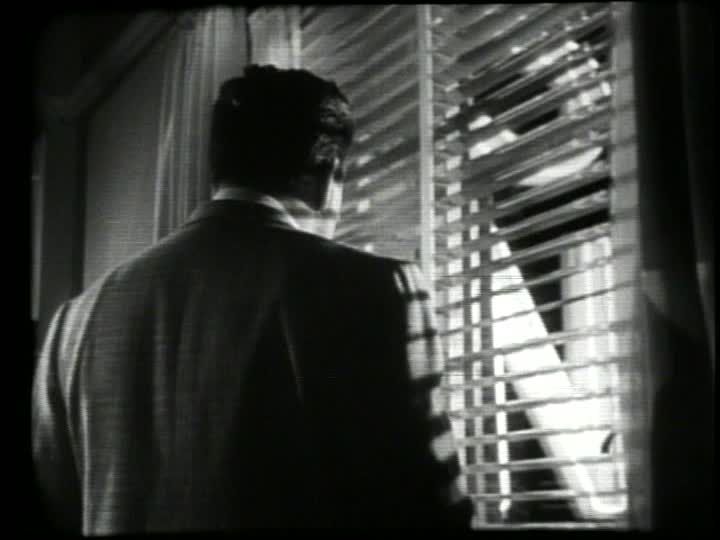

The film's script was written by Collier Young, who was, in a metafictional touch, married to both Lupino and Fontaine — albeit at different times — which suggests a bit of a psychological undercurrent to the film's examination of a man falling in love with two women. Young himself appears in the film as a creepy bar patron, disturbing Harry's growing intimacy with Phyllis. Indeed, there's a bit of a Hollywood insider tone to the film in general, particularly surrounding the character of Jordan. Harry and Eve refer to Jordan as a kind of Santa Claus, giving away babies, a clever reference to Gwenn's famous role as Kris Kringle in Miracle on 34th Street a few years before — which is again referenced when Harry takes the movie star tour and Gwenn's home is mentioned alongside the houses of Jimmy Stewart, Barbara Stanwyck and others.

This Hollywood namedropping aside, Young's script is The Bigamist's greatest weakness, loading the back half of the film with moralist speeches and stiffly written, unsubtle discussions of the morality and irony of Harry's situation. The final courtroom scene explicitly mentions "irony" or "ironic" in virtually every other sentence, driving home the idea that, yes, this is a very ironic predicament. The film is much stronger in the way it examines the emotional stakes of these two relationships, going beyond the usual dichotomy of a cheating man seeking sex from one woman and domesticity from another. Instead, there are real and complicated feelings tangled up in both of these marriages, as well as some tension over the stereotypical roles of the man and the woman in a relationship: it's obvious that Harry feels threatened by Eve's independence, her ability to outdo him in business.

In fact, the film's gender politics are generally very interesting, if inconsistent and occasionally insulting. The film draws parallels between Eve, who's unable to have kids and thus immerses herself in business, and Phyllis, who easily gets pregnant apparently after a single night of passion. There's also a weird morality in the film, in that it seems to assume that a man will cheat on his wife, and that a woman is somehow incomplete if she doesn't have a child: in other words, it's all too obvious that Lupino didn't write this. She does, however, bring a stark, potent style to the film, crafting a shadowy, strikingly noirish atmosphere around this story of infidelity.

Tuesday, May 17, 2011

Gion bayashi


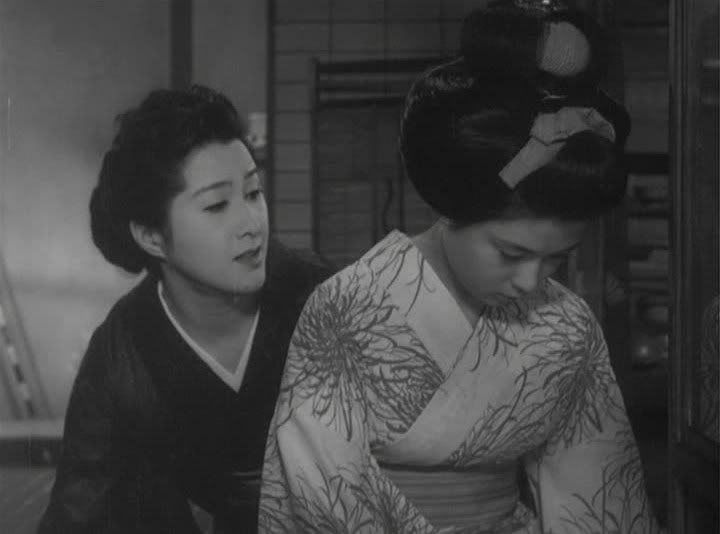
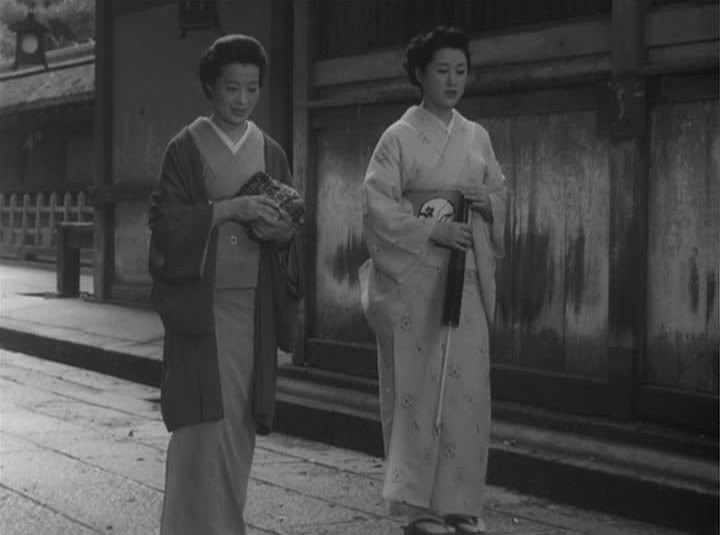
At the heart of Kenji Mizoguchi's Gion bayashi is the effect of changing sexual politics coming into contact with the traditional role of the geisha in Japanese culture. The film represents a dialectic between the traditional understanding of a woman's place as submissive and obedient and more modern attitudes regarding the ability of women to define their own desires and their own lives. Mizoguchi's film suggests that the reality of the world lags well behind these changing attitudes, as many expect the old ways to continue unchanged. This is a film, above all, about sexual exploitation, and it candidly examines the many ways in which women are exploited by the male-dominated society in which they must live. Eiko (Ayako Wakao) decides to become a geisha as a last resort: her mother was a geisha, and when she dies, Eiko is left with no one but an uncle who takes her in only on the condition that Eiko should sleep with him. Fleeing her uncle's sexual advances — forced upon her from a position of power and control — Eiko goes to the geisha Miyoharu (Michiyo Kogure) and begs to become a geisha. Miyoharu agrees to train the young girl, even though it would be at her own expense, because she sees that Eiko has nowhere else to go. The two women soon become embroiled in a complex set of pressures constricting them and limiting their choices, as they become pawns in the business plans of Kusuda (Seizaburo Kawazu) and Kanzaki (Kanji Koshiba).

The film's plot is relentless in documenting the pressures weighing down on Miyoharu and Eiko, as women whose sole role is to be desirable and solicitous, to tend to the needs of men as objects of beauty. Kusuda is a powerful older businessman who loves to be surrounded with young girls. He plays games with a harem of geisha like a little boy, running around and pantomiming baseball gestures, but he takes an especial liking to Eiko as soon as he meets her. Kusuda is also using Miyoharu as a tool in his attempts to get a lucrative contract, since the mid-level minister Kanzaki — who has the ability to make a decision on a business deal affecting Kusuda — falls in love with Miyoharu. Both women thus becomes objects in this business deal, ornaments to the negotiations between Kusuda and Kanzaki. The film carefully establishes the stakes, as Miyoharu and Eiko are manipulated into place by the powerful Madame Okimi (Chieko Naniwa), whose favor is necessary to find work as a geisha.

Miyoharu and Eiko are the only decent people in the film; everyone amassed around them is out to use them or exploit them in some way, especially but not only the cartoonishly lecherous Kusuda and Kanzaki. Eiko's father (Eitaro Shindo), an ailing and struggling storeowner, refuses to support his daughter, washing his hands of her and leaving her to either live with her sexually predatory uncle or to struggle wherever else she can. Later, however, when Eiko becomes a successful geisha renowned for her beauty, her father comes crawling around, begging Miyoharu for money, pathetically telling her that if she doesn't lend him some money he'll have no choice but to kill himself to escape his debt and his failing business. He tells her that he feels entitled to a share of his daughter's earnings — this despite his refusal to support her during the girl's training period to become a geisha, when Miyoharu was forced to borrow a great deal of money to establish Eiko as a geisha. Okimi, as well, is exploitative and predatory, with an old-school understanding of a geisha as basically a prostitute. Eiko resists the idea that she has to take on a "patron," and so does Miyoharu; the two women have more modern ideas, primarily the idea that they don't have to sleep with a man they don't like. This is anathema to Okimi, who tries to maneuver the two women into keeping Kusuda and Kanzaki happy.


The film's story is thus naturally melodramatic, with the character types deliberately exaggerated to maximize the horrors these women are subjected to. Mizoguchi's style, however, is low-key and unobtrusive, and the contrast between the direct, observational realism of his style — which captures in its delicate way the simple day-to-day lives of these people — and the passionate melodrama of the narrative creates a pleasing tension in the film's aesthetic. Mizoguchi's style doesn't call attention to itself, but in subtle ways he's constantly accentuating the film's themes, crafting striking compositions that guide the eye to the power relations that are at the heart of the film. One of the most suggestive images comes when Miyoharu, realizing that she has no choice if she wants to support herself and Eiko while keeping the younger girl pure, finally gives in and agrees to spend the night with Kanzaki. When she goes to see him, he's lounging on his belly on the floor, reading, and Mizoguchi shoots him from above, with Miyoharu towering above him as she walks in. The composition superficially suggests that the power relations are in favor of the woman, but the man's languorous pose and the gaze of entitlement he gives her as he says he's been expecting her work against the composition to suggest that in fact it's the man, languidly doing nothing and waiting for the woman to come serve him, who's in control here. The next shot, in which Miyoharu silently goes off into the corner to undo her complicated geisha robes and sashes, reinforces this impression. The geisha is a servant for the rich, and this scene subtly parallels Miyoharu's obsequious behavior with the many scenes of servants catering to the women throughout the rest of the film. If elsewhere the geisha is respected and served, treated with dignity, in the privacy of the bedroom she's expected to be a servant.

Mizoguchi's style is similarly effective in the scene where Eiko first hears that Miyoharu has spent the night with a man. Mizoguchi stages the scene in a single shot, from just outside the door of Eiko and Miyoharu's home. After Eiko hears the news, the door is closed, inserting a wooden grate over her, obscuring her reaction to the realization of what has been necessary to provide for her. The static shot, and the grating layered over it, simultaneously distance the viewer from Eiko's reaction and call attention to it. Mizoguchi's formalism is more restrained, more subtle than that of his contemporary Yasujiro Ozu, but there's still a clear sense of a constructed world in this film, not only in the artificial contrivances of the script but in the gentle aesthetic sensibility guiding the material. Ozu is an inevitable comparison here, since the theme Mizoguchi is addressing — the conflict between tradition and modernity in a changing postwar Japan — was Ozu's essential theme throughout his postwar work. In comparison, though Ozu is the bolder stylist, Mizoguchi is more overt and melodramatic than his peer, approaching this story as a big theme to be worked out, a message to be communicated, which is very unlike Ozu's method of allowing his themes to gradually emerge from the texture of ordinary lives. If in Ozu's films tradition and modernity are simply part of the fabric of everyday life, in Gion bayashi the script establishes these conflicts in broad strokes and constructs scenes and dialogues obviously intended to bring out one point or another.

This message-oriented perspective is sometimes grating and overbearing, but more often the delicacy of Mizoguchi's aesthetic and the warm, natural performances of his leads prevent the film from becoming too didactic. There's a tenderness and warmth between Miyoharu and Eiko that becomes more and more powerful the more the women suffer together, culminating in the late scene where Miyoharu tells the younger girl how much she loves and cares for her. Mizoguchi deliberately leaves the nature of this love ambiguous — Miyoharu doesn't say she loves the other girl like a daughter — because it's a multilayered bond that encompasses mother/daughter loyalty, friendship, and even a hint of attraction in the way he frames the two women so close together, their heads bowed toward one another in their shared grief. The film ends with them walking down the street together, side by side; in a world amassed against them on all sides, conspiring to sabotage the independent lives they desire, they can ultimately only count on one another.

Monday, February 14, 2011

The Big Heat


[This is a contribution to For the Love of Film (Noir), the second Film Preservation Blogathon hosted by Ferdy on Films and Self-Styled Siren. The blogathon has been organized for the benefit of the Film Noir Foundation, who do important work to restore and preserve the noir heritage. Please consider donating to the Foundation during this week. The blogathon will run from February 14-21, and during this time I'll be posting about some noirs to raise awareness of the blogathon and its worthy cause.]

Fritz Lang's The Big Heat is a dark, tough noir, an intense crime thriller that moves at an unrelentingly brisk pace as it delves fearlessly into the darkness of its story. It is a remarkably adult film, never wincing away from the seedy truths at its core, and for the Hollywood of its era — even in the gritty world of the noir — it especially stands out. Its dialogue is taut and punchy, dealing candidly with this world of corruption, adultery, death and disfigurement, and the sad fate of "that kind of girl." The film focuses on the scrupulously honest cop Dave Bannion (Glenn Ford), a guy with such a highly developed sense of morality that he never thinks twice about doing the right thing. When the suicide of a highly positioned police officer starts stirring up some ugly suspicions, Bannion charges into the middle of the case, even when it becomes apparent that there are some very powerful people above him who would like the whole matter to be put to rest as quickly and cleanly as possible. Bannion can't go along with that. He's got a kind of brute force morality that drives him forward, pushing at the people who'd like him to simply go away — including the dead cop's widow, Mrs. Duncan (Jeanette Nolan) and the gangster Lagana (Alexander Scourby), a powerful man with connections that run deep into the police force. Bannion doesn't have the smarts to conduct his investigation quietly or subtly, so he just keeps forcing himself on underworld contacts and on Lagana himself until someone decides he needs to be dealt with.

Bannion is setting himself up for tragedy, and of course he gets it. The film goes to some very dark places, but before it does, Lang takes pains to establish the stakes for Bannion: a very happy home life with a lovely wife, Katie (Jocelyn Brando), and a daughter. The early scenes of Bannion and his wife at home create a contrast against the darkness and corruption he encounters at work. Bannion is scraping by on a cop's salary, always conscious of the tight budget his family has to maintain, and his conversations with his wife about money set him apart from the dead Duncan, who'd transcended his cop's salary by serving on a criminal's payroll, at least until his conscience caught up with him. Moreover, the scenes between Bannion and Katie serve as a tonal contrast; these scenes are syrupy and romantic, dripping with pathos and big goopy closeups, and the bright, clean light of the Bannions' home makes it look like a cheery sitcom set as opposed to all the shadowy hotel rooms and seedy bars where the corrupt and the crooked do their deals. The couple has a light, flirtatious relationship, rooted in concrete details like Katie's habit of taking a sip of her husband's beer or polishing off his whiskey, or their gentle sparring and coded sexual banter as she prepares dinner. Their romance is pure and good, but it's obvious from the beginning that Lang is establishing this foundation for Bannion only in order to disrupt it in some way.

When the disruption finally comes, it's one of the film's most chilling scenes, a shattering break in this domestic bliss that comes just as Bannion is telling a story to his daughter. The remainder of the film ventures even further into darkness, as Bannion becomes obsessed with breaking up the ring of corruption in his city, following the chain of crime towards the men who pull the strings from behind the scenes. He particularly becomes concerned with Lagana's right-hand man, Vince (Lee Marvin), a sociopathic tough guy who takes his anger out on women more often than not. Vince has a bouncy, cheery good-time girl, Debby (Gloria Grahame), who drunkenly mocks Vince's eager obedience to Lagana, but is still happy to profit off the illegal gains from her man's shady activities.


Like so many of the best noirs, The Big Heat is about pain and rage, about revenge and justice. Lang focuses intently on both the violence and its ugly consequences, particularly when the psychopathic Vince goes too far with Debby. Vince is a brutish character, played with chilly intensity by Marvin, whose tight-lipped, stony expression perfectly captures the casually sociopathic violence of this killer. In one crucial scene, Vince utterly loses his cool and assaults Debby with a coffee pot, perhaps a nod to Raymond Burr in a similarly unhinged performance in Anthony Mann's Raw Deal.

Grahame is even better as the hard-drinking party girl who's eventually forced to sober up and face the ugly reality of the life she'd been living. As with the use of Bannion's relationship with his wife, Lang develops a contrast between the playfulness of Debby and the crude nastiness of Vince. There's also a contrast between Debby in the first half of the film and the increasingly pained, pathetic Debby in the second half of the film. Debby goes from a character of light — dancing around in Vince's well-lit apartment, cracking jokes and admiring herself in a mirror — to a woman who's afraid of the light, who wants to hide in the shadows instead. The film cleverly exploits these dichotomies between dark and light, and it's especially interesting that Lang reverses the motif for Debby. When she's in the light, she's living a corrupt life as a thug's moll, enjoying her decadent ease with dirty money paying for her shopping trips and keeping her supplied with liquor. It's only when she's swallowed up in shadows that she sees things with some clarity. It's fitting, then, that she spends the second half of the film divided in half, her face half-covered with a white bandage, the other half of her face often bathed in the richly textured shadows of Lang's images. Debby is divided between a fun, mostly carefree past that now seems lost forever, and the knowledge of the ugliness on which that life had been built.

The Big Heat is a powerful film, a stark examination of the tremendous difficulty of maintaining honor and morality in a corrupt world — an examination of the risks of speaking truth to power, and the slim rewards. In the film's final scene, Bannion has returned to the daily routine of police investigation. There is no glory, no real reward, only the resumption of relative normality, minus the horrible costs he'd already paid. That's part of what makes the film so bracing and affecting and even, despite its glossy aesthetics, somewhat realistic in its portrayal of corruption and the cost of honesty.

Friday, November 21, 2008

Gentlemen Prefer Blondes


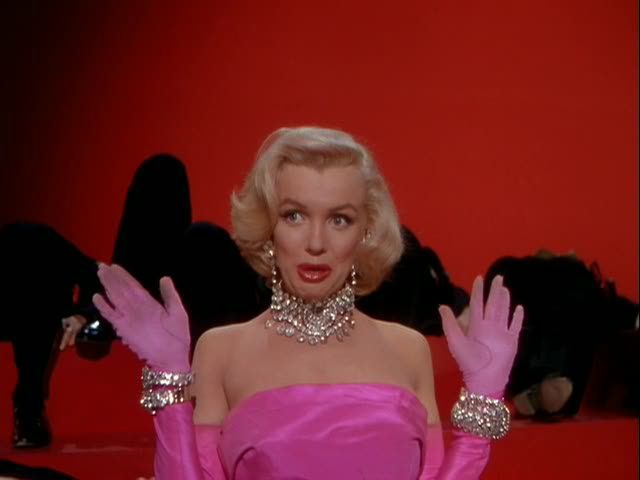
Today, Gentlemen Prefer Blondes is most fondly remembered for a single musical number which is pretty much the iconic Marilyn Monroe scene: her vampy, bubbly performance of "Diamonds Are a Girl's Best Friend." It's one of Monroe's most memorable scenes, as she coos and dances while delivering the lyrics that would come to personify, if not her true self, then at least the most true representation of her public persona. She's a cheerful, unabashed gold-digger here, surrounded by men who adore and lust after her, rejecting all their declarations of love as fickle, fleeting, and more often than not two-faced. It's easy to mock or dismiss Monroe's showgirl Lorelei Lee, who admits with a smile on her face that she's in love with money and wouldn't dream of marrying a man who wasn't rich. But underneath her brash forthrightness, barely concealed, are her fears, especially the fear of getting old, of losing her charms and her ability to make men fall in love. The "Diamonds" number, as upbeat as it is, is actually about a woman's insecurity in a world where she is judged for her physical beauty while a man is judged by his monetary success: Lorelei realizes that while women's assets are momentary at best, money and power doesn't dissipate with age. She believes that wealth is the only security against a woman's sad fate, of being cast aside for younger and prettier girls down the road. "Don't you know that a man being rich is like a girl being pretty?" she murmurs, so charmingly that it's hard to argue the point. "You wouldn't marry a girl just because she's pretty, but my goodness, doesn't it help?"

Sure, and it also helps when she's clever and self-aware and delightfully fun, all adjectives that apply perfectly to Monroe, perhaps more here than anywhere else. What comes through in this film is a sly, winking quality in Monroe's performance, a sense that she knows very well — as her character knows — the effect she can have on men, and that she's perfectly willing to conform, at least outwardly, to stereotypes if it'll get her what she wants. This seems to apply at least as well to the real Marilyn as it does to the bubbly, bouncy blonde Lorelei, and one suspects there's some truth to the rumor that Monroe herself suggested Lorelei's coy admission that "I can be smart when it's important, but most men don't like it." If a film as light and airy as this one can be said to have a theme, it's that women, living in a world with rules set by men, must erect elaborate facades over their true selves in order to exist comfortably.

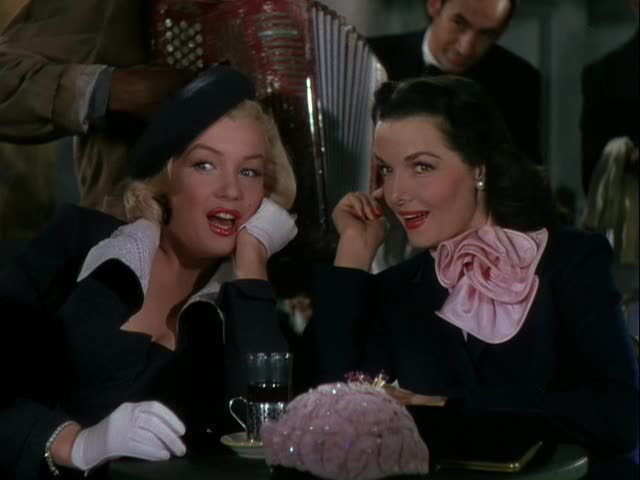
Lorelei's best friend Dorothy (Jane Russell) doesn't see things the same way though, and where Lorelei loves only diamonds, Dorothy loves the company of men and the fun to be had on long nights with plenty of drinks and dancing. This duo of bombshells are opposites in almost every way — blonde and brunette, giggly and serious-minded, a whispery-soft murmur and a brassy tough-gal voice, a wide smile and a side-of-the-mouth smirk — but their friendship is nevertheless rock-solid. Russell and Monroe play off of each other beautifully, and it's a delight to watch them together, whether they're singing and dancing or trading fast-paced patter. They trade roles admirably in the comic scenes, taking turns playing the straight woman for one another. Sometimes Monroe's wide-eyed silliness sets up Russell for her deadpan one-liners, while at other times Russell simply stands back and lets her friend fire away.


With two such dazzling actresses at center stage, the plot doesn't have to do much besides stay out of their way, and for the most part it does. Lorelei's pending engagement to the goofy but sincere young millionaire Gus Esmond (Tommy Noonan) is threatened by Esmond's father (Taylor Holmes), who disapproves of his son marrying a showgirl. As a result, Lorelei and Dorothy head off to Europe together on a cruise, while Esmond's father hires the private detective Malone (Elliott Reid) to spy on Lorelei and gather incriminating evidence against her to halt the impending marriage. There's not a guy here who belongs in the same frame with these two, much less who can match wits with them as equals, and if the film has one weakness it's the necessity of believing that the tough Dorothy, who'd fit right in as a noir femme fatale, could fall for a wet blanket like Malone. Still, all these narrative detours are mainly an excuse to get Lorelei into hilariously improbable but incriminating circumstances, like the moment where an over-eager big-game hunter (Charles Coburn) demonstrates to Lorelei how a python kills a goat by strangulation. How would that be incriminating, you ask? "Well," Lorelei explains, "he was the python... and I was the goat!"

If the plot is largely decorative, so too are the many musical numbers, which are primarily designed as showcases for the girls and their ample charms. The "Diamonds" performance is undeniably director Howard Hawks' best musical piece, a gaudy delight of costume design and choreography: Monroe in a pink strapless dress that seems to be just barely clinging to her bosom, twirling and singing amidst crowds of valentine-toting tuxedo-ed men and ballerinas with black gauze masks drawn across their faces, all of it against a cartoony red backdrop that sets off the deep blacks of the tuxes. The opening number, "Two Little Girls From Little Rock," is similarly opulent, setting the girls' bright red dresses off against a similarly bold blue curtain. The film's palette favors primary colors, including the ever-present bright red of the girls' lips, while the wardrobes mostly cycles through a series of radiant green, blue, and red hues. As a result, even the less showy musical pieces, like "When Love Goes Wrong" and "Bye, Bye, Baby," have an impromptu charm that's hard to resist: they seem like pick-up songs casually performed with whatever passersby happen to be around, gathering performers from among the bystanders for a bit of song and dance.

Above all, this is a fun and light-hearted film, driven by the comedic performances from both stars. Howard Hawks seems to have ceded the film to Monroe and Russell, and there's very little sign of the auteur's signature concerns or style, except perhaps in the staging of the musical numbers, which seem at times like crowd scenes with an infectious sense of rhythm. The film as a whole has this same underlying rhythm, a propulsive beat that drives the songs and the comedic bits alike. It's the pulse, perhaps, of the men who come into contact with Monroe and Russell: hearts pounding like mad, dizzy smiles plastered across their faces.

Tuesday, November 27, 2007

11/27: Sawdust and Tinsel


When Ingmar Bergman died earlier this year, there was a certain strain of criticism — most (in)famously presented by Jonathan Rosenbaum in the New York Times — that took the occasion to re-evaluate the famed director's art and importance. At the time, I found the timing unfortunate and the arguments unconvincing; Bergman has always been a director who has meant a great deal to me, and at least several of his films have to be counted among my personal canon. Looking back now, having just watched Sawdust and Tinsel, a key developmental work for Bergman and yet probably the weakest of the many films I've seen by him, I nevertheless remain more convinced than ever that Bergman is a cinematic great.

Let me explain. I have yet to explore much of Bergman's early career, and it's mainly some later milestones that have endeared him to me: Fanny and Alexander, Persona, The Silence, and even a few flawed but powerful works like Shame and Hour of the Wolf. Sawdust, the story of the bitter circus owner Albert (Åke Grönberg) and his unfaithful mistress Anne (Harriet Andersson), shares some similarities with these later works, and it's easy to see how Bergman got from here to the more fully realized films he'd be making just a few years later. The film's story is told in a blend of expressionism and neorealism, with the latter pointing back to Bergman's earliest dramas and the former pointing ahead to the direction his films would take from then on. The expressionistic sequences are often compelling, displaying the kind of visual sense and eye for composition within cinematic space that detractors like Rosenbaum are continually insisting is missing from Bergman's cinema.

In the film's most compelling image, when Anne goes to visit the local theater troupe after a fight with Albert, she's left on the abandoned stage after a rehearsal. As the theater goes dark, she's framed within a circle of light, all alone in a sea of black. Critics often point to Bergman's theatrical fascination as an inherent negative — something you'd never hear about, say, Fassbinder — but this scene makes it clear that even early on Bergman understood the difference between cinematic and theatrical space, and was able to combine them in interesting ways. In this sequence he creates an interplay between the theater and the cinema, framing Andersson first in what might be called theatrical space, with the camera at a distance showing the whole stage with her in its center (though even here he tweaks the theater by placing the camera backstage rather than in an audience's position). Then he cuts to a medium shot, with Andersson approaching the camera, slowly filling the frame, the close-up allowing her cold and determined expression to complicate the scene's emotions, in a sense contradicting the lost, confused sense communicated by the earlier distancing long shot. Both emotional sensations remain in the shot; just as the theatrical space is being contained and reshaped by the cinematic frame, the loneliness and isolation of the long shot is being subsumed by Anne's determination to control her life.

There's also a wonderful scene early on in the film in which one character relates the story of the clown Frost (Anders Ek), whose wife betrayed him by swimming nude with some soldiers from the local garrison. Frost's very public humiliation as he's forced to retrieve his wife in front of a laughing mob and carry her naked body away prefigures the story of Albert's problems with his mistress. Bergman presents the flashback in a washed-out, overexposed white that obliterates detail and gives the scene a haunting, mesmerizing quality. There is quite possibly no greater director of embarrassment than Bergman, and he perfectly captures the humiliation of Frost, cutting between tortured close-ups and wildly exaggerated crowd shots of the observers. The soundtrack is similarly suggestive, veering between an eerie stillness and the roar of cackling laughter. The scene becomes sheer torture as it goes along, as much a purely symbolic representation of primal emasculation as a recounting of a specific incident.

Unfortunately, such scenes are the exception rather than the rule in this film. Bergman's engagement with neorealist aesthetics is much less interesting than his more expressionistic mode of storytelling. And though Bergman is frequently accused of theatricality because of the overwrought performances he wrings out of his actors in his wildest scenes, it's in the more realistic segments of his work that theatricality more often has free rein. For me, Sawdust is dragged down by the prosaic quality of its story and the overly theatrical emphasis on lengthy dialogue scenes with little visual or intellectual interest. Everything that the film might have to say in Grönberg's blustering speeches was already said far better in that self-contained early scene depicting Frost's humiliation, and doing so primarily in visual terms rather than verbally. The narrative never progresses far beyond there, because Bergman has structured things so that Frost's story is meant to foreshadow Albert's. What it actually does is render the rest of the film redundant. There's some pleasure in Harriet Andersson's effortless sensuality, and in Anders Ek's drunken, spiteful performance as the broken clown Frost, but the emphasis on such theatrical, actorly elements is exactly what Bergman's critics latch onto in the first place. In this early film, at least, there's some justice to the complaints.

It may seem odd that I've chosen a Bergman film I don't really like that much to mount a defense of this great director. But what struck me, on watching Sawdust and Tinsel, was not only the number of things that didn't work, but just how much did work in spite of the many weaknesses. Even in this minor transitional film, Bergman was already displaying the foundations of a powerfully expressive visual style and a tendency to intertwine cinema and theater in ways that comment on and develop both. He will certainly be missed.