Showing posts with label 1957. Show all posts

Sunday, July 19, 2009

Night Passage


[This review has been cross-posted at Decisions At Sundown, a blog started by Jon Lanthier and dedicated exclusively to the Western genre. From now on I will be cross-posting all of my Western reviews with this blog, a valuable resource for the Western genre.]

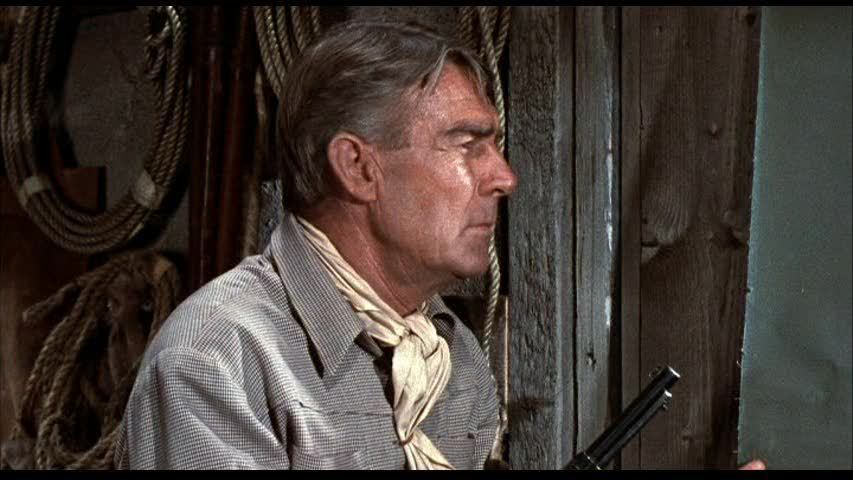
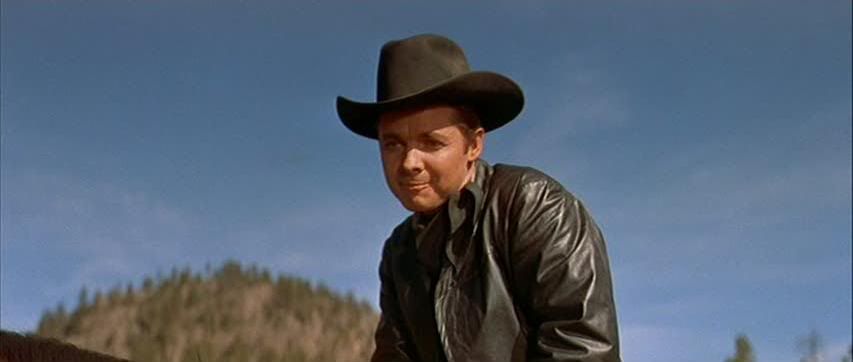
Night Passage is best known as the film that ended the fruitful period of collaboration between director Anthony Mann and star James Stewart. The pair had made eight films together, and this was to have been the ninth, until Mann walked off the picture, citing the poor script and costar Audie Murphy. The finished film, directed instead by James Neilson, proves Mann right, and one can only regret that the Mann/Stewart friendship was ended by such a slight film — Stewart never worked with Mann again. The film itself is melodramatic and convoluted, surrounding a relatively straightforward story with all sorts of distractions and ornamentation, populating it with an oddball cast of bit players who keep wandering into the story for no apparent reason. It gives the film a weird, faux-folksy vibe, a very stagey, artificial idea of frontier life. The core of the film is a story of redemption, about the former railroad troubleshooter Grant McLaine (Stewart), who was fired from his job, suspected of working with train robbers after he allowed the outlaw the Utica Kid (Murphy) to escape. Now, Grant still hangs around the train camps, playing his accordion for money, until a string of payroll robberies cause the train management to ask him back.

This story is the film's center, and one can imagine it being made with Mann's characteristic toughness and single-mindedness, with a driven Stewart willing to do anything to redeem his shattered reputation. One can also imagine it, with twenty minutes cut out, as a stripped-down low-budget B Western. Instead, it's bloated and torturously overwritten, with so many characters crowding around the fringes of the film that it never really acquires a forward momentum. There's Grant's former girl Verna (Elaine Stewart), now married to the train company boss Kimball (Jay C. Flippen) because she'd believed Grant was a crook. There's the local restaurant girl Charlie (Dianne Foster), patiently waiting for the Utica Kid to go straight so she can marry him. There's crooked railroad man Renner (Herbert Anderson), struggling cross-country on a mule, trying to reach the robber gang to give them information. There's a kid named Joey (Brandon de Wilde) who was formerly a lookout for the gang but ran away and started hanging around Grant instead. There's an ornery old frontier woman named Ma Vittles (Olive Carey), who seems to wander into the frame whenever things are starting to get slack, to provide a bit of eccentric humor. There's a big group of tough Irish railroad workers waiting for their pay and getting antsy, brawling and dancing and running after the prostitutes kept around the camp for them. And of course there's the wild outlaw leader Whitey (Dan Duryea doing his best whiny, cackling impersonation of Richard Widmark in Kiss of Death) and his gang, among them, of course the Utica Kid.

This is a big cast for a short little Western actioner, and director Neilson can never quite manage to balance the film's many different tones against each other. The ragged comedy relief of Ma Vittles and the railroad workers, including a bickering married couple, sits uncomfortably against the darker undercurrents of Grant's beaten-down depression. And then there's the musical numbers, with Stewart lip-syncing along with a couple of accordion tunes. There's even a dramatic showdown with the Utica Kid — who turns out to be his brother — where he wins over the Kid by playing a song their father always used to play on the accordion. Neilson captures the moment by focusing on the Kid's foot as it starts tapping along with the rhythms of the music. It's silly and kind of goofy, as is the sight of Stewart lugging his accordion around with him everywhere he goes, including into battle.

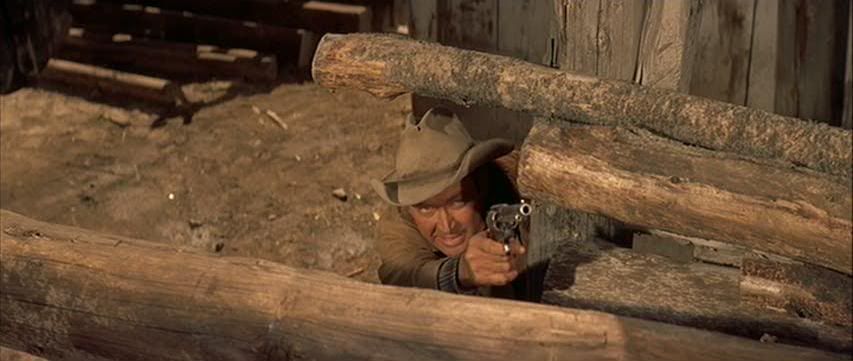
The film does have a few virtues, mainly in the grandeur of its Technicolor compositions of the open range, a virtue it shares with even the worst of the period's Hollywood Westerns. Its action sequences are also satisfying, particularly the robbers' assault on the payroll train, with the Utica Kid watching it all from a high cliff, as below the other men break off into groups, each accomplishing their tasks with mechanical efficiency. Later, the multiple shootouts of the climax are inventively staged, with real urgency. The first is a confrontation in a darkened saloon after Grant smashes out all the lights and hides behind the bar, shooting through the darkness at the robbers while he makes his escape beneath the floorboards. Then, after a chase through a (suddenly sunny) valley, shot from a distance to emphasize the wide blue sky, Grant and the robbers settle in for an extended siege at an abandoned mining camp, where Grant picks off the gang one by one. Neilson obviously knows how to stage action, and these scenes are as tense and well-crafted as the rest of the film is aimless and talky.

Night Passage is obviously a second-rate Western, a meandering mess of a film that only really comes together when the trite dialogue (including Grant's corny speeches about good and evil and "the soul") is replaced by gunfire.

Sunday, July 12, 2009

The Monolith Monsters


[This is a contribution to the Spirit Of Ed Wood Blog-a-Thon currently running at Cinema Styles from July 6 to July 12. Greg at Cinema Styles has opened up this week-long event to posts about legendary B-movie maker Ed Wood, as well as any likeminded examples of low-budget sci-fi and horror filmmaking. I'll be following his lead this week with a series of posts about 50s sci-fi.]

They're coming. Slowly, insistently, they're creeping closer, leaving a wake of destruction in their path, an unstoppable force inching towards a desert town, killing and destroying anything that gets in their way. They came from outer space, and once on Earth they're deadly and terrifying. Worse still, they're multiplying at a fantastic rate. They're... a whole bunch of rocks. From outer space. They're made of silicates and they're angry. Okay, not exactly angry, because they have no emotions at all: they're just rocks, after all. That's right, the "monster" in The Monolith Monsters is a rock, a black silicate that landed in the California desert in a meteor. It takes a special kind of sci-fi thriller to eke out all its scares and drama from chemical reactions involving a strange mineral deposit, but despite its inert villain — and the unfulfilled promise of monsters hinted at by the title — The Monolith Monsters manages to provide a few thrills before descending into a deadly dull waiting game.

The rocks in the desert start spreading their destruction whenever they come in contact with water. This kicks off a chemical reaction that causes the rocks to begin expanding and multiplying, sucking off needed chemicals from whatever they come in contact with, whether it's the desert sand, a wooden structure, or living creatures. Director John Sherwood gets as much tension as he can from this set-up, particularly during the early stretches of the film, when it's not quite clear yet what's going on, only that the rocks are reacting to water and that afterward everything is destroyed and people are virtually turned to stone, their bodies petrified and hardened by whatever the rocks are doing to them. It's a creepy premise, and Sherwood gets a lot of mileage out of eerie shots of the rocks sitting in the desert, strewn across the landscape, black and shiny, looking very much out of place in these ordinary settings.

But the film is sabotaged by its own title to some degree. The Monolith Monsters conjures up images of lumbering rock creatures in the classic mold of the Hollywood B-movie creature feature — alien rock monsters unleashed from a meteor to destroy everything they touch. The film's set-up only prolongs this impression, utilizing the usual tropes of the monster movie, with creepy suspense set pieces in which the actual attack happens offscreen, and only the dead bodies and destruction left behind suggest something terrible happening. One suspects, watching this, that Sherwood is doing what these films always did, keeping the monster offscreen for as long as possible, building up to its revelation. But no, the "monster" is just a rock, and the suspense in the film centers around the rocks' inexorable progress towards a tiny desert town after a rainstorm sets off a chain reaction.


Sherwood milks this premise (partially supplied by a story from sci-fi great Jack Arnold) for as much as it's worth, but he can't manage to overcome the fact that his "monster" is a mineral made active by chemical reactions. These rocks aren't a good sci-fi threat for the same reason that a really big avalanche wouldn't be a good one — it's hard to make compelling drama out of the geological research and chemical experimentation that the film's characters engage in to stop the rocks' growth. The resulting film is more of a disaster movie than a sci-fi thriller, and a rather dull disaster movie at that. The bulk of the action centers around geologist Dave Miller (Grant Williams) and his schoolteacher girlfriend Cathy (Lola Albright) as they try to figure out what's going on and how to stop the rocks from multiplying and overtaking the town. They enlist a string of doctors, journalists, police and professors in the task, but nobody in the cast has much more personality or verve than the rocks themselves, and the script is so generic that the characters are barely differentiated from one another.

All in all, The Monolith Monsters is just a big disappointment, a film that offers up little to even talk about, good or bad. There are a few compelling suspense sequences before the nature of the threat is revealed, and then the film becomes a static, anti-dramatic snoozefest. It's faintly hilarious to see Sherwood desperately trying to wring some tension out of the progress of the rocks, but they move so slowly that everyone in town finally has time to pack up all their things and leave before the rocks get even remotely close. Movie monsters are often notoriously slow and ungainly, lumbering after victims who can only be caught by falling multiple times, but this film manages to go even further by positing a sci-fi threat that creeps along so slowly that its potential victims are in the next state before it's even advanced a few feet.

Thursday, March 12, 2009

The Vampire


The Vampire is an eerie, unsettling 50s monster movie in which monstrous evil infiltrates suburbia. Like The Return of Dracula from a year later, it was directed by Paul Landres and written by Pat Fielder, and it's another film in which horror seems to emerge organically from the fears and tensions affecting late 50s American society. If the other Landres vampire film was all about the fear of immigration and integration, the desire to hold onto quintessentially American values, The Vampire takes as its subjects drug addiction, single parenthood and the increasing reliance on medications and the health industry. This is not, of course, to imply that either of these Landres/Fielder films could be called a "message movie," because they're not; they're grim, minimalist horror flicks in which creeping monsters tear apart the fabric of an ordinary American small town by infiltrating it with rot, evil and destruction. But they're also films that deal in deeper ways with the zeitgeist of their time.

Despite its title, The Vampire is more of a Jeckyll and Hyde tale than an actual vampire legend. It's the story of small town doctor Paul Beecher (John Beal), who accidentally ingests one of the strange experimental pills that a dying colleague gives him. The pills transform Beecher, initially without his knowledge, into a raving monstrosity, a killer who stalks through the streets of the town, biting his victims on the neck and, in the process, infecting them with a rare blood disease that destroys their body tissues. All Beecher knows is that he's becoming addicted to the pills, unable to let 24 hours go by without taking another, unleashing the monster inside him. The mechanics of the plot are somewhat shaky, and the script carelessly tosses around pseudo-scientific jargon as though it explains everything. Actually, though, it's never quite clear what these pills are doing to Beecher or where the disease that infects his victims comes from or why his colleague was ever working on such a thing in the first place.

Such things hardly matter. The film is rough and raw and unapologetically a B-movie, but its narrative sloppiness does little to dilute the intensity of its effect. Beal's performance is stunning. The doctor slowly unravels, growing more and more frazzled and unwound as the pills affect him more deeply and he comes to suspect what's happening to him. He's saddled with some truly ridiculous-looking monster makeup during his transformations, changing him into a slack-jawed, shuffling creature with boils on his face and claw-like hands, but his human performance is stark and emotionally devastating. Essentially, he's playing a man suffering from drug addiction: pacing, sweating, twitching nervously, increasingly caring little about his disheveled appearance, exploding with anger at those close to him and then tearfully regretting it later. He's a single father to a sweet young girl (Lydia Reed), and in his medical practice he cares for the entire town while not being too picky about billing for those who can't afford it. He's a good, kind man who is simply transformed by an accident, and who finds that he can no longer control his behavior. His addiction begins to control him instead, forcing him to continue taking the pills even after he suspects that something has gone terribly wrong, and even though each morning, when he wakes up groggy and disoriented, he learns that another corpse has been found somewhere in the town.


The Vampire is not quite as bracing or potent as Landres' masterful Return of Dracula, but it shares with the latter film an economical sensibility that draws terror and suspense from simple techniques. The film is often roughly edited and put together, with jarring cuts in the middle of dialogue scenes, but its horror sequences are fast, brutal and compelling. One of the best is a scene in which Beecher's pretty young nurse Carol (Coleen Gray) is walking home at night and hears footsteps behind her. It's the most basic horror sequence imaginable, one of the foundational building blocks of the genre, but it's so beautifully shot and lit, so precisely conceived, interspersed with haunting empty shots of the suburban streets, that it doesn't feel rote or cliché. Landres invests a great deal of tension into the frequent shots of the victims' necks, marked with those telltale dual bite marks that, by now, you'd think everyone would recognize for what they are, even if movie characters never seem to. The director also clearly loves brutal shocks, like the sudden cut to a staring, grinning skeleton after the local sheriff (Kenneth Tobey) opens the coffin of a freshly buried woman.

The Vampire is in many ways just a conventional B horror film, a sleazy, quickly made thriller with a monster who's really only terrifying as long as he's lurking in the shadows — the shots of him in stark daylight at the film's denouement are funnier than they are scary. At the same time, though, the film engages seriously and earnestly with issues of drug addiction and single parenthood, addressing the urge to self-destruction that causes otherwise respectable, decent people to undo the lives they've made for themselves. Beecher's performance is the key here, and the film's themes revolve around his desperation and despair and desire to overcome what he's become. This is a smart, energetic piece of schlock, a horror film that recognizes that true horror emanates from within us.

Sunday, February 1, 2009

The Incredible Shrinking Man


There is perhaps no better way of tracing the fears and obsessions of a particular culture than by observing the kinds of fantasies they concoct in their storytelling arts. This is why, of course, the horror and science fiction movies of 1950s Hollywood so often centered around the terrifying effects of radiation, around the idea of science gone mad: after Hiroshima and Nagasaki, with the Cold War seeming to threaten even more widescale nuclear devastation, hadn't the whole world gone mad? In these films, science and radioactivity created warped, bizarre creatures, never before seen; unleashed murderous monsters on the streets; and blew up ordinary earthly creatures to terrifying proportions. The horror and monster movies of the 50s are thus often barely disguised allegories for the damage done to the world in the nuclear age, visions of a grim future in which nuclear atrocities will do even greater harm. Among these films, Jack Arnold's The Incredible Shrinking Man provides perhaps the most striking and elegant vision of nuclear age horror, because it turns the effects of science directly onto man himself, rather than on the world around him. If monster movies like Them! imagined that radiation could create massive ants, towering over ordinary humans, this film instead shrinks down man, leaving the world untouched but humanity smaller, more inconsequential, an infinitesimal particle of dust in comparison to his own creations, a mere speck lost within the industrial, nuclear world he's created for himself. This is a poetic vision of the tragedy humanity has wrought for itself, a vision of a self-created world that leaves the individual an ever smaller, more unimportant role within it.

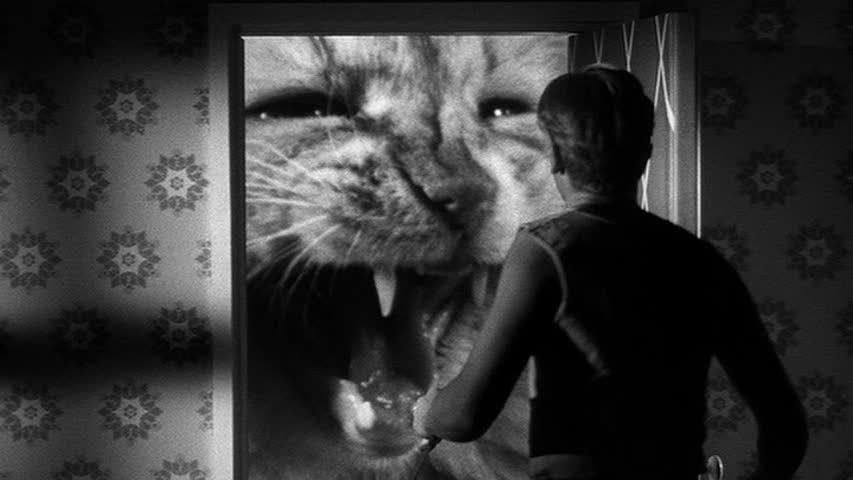
The roving cloud of radioactive mist that sparks the shrinking process of an ordinary man named Scott Carey (Grant Williams) is never explained except in the most vague, pseudo-scientific terms. It hardly matters: the cloud's very randomness and mysteriousness enhances the sense that Carey's predicament is universal, that it could happen to anyone, that he is only one among potential waves of victims of human "progress." The film's horror arises from Carey's increasing impotence, his loss of the usual signifiers of manly accomplishment. His initial shrinkage merely makes him comical in his business suits, like a child trying on his father's clothes, the sleeves too long and the material lying in baggy ruffles around his slightly smaller frame. As he shrinks further, he soon becomes distant from his wife Louise (Randy Stuart), his child's size body implying the impossibility of sexual contact, making their relationship strained and bizarre. There is a brief possibility of a different kind of "normal" life, with a midget woman (April Kent, not an actual midget but a woman shrunken down by optical printing, just as Williams is), but as Carey's shrinking accelerates that hope slips from his grasp as well. He's soon living in a dollhouse, completely divorced from the ordinary world, creating his own much smaller domain wherever he can. And following a harrowing cat attack, he is thrown into the basement, thought dead by his wife and brother (Paul Langton), forced to fall back on primitive hunt-and-gather means of survival in a harsh world made alien by his small size.

The film is thus a potent allegory for the reversal of progress, for the imagined point at which humanity's thirst for forward motion might backfire, unleashing consequences that would send us back to ground zero. Carey is continually forced to start his life anew, to adjust to his new circumstances with compensating actions, figuring out how to survive in each new state he progresses through as he shrinks. Carey loses his grip on the modern world, eventually becoming nearly a caveman, creating makeshift shelter, building tools and weapons in order to find sustenance, navigate his suddenly massive world, and fight off potential predators. The markers that formerly stabilized and drove his life — success in business and sexual love with his wife — become irrelevant, forgotten as early as the scene where Carey, preoccupied with the beginning stages of his shrinkage, shrugs off his wife's question about something that happened at work. It is not insignificant that the film is about a shrinking man rather than a shrinking woman. Carey is definitively a 1950s masculine archetype, the strong, career-driven man who provides for his family, and his shrinking is emasculating and embarrassing as much for the way it strips him of occupation and potency as for its inherent physical effects.


The film visualizes Carey's astonishing transformations with a combination of optical printing and oversized set construction, and despite some occasionally crude tricks (Williams' legs are noticeably transparent in at least one optically printed scene) the overall effect is convincing. When Carey, shrunken down to doll size, is attacked by his own pet cat, the actual mechanics of the attack are clumsy, but it is nevertheless a terrifying sequence, the urgency of the cutting and the soundtrack's emphasis on the cat's enraged shrieks overcoming the awkward use of rear projection. Later, the scenes where Carey struggles with a nasty, hairy spider in the basement are even scarier and better executed, perhaps because the filmmakers could resort to models as well as footage of a real spider in assembling this sequence. The film is raw and forceful in its aesthetics, never hiding its origins as a low-budget sci-fi/horror B-film, but director Jack Arnold takes full advantage of the story's straightforward progression. The film rarely deviates from Carey, particularly in the second half, once his isolation from his wife and the rest of the world becomes complete. At this point, everything is filmed from the tiny Carey's perspective, creating a world in which ordinary objects become towering and insurmountable, where the four walls of a basement encompass the entirety of the known world. The basement staircase, filmed from an extreme low angle, looks like it ascends into the stratosphere, so high does it go, and so large are the tremendous gaps between each step.

This claustrophobic commitment to Carey's outlook, to his worm's eye viewpoint on the suddenly massive confines of his own home, makes The Incredible Shrinking Man a startlingly effective piece of genre filmmaking. It is frightening, exciting, and also almost unbearably sad: Arnold never lets his audience forget that Carey's predicament is not only a physical one, not only a question of survival and facing threats like killer spiders, but an existential dilemma, the loss of a man's sense of his own place in the universe. The finale thus locates its climax, not in Carey's tense, violent confrontation with the spider, but in its aftermath, in the hero's existential voiceover as, finally shrunken small enough, he slips through the grating of the basement window and out into the massive frontier of his backyard. At this point, Arnold begins pulling back, revealing the hero as a speck amidst the overgrowth of the yard, as tiny and insignificant as a blade of grass. The image then fades into the cosmos, into a field of stars and galaxies, pulling back even further, pulling back until even individual stars appear small and dot-like. From a wide enough perspective, this finale suggests, everything is unimportant, everything has only the smallest of places within this vast universe. Carey's situation is not unique; it is shared with all of humanity, and with the world as a whole.

Sunday, January 25, 2009

Decision At Sundown


Decision At Sundown is a highly unusual Randolph Scott/Budd Boetticher Western in which Scott's ordinarily driven but heroic persona is tainted, twisted, by an irrational, all-consuming hatred. Boetticher keeps the tension high in this mostly static, action-free chamber Western, in which the emotional and philosophical undercurrents of the story are developed slowly and patiently. Scott plays Bart Allison, a man overwhelmed by a desire for revenge. He arrives in the town of Sundown, along with his pal Sam (Noah Beery), after three years of searching for a man named Tate Kimbrough (John Carroll). It's not clear at first why exactly Bart wants revenge, though it's hinted, with increasing pointedness, that it might have something to do with Bart's wife, Mary — which makes it ironic that when Bart and Sam arrive in town, Kimbrough is getting married later that day to local girl Lucy (Karen Steele). Bart quickly stirs up trouble, breaking up the wedding by announcing that he plans to make Lucy a widow by the end of the day. In the ensuing chaos, Bart and Sam hole up in the stables, surrounded on all side by Kimbrough's goons: Bart's target basically controls the town, keeping even the sheriff Swede (Andrew Duggan) in his employ.

This situation sets up the rest of the movie, which quickly settles into a taut stalemate, with the two heroes trapped inside and Kimbrough's men arrayed against them outside. What becomes increasingly apparent, however, is that Bart's quest for revenge is actually a fool's errand: he blames Kimbrough for the death of his wife, several years earlier, but it's soon clear that his wife was not a virtuous woman, that she cheated on him with Kimbrough and many other men, and eventually committed suicide in disgrace. The script has an uncomfortable misogynist streak, a tendency to view women as tramps at worst, fools at best, and at one point Bart even assaults Lucy, spanking her and tearing her dress when she dares to suggest that what happened was his wife's fault as well as Kimbrough's. At the beginning of the film, Bart is a conventional Scott hero, likable and taciturn, with a sly smile that signals his amusement at anyone who dares to mess with him. Things quickly begin to unravel, however, and Bart begins to seem somewhat unhinged. Even his "plan" to confront Kimbrough reeks of lunacy, a lack of foresight that gets him trapped in the stables for the remainder of the film. As the tension builds, it becomes harder and harder to sympathize with the stubborn, angry, vengeance-seeking Bart, who basically makes his own mess and then has to sit in it.


With the film's sympathies tearing away from Bart, who is ostensibly playing the role of the hero, the narrative centers more on the town as a whole. The story is not actually the usual Western tale about a hero seeking revenge against a bad man to right a long-ago wrong, but is a different kind of Western fable, basically High Noon in reverse, with the townsfolk awakening to the rottenness in their midst and coming together around a man who neither wants nor appreciates their help. If the film is not actually about the hero, who ends the film consumed by feelings of hatred, rage and loss, it's about the way the town's people collectively relearn about the value of self-respect. Kimbrough may not have been wholly responsible for the death of Bart's wife, but he is undoubtedly a malevolent influence in Sundown, keeping the people docile with his enforcers posing as lawmen. Led by the righteous local doctor (John Archer), the people of Sundown eventually redeem themselves by speaking up for once, fighting back, not letting the crimes of Kimbrough and his men go unnoticed or unpunished.

Throughout all this, even Kimbrough himself is humanized, as the film's sympathies become more diffuse, harder to trace. It's unclear from the beginning what exactly Kimbrough has done to the people of the town, concretely, other than buy off the sheriff and make some thugs into deputies. He's also a womanizer, keeping company with his longtime girl Ruby (Valerie French) even as he prepares for his wedding; but then, the film's perspective on such things tends to blame the women far more than the men. In the end, Kimbrough is seen as an ordinary man like any other, afraid to face off against Bart but willing to do so anyway to maintain his pride. There are several long scenes leading up this final showdown, with Kimbrough first letting his mistress Ruby know about his inner fears before making more of a show of bravery and steel in the bar downstairs, with the townsfolk all around him. Kimbrough is ultimately more of a fleshed-out, human character than the rigid, unyielding Bart is ever allowed to be, further blurring the boundaries between hero and villain.

This ambiguity is among the film's most interesting components, and Boetticher at every point seeks to problematize traditional Western dynamics, shifting from the usual hero/villain dichotomy to a much more complex situation where everyone in town is equally guilty and complicit. The final gunfight sequences are as suspenseful as expected, with long build-ups for a lightning-fast payoff, though in the last showdown, Boetticher purposefully builds towards an anticlimax to dissipate the accumulating tension. The film is largely static, and sometimes overly talky in its philosophical discourses, and its undercurrents of misogyny are often hard to stomach. It's nevertheless an interesting variation on Western norms from a director who was always thinking about such formal questions.

Tuesday, January 6, 2009

Daughter of Dr. Jekyll


Daughter of Dr. Jekyll is a bizarre little slice of horror schlock, as rough and ragged as one would expect, by turns maddeningly dull and curiously compelling. The film signals pretty much right away what's in store, with an unabashedly cheesy opening in which a narrator summarizes the familiar legend of Dr. Jekyll and his monstrous alter-ego Mr. Hyde, while a haze-shrouded silhouette of Hyde himself slowly turns towards the camera, his hairy, warped visage grinning as a disembodied voice threatens the audience. It aims for creepy, but just about reaches hilarious instead. The rest of the film follows through on its horror premise with raw, low-budget enthusiasm. When Janet (Gloria Talbott) and her fiance George (John Agar) arrive at the country manor of her guardian Dr. Lomas (Arthur Shields), they find that the locals are overwhelmed by superstition and terrified of going out during the full moon. Soon enough, as bodies start to pile up in the surrounding woods, Janet learns that she is, of course, the titular daughter of Dr. Jekyll, and she begins to fear that her father's condition — he's inexplicably referred to as a werewolf here — has been passed on to her. Her fears only intensify, naturally enough, when she is plagued by horrible, violent nightmares and wakes up with her clothes torn and streaked with blood. As anyone familiar with horror conventions knows, anything so obvious must of course be dismissed as silly by George and the good doctor, who deny that there's anything wrong with Janet beyond simple (female) hysteria.

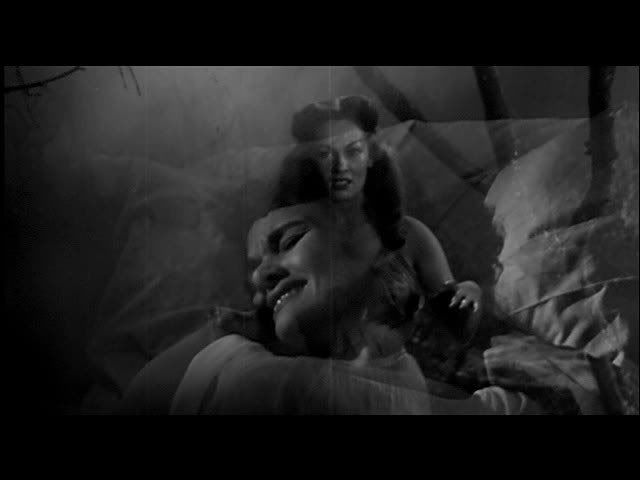
Director Edgar G. Ulmer has been acclaimed as a king of B-movies for his ability to inject a certain roughshod aesthetic sensibility into even the lamest of sub-B plots, and to the extent that he infuses this unbelievably weak scenario with some frisson of atmosphere, suspense, and even strange beauty, his reputation proves to be well-earned. There are long stretches of the film, particularly early on, that are really rough going, like everything involving the supposed romance between Janet and George; Agar seems positively bored and can't manage to suppress a smirk when delivering some of his generically reassuring dialogue. Talbott, at least, is competent, and what she lacks in acting chops she makes up for in sheer intensity and charisma. Her glaring black eyes give a certain credibility to the idea that she really is a "werewolf" or Hyde-like creature, even if one knows instinctively that she isn't. She especially shines in a series of dream sequences where Ulmer superimposes her sleeping face over scenes of moonlit stalking in the woods around the mansion. Janet dreams that she has transformed into a cold-eyed monster who hunts and kills young women before drinking their blood (because apparently the film's script also had to blend elements of vampire lore into its already confused monster). Ulmer finds blunt, bloody poetry in images like this, as he does in the rhythmic recurrence of shots of clouds passing across the moon, or in the soulful terror with which Janet stares into her mirror, caressing her cheeks as though expecting hair to sprout at any moment.


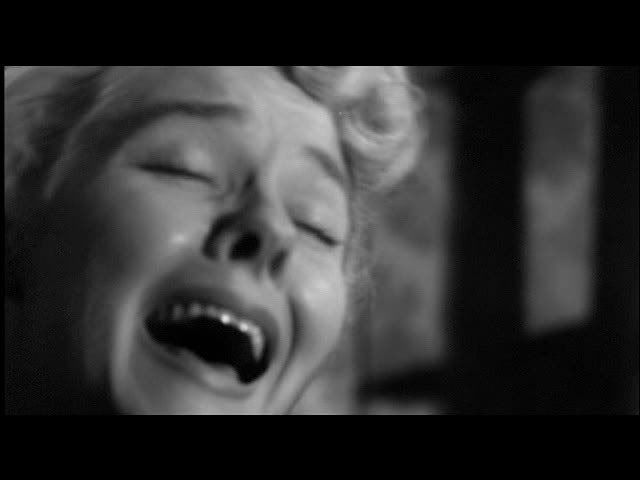
For the most part, Ulmer does a fine job of populating the film with enough memorable images like this that the otherwise shaky aesthetics (like the jittery, uncertain editing and laughably fake miniatures of the house and grounds) seem less important. Ulmer has no patience for the niceties of smooth plotting or transitions; he's only got a little over an hour to tell this story, and he seems determined to milk it for all the potent imagery it can yield, even if it means giving in to incoherence and silliness from time to time. The film's finest scene comes towards the end, during the monster's last nighttime raid, as it pauses to peer into a window at a sexy young woman changing into raunchy black lingerie. It's an unashamedly exploitative moment, one that's completely out of tune with the rest of the movie: in the midst of these desolate country back roads where all the locals have jagged teeth, dirty faces, and hard edges, suddenly the monster stumbles across this incongruous pin-up model who seems to be posing for a Playboy shoot. It's played for laughs with a knowing wink, but it just as quickly transitions into the film's most stunningly executed sequence, and in fact its only genuinely frightening one. As the monster advances on this young woman, Ulmer focuses only on her face in close-up, capturing her dawning recognition and a terror that finally erupts as a series of screams. As the attack commences, Ulmer maintains his fixed perspective, as the woman's face leans into the frame, her screams intensifying and the blurred motion of her face in close-up substituting for the unseen violence done against her body. The scene ends with a pan downward to see her limp hand sticking out from underneath a table, the rest of her body obscured from view. Ulmer pans right then, to catch a glimpse of her other hand and her stockinged leg sticking out from under the table on the other side; the scene's resolution is a dark mirror of the way the woman had earlier stuck out her leg alluringly to pull her stockings on.

Daughter of Dr. Jekyll is ultimately as silly and uneven as its title would suggest, punctuated by long stretches of utter boredom, but also possessing a sporadic sense of visual imagination and playfulness that is wholly unexpected in such an unpromising bottom-of-the-barrel genre piece. This is Ulmer's trademark, and while it may sound like faint praise to say that he spruces up such otherwise ratty material — like embedding tiny nuggets of gold in shit — his talents are far from insignificant. Rather, he manages to locate and magnify the virtues of whatever he makes, crafting moments of strange, unsettling genius in the midst of the most disposable films.

Monday, December 29, 2008

The Tall T


The Tall T is a crisp, economically made and structured Western, director Budd Boetticher's second collaboration with star Randolph Scott. It's a taut thriller for much of its short length, but Boetticher builds up to it slowly. The rambling, laidback introduction establishes Scott's Pat as a real good old boy with an easy smile and a gentle temperament, a former ranch hand who's only recently struck out on his own, buying a small piece of land and a few goats for himself. The Hollywood Western has such a long tradition of stoic, hard-edged heroes that it's almost shocking to see how cheery and charming Pat is, displaying his folksy good humor as he banters with his friends and engages in a bit of good-natured oneupsmanship with his former boss, a ranch owner who wishes he could get back his best employee. One expects a Walter Brennan type to be engaging in these kinds of games: the wizened old-timer sidekick, always quick to spit out a corny joke or stumble into a rough-and-ready physical gag. It's disarming to see the gangly, square-jawed Scott, with his craggy good looks and tough-guy build, putting himself on even ground with the sidekicks and bit players of the Western genre. This is perhaps one of Boetticher's characteristic touches: a few years earlier, the climax to The Man From the Alamo had gathered together all the usual castoffs of the Hollywood Western — women, cripples, and old-timers — to take center stage as heroes for a change. There's a similar logic at work in making Scott the butt of the joke as well as the traditional über-masculine hero.

Scott's predicament doesn't stay funny for long, though. The introduction is just long enough to give a sense of Pat as a quick-witted, easygoing guy who can't resist a challenge, and who nevertheless has a sense of obligation towards making his ranch work. He is proud to own something that's all his. After losing his horse in a bet — and getting all wet in the process — he hitches a ride on a stagecoach that's carrying the shameless gold-digger Willard Mims (John Hubbard) and his new bride Doretta (Maureen O'Sullivan), who he obviously married because her father owns the biggest copper mine in the area. This sets up a situation that should be familiar to anyone who saw the previous Boetticher/Scott collaboration, Seven Men From Now: the cowardly husband, the wife who deserves better, and Scott, who just happens to be providing a counter-example of proud, self-assured masculinity nearby. The film's igniting incident occurs when the stage is hijacked by a trio of thugs, who Mims quickly alerts to the fact that they have a potential ransom on their hands; he sells out his wife to save his own skin. It's a perfectly schematic Western plot, and one that's well-suited for Boetticher to explore the broad outlines of his typical concerns: the definitions of masculinity, cowardice, and bravery.

If that was all the film had to offer, it'd probably be enough: another well-made, reasonably exciting Western actioner from a director who made a long string of similar movies. But in fact, despite the relative simplicity of his plots and the broad strokes of his morality tales, Boetticher is at his best in the smaller touches, working around the edges of the story, infusing personality and an eccentric eye for nuance into these otherwise relatively standard stories of frontier violence. The humor in the film is surprising enough, and even more surprising is that it's not limited to the folksy introduction. At one point, Boetticher interrupts a taut standoff between Pat and the head outlaw Frank (Richard Boone) with a bit of slapstick that sends the villain into hysterics. The soundtrack, sparsely used throughout, here builds tension as though it's leading towards a dramatic break, then abruptly fizzles out into laughter instead.


The outlaws themselves are an interesting trio, particularly Frank, who is in many ways a sympathetic character. He's sick of the immaturity of his two much younger compatriots, the cold-eyed killer Chink (Henry Silva) and the dim-witted man-boy Billy Jack (Skip Homeier). In many ways, Frank keeps Pat around simply to have someone to talk to; Pat isn't really needed for the whole hostage and ransom plot, and Frank's henchmen would just as soon have killed him straight off. But Frank wants to hear about Pat's ranch — he has dreams of having his own place someday, too — and at one point orders his captive to talk at gunpoint. He's a man desperate for real companionship, a subtext that runs through the whole film and through several different characters, including the frontier stationmaster who Frank's gang kills earlier in the film. Pat himself is a lonely man, unmarried and working land that is not yet well-established enough to even have any other ranch hands. The film's most poignant thrust is the necessity of having someone to talk to in the midst of this forlorn, empty country, a terrain that Boetticher emphasizes with gorgeous wide shots of lone riders isolated in the midst of the rocky, expansive open country.

The film dispenses with its discourse on bravery and cowardice relatively quickly, particularly in comparison to Seven Men, where this remains the central dichotomy driving the story. The craven Mims is the film's least developed character, never rising above the level of caricature, and never getting the moment of redemption that Walter Reed's much more fleshed-out variation on the character earned in the earlier film. Boetticher's penchant for recycling basic plot structures can be misleading; in this film, he is far more interested in the relationship between the lead and the outlaws than he is in probing the contrast between the hero and the coward. This interest is reflected in the geometry of Boetticher's shots, the way he weighs Scott against the three bandits in the frame. There's an in-built tension and drama to the way Boetticher uses the widescreen frame, the way he balances figures against one another. They seem to be forming abstracted shapes together, their bodies standing at the corner points of invisible figures traced in space, the lines drawn by the aimed barrels of guns. When Pat learns that the outlaws have killed two of his friends, a stationmaster and his young son, the camera traces the path of Pat's gaze, towards the well where the bodies have been thrown and then back to the outlaws. Nothing is said, and Scott's stony face betrays little overt emotion, but the camerawork in the scene nevertheless conveys the impact this has on the hero.

What this is all leading to is the even more careful geometry of the film's climax, in which Pat faces down the outlaws one by one, culminating in a violent denouement that must have been downright startling at the time it was released, and which still maintains its bracing intensity. The Tall T is a Western masterpiece from Boetticher, a master of the genre who turns his pulpy, low-budget material into an epic morality play with potent, unforgettable imagery.