Showing posts with label 1974. Show all posts

Wednesday, September 19, 2012

Demoniacs


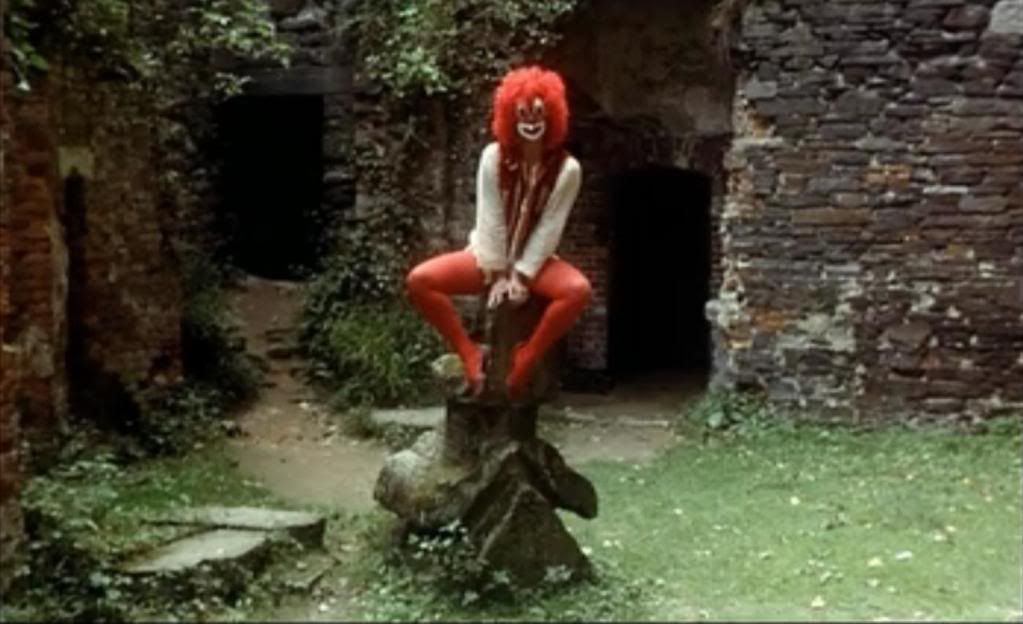
Jean Rollin walks a very fine line in his trashy B-movie exploitation flicks. So much is "bad" and amateurish in his movies, from the wooden acting to the flimsy props to the ridiculous scripts, that it's sometimes difficult to determine just why the resulting films aren't bad, but in fact create a kind of budget poetry and eerie beauty from these minimal building blocks. Demoniacs perhaps proves just how easy it is for a Rollin film to tip over from that atmospheric minimalism into more typical sub-B-movie horror tripe. Demoniacs feels very much like a Rollin film in most ways; he's taking a brief detour from his obsession with lesbian vampires, but otherwise the film provides plenty of eerie beaches, ruined castles, sinister clowns, and languid softcore sex scenes. The usual shoddy production values and amateur acting are very much in place here. All the elements are there, but for whatever reason the ineffable magic that allowed Rollin's earlier films to transcend their trashy premises is missing here.

The story concerns a band of pirates who wreck ships by guiding them into the rocks with false light signals. After one of these shipwrecks, while the pirates are gathering their loot, two sisters (Lieva Lone and Patricia Hermenier) stumble to shore, the sole survivors of the wreck. The pirates attack and rape the girls — in a sequence staged so incompetently that it's laughable and discomfiting rather than harrowing — and leave them for dead on the shore. The girls aren't dead, though, and they eventually make their way to a ruined castle where the devil (Miletic Zivomir) is trapped along with two strange retainers, a clown (Mireille Dargent, donning clown makeup again after Requiem for a Vampire) and a bearded man who looks like Rasputin (Ben Zimet). The devil gives the girls his power through a sexual ritual, sending them off to get their revenge against the pirates.


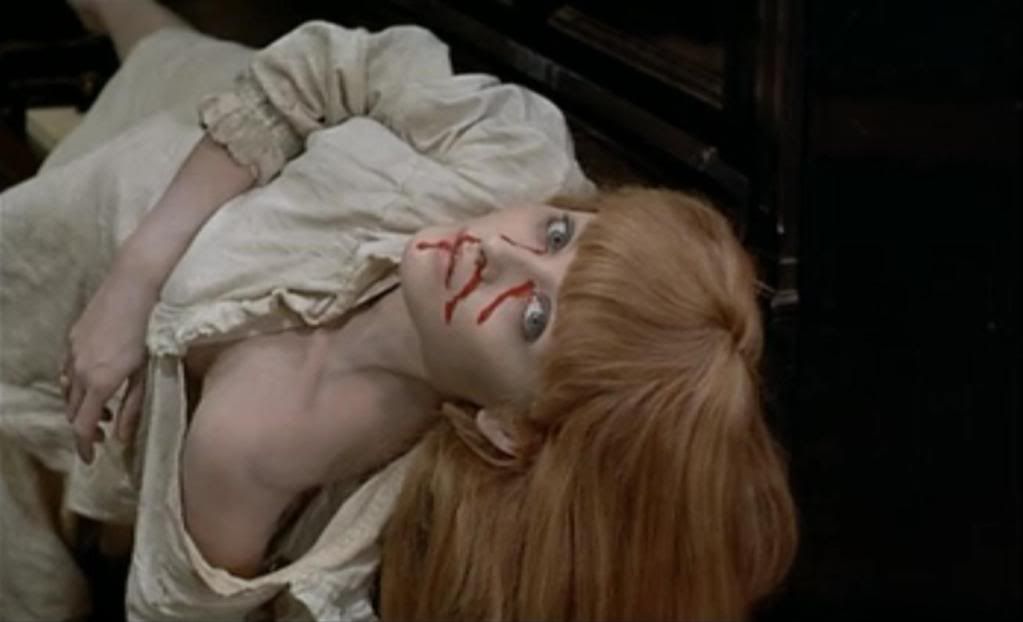
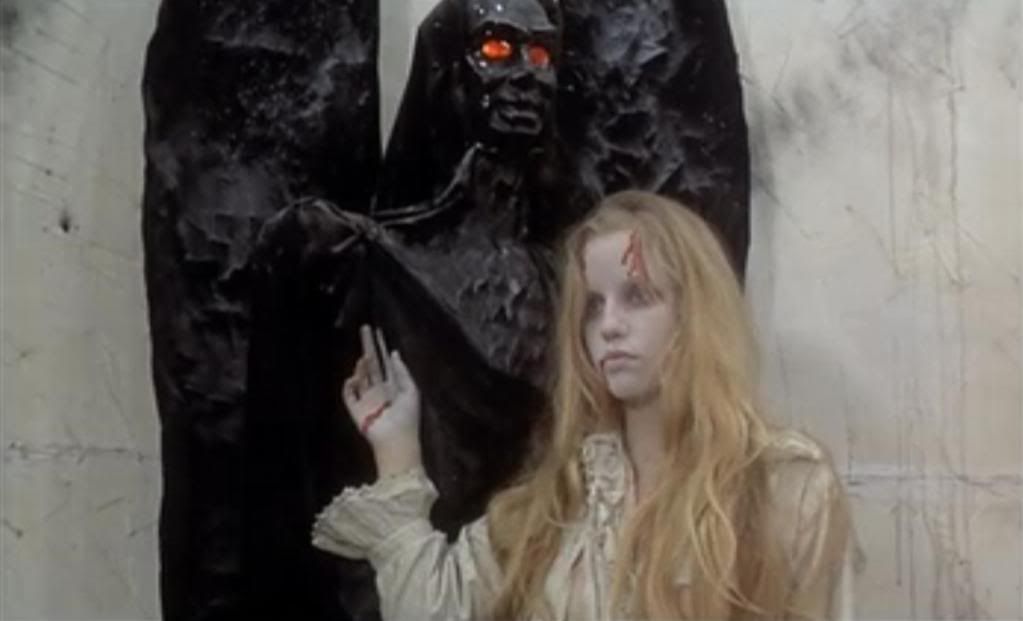
It's a compelling enough story in its broad strokes, but Rollin, typically, isn't that interested in telling it. Instead, there are endless scenes of the pirates loitering around a bar where a psychic barmaid (Louise Dhour) stares into space and issues dire pronouncements about spirits, demons and violence. The pirate captain (John Rico) is occasionally plagued by a guilty conscience, which provides opportunities for some striking visions, as he sees the two girls from the shipwreck, dripping with blood, posing with skeletons and a creepy black stone angel with glowing red jewels for eyes. Mostly, though, the film feels slack and empty; it's just over an hour and a half long but feels much longer, its slowness not hypnotic as in Rollin's best films but draggy and numbing.

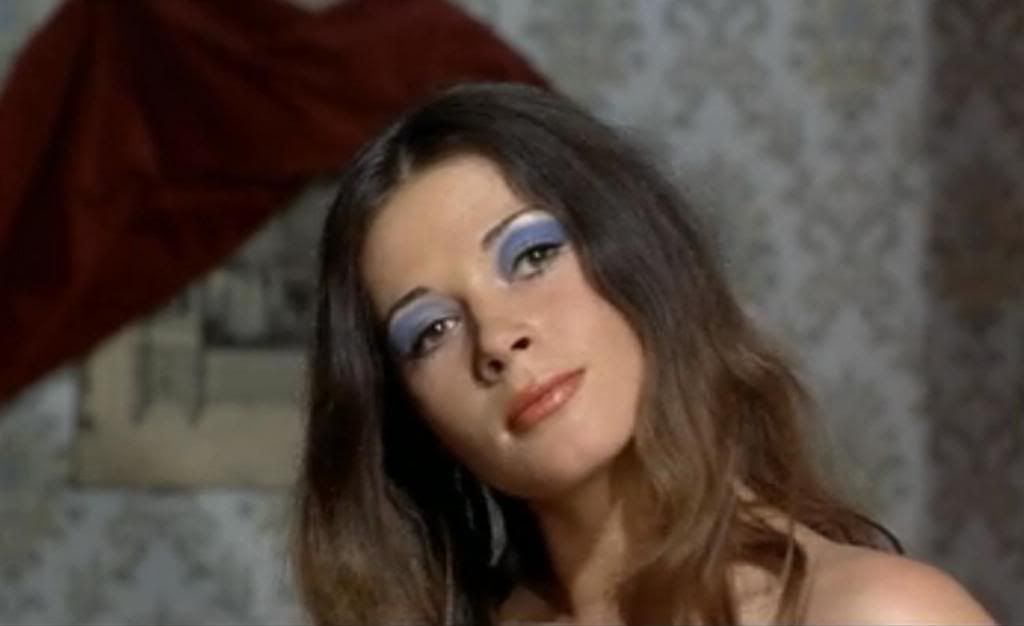
The highlight of the film is undoubtedly the presence of Joëlle Coeur's vicious nymphomaniac pirate Tina. Coeur isn't really any better an actress than the average Rollin star, but she does project a savage form of sexual menace that makes her an especially magnetic, memorable screen presence. Tina's a deadly femme fatale who's turned on by evil: in the opening scenes, she watches with a wicked smirk as her fellow pirates attack and rape the two survivors of the shipwreck, and all the violence moves her to strip down and seduce the pirate captain into her arms. Rollin treats her to multiple closeups in which she smiles that sinister, lusty smile, sensually shaking her long hair away from her face, throwing her head back, overcome with arousal at the prospect of violence and pillaging. Her performance is totally unmodulated, violently sexy, awkward and erotic in equal measures, and she brings a level of energy and enthusiasm to the film that's otherwise totally missing. Her constant posing — putting her hands on her hips and thrusting to and fro in a sexually charged celebration of death and destruction — is blatantly theatrical, making her a caricature of erotic evil, a nasty cartoon character come to fleshy life.

If only Rollin had built a worthier movie around this devilishly unrepressed villainess. The credits sequence introduces this as "un film expressioniste de Jean Rollin," but that description is far more apt for the director's earlier movies, which truly did create expressionist beauty from low-grade horror schlock. This film just meanders aimlessly without ever taking advantage of its most promising elements; even the revenge quest of the two girls is disappointing. With all the power of the devil at their fingertips, the best the sisters can do for vengeance is to make some statues fall from pillars while Tina runs around screaming, in what must be the silliest and least convincing sequence in a movie with some very stiff competition for that title. A few compelling moments aside, Demoniacs is one of Rollin's weaker efforts, where the unique alchemy of his approach fails to come together, leaving only the multiple failings of performance and plotting that are usually glossed over by the director's idiosyncratic aesthetic.

Wednesday, February 1, 2012

Stavisky...


With Stavisky..., Alain Resnais has made a film that seems to be all about appearances and surfaces, but uses its glossy, charming — but ultimately tragic — gangster story as a way of exploring questions of identity and politics. The story of the conman Stavisky (Jean-Paul Belmondo), who reinvents himself as the sophisticated financier and businessman Serge Alexandre, takes place in the crucial years of 1933-1934, a period of slowly increasing tension in the lead-up to the Spanish Civil War and World War II. The film is based on real events that inspired right-wing riots on February 6, 1934, leading indirectly to the gradual loss of power by leftists and socialists within the French government. The film was written by Jorge Semprún, who had also written Resnais' La guerre est finie in 1966; like that film, Stavisky... engages with European fascism and leftism through questions of identity and personality. Stavisky/Alexandre is a man of many names, many identities, a small-time crook who has put his past behind him and become a well-respected member of society, dealing with high-ranking politicians and businessmen, coming up with grand plans that would impact the entire world economy. Stavisky is hiding from his past, at times acting as though the man he was is someone else entirely, with no connection to his present self at all.

Resnais connects this denial of self with the question of Jewish identity during a time of steadily increasing anti-Semitism in the years before the Holocaust would begin in earnest. Stavisky is a Jew, and a self-denying Jew, just like his father, who had entirely repudiated his faith. But he's self-denying in an entirely different way from his father, who had always advised him to be "average," to let people ignore him; Stavisky doesn't believe in this advice. As one of his employees says about him, "He wanted the world to talk about him. He should have wanted it to forget him." Stavisky's grand plans only draw attention to him, make him a target, impossible to ignore or to forget. In this, he is compared to a refugee German actress (Silvia Badescu) who he sees giving an audition in his theater: she stands up on stage and announces that she is a Jew, that she has fled from Germany. She is announcing her identity up front, hiding nothing, very unlike Stavisky, whose Jewish roots are deeply buried beneath layers of alternate identities and invented names. Perhaps that's why he's so moved by her, although their stories only intersect briefly. He sees in her a pride and a strength of character that, despite all his bravado and his smiling confidence, is utterly missing in him because he can never truly be himself. And yet Stavisky, in his own way, also refuses to be "average," refuses to hide or to congenially assimilate into society. Instead, he places himself out in the open, using the connections he builds to ingratiate himself into polite society, politics and the inner workings of the world economy.

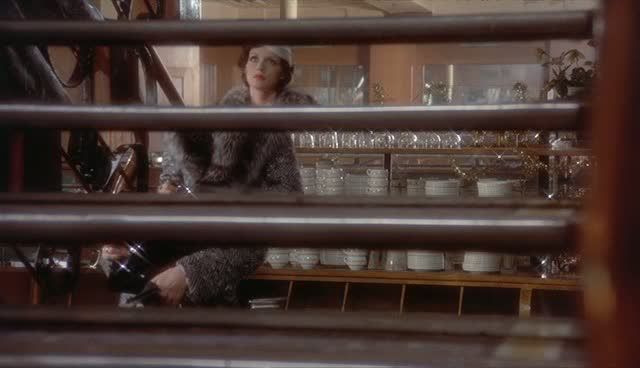
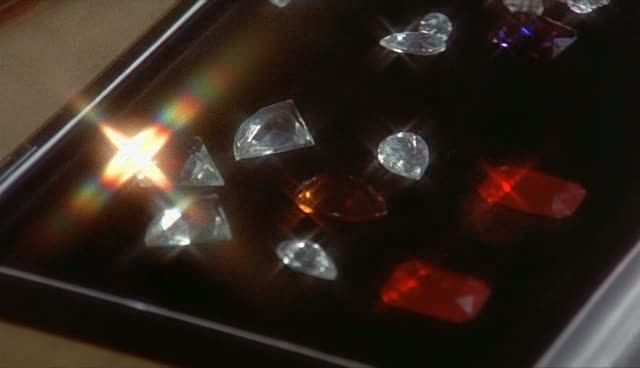
It's this domain of privilege and power that serves as the film's milieu. The film is set almost entirely in fancy hotels, glitzy seaside casinos, resorts for the idle wealthy. The camerawork of Sacha Vierny accentuates the shiny, colorful veneer of these surroundings. The camera drifts lovingly over the facades of these pleasure palaces — although Stavisky, who says that happiness is momentary and pleasure permanent, would likely not call them that — and revels in the excess and grandiosity of this lifestyle. Jewels glitter brightly, sparkling with stars of white light. The women, like Stavisky's beloved wife Arlette (Anny Duperey), are dressed in fine furs and sleek dresses, their made-up faces surrounded with shimmering jewels. Everything is glamorous and draped in riches, even in the midst of the Great Depression, which hardly seems to have touched the social circles that Stavisky operates in. The lively Stephen Sondheim music makes the film seem like a musical with no real musical numbers, just the sprightly accompaniment of Sondheim's jaunty melodies and romantic string themes. Alexandre puts on theater productions, giving the public garish spectacles to distract from the real conditions of the world for ordinary people. As his employees tell him, no one wants frugality in their entertainment, they want to be entertained and delighted by everything they don't have in their own lives. The film is dripping in ostentatious displays of wealth and privilege, set in a fantasy world that seems entirely disconnected from both the poverty of most people and the brewing political turmoil that would throw the entire world into chaos and horror by the end of the decade.


That turmoil rarely intrudes in obvious ways into the world that Stavisky has built for himself, and yet he's surrounded by signs of what's to come. He has associates and friends on both sides of the political spectrum, especially among rightists like the charming, cheerful fascist Baron Jean Raoul (Charles Boyer), who wants to replace France's parliamentary government with a National Union comprised of wealthy, influential society people. Stavisky also nurtures his connections with Juan Montalvo (Roberto Bisacco), a Spanish exile who's gathering funds and weapons to trigger a civil war back in his native country. Stavisky involves himself in wild schemes, financed with fake bond issues, to rejuvenate the world economy and end unemployment, but the real future is to be found in the plans of his friends, who plot against the left with the help of this disguised Jew, who barely thinks about the political consequences of his associations. He says that he remains neutral, that he'll support whoever is in power and forge connections on both sides to cover himself in any eventuality, but he never seems to grasp the deeper implications of the platforms that these polite fascists are really pushing for.

The film's political subtext also involves the parallels and connections between Stavisky and the exiled Leon Trotsky (Yves Peneau), who arrives in France in the opening scenes of the film. Resnais then cuts from Trotsky's motorcade to an image of Stavisky/Alexandre descending in an elevator in one of his posh hotels. Just to underscore the point, Resnais cuts back and forth a few times, stuttering the image between Trotsky's car and Stavisky in his elevator; the hotel scene is accompanied by lushly romantic strings, while no music plays over the images of Trotsky. This montage at first seems like a simple joke, juxtaposing the arrival of this important political figure with the lavish lifestyle of the conniving gangster, but the parallels between the two men go deeper than that. Both are Russian Jews in exile, and by the end of the film, the failure of Stavisky's criminal schemes will have catapulted the rightists to power and endangered Trotsky's position in France. Throughout the film, Stavisky's showy existence and denial of his roots is contrasted against Trotsky's quiet maintenance of his beliefs and his low-key engagement with the radical politics of the era.

Although the film's surface period evocation is flawless — the art direction is sumptuous and detailed — Stavisky... is far from a typical period epic. Resnais, as he often does, uses non-chronological editing to fragment the narrative, weaving together flashbacks and flash-forwards that foreshadow and then outright depict Stavisky's downfall and death while he's still at the height of his power. In one key sequence, Stavisky goes walking in the woods, visiting the house where his father, embarrassed of his son's criminal record, committed suicide. As Stavisky prepares to leave the site, Resnais cuts in for a surreal closeup of a dead mouse that Stavisky steps past without seeing it, a symbol of the doom that he can't see coming. (Later, a white ermine frolicking in the snow serves as a prelude to Stavisky's actual death; Resnais loves playfully using animals as mysterious symbols like this.) The film's interpretation of the real-life Stavisky Affair suggests that the title character was unwittingly responsible for many of the failures of French leftism in the pre-WW2 era, haplessly paving the way for the Vichy regime and the victories of French fascism.

Monday, July 11, 2011

The Traveler


The Traveler was one of Abbas Kiarostami's earliest features; the director himself considers it his first true feature. In a direct, pseudo-documentary style, the film chronicles the adventures of the young schoolboy Qassem (Hassan Darabi), an undisciplined kid who plots to run away to Tehran to see a big soccer match. The rough, grainy black-and-white aesthetic of the film gives it the impression of an observational documentary shot in working class neighborhoods; its schoolboy looseness and rebellious humor recall the French youth dramas of Jean Vigo and François Truffaut. Qassem is a bad kid who coasts through school, rarely paying attention in class, never doing his homework, repeatedly failing all his classes. He cares only about soccer, whether he's running around town playing pickup games with gangs of similarly rowdy kids, or splurging all his money on soccer magazines (which promptly get taken away by his teachers because he reads them in class).

His parents are ineffectual, as demonstrated in a shrilly funny scene where Qassem's mother visits the school to check up on her son and gets scolded and reprimanded by the principal for not doing enough to curb her son's lack of discipline and disinterest in school. Qassem's mother is constantly yelling at him, but he simply dodges out of the house to go play soccer; as she tells the principal, she can't read or write herself, so she's unable to help him with his work or even check that he's doing it. Kiarostami is hinting at the difficulties of developing a respect for education among working class people who are mostly uneducated. The generation gap is widened when people with no learning send their children to school, but in Qassem's case it seems that he's not likely to advance very far beyond his parents' station despite his education. If his mother is unable to do much to help, his father seems simply disinterested: his mother keeps threatening that his father will beat him for failing, but in actuality the father sits quietly, listening patiently to his wife's complaints about their son's problems, and never saying a word or doing a thing.

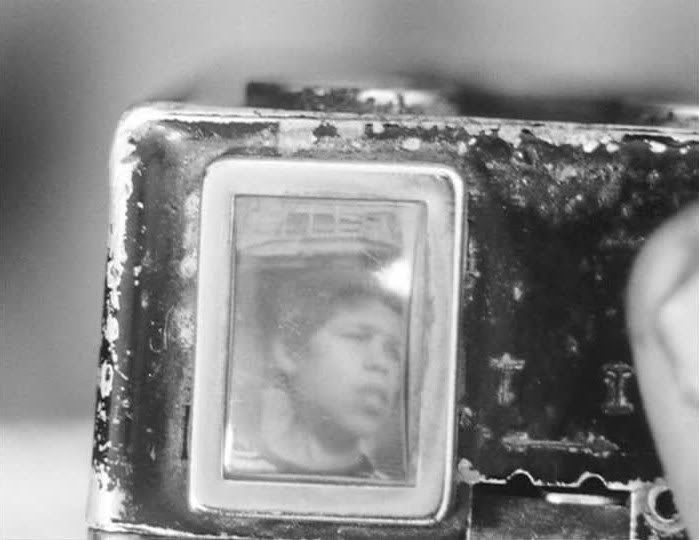
Class is a big part of the film. The bulk of the first half is dedicated to Qassem's attempts to scrounge up enough money for a trip to Tehran for a big soccer game. He calculates how much he'll need for a bus ticket, a ticket to the game, and some cab fare, and then starts scheming to gather the money. He outright steals a small sum from his mother, but the rest he tries to get together by selling whatever broken trinkets he can find. Kiarostami emphasizes the haggling with local shop owners, the difficulty of slowly building up a little money. In one scene, Qassem uses a broken camera — which he had earlier failed to sell — to pretend to take pictures of kids coming out of school, charging them a few cents for each photo, and planning to tell them later that the pictures didn't come out. Qassem's scheming is alternately sad and funny, and in this scene it's the latter, as the kid gets into his role, bantering with the subjects of his fake photos, calling one girl a "cutie" and joking with a mother who poses with her baby.


Qassem finally gets the money he needs by selling the soccer equipment that he and his friends had saved up for; he gets only a small fraction of the money they'd paid, but it's enough for his Tehran trip. In the second half of the film, Qassem finally makes his trip to Tehran, riding by night on a bus, its light cutting through the eerie darkness. Once there, however, he experiences nothing but further delays and problems in his quest to get into the game, waiting in a ticket line for hours only to just miss the cutoff before they stop selling tickets. He finally does get a ticket from a scalper, and enters the stadium through the rush of the crowds only to find that he's gotten there way too early and must wait for three boring hours before the game even starts. His conversation with an older fan suggests some of Qassem's alienation: he has few friends and sees himself as an outsider, a country boy who the city kids would never want to have anything to do with.

This note of melancholy infuses the broad irony of the film's ending. One of the film's final sequences is a dialogue-free, near-silent dream sequence in which Qassem imagines himself back in his hometown, suffering the punishments and disapproval of his parents and teachers, as well as the hatred of all his classmates, who he'd schemed against and cheated in order to make this trip. In one of the most striking sequences, Kiarostami holds a closeup of Qassem's face as he lays on the ground, screaming and thrashing around as the other students beat him and drag him along the ground. They're clustered all around him, their faces masks of anger, their eyes cold and staring. He sees his mother among those in the crowd observing his torment, her face hidden behind a wrap, only her eyes looking on, just as earlier she'd watched as a teacher beat the boy at her behest for stealing money from her. After the low-key humor and disarmingly casual aesthetic of the rest of the film, this dream sequence stands out for the way it suddenly externalizes all of Qassem's previously hidden insecurity and fear, the emotional turmoil churning within this disobedient, insolent kid.

The Traveler is a lovely, quietly moving film with some unexpected moments of sharp visual poetry. In one scene, Qassem looks through a camera's viewfinder at his friend as the other boy tries to convince him to sell the camera for a cheap price; the image in the viewfinder is cloudy and washed out, as though the other boy is far away rather than right next to his friend. Later, when Qassem finally gathers enough money for his trip, he celebrates by leaping onto the back of a horse-drawn carriage, sitting on the rear of the carriage as it speeds away, leaving his friend behind. Kiarostami draws the moment out into a poetic celebration of motion and speed, focusing on the horses' hooves, the look of pleasure on the boy's face, the shadow of the carriage's driver moving along the ground as the horses pull the vehicle onward. It's a crucial moment, and Kiarostami beautifully communicates the sense of freedom and accomplishment that Qassem feels at this point, finally liberated from his working class context, his disciplinarian school, his seemingly uncaring parents. This, and not the actual (and disappointing) trip to Tehran, is the real climax of the film, the real heart of Qassem's story. His youthful yearning for freedom, his desperation for something of his own, is vividly felt through Kiarostami's calm, stripped-down aesthetic.

Thursday, July 7, 2011

Italianamerican


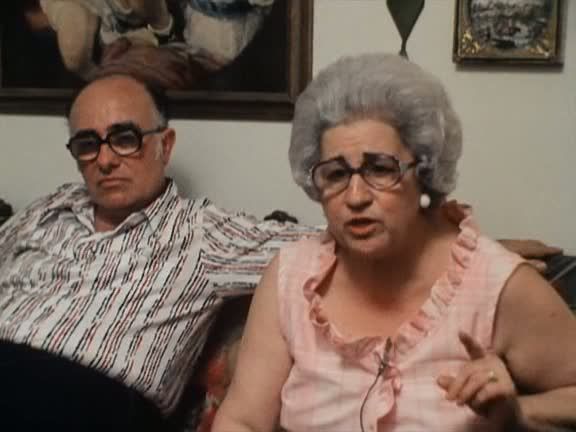
Martin Scorsese's Italianamerican is a charmingly off-the-cuff documentary that captures the director's parents, Catherine and Charles, talking about their lives and the lives of their own immigrant parents. The film is an utter delight from start to finish, full of the wit and vitality and obvious love of talk that these people bring to their unscripted conversations about the past and the lives of Italian immigrant communities in New York. Scorsese set the film in his parents' own home, where they're totally at ease, not tempering their effusive personalities a bit for the camera. There is no artifice here, no attempt to disguise the fact that a movie is being made. In the opening scenes, Scorsese shows himself walking around the living room, then stepping behind the camera to watch his parents hash out where they're going to sit on the couch (a running gag is built around Catherine's jokes about Charles not wanting to sit too close to her). Scorsese then tries to coach his mother into giving him an introduction about the tomato sauce recipe she's going to prepare on camera. Instead, she asks him again and again what he wants her to do, and then, in a very funny moment, tells him what he should say, unable to resist acting like a mother, giving filmmaking advice to her son the director. Scorsese finally nudges her into actually demonstrating the sauce recipe, and the camera follows her into the kitchen, where she jokes about the hard meatballs of some of her friends — "you throw them against the wall and it cracks" — and then laughs abashedly, saying she shouldn't be talking that way.

Scorsese leaves it all in, letting the seams show. Later on, as he and his parents converse around the dinner table, they eat pasta and drink wine as though it's just an ordinary meal, as though the camera just happens to be there. At one point, Scorsese's hand reaches into the frame from behind the camera with a fork to pick at a bowl of salad on the table while his parents talk. It's all so casual and offhanded, adding to the atmosphere of family closeness.

The setting is perfect, too, an obviously cramped but homey apartment that, it gradually emerges through Catherine and Charles' stories about their childhoods and their early years as a couple, is actually an upgrade for them. Catherine talks about living in an even smaller apartment — only three rooms — with her parents, nine siblings and, eventually, her aunt and uncle and their child. They made the most of the space, too. Catherine talks about how they even used to make wine in her family's apartment, keeping the barrels of fermenting grapes in one of the rooms where they slept. She looks around her as she talks about this, as though imagining how they managed to fit so many people and do so much in such a small space, and a sad, wondering smile crosses her lips. It's wonderful: there are so many shots and moments here where one can see Scorsese's parents mentally returning to previous eras, their eyes shining with the reminiscences, fondly smiling as they remember how their lives used to be.


Through their funny, charming stories, there emerges a portrait of the Italian-American experience in New York, and indeed the experience of all lower-class immigrants struggling to make lives for themselves in a new land. The cramped apartments, the large families, the kids working as soon as they're old enough rather than continuing in school, the wife supplementing her husband's income with sewing, the cooking, the sense of community: it's all told with such obvious love and tenderness and joy that the hardships and struggles don't seem nearly as important as the love of life and the hard-working values of these people.

Scorsese obviously knew what he was doing in choosing his own parents as his subjects. In front of the camera, they are surprisingly loose and open, bantering and bickering with one another, laughingly ribbing one another the way only a long-married and still close couple can do. They have a real way with words, an intuitive verbal skill that makes them an absolute delight to listen to. Their stories are, in some ways, about poverty and immigrant slums, but their tone suggests only happy memories, and above all an abiding respect for the values embodied by previous generations, values that they strive to carry on in their own lives. It's a vivid portrait of this lifestyle, achieved almost entirely through their evocative words; Scorsese occasionally cuts in archival family photos, but mostly the camera remains trained on Catherine and Charles. This is a verbal movie, a movie that celebrates the art of storyelling and the personalities of the people telling the stories. Catherine and Charles represent a particular way of life, and their way of talking, their relaxed, self-confident way of being, will be familiar to anyone who has ever had parents or grandparents from similar backgrounds. They embody traditional gender roles — at one point, Charles jokes that while everyone knows men are better cooks than women, cooking is simply not the man's job — but at the same time they have great respect for each other's hard work, and they spar and joke with one another as obvious equals. The way they take turns telling stories, filling in details, occasionally stubbornly disputing one another on facts, suggests their level of comfort and familiarity with one another.

Italianamerican is a remarkable documentary that emphasizes how vital and exciting a simple, well-made film can be just by placing compelling subjects in front of the camera and letting their stories slowly emerge. The disarming casualness of the film adds to its effect, keeping the Scorseses in their own home, interacting with their own son as their son rather than as the man behind the camera. The film's brilliance could only be produced by this intimacy and familiarity. It is a truly homemade film, and a film about homes, about families, about heritage and history.

Thursday, April 8, 2010

Nuits rouges


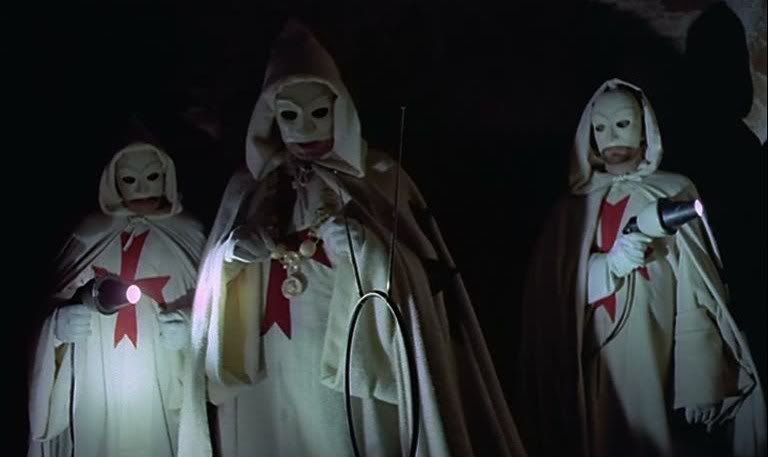
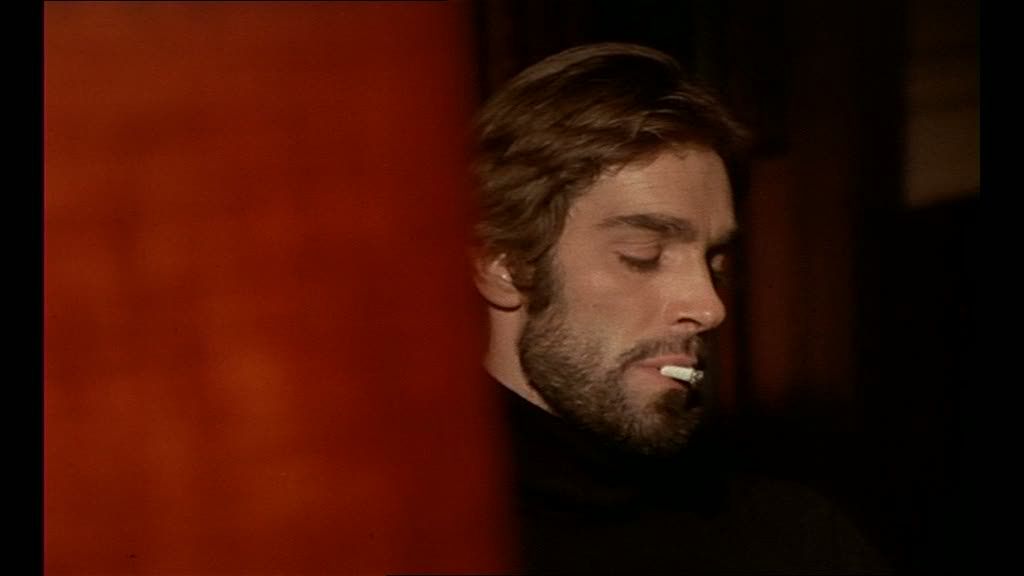
With Nuits rouges, Georges Franju returned to the territory of Louis Feuillade, whose adventure serials also provided the inspiration for Franju's 1963 Judex. Made a decade later, Nuits rouges is far wilder, more garish and absurd, than its predecessor: if Franju's Judex captured the mystery and poetic magic of Feuillade, this later tribute is all about the pulpy delights of Feuillade, the over-the-top pleasures of a ludicrous, convoluted narrative, secret conspiracies, spies and killers in stylized costumes. The narrative revolves around the mythical treasure of the Templars, a secret long guarded by this secret society and coveted by all others who suspect its existence. The nameless master criminal (Jacques Champreux) known only as "the man without a face" is one of those who seek this treasure, and is willing to do anything to get it. He is a master of disguise (even if many of his disguises, in the grand tradition of movie disguise masters, consist of nothing but a cheap wig or a false nose) and often appears in a sleek black suit and red mask, behind which his eyes are insane and unblinking.

Quite frankly, this movie is nuts. The elusive Templar treasure provides a (slim) justification for one loony set piece after another, as the red-masked villain's secret criminal organization squares off against the Templars in their white robes and masks. The film was edited down from an eight-episode television miniseries, which presumably made more sense in terms of narrative, but here Franju has distilled the story down to its bare essence, one weird moment after another with little concern for continuity. In the midst of all this scheming and spy movie pastiche, Paul (Ugo Pagliai) gets drawn into the mystery because of his murdered uncle, who had been safeguarding the Templars' treasure, while police inspector Sorbier (Gert Fröbe) tries to make some sense of this all and the "poet detective" (whatever that is) Séraphin (Patrick Préjean) keeps bumbling along and screwing everything up. Franju's visual imagination is in high gear throughout, spinning out a goofy, endlessly inventive series of colorful set pieces. Thus the red-masked criminal's lair is a cross between a sci-fi compound and a business office. The villain marches through secret passages and sits down behind a silvery desk — cheap and fake-looking, like it's simply been coated in aluminum foil — but then calls his employees over the intercom like he's paging his secretary, and asks for files. His criminal underlings sit in neat rows at typewriters, dressed in black jumpsuits to match their boss' outfit, though without the nifty red mask.


Franju is obviously toying with his genre lineage here, drawing on Feuillade's black-suited spies and adventurers, all the weird secret organizations, the rappelling along rooftops, the strange technology that's more or less represented by cardboard boxes and TV rabbit ears. Franju also respects another standard of the genre: the lousy, hammy performances and awkward dubbing that infuses the film with such a disorienting, amateurish disconnect. The multinational cast hardly delivers any convincing performances, and some of the smaller players are especially laughable: a professor (Henry Soskin) makes his big death scene absolutely hysterical by squealing melodramatically as he watches his would-be killer approach. Franju highlights the moment by zooming in, as though his camera was going to keep probing until its lens was engulfed by the professor's gaping, screaming maw. Franju is obviously delighted by the inconsistent, knowingly silly performances on display here, and he manages to make a virtue of the film's campy self-consciousness by reveling in the unrestrained quality of it all.

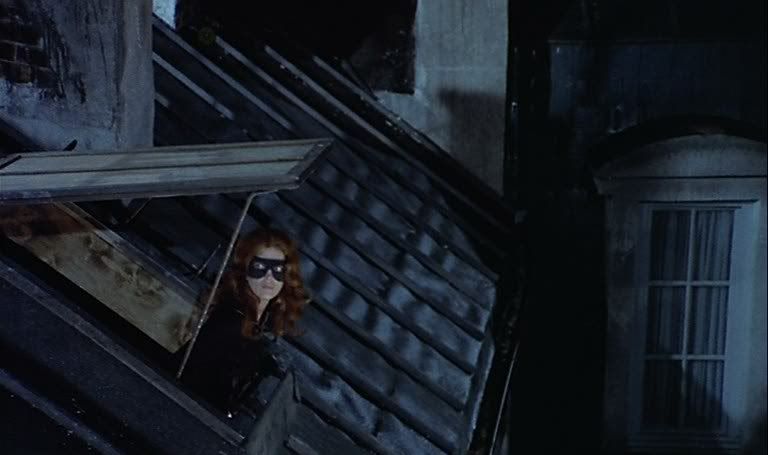
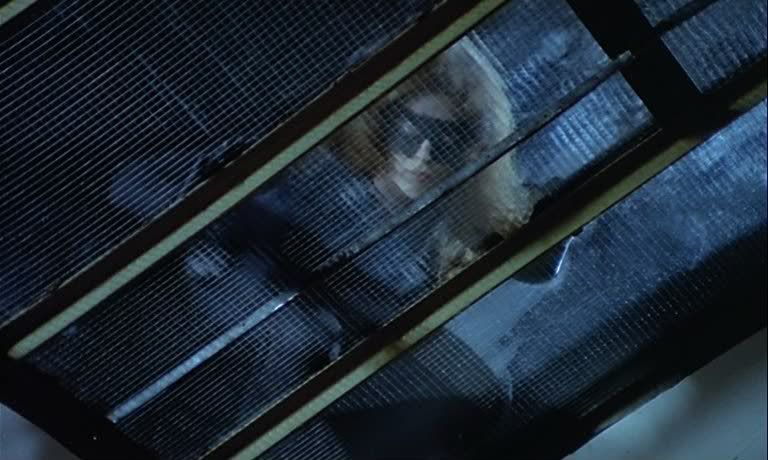
Certainly, the uneven performances are counterbalanced by the lo-fi visual beauty of the film. Franju's sets might be minimal and deliberately, transparently artificial, but his aesthetic sense makes them beautiful in that knowingly fake way that so often informed the early cinema (but, ironically, not so much Feuillade, whose films relied more on surface realism and location shooting). At times, Franju seems to be nodding as much to the golden age of Hollywood cinema as he is to Feuillade. A sequence where the red-masked villain's sexy accomplice (Gayle Hunnicutt) stalks across the rooftops in a cat burglar outfit and domino mask is especially evocative of Hitchcock's To Catch a Thief. It has that same stylized atmosphere, the eerie darkness, the slinky woman tiptoeing across the roofs on a mysterious mission. And when she arrives at her destination and looks down into the room where her target lies sleeping below, Franju switches to a shot from the other side of the window: the woman's face hazy and distorted through the frosted glass, her features abstracted by the distortion. Batman's nemesis Catwoman, and comics in general, are another obvious touchstone. It all ties back to Feuillade as the common source, the cinema's great pioneer of pulp storytelling, the root of so many of these iconic images.


Franju also incorporates a nod to the classic horror cinema, including his own early mad science feature Eyes Without a Face, still probably his most famous film. The mad scientist (Clément Harari) here is a truly deranged figure, a sinister and wacky monster who sweats and bulges his eyes out as he operates on his "patients." His goal? To create lobotomized robots — the ideal common man, in his view — with no brain activity, who will do anything they're ordered to do, and who can be used as zombie assassins. He keeps these zombies in simple wooden coffins with nutrient drips, and rants over them about how helpful his work will be for the future of society. These perfect slaves will aid the economy and the military, creating a workforce that can be stored away and turned off during periods of downturn, without inconvenience to the world's elites and rulers, who will alone retain their agency and minds. It's a nightmare vision, and Franju illustrates it quite literally when an army of these zombies, disguised as mannequins, attempt to kill Paul and Séraphin. It's a pointed satirical jab — at the dehumanization and oppression of the populace by elites — in a film that's otherwise concerned with being simply a fluffy tribute to old movies and old genre tropes.

That might seem a relatively modest goal, but Franju has so much obvious fun with this material that Nuits rouges is a purely joyous experience. Even more than Franju's Judex, in which he explores the poetic resonances of this material, Nuits rouges captures the trashy, pulpy qualities of old cinema, the bold visual ideas and the excitement of never knowing what wild idea is coming up next.

Monday, December 28, 2009

The Conversation


As befits a film about a wiretapping and surveillance expert, Francis Ford Coppola's The Conversation is driven by its soundtrack, by the complex intersections of tape recordings, jazz music and overlapping dialogue that create this dense, layered audio construction. The wiretapper Harry Caul (Gene Hackman) is a solitary and paranoid man, a consummate professional who builds all his own equipment and jealously guards his secrets from everyone in his life, including his longtime partner Stan (John Cazale) and his sometimes lover Amy (Teri Garr). Harry's lonely but stable life is disrupted when he becomes more involved than usual in his latest case, in which a businessman has asked Harry and his crew to record a conversation between a young couple in a public place. The couple, Mark (Frederic Forrest) and Ann (Cindy Williams), are aware that they're always being observed, so they go to a busy public park in the middle of the day, walking in endless circles through the crowds, believing that this will make it impossible to record what they are saying. For Harry, this is first and foremost a professional challenge, and he initially relishes the difficulty of the task he's been given. He is proud of his skills, and knows that he is possibly the only man in his field who could accomplish this job.

The film's introduction thus focuses on Harry's technical skills, and Coppola cuts crisply back and forth from the surveillance men in their various hiding spots, to the couple walking around and talking. We hear snatches of their conversation, sometimes crystal-clear, sometimes heavily processed or interrupted by other noises. The soundtrack reflects the attempts of the surveillance men to assemble a coherent tape by tracking the couple with three different mics. The couple talks about seemingly innocuous things: Christmas presents, the homeless, getting bored of walking in circles. This basic dialogue will return again and again throughout the film, with new details being filled in and new snatches of dialogue being heard as Harry works with the tapes and discovers new nuances in the audio. Each time he hears the tape, he seems to hear something new, and as new exchanges are unveiled, previous ones take on new meanings. At other times, a simple phrase might mean multiple different things based on context and how it's said, the exact tone of voice behind it. The audio, and the images of the couple that often accompany this recording, form the structural foundation for the film, as Harry begins to invest more and more emotional meaning into this recording.

Harry, who opens the film insisting that he doesn't care about the actual content of his recordings, and doesn't care what impact his work has beyond the mechanics of doing it, begins to feel the moral weight of his profession. Certainly, this morality is something he's tried hard to escape, as is revealed later in the film. Harry's sleazy competitor Bernie Moran (Allen Garfield) tells a story about how the information gathered in one of Harry's previous jobs had led to the deaths of an entire family. Harry tries to shrug it off, insisting that it's none of his business, that his only concern is the technical challenges of getting the best possible audio, but it's obvious that he's moved by the idea that his work can have devastating and horrifying implications in the outside world. At one point, convinced that his newest tape is going to lead to another murder, he even goes to confession, attempting to cleanse his soul of the guilt. He leads up to the admission with minor sins like taking the Lord's name in vain, an offense that bothers him throughout the film, but throughout his whole confession the priest, seen in hazy outline through the thin gauze screen of the confessional, simply nods his head silently. There is no answer for Harry's overpowering guilt, his growing impression that he's going to cause a horrible crime.


These guilty feelings soon escalate into outright paranoia, as Harry feels he's being stalked by the blandly sinister Martin Stett (Harrison Ford), a representative for Harry's employer who's angry that Harry is waffling about handing over the tapes. Harry's fears deepen after an encounter with unlikely femme fatale Meredith (Elizabeth MacRae), a giggly, earnest blonde whose unexpected betrayal — after a moody, late-night noir love scene where her naked body, in Harry's spacious workshop, is a black-on-black silhouette — sends Harry spiraling further into isolated paranoia. The film's lengthy and borderline-surreal denouement increasingly ventures into Harry's frazzled subjectivity, encompassing a dream scene where a fog-shrouded Harry shouts out non-sequiturs about his life at Ann, his latest recording subject, whose words and fate have held such intense fascination for him. By the time Harry discovers a previously unheard section of the tape where the couple plans a rendezvous, and subsequently visits their hotel room, his imaginings and fears have taken over the film, as Coppola shifts fluidly in and out of Harry's imagination. The film's most famous and startling image — a toilet overflowing with blood — is a potent symbol of Harry's feelings of guilt.

This extended ending also winds up being a neat and ironic reversal of what we (and Harry) assume is going on here. A crucial bit of tape is replayed, one last time, and this time a subtle shift in emphasis on one word completely changes the meaning of what's being said. It's a final reminder of the importance of words, of how much can hang on the meaning and intent of a single word, a single syllable, of how much information can be encoded in the most seemingly innocuous audio. One word, pronounced slightly differently, makes all the difference between innocence and guilt, between the murderer and the victim. It's this kind of subtle, surprising effect that makes Coppola's The Conversation such a taut, powerful film, a film where the soundtrack is at least as important, and probably even more important than, the methodical, carefully composed images.

Sunday, June 28, 2009

Nada


[This is a contribution to the Claude Chabrol Blog-a-Thon currently running at Flickhead from June 21 to June 30. For ten days, Flickhead will be dedicated to the works of the French New Wave master, and I'll be following along with many reviews of my own.]

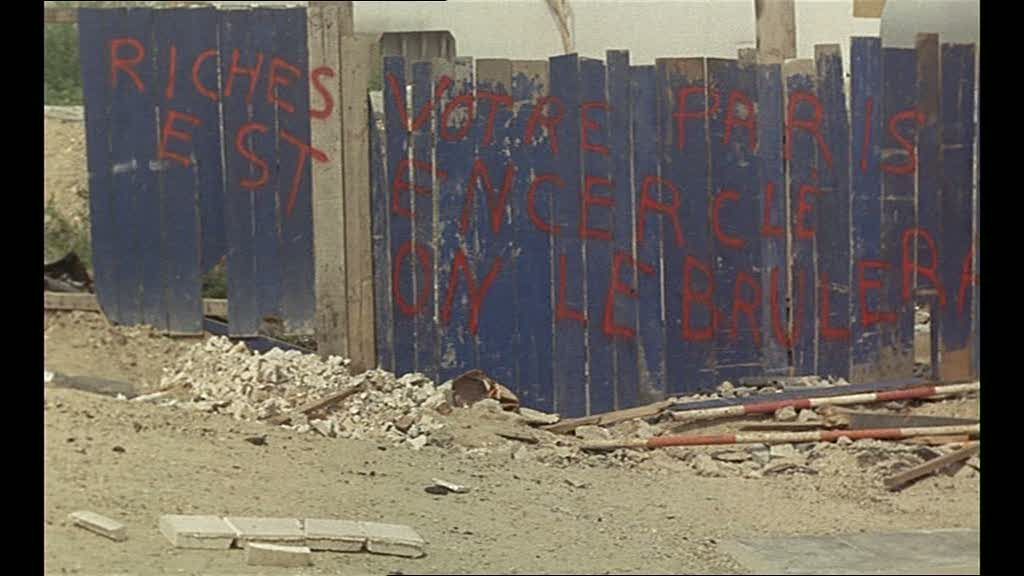
Claude Chabrol's Nada is a wry, blackly comic epilogue to the May 1968 period of leftist student uprisings in France. One imagines it as a kind of sequel to Jean-Luc Godard's May '68 cine-tract La Chinoise: Godard's photogenic, slogan-spouting student revolutionaries a few years older, more cynical and worn-out, their political ambitions increasingly remote. They've watched a few more years worth of American gangster pictures and absorbed their lessons from that, picking up the lingo and the affectations, the machine guns and trenchcoats and secret plotting in smoke-filled rooms. They're in love with this image of themselves as romantic revolutionaries, a secretive sect making dramatic political statements through violence, and so naturally they plot to kidnap the American ambassador to France. Chabrol's wit is at its sharpest here, satirically savaging both the inept revolutionaries — whose plot makes no statement or impact of any kind — and the corrupt, smug, casually violent government officials investigating the kidnapping. The ghost of La Chinoise, and of May '68, lingers throughout the film, especially in Chabrol's sly habit of filling a corner of the frame with various bright red lampshades, the Maoist color of so many of the lampshades in Godard's earlier film, and also the color of the painted slogans on the walls, and also the color of blood when it's spilled in these films. Chabrol is making a parody of a leftist film, mocking these supposed revolutionaries who are simply falling into the trap of those they hate so much.

The film is deadpan and as coolly distant as any of Chabrol's works, but it's nevertheless one of his funniest films, as he cuts back and forth between the terrorists executing their plan and the police and government working behind the scenes to foil them. The letists are led by the anarchist Buenaventura Diaz (Fabio Testi), along with his old friend André Épaulard (Maurice Garrel), who has lost his fervor for leftist politics but nevertheless agrees to lend his expertise to the plot. In fact, the politics of this scheme are dubious to begin with, as the statement that the group issues after the successful kidnapping (a hilarious document that describes the scene of the crime as a brothel "where his Excellency was getting laid") admits that they are temporarily compromising their politics, just this once, in order to get a "nest egg" from the ransom. Even before the kidnapping, one of Diaz's friends, the schoolteacher Treuffais (Michel Duchaussoy), drops out, decrying terrorist methods of revolution. The remainder of the group consists of the perpetually drunken D'Arey (Lou Castel), the sarcastic, self-aware Veronique (Mariangela Melato), and Meyer (Didier Kaminka), who is only thinking about getting some money so he can take his wife on vacation.

It's obvious that the revolutionary zeal of 1968 has died down, though the old ideas and the old methods are still around; the eager young revolutionaries of Godard's late 60s films have aged but not matured. They still scrawl red-paint slogans on the walls, still spout the same jargon about capitalism and "the State," still romanticize and fetishize the idea of violent revolt. But if they are mostly just clueless and naïve, their opponents are vicious and uncompromising. They view this kidnapping as little more than an opportunity to strike a blow at their eternal enemies the leftists, to further suppress dissent and discredit their political adversaries. But first, there is infighting within the government itself, and Chabrol documents this with deadpan humor, as the minister of the interior (André Falcon), who always seems to be half-asleep, is confused by his underling's report of various intrigues and counterspying going on within the government. Indeed, in the immediate aftermath of the kidnapping, the government agencies seem more intent on spying on one another than catching the leftists — when one policeman gives a report, his boss hurries him through the account of the actual investigation, telling him to get to the part where he jailed and interrogated two members of a rival government agency.


Soon enough, though, this intergovernmental squabbling gives way to a concentrated effort to uproot the leftist kidnappers. This effort is led by the detestable Goemond (Michel Aumont), a weaselly henchman who beats up anyone he gets his hands on and doesn't hesitate to use any shady methods. One of the film's most chilling scenes is a conversation between Goemond and his superior in which much goes unsaid. Having found the hideout of the terrorists, they're talking about what happens next, whether the leftists will simply surrender or if they'll try to fight their way through, whether they could be captured alive or if they'll all be killed. They'll probably be killed, is the consensus. And what a shame it would be, they both agree, if the leftists should shoot their hostage, the American ambassador. Why, that would really turn public sentiment against leftist ideas. Nothing is said directly, and both men maintain a crisp, businesslike tone throughout this horrifying exchange, but it's obvious that implicit orders are being given, and just as obvious that they'll be denied later.

Chabrol's point becomes especially clear in the aftermath of the inevitable bloodbath, when the sole survivor of the leftists sits down with a tape recorder and admits that he was wrong, that his methods only fed into exactly what the government wanted, that he was hurting, not helping, his cause. Beneath its satirical surface, the film is a bracing condemnation of political violence, a portrait of the foolishness and uselessness of taking up arms in this haphazard manner, as though kidnapping some poor idiot from a brothel is a profound political statement of any kind.

Sunday, May 3, 2009

The Mouth Agape


Maurice Pialat's The Mouth Agape concerns itself with the body, with flesh and corporeality. It's a film about death and dying and illness, and also about sex, sensuality, pleasure, infidelity, love. Monique (Monique Mélinand) is dying, her body wasting away with cancer; she has only months left to live, and knows it. Her family gathers around her, tending to her and awaiting the inevitable. Her son Philippe (Philippe Léotard) is dutiful and loving, but he has his own life and his own problems, and in any event he can't bear to see his beloved mother suffering for very long. So he darts in and out, coming to see her often but seldom staying long. Her husband Roger (Hubert Deschamps) has had a long and stormy relationship with her, marked by serial infidelities and arguments and separations, and it seems that before her illness they hadn't actually seen very much of one another. But in his gruff, aloof way he cares for her now. Whenever he's not with her, he vocally wishes for it all to be over, saying he can't take it any more, and he retains his philandering ways right up until the end. He's an archetypal French dirty old man, using his clothing store as an excuse to get nubile young girls to strip down for him. His status as a lovable old man, affectionately called "the old goat" by the young girls, allows him to indulge his incorrigible nature, hitting on girls with blatant sexual come-ons that would get a younger man slapped. And he continues to visit his aged mistress (Jeanne Dulac), the woman who he had once wished to marry instead of Monique.

When he's with Monique, however, he is tender and caring, displaying a serene patience that his son utterly lacks. It is obvious that in his own inconstant way, he loves this woman, and is devastated by her departure — and perhaps by his own failures to be better to her when she was healthy. This is a film about the past as much as the present, and the dialogue allows the histories of these characters to unfold slowly, in short vignettes and stories that draw connections backwards from the present to old decisions and problems and mistakes. These people are all wounded and damaged in some way, they have come through strife to the places where they are today. They've hurt each other, too. Philippe, like his father, is congenitally unfaithful, seemingly unable to prevent himself from cheating on his wife Nathalie (Nathalie Baye). He seems to love her, to have real affection for her, and yet as soon as she's away from him he's picking up another woman, just because he can, one supposes.

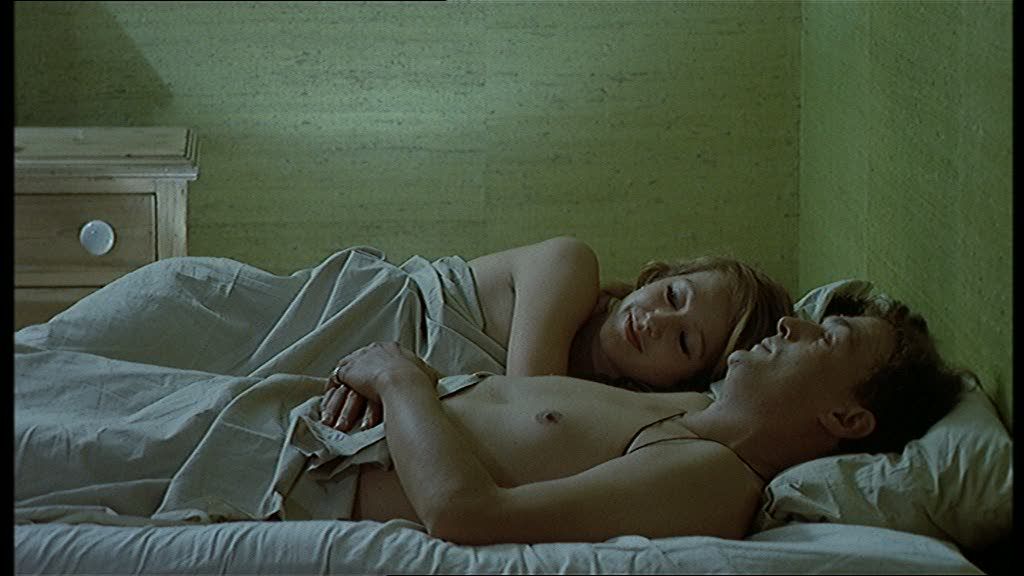
In this film, death and sex are intimately woven together. Pialat alternates scenes in the hospital where Monique is wasting away — confrontations with mortality — with more sexual and sensual scenes. After visiting his mother in the hospital, Philippe returns home to find Nathalie in bed; he joins her and talks about his mother's illness and her impending death while his wife lies next to him, naked, not saying a word, sprawled out with the sheets draped casually across her breasts. She is quietly sensual and sexy, comfortable in her skin, and her presence is an unspoken counterpoint to Philippe's words. Later, a scene at the hospital cuts directly to Philippe passionately making out with a young woman named Corinne (Corinne Derel), stripping off her clothes to reveal an over-ripe body, fleshy and curvy, her buttocks distorted beneath his grasping hands, the imprints of her bra and panties still embedded in her skin. Her flesh, her body, the way her bra constrains and reshapes her proportions, recalls the opening scene in which Monique, stripped to her bra and a skirt, lies down for X-rays, the machine optically overlaying measurements and grid markings across her body. The decaying, dying body of Monique is continually contrasted against the young, supple flesh of the girls Philippe and Roger meet and seduce, and the continuity between these scenes emphasizes that both extremes are endpoints in a cycle, youth and beauty eventually aging into devastation and death.


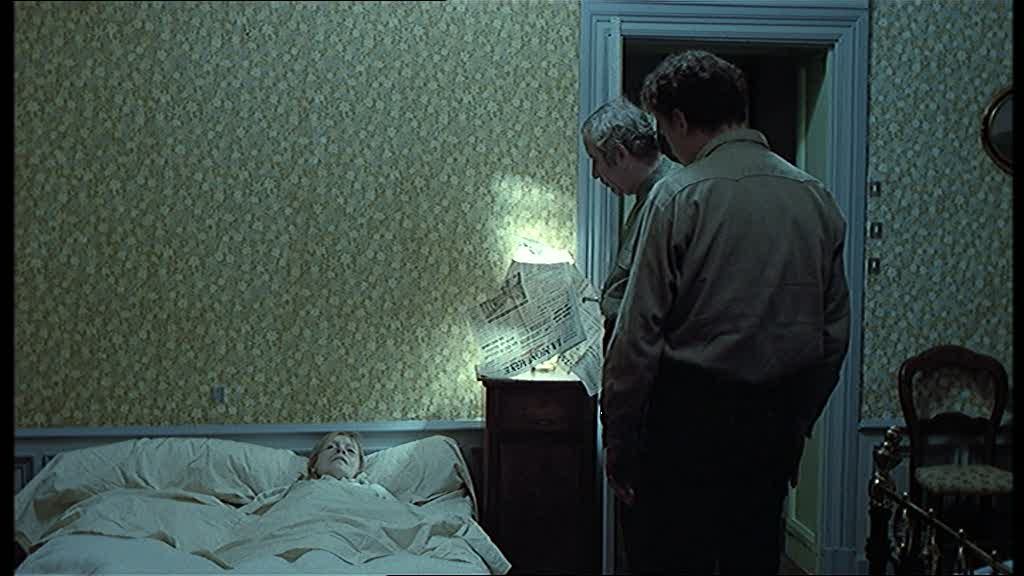
Mélinand gives an extraordinary and stripped-down performance here, speaking less and less as the film goes on, progressing toward a pale, zombified state, wrapped up in her sheets like a mummy, unable to move, her mouth convulsively opening and closing as the harsh gasp of her breath rattles and wheezes on the soundtrack. Pialat increasingly places her at the extreme lower boundaries of the frame, her prone form parallel to the frame and hovering just above its bottom edge, only her head visible above the sheets enfolding her, as though she were a drowning woman just barely managing to keep her head above the water.

The formal purity of Pialat's framings accentuates her increasing isolation, wrapped in a cocoon, her disembodied head gasping for air. A vast stretch of yellow patterned wallpaper fills up the majority of the frame above her. The camera often holds steady for long stretches of time, simply staring with discomfiting directness at the truths of mortality and disease. The camera occasionally quivers, subtly shifting and reframing — the hand of the cameraman weakening, his own human frailty and the limits of his body intruding into the picture — but it never looks away, never flinches from the realities of feeding, injections, the total failure of Monique's body.

This is a harrowing, deeply affecting film, with great patience for allowing the full complexity of these characters to reveal itself over time. Pialat understands that you can love someone, care for them, and still hurt them badly. He knows that the tenderness these characters show for each other in one scene is not necessarily inconsistent with the craven behavior they display in another. He also knows that these complexities, these complicated relationships and the characters' experience of sensuality, are ultimately trumped by the finality of death. In the film's last twenty minutes, the focus subtly shifts back towards Monique, the narrative paring away the various threads surrounding her until the camera is back to staring relentlessly at her wasted body as she gasps her last few breaths. Pialat does not look away, not from the prepping of her body after her death; not from the emotional catharsis of placing her in her coffin; not from the funeral itself, which he creeps up on from around a corner, his camera slowly arcing until the grieving family comes into view. The penultimate shot is a long view from the back of Philippe and Nathalie's car as they leave after the funeral, speeding away from death, even as the camera looks steadily backwards, like Orpheus leaving the underworld, unable to resist looking back on the scene of death once more.

Monday, November 10, 2008

Films I Love #6: Edvard Munch (Peter Watkins, 1974)


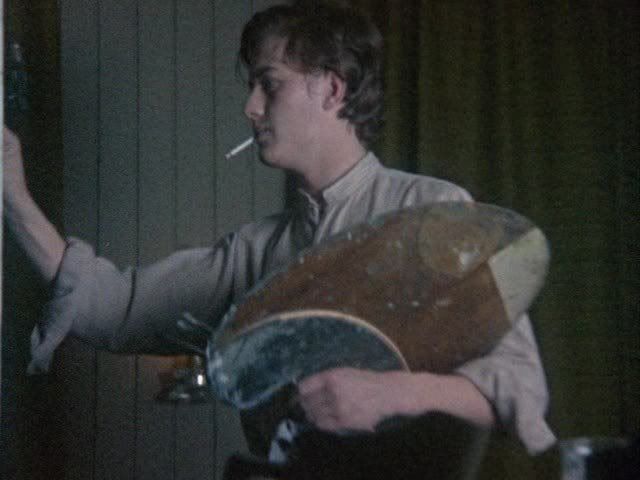
Despite its title, Peter Watkins' Edvard Munch is more than just a biographical film about the painter of the famous Scream. Munch's tortured life story, from his sickly childhood to his adult affair with a married woman, figure prominently in this fragmentary, elliptical masterpiece, but these dramas are far from the film's only subject. For one thing, the film is one of the best chronicles of the art of painting that has ever been committed to celluloid. Has there ever been a film that engages more thoroughly or more analytically with the physicality and texture of paint on canvas? Watkins lovingly pans across the surfaces of Munch's paintings, lingering on the scratched-out areas and dense layers of overpainting that indicate Munch's obsessive, often violent process of creation. This recursive creativity, with Munch revisiting the same canvases over the course of many months and compulsively worrying at their details, is mirrored in the film's aesthetics. The chronology is frequently disrupted by scenes that recur over and over again, primal scenes from Munch's youth or the short-lived affair that haunted his entire life. As the film goes on, its linear narrative is increasingly complicated by such diversions and the continual looping back that gives equal emphasis to all times at once.

Watkins injects further variety into the narrative through the use of faux-documentary techniques, as a narrator provides commentary on Munch's life, surroundings, and painting process. Most importantly for a political filmmaker like Watkins, the film also makes every effort to position Munch in the broader context of the social and political upheavals of his time. One of Watkins' theses is that Munch was an artist tragically ahead of his time, reflecting a more unfettered, emotionally honest, and deeply personal artistic expression, as though he belonged to a much freer era than the one he was born into. As such, the film frequently diverts from Munch's story in order to document problems of social class, women's rights, and sexual oppression and repression. The film is a revolutionary form of biography that resolutely refuses to limit itself to a simple chronological accounting of events. Not only does Watkins shatter chronology in order to communicate emotional truths rather than dry objective facts, but the film expands beyond the immediate details of Munch's life to explore his social context and the ways in which creativity is shaped by political realities.


Monday, July 28, 2008

Phase IV


Phase IV, the only directorial feature from famed credits designer Saul Bass, is a highly unusual science fiction film in which the extraordinary menace (a colony of highly evolved ants) figures much more prominently than the human characters fighting against them. Indeed, the film begins at ground level and it is nearly ten minutes before a human character even appears onscreen. Even then, Bass slowly, even hesitantly introduces humanity into the picture, starting with a shot of a jeep ponderously moving through a barren landscape, then shooting the two men who get out of the vehicle from a low angle, filtered through blades of grass, as though the ants were looking up at them. Before this, the film opens with a near-abstract montage that veers from the reaches of deep space, where puzzling motions in the planets and stars signal unknown changes, into the depths of the earth, where ants crawl and skitter around on mysterious errands. Right from the start, Bass gets intimate with these inscrutable creatures, granting them closeups and even personalities. They communicate with each other, though we cannot know what they say, and their every action is infused with purpose. Bass' camera traces their paths and their actions as though he were following a conventional narrative, perhaps a more traditional horror story in which the camera tracks the monster as he stalks and kills. These ants are also killers, they are the film's "monster" by default, but unlike the gigantic irradiated ants of the 50s sci-fi classic Them!, the menace of these ants is subtle, subterranean, and driven by intelligence rather than rampaging brute force.

This makes Phase IV a very tricky brand of sci-fi horror, one perfectly suited to Bass' unique sensibility. The film builds it horror not through special effects or violence, but through the subtle development of atmosphere, and Bass has infused every second of the film with an escalating sense of dread. A large portion of this must be credited to the sound design, which contrasts the dry, crackling sounds of the ants — mandibles crunching, antennae and legs scraping against various surfaces — against the eerie, atonal electronic soundtrack. The opening scenes establish this sound palette almost immediately, as Bass dives into the subterranean world of the ants, allowing their noises to dominate the soundtrack even as their calcified bodies fill the screen. There's something inherently terrifying about seeing tiny, unknown worlds magnified in this way. It's an effect David Lynch used to good purpose in the famous opening of Blue Velvet, and here as there it suggests the creepy, crawly evil lurking underneath ordinary reality. Nature is frightening whenever one stops to think about it, and Bass' unflinching intimacy with these insects invites one to contemplate the horror of the natural world at length.

It must be said, the film is much less interesting whenever it abandons the ants for any length of time to focus on more human-scale dramas. Bass' instinct for design and interesting visuals is perfectly suited to abstract montage and dialogue-less documentation of ants at work, but his talents apparently do not extend to working with actors or filming human drama. It doesn't help that in this respect, the script he's working with is entirely generic and perfunctory. The film's central plot concerns a duo of scientists, the supremely rational Hubbs (Nigel Davenport) and the humanist Lesko (Michael Murphy), who are studying the ants and who soon become involved in a war against the colony. They quickly pick up the orphaned innocent Kendra (Lynne Frederick), after accidentally killing her grandparents with poison meant for the ants — an incident that both Kendra and the film shrug off with an alarming lack of emotion or concern. To some extent, Bass uses the limitations of the film's human interest to his own advantage. He films the scientists with a cold, clinical eye that connects them with the ants, as just a few more specimens in his cinematic jar. Even as they observe the ants, the ants are observing and toying with them, and Bass observes both sets of antagonists with the same objective gaze, his camera panning in the same precise, steady tracking shots whether he's in subterranean tunnels or the shiny metal insides of the scientists' outpost.

The result is a film that sides most closely with the coolly anti-humanist Hubbs, who reacts to the deaths of Kendra's grandparents with near-complete indifference, reserving his emotion for the excitement he feels when studying the ants' behavior. The film's most disconcerting aspect is its profound equivalence of human and animal life; the deaths of ants, crushed under rocks or eaten by other insects or poisoned by the scientists, are felt even more strongly than the film's human deaths. Bass privileges the point of view of the ants, suggesting that human dominance and pre-eminence is merely a matter of perspective. From another point of view, humanity is just one more organic presence on a planet thriving with many varieties of life. In one scene, as a thick liquid poison is sprayed over the ants outside, Bass cuts back and forth between shots of the ants dying, writhing in the yellow liquid, and the humans who are also trapped in this deadly downpour, struggling through the thick sheets of yellow rain. The intent is obvious: humans and ants dying together from the same cause, their struggles so similar in the face of death, very different forms of life unified in the end.


This cold, distanced perspective is enhanced by Bass' rigid and geometric visual aesthetic. There is no credits sequence at the opening of Phase IV, no sign of the playful assemblages of form and color that Bass invariably deployed in his inventive credits designs for numerous Hollywood productions. Instead, his fascination with geometry and color have been translated into the film itself, channeled into the design of the sets and the camerawork he employs. Geometric forms play a crucial role in the film, from the circular scientific station with pipes radiating out from its sides at regular intervals, to the strange towers the ants build, to the rectangular designs the ants carve into a corn field. "Mathematics is a universal language," Lesko says at one point, as he attempts to communicate with the ants' hive mind intelligence. Clearly, Bass agrees, and his mise en scène is all hard lines and rigidly defined shapes. The research station's outer walls are constructed from a series of end-on-end triangles, forming diamonds, and the ants amass a corresponding array of reflective diamonds that they build up around the outpost, reflecting light inward to overheat their human enemies. In another fascinating sequence, Bass films the inside of an air conditioning unit as an ant and a praying mantis stage a battle amidst the coils and grids of the machinery.

It's in sequences like this that Bass' genius is most apparent. His eye for geometric forms sometimes falls upon an image of startling emotional impact — like the eerily quiet ant graveyard where a single black ant skitters between neatly arranged rows of the dead — but only in relation to the ants. His aesthetic here might almost be described as anti-human in its rigidity and asceticism. The point of view of the ants is privileged. They are never quite anthropomorphized, but given an emotional depth and complexity that's almost entirely absent from the human characters. The ants are mysterious, unreadable, and their black-eyed gaze in Bass' closeups seems to communicate something strange and frightening as they catch the camera's stare head-on. Ironically, Bass gets no such fascinating performances from his human actors, who are more like robots mechanically fulfilling tasks. Frederick's performance is a hilariously awful amateur turn, her wide eyes and cracking voice a parody of innocence, and she can't even keep from slipping back and forth between American and British accents; she's cute though. Davenport and Murphy make out a bit better, if only because their roles don't demand much more from them than scientific precision and a poorly defined contrast between their characters. Even there, the supposedly caring and humanistic Lesko doesn't come across as much less of a robot than rationalist Hubbs. Their opposition is sketched in the broadest of strokes, and Bass' interest obviously lies elsewhere, with the film's non-human characters.

Even saddled with a somewhat plodding narrative and cardboard-thin characters, Phase IV winds up being a fascinating sci-fi experiment, thanks almost entirely to Bass' visual ingenuity and the decision to make the ants the film's real focus. The ants' struggles are dramatized and intensified even as the human drama is stripped down and dulled. In one wonderful sequence, the ants conduct a chain of self-sacrifice, dragging a piece of poison back to their lair, a new ant joining the line as each one keels over and dies in turn. This remarkable feat is aimed at immunizing the colony's queen, allowing her to produce new offspring who are resistant to the poison — the science is certainly shaky, to say the least, but the scene is no less eye-catching for the way it dramatizes the emotions and spirit of these expressionless creatures. As he did with the earlier scene of the poison rain, Bass cuts back and forth between the ants' subterranean struggles and the efforts of the scientists inside to decode the ants' language. The parallel cutting creates a contrast between the small-scale adventure narrative going on underground, and the rather dull, abstracted analysis of the scientists, who spend their time mostly staring at computer readouts. It's an interesting and even wryly funny scene, mocking the boredom created by the script's more prosaic elements even as Bass' inventive approach to this material elevates the film far above its B-movie sci-fi origins.