Showing posts with label 1977. Show all posts

Friday, October 5, 2012

The Man Who Loved Women


François Truffaut's The Man Who Loved Women is a retrospective look at the life and many affairs of an unrepetant womanizer, a man who can't resist chasing after one woman after another, never settling for any one woman for very long. But Truffaut's film, unfortunately, is nearly as shallow as its protagonist, Bertrand Morane (Charles Denner), who flits around after all these women, waxing poetic about their charms, the beauty of their bodies, and making his pursuit of them seem like an art, an expression of his philosophy about the world. Bertrand pours that philosophy out into the pages of the book he's writing, and it's around that book that Truffaut structures the film, relating anecdotes from Bertrand's past through the stories he writes in his lightly fictionalized novel.

This is, despite its potentially lurid subject matter, a curiously flat and dry affair, simply relating one interchangeable affair after another, as Bertrand serially seduces women he meets at random and women who he goes through elaborate machinations to encounter. As a comedy, it's not especially humorous, and as a character portrait it skates along the surface except for a few moments when the script (by Truffaut, Michel Fermaud and Suzanne Schiffman) delves into Bertrand's psychology only to come up with some trite rationalizations for his behavior. It's hard to know what's more disappointing, the fact that the film spends most of its time observing this man's surface presentation of himself, or the fact that when it does dig deeper, it comes up with only clichéd mommy issues and a failed romance that seemingly set him upon his current path.

Truffaut spends much of the film on the surface of Bertrand's life, but these glimpses into his formative experiences suggest a very simplistic psychology at the core of the film. Bertrand is copying the behaviors of his mother (Marie-Jeanne Montfajon), who was a promiscuous lover who didn't want a child to change her life, so she simply ignored her son as much as she possibly could. So Bertrand's desire to "collect" women is both an imitation of his mother and a kneejerk response to her neglect, causing him to be desperate for women's affection and attention. Or else Bertrand was deeply wounded by Véra (Leslie Caron), who appears late in the film, when it had seemed like Bertrand was incapable of a truly substantial relationship with a woman, to describe a time when he did have what could have been a real, significant love if he hadn't screwed it up. Both of these possibilities are floated as possible psychological explanations for Bertrand's attitude towards women, which reduces this character to little more than a collection of well-worn clichés.
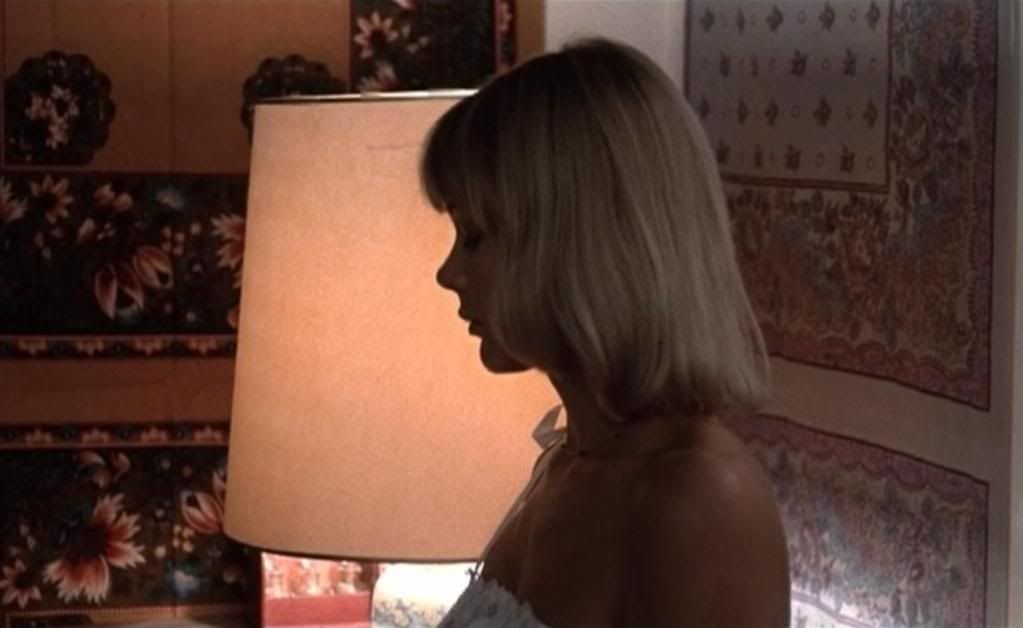

At one point, Truffaut seems to anticipate the potential criticisms of his film and tries to duck around them with a scene where Bertrand sends his manuscript to some publishers. At a meeting regarding the manuscript at one of these publishing houses, none of the readers like the book except for Geneviève (Brigitte Fossey), who defends Bertrand's book against the criticisms of the others. Most of the critics' complaints about the book could just as easily apply to Truffaut's film — that its protagonist is too self-aggrandizing, that the psychology of it is uninteresting — but Geneviève deftly overturns their objections, thus defending the film as well, making these seem like both a preemptive defense and a self-congratulatory assertion of the film's success. She claims that Bertrand's story is simply full of "the contradictions of life," that the writer is actually self-aware about his own womanizing, which he is to some extent, but the implication that Truffaut's film is so dramatically unsatisfying because it's about reality is hard to take. This isn't reality but a flat, overly literary bundle of character types and shallow characterization.

There are, nevertheless, some nice moments here, scenes and performances that hint at a potentially more satisfying movie that Truffaut could have made. Denner's performance as the titular womanizer is mostly fine, projecting some of the charm and elegance that make this otherwise unremarkable-looking man so irresistible to so many women. But it's the women who really shine, and it's to Truffaut's credit that he populates the film with so many lively, winning performances from women, so that Bertrand's conquests become as much a tribute to the loveliness and appeal of all these actresses as they are a more general poem to the lure of women. Especially compelling is Nathalie Baye as a woman who Bertrand goes to great lengths to meet, only to find out that she's not the woman he thought she was. Baye's appearance, towards the beginning of the film, provides a tantalizing glimpse of a path not taken for Bertrand. Once he finds out that she's not actually the woman he'd glimpsed on the street one day and tracked down so relentlessly, he leaves, but Baye's shy smiles and straightforward manner make her a compelling presence, lingering past Bertrand's loss of interest, implicitly condemning his shallow fixations.

Many of the film's other women are equally compelling — Nelly Borgeaud as an unhappy housewife who gets off on danger, Valérie Bonnier as a girlfriend who eventually decides she needs more from a relationship than the cool Bertrand can offer — but by necessity none of these characters stick around very long or are developed beyond a few scenes. Truffaut's film ultimately just provides a mirror for Bertrand's life: shallow, self-absorbed, displaying a stereotypical masculinity and flitting from one moment to the next without ever spending too long with any one person or thinking too hard about the meaning of it all.

Monday, April 30, 2012

Providence


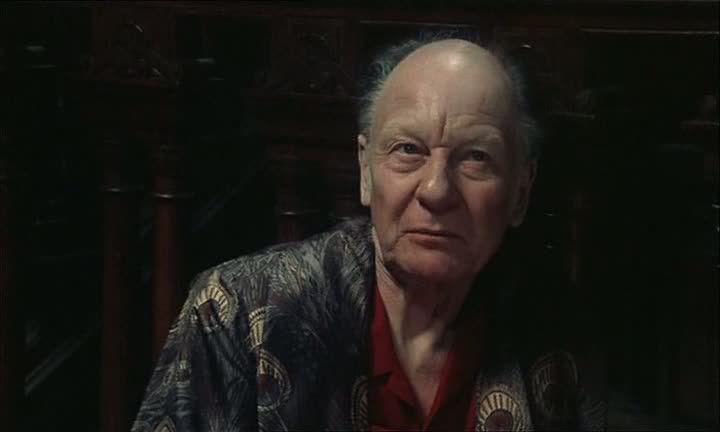
Editing is the key to the cinema of Alain Resnais, the crux of his work. Through the cut, the filmmaker controls the flow of space and time, controlling what's seen and not seen, where a scene starts and where it ends, and few other directors have made this truism so explicit in their art. For Resnais, this process has often been a cinematic analogue for the workings of memory, for the self-editing capacity of the human mind. This is especially apparent in Providence, his first English-language film, in which the dying writer Clive Langham (John Gielgud), suffering in agony from the cancer tearing him apart, constructs an elaborate and surrealistic narrative involving his relatives. Clive is reconstructing his past, casting his son Claude (Dirk Bogarde), his bastard son Kevin (David Warner), and Claude's wife Sonia (Ellen Burstyn) in a strange drama of adultery and psychological abuse, imagining them suffering emotionally as he's suffering physically, imagining them as cruel and petty and vile.

And it's editing that allows him to do this. The film's opening is a disorienting flow of seemingly disconnected scenes and images, gradually taking shape as Clive's voiceover intrudes, commenting on the action, shaping it into the form that he wants to. There's an obvious connection between Clive's narrative direction and the role of the filmmaker. Clive begins speaking over the images, banishing certain images and characters from view, expressing his appreciation for other moments, waffling over what he wants to see next. He frequently loses control of the narrative — Kevin enters a room instead of Claude, a door is sometimes located down a long stairway and sometimes on level ground, a soccer player described as Kevin's brother sometimes jogs into the scene without warning or purpose — and has to start again, to shift the scene, his words demanding a cut, a change of scene, a restructuring of the images. He sometimes speaks from off camera, giving directions to the "actors" in this narrative, suggesting lines that they then repeat; in one hilariously disjunctive moment, Sonia opens her mouth to speak and it's Clive's dubbed voice that comes out, a reminder that the characters in a film are simply giving voice to ideas and words decided upon by a screenwriter (British playwright David Mercer in this case) and a director (Resnais).

Indeed, at some points Clive, through his imagined characters, sometimes seems to be directly parroting the voice of Mercer and/or Resnais. In one of the most telling moments, Clive says, monologuing over a love scene between Claude and his mistress Helen (Elaine Stritch), "It's been said about my work that the search for style has often resulted in a lack of feeling... However, I'd put it another way, I'd say that style is feeling, in its most elegant and economical expression." That's a pretty apt summary of Resnais' work, which is far more emotional than it's often given credit for, the emotion arising from the rigorous application of formal structures. The style of this film is ravishing, too, with an understated elegance that sometimes gives way to bursts of surreal but subtle stylization. In particular, there's a certain veranda where the characters sometimes meet and talk, the background changing from one patently artificial matte painting to another depending on the mood and context of their talk: a gorgeous, perpetually sunny seaside with painted waves for evocations of childhood pastoral perfection, and a gloomy, cloudy backdrop of grim little houses stretching off into the distance when childhood memories are far from the mind.


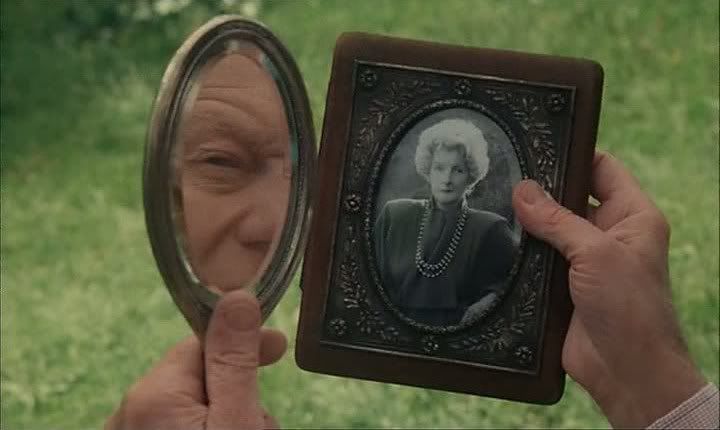
It gradually becomes clear over the course of the film that Clive's impressions of his family are not to be taken at face value. His narrative at times seems to tear apart as the characters stop playing their parts, instead voicing complaints and recriminations addressed, not at each other, but at Clive; it's as though the author's creations are refusing to play their parts, turning on their creator to express the bitter, unhappy feelings haunting this bitter dying man. He seems to be projecting his own failings and his own guilt onto his relatives, creating a narrative that contains, coded within it, the real anguish he feels over his cruelty towards his wife and son, his guilt about his wife's suicide, his regrets about the philandering he did while she was still alive. His wife appears several times, trapped in a concentration camp guarded by soldiers who are rounding up civilians and killing them, and his wife is also echoed in Sonia and Helen, both of them physically similar to the woman Clive loved, both of them suggesting the Freudian resonance between wives and mothers, lovers and mothers.

That imagery of war, terrorism, and concentration camps haunts the film, appearing as psychic tears in the story Clive is constructing, a war felt in the gunfire and explosions that pop and crack in the background of the soundtrack, only occasionally commented on by the characters, who mostly seem to have internalized and grown accustomed to this constant state of violence and breakdown. It's a potent metaphor for the way in which a lifetime of cruelty towards others gradually begins to seem like background noise, the scars healed over, the emotions flatlined to a constant dull throb of misery. Clive is a man trapped by his past and his own miserable persona, so that even his deathbed fantasy is dripping with spite for the people in his life. The film's final twenty minutes, which represent an abrupt shift in tone, suggest that Clive's entire narrative is populated with twisted versions of his family who represent only reflections and projections of himself, nothing like the mostly happy, well-adjusted people who appear at the end of the movie, representing perhaps the reality of Clive's family or maybe only his more optimistic vision of them, with his bile replaced by genuine, if still rather cranky, love.

This is yet another complex, provocative masterpiece from Resnais, another in the long and pretty much unbroken chain of deliberately constructed, fascinating experiments that he'd been making since the start of his feature film career. The film's structure provides both a clever metaphor for the workings of the cinema and a stunning examination of death and memory: "feeling, in its most elegant and economical expression," an enthralling film in which its style and its formal framework lead the way to its potent insights about the mind and the creative process.

Monday, August 8, 2011

Close Encounters of the Third Kind


Steven Spielberg's Close Encounters of the Third Kind perfectly captures the fear and the fascination that the unknown holds for humanity. The film focuses on the utility worker Roy Neary (Richard Dreyfuss), who's sent out into a remote country area to investigate a rash of mysterious power outages and instead comes into close contact with inexplicable sights that seemingly could only be alien ships. From that point on, Roy becomes obsessed with what he saw and felt, obsessed with getting answers, some explanation for his bizarre experience. The film is about the possibility of alien life coming to Earth, but more than that it's about the larger search for meaning, for understanding, the desire to make some sense of life, the universe and everything.

Spielberg is well-suited to capturing the mingled wonder, fear and confusion that characterize the film's complex mix of emotions and tones. Although Spielberg opens with a scene in which the French scientist Lacombe (Francois Truffaut) tracks the signs of the aliens' arrival on Earth, and returns to Lacombe at intervals throughout the film, the real substance of this movie is the effect of such unusual events on ordinary people. When Roy first encounters the alien ships, he's driving along on a deserted, pitch-black country road, lost and struggling with maps to try to find out where he is. Behind him, a set of lights pulls up in the window behind his head, and he gestures for them to pass by; they do, as a car impatiently goes around his truck. The next time some lights pull up behind him, Roy similarly waves them on and returns to his maps, so that only the audience sees that the lights go up, revealing a distinctly un-car-like shape hovering behind Roy. Spielberg's visual playfulness makes moments like this even more potent: witty, awe-inspiring, surreal and yet also somehow ordinary, the extraordinary seeping into the prosaic without warning, upturning all expectations and altering even one's basic presumptions about the way things work.

Roy's experience is indirect — mailboxes vibrate, all the metal in his truck is pulled momentarily up into the air by an electromagnetic force, and a bright light shines down on him, burning his face as he cranes his neck out of the truck's window to bask in its blistering beauty — but he'll soon see even more startling sights. Spielberg's presentation of the alien spacecraft is just as casually awesome, showing these hovering ships surrounded by halos of light, speeding down highways in convoys, turning whimsical circles in the air, trailed by a small ball of red light that seems to be scurrying to keep up with the larger ships. The imagery is spectacular but also grounded, suggesting that there's some kind of order and purpose to the ships' configurations and actions, even if it's a purpose that's obscure to those who witness these events.


Roy, along with fellow witness Jillian (Melinda Dillon), begins to get visions of a mountain that seems to have some importance to the aliens, but his family, especially his wife Ronnie (Teri Garr), is unsympathetic to his increasing obsession. Roy loses his job and begins spending his nights with fellow obsessives and curiosity-seekers, hoping to see something again, to get some confirmation that he wasn't just crazy. Nevertheless, there's more than a little humor in Spielberg's portrayal of Roy, who totally loses touch with ordinary day-to-day life in the aftermath of his "close encounter." At one point, Roy, finally having a clear vision of the mountain image he's been trying to capture, begins gathering plants and dirt and bricks from his yard, throwing them through the window into his house, as his distraught wife tries to stop him. He's oblivious, so caught up in his own excitement that he can't understand why no one else shares his thirst for answers. Later, after he's constructed a massive sculpture of the mountain in his living room, he looks out the window, his face covered in clay and grime, the mountain towering over his shoulder, and looks around at the beautiful sunny day outside. His wife and kids are gone, and his neighbors are playing and enjoying the day, puttering around in their gardens and playing with their children, and the contrast between inside the house and outside emphasizes the total disconnection that Roy feels. He's seen something he doesn't understand, and now he only wants, or needs, to know more, to make sense of it all.

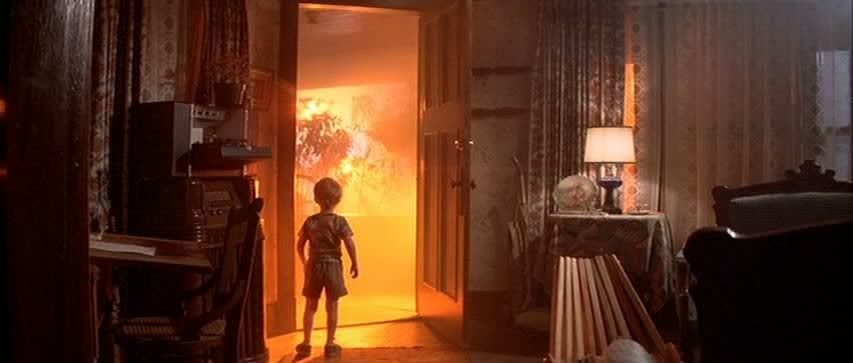
At other times, Spielberg plays this confrontation between humanity and the aliens as a horror movie, as when the ships surround Jillian's house. She struggles to close everything off, to keep the aliens out, and Spielberg shoots the sequence as horror, emphasizing Jillian's fear, even while her son Barry is as excited and curious as Roy is. The boy opens the front door as his mother desperately struggles to close off the house, and outside the open field around their home has been transformed into a glowing orange landscape, alien and strange, infused with the light of the ships hovering above. In another shot, Spielberg shoots down a chimney as Jillian fumbles around inside, trying to close the flue; the point-of-view shot suggests that an alien is scurrying down the chimney towards her as her hand blindly flails about for the lever. Perhaps the most chilling image, though, is the shot of screws turning themselves, rising out of a floor grating and falling out to loosen the grate.

The film does such a good job of evoking complicated, contradictory emotions about the aliens that the ending, in which Spielberg finally reveals the aliens as a benevolent presence (one even smiles at Lacombe), can only be a disappointment. The film is about the unknown, about mystery and awe and the struggle to understand, and the final confrontation between the humans and the aliens preserves this sense of wonder and uncertainty right up until the moment when the aliens are revealed as the typical large-headed humanoid creatures that we've so often imagined them to be in popular representations. When the humans try to communicate with the aliens by using a musical language — not fully understanding what's being said except that some kind of back-and-forth communication is happening — that's beautiful and mysterious. The aliens, in their rubber costumes, obviously fake even when they're shot through a haze of light obviously intended to maintain some distance and mystery, are a bit of a letdown in comparison to the unsettling, wondrous effects that came before. Still, Close Encounters of the Third Kind is a powerful, deeply affecting film that shares its protagonist's sense of gape-mouthed fascination with the prospect of life beyond Earth.

Thursday, February 3, 2011

3 Women


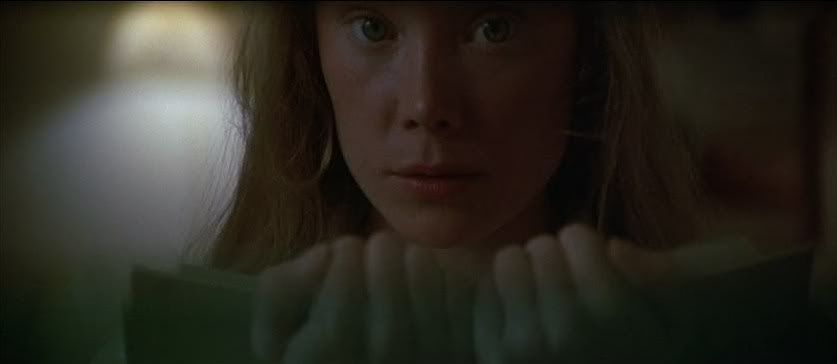
Robert Altman's 3 Women is a bizarre, unsettling, darkly funny and mysterious film. It is virtually indescribable, proceeding according to its own skewed, dream-like logic, presenting the frequently absurd dialogue and characters with an utterly straight face, balancing carefully between portentous, densely symbolic drama and loony black comedy. The film centers on the relationship between two women, both named Mildred: the relentlessly chatty Millie (Shelley Duvall) and the shy, awkward young Pinky (Sissy Spacek). The two women meet at a job, working at a spa caring for elderly patients, and the girl-like Pinky, who seems more like a child than an independent young woman, instantly idolizes Millie and latches onto her. The two women soon become roommates, despite Millie's offhanded nastiness towards the other girl, and Pinky's attachment to her new friend only becomes more intense and creepier. The third women of the title is Willie (Janice Rule), a slightly older woman who runs a local bar where Pinky and Millie sometimes hang out. The pregnant Willie says little throughout the film, though her disturbing paintings of monstrous, Egyptian-influenced figures locked in combat show up everywhere. Together, the three women represent three generations of womanhood, with Willie as the grandmother, Millie as the mother, and Pinky as the child. This linkage between the women only becomes clear during the film's coda, but before that point it's obvious at least that Pinky is like a free-spirited child, excited by everything, always asking innocent questions, playfully blowing bubbles in her drinks.

The film is a strange character study of these three women who, in different ways, are dissatisfied with their lives. Millie is a chipper, cheery woman who presents herself as a popular girl with an endless string of boyfriends and suitors, but in fact she's strange and lonely, unable to connect with anyone. Her stories about herself don't match up with reality at all: it's clear that no one wants to be around her, and rarely does anyone even acknowledge her constant stream of non-sequitur anecdotes and self-promotion. Her outgoing persona is a mask, disguising her inner loneliness and desperation, and she has a whole vital fantasy life about how all these guys want her, how she has countless men wrapped around her fingers when in fact she can barely get anyone to acknowledge her existence. Although Pinky outwardly seems very different, she is similarly lonely and strange, similarly disconnected from everyone around her. At work, everyone ignores her as thoroughly as they do Millie, and she seems immature, arrested in her development, like a child sent out on her own before she was really ready.

The relationship between the roommates reverses, however, following a confrontation over Willie's washed-up former stuntman husband Edgar (Robert Fortier), who's clinging pathetically to his TV cowboy persona. Millie comes home with him one night, and when she yells at Pinky for judging her desperate promiscuity, Pinky throws herself off the balcony into the pool below, a pool decorated with Willie's sinister paintings, seeming to writhe with the waves and ripples in the water. When Pinky emerges from a coma some time later, she's assumed Millie's personality, writing in Millie's diary, hanging out with the guys at the apartment complex who Millie had always wanted, even coming on to Edgar. She begins to seem like a more successful and well-liked version of Millie, garnering the attention that Millie had always wanted so badly herself. Faced with this change, Millie begins shrinking into herself, losing her flirtatious demeanor, becoming more like the indrawn girl that Pinky had previously been.


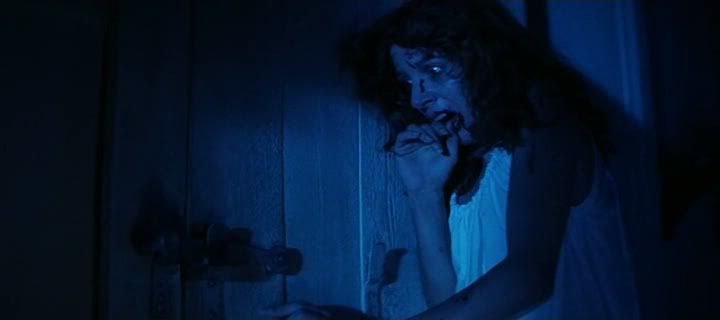
Altman presents this drama of psychological transference and doubling with a detached, unsettling directness that enhances the strangeness of the story and the characters themselves. The film is a complex web of symbols, from Willie's paintings with their exaggerated sex organs and violent poses to the constant use of water to overlay the characters. At various times, there seems to be a filter of water wavering across the frame, turning the women's faces blue, its waves flickering up and down to cover the screen and then recede. Sometimes these shots might be motivated by the presence of a fish tank, but more often the water appears without any obvious motivation, as though there were waves constantly churning in the characters' heads, foreshadowing Pinky's watery plunge and subsequent mental realignment.

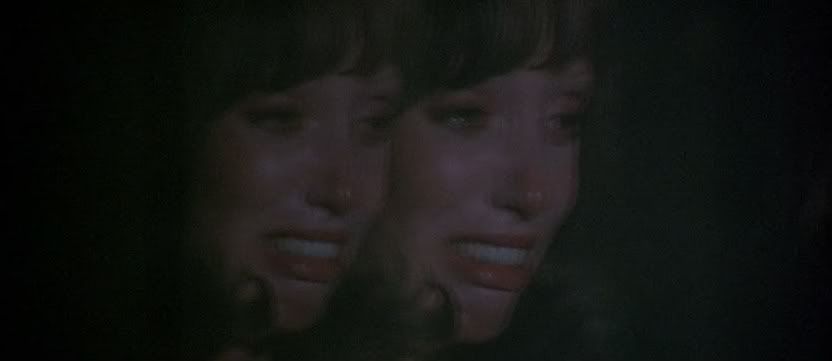
Doubles are also important here. Millie and Pinky work with a pair of twins (Leslie and Patricia Ann Hudson) who don't talk to anyone but each other, who are locked into their own private world, maintaining an abstracted distance from everyone around them. Pinky wonders aloud what it would be like to be twins like that, and raises the possibility that maybe they switch places every day, deciding which twin they'd like to be that day. Pinky obviously wishes for that kind of fluidity of identity, the ability to become someone else, to trade places with Millie, who she worships so deeply. The film's second junction point, after Pinky's near-drowning, is preceded by a lengthy dream sequence in which Pinky dreams of superimpositions and doubles, seeing Millie's face doubled as it had been in the mirrored surface of Pinky's hospital room, seeing Willie doubled in her grief over Edgar's cheating, seeing the face of a plastic witch from Willie's bar superimposed over the face of Pinky's mother, who Pinky insists isn't really her mother. When she wakes up from this dream, she seems newly vulnerable, more like her old self, and this prepares her for her final transformation, when, in the film's mysterious coda, she seems to have formed a makeshift new family with Millie and Willie, taking on the role of obedient but sullen daughter.

Implicit in this ending is a commentary on gender roles and expectations, on the place of women. By the end of the film, the three women are inhabiting an older ideal of the family unit, but notably without any men in the equation. With their quirks and their idiosyncrasies, these women never quite fit in anywhere, so they have to create their own space, their own family to replace the absences that are otherwise in their lives. Millie didn't know her parents, who didn't want her and abandoned her to various foster families. Pinky rejects her parents, who are surprisingly old considering their daughter's youth, and who seem utterly disconnected from the world, reacting even to the news of their daughter's coma with a curious abstraction and lack of emotion. And Willie's only family is Edgar, a philandering drunk who cheats on his pregnant wife and pathetically lives in his past, when he at least flirted with fame and success by appearing as a stuntman on TV. Clearly the families these women have are inadequate, and by the end of the film the women only have, and only need, one another.

All of which implies that 3 Women is a very heavy movie, but in fact it both is and isn't. The heavy symbolism and dour mood is constantly being subverted by the goofy, absurdist, intentionally banal dialogue, which everyone delivers with a deadpan nonchalance that only winds up making it more disarmingly comical. There's something purposefully off about the film's tone which enhances the sense of wrongness and disconnection in these people's lives. Millie in particular is a source of loony comedy, as she's constantly babbling about hula dancing, "hot dates," and her low-budget recipes for tuna casserole, pigs-in-a-blanket and cheese on crackers. There's something helplessly funny about her, and about Duvall's earnest performance, like the way she very sincerely explains the difference between English mustard and French mustard as colors, or the stunned expression on her face as she watches the childlike Pinky gulp down a whole glass of beer after pouring salt into it and blowing away the top of the foam. The film seems especially disconnected from reality during the visit from Pinky's supposed parents (John Cromwell and Ruth Nelson), who bring along a prayer placard — "for the kitchen," the mother helpfully explains, in a line that is unaccountably funny in context — and who seem generally unattached to the same reality as the other characters. But then all of these characters seem to be inhabiting their own individual realities, separated from normal society and fully invested in the odd alternate world of Altman's film.

Wednesday, February 2, 2011

Suspiria


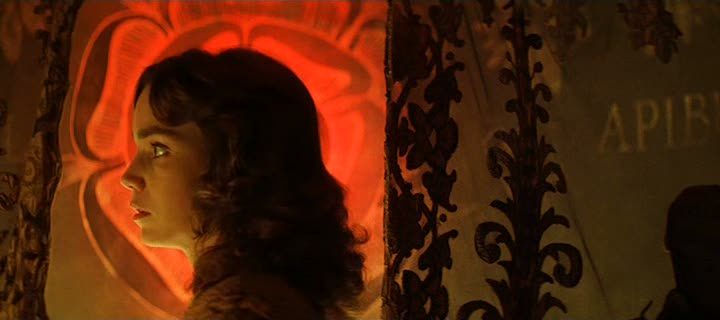
Dario Argento's Suspiria is a horror film based almost entirely around mood and the slow escalation of tension through music and garish color schemes. The film's concrete horrors — a sequence of murders and creepy occurrences at a German ballet school — don't arouse nearly as much terror or suspense as Argento's habit of filming nearly every scene as though something indescribably awful were lurking just out of sight. The film's design is lavish and ornate, and rather than finding terror in shadows and dark tones, Argento bathes these scenes in bright, saturated colors. The ballet school where American student Suzy (Jessica Harper) goes to study is a high Gothic palace with hallways decorated in bright red, its wild architecture topped only by the geometric lunacy of the apartment building where doomed ballet student Pat (Eva Axén) flees to in the opening scenes of the film.

The film's opening in general is a masterpiece of slow-building horror. Suzy arrives at an airport, and as she walks towards the doors leading outside, Argento immediately begins building up the suspense, well before there's anything to get the least bit scared about. Suzy seems hesitant and timid, somewhat rattled already; Harper makes good use, throughout the film, of her big brown eyes, which are often widened in anxiety, shifting back and forth, her pupils small and skittish, seeming lost in the broad whites surrounding them. Argento alternates closeups on Suzy's fragile face with shots of the airport doors. The closeups are silent, but the door shots are accompanied by the sinister but gorgeous chiming tones of the score, by Italian prog rock band Goblin, whose eerie chanting and chugging rock set the tone of the film. When Suzy leaves the airport, into a dark, rainy, windy night, the doors slide shut behind her with an air of finality that suggests a break with normalcy, the terror to come foreshadowed by the gloomy, stormy night that engulfs her. Her cab ride to the ballet school, with Goblin's pulsing main theme returning on the soundtrack, is equally chilling. It's only in the subsequent scenes, following Pat as she flees from the school just as Suzy arrives, that these premonitions of terror turn out to be warranted. Pat escapes the school and shows up at a friend's apartment, the very design of which, with its colorful patterns and high, vaulted ceilings, establishes that something strange is going to happen here.


Argento is excellent at using lighting and design to create the film's unsettling tone. He frequently focuses on closeups of the film's women — Pat during the opening, Suzy and her new friend Sara (Stefania Casini) later on — as they confront the strange events surrounding them. Faces mean a lot to Argento, faces in various contortions of terror and uncertainty, faces with eyes widened in fear and mouths gasping breathlessly. Agento films Suzy with colored lights washing across her face, especially hovering around her eyes, emphasizing her deer-in-headlights stare. It's obvious that he likes exploring the vulnerability of these women: Suzy seems afraid even before she arrives at the school, in the opening scenes at the airport, as though she's anticipating the rest of the film. The faces of the women, bathed in various colored lights, telegraph the film's mostly abstract horrors, because despite the murders that occur throughout the film, Argento seems more concerned with capturing the pervasive, undirected sense of dread and strangeness that exists within this film, taking hold of these women and slowly driving them to madness.

The film is thus a study in feminine vulnerability and fear. Argento allows the tension to build and build. At one point, he zooms in for a closeup on Suzy and Sara, their heads pressed together in conspiratorial whispering, the whole image filtered red. The women are talking about the odd snoring of one of their teachers, sleeping nearby, her silhouette cast against a curtain, black in the red room. It would be innocuous or even comical, except that Argento pitches it towards unhinged terror, the two women looking terrified, working themselves into a state of weird excitation over the raspy snoring of an old woman.


The impact of the film's music in creating this state of irrational anxiety can't be overstated, either. Goblin's music is as integral to Suspiria as the stylized imagery, despite the fact that the band — who had previously scored Argento's Deep Red — composed the music before seeing the film. The music just fits perfectly, becoming inseparable from the bright, creepy images. The tinkling chimes and bells of the main theme, which reappears frequently, is often joined by whispery chanting and moaning, ghastly voices that seem to be communicating with the film's characters. The word "witch" is whispered in the music long before any of the characters actually utter it, which makes it seem like the music is emanating from a kind of demon band who are foreshadowing the film's plot with their haunting music. In one scene where Sara is reacting to some unsettling sounds in the darkness, the sounds she's hearing blend into the sighs and thuds of the music, so that it's not clear if she's reacting to an actual noise in the room, or to the music that's creeping in from outside the diegesis.

That the film eventually provides a supernatural explanation for all these odd occurrences and acts of violence does little to resolve anything. Argento is so good at whipping up an atmosphere of edgy, all-encompassing dread that harnessing this aimless terror to concrete causes is somehow unconvincing. The film never seems to be actually about a coven of evil witches who run a ballet school, even though that's a fair description of its plot. Suspiria is rarely constrained or dominated by its plot; at times it seems almost plotless, more of a mood than a story. That's what makes it so affecting, so unsettling. In typical horror movie fashion, it wraps everything up in the end, driving the protagonist towards a confrontation with the evil lurking within the school. But the operatic excesses and flashy violence of this denouement do nothing to ease the sense of unmotivated fear roused by the union of Argento's visuals and Goblin's music. In the final scene, Suzy grins with relief as she rushes out into the rain, mirroring the stormy opening scenes, but the unease generated by the film lingers well past its supposedly happy resolution.

Friday, January 21, 2011

I, An Actress


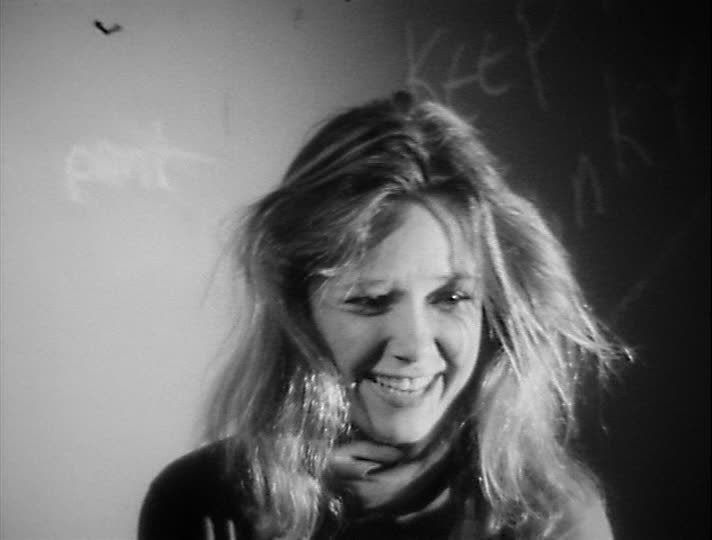
I, An Actress is a short film made as a kind of screen test for one of filmmaker George Kuchar's acting students during a filmmaking workshop. The student, Barbara Lapsley, is given a page from a ludicrously melodramatic script, set opposite a dummy draped in a coat with a curly wig to represent her husband, and then set loose to read her lines. The whole thing quickly degenerates, however, as Kuchar himself steps into the frame as the director, instructing his actress in how to read her lines and how to act, constantly urging her further and further over the top, towards more and more outrageous behaviors and line readings. Kuchar, nebbishy and overwrought as he careens into the frame after virtually every line from the actress, encourages her to caress her breasts as she acts, or to fall on the floor and kick into the air, or to throw her arms spastically around the dummy and kiss its "shoulder."

He is driving her towards a performance of sheer camp awfulness, in other words, and she's all too eager to go along with it, laughing uproariously, slurring her lines through clenched teeth with a cigarette sticking out from between her lips like a whistle, spitting out the script's hilarious melodramatics with mock venom. "When I cheat it's not for sex, it's for revenge," she sneers, then can't help but giggle. Later, as she falls down at the dummy's "knees," she's even goofier as she barely manages to snarl, "aren't you used to women on their knees, Harold, or are you only used to women on their backs?" It's glorious fun, especially whenever Kuchar's on camera, coaching the girl by acting out her part himself, showing her how to pose seductively, how to fall on the floor, how to eke out every bit of fun from this role. As an actor's workshop, its main message seems to be not to take things too seriously, not to actually worry about talent or believability. Instead, Kuchar keeps casually disrupting whatever hint of artifice there might be in this scene, never allowing the actress to get into the part; she probably doesn't ever get to deliver more than two uninterrupted lines in a row throughout the whole scene. He races around the small set, acting things out, guiding the actress, shouting instructions to the camera operator. The whole thing quickly becomes less a screen test for Lapsley, gaping and giggling at all this chaos, and more a demonstration of the sheer joy of moviemaking, the hands-on fun of the director in dictating what happens on a movie set.


To that end, the cinematography dances and bounces along with Kuchar's frenzied improvisations and instructions. At one point, he tells the camera operator to move in on Lapsley, and the camera frantically zooms in, at first seeming like it's going to center on the actress' bust until the cameraman perhaps realizes, belatedly, that Kuchar meant her face. It's one of many funny, absurd little touches that add a bit of sexual frisson to the film's crude pseudo-documentary aesthetics. Of course, part of Kuchar's coaching is to continually urge his actress into sexually compromising positions, like kneeling beneath the dummy, her head buried in its coat, so that as the camera probes in the composition makes it look like she's giving the dummy a blowjob. Later, the obvious subtext of Kuchar's continued insistence that she lie on the floor and kick up at her husband in anger is that this position will cause her skirt to ride up and her underwear to show. It's all completely ambiguous: is Kuchar exploiting a student, or is she in on the joke, contributing to a sly satire of the ways in which filmmaking is a sexual power struggle in which male directors control and dominate female performers? Certainly, the film's flippant tone, and Kuchar's habit of stepping into the female role himself, posing flamboyantly and feeling up his imaginary breasts, suggests that the latter is the case.

Either way, of course, I, An Actress is a fun, frequently hilarious short spoof, a ridiculous parody of Hollywood moviemaking that turns melodrama into farce, reveling in the nuances that can be suggested through supposedly "bad" acting.

Monday, June 28, 2010

A Grin Without a Cat


Chris Marker's A Grin Without a Cat is a kind of eulogy for the worldwide failures of the revolutionary, socialist spirit that ran through many youth, workers and intellectuals in the turbulent 60s. It is a response to the disappointment engendered by the ultimately ineffectual demonstrations and protests of May '68, in France and elsewhere, and to the increasing corruption of idealistic movements by dictatorial forces, by disillusionment, by acceptance of the status quo. The "grin without a cat" of the title (a substitute for the thematically analogous French play on words of the original title) refers to the empty words that never led to concrete action, to the ideal that never quite corresponded to the reality, to the rhetoric that never got a real mass of people behind it to give it meaning and strength. The missing cat behind the grin is what might have been: the masses that never materialized, the revolution that never came, or that dissipated in the wind as it became clear that the ideals were not being lived up to in reality.

It is a remarkable film, an attempt at telling history from the point of view of the losers for once. History, it is said, is always written by the victors, and never by those who tried and failed, never by those whose ideas were crushed by opposition, or whose struggles were ultimately quashed. Marker, of course, is more interested in those whose stories aren't often told by history, those who dreamed and then were forced to wake up, those who don't get to write their stories in the conventional history books. The three-hour film is divided into two equal halves, which together don't so much relate a chronological history as present the factual events followed by the commentary upon those events, the analysis of what it all means. The film's first half, entitled "Fragile Hands," presents a documentary account, assembled through video records of the late 1960s, of the student revolutions and protests, the air of socialist revolt that crystallized in France, in the US and Latin America and elsewhere, around 1967 and 1968 especially. The "fragile hands" referred to here are the hands of the students, the intellectuals; a popular slogan suggested that the students, with their ideals and their posters, were the vanguard, that they would soon hand on the torch to the workers, who were more robust, more suited to actually carrying out these ideas in practice. This film, perhaps, is a record of how and why this passing of the torch never happened.

To tell his story, Marker strings together various documentary sequences, tying together Maoist China, the Stalinist USSR, the war in Vietnam, socialist organizations on college campuses in France and the US, factory workers and their unions, guerrilla revolutionaries in Cuba and Latin America, and of course the capitalist bosses and political leaders who opposed all this upheaval and change. It is a true radical history of 1967-68, and Marker's purposeful juxtapositions emphasize both how united all these various factions and ideals were in their overall ideology and goals, and how divided they were on virtually everything else. Marker gathers together a cacophony of competing voices, many of whom don't seem entirely sure of what they want or what they're fighting for. The revolutionary certitude of Fidel Castro and Che Guevara is contrasted against the workers in French factories, who went on strike without even knowing what they were demanding, what it was all about. The seeds of discord are apparent already: fellow radicals being accused of counterrevolution, the split between the workers and the students.

Several narrators comment on this action, providing context, naming the prominent people who appear on screen, but the bulk of the narrative is conveyed entirely through the archival material that Marker has gathered together. His achievement here is one of editing, compressing and molding a wealth of material into a coherent narrative, condensing the multitude of viewpoints into cogent oppositions and arguments. Marker seems simultaneously nostalgic for this atmosphere of revolt and radicalism, and all too aware of its failings and limitations. At one point, several workers call for a coherent platform of the left, a set of concrete principles for everyone to rally around. It is clear, from Marker's arrangement of the contradictory demands, dreams and ideas of the people arrayed on the side of radicalism, that this is not forthcoming.


If the first half of this film is an attempt to document and provide a historical overview of this particular fraught moment in time, the second half, entitled "Severed Hands," is Marker's more direct commentary on the defeat of radicalism in the late 1960s. It is clear, almost immediately, that Marker's perspective on this material is going to be more intrusive, in terms of aesthetics and commentary, in this second half. The film's midpoint centers around the Soviet invasion of Prague in August 1968, just months after the student uprisings of May. A voiceover darkly hints at the invasion at the close of "Fragile Hands," and "Severed Hands" opens with a lengthy analysis of the situation. One of the most striking sequences involves Castro hedging his bets on the Soviet invasion, declaring it simultaneously illegal and necessary, perhaps afraid to come out too strongly against his Soviet benefactors. As he speaks, the dissonant synthesizer score, by Italian experimental composer Luciano Berio, nearly overwhelms Castro's words with squealing feedback and threatening bursts of noise, as the image jumps and jitters, worn with age, so that the film seems to be on the verge of tearing itself apart. The score, often present as a subliminal hum in the first half of the film, here emerges more frequently and more violently to the forefront, lending a mood of dissonance and disruption to the images that Marker has assembled.

Later, the names of killed dissidents and activists are read out above a melancholy organ drone, as images of their funerals are collaged together, and the drone eventually coalesces into a burbling, insistent dirge. Marker's perspective on this material becomes more forceful. The subdued air of nostalgia that inflected the first half of the film gives way to anger and disappointment, the feeling that something potentially magical was lost in the aftermath of the hopeful atmosphere of 1967-68. The Prague sequence demonstrates this loss most poignantly, as Marker shows images of a Congress held by the Czech Communist Party in the wake of the invasion, a meeting at which everyone participated rather than just the usual leaders, suggesting a potential new democratic ideal within socialist organizations. Of course, the Soviets subsequently suppressed this Congress, and Marker ironically remarks that these images, these silent and tinted black and white images of people passionately stating their resistance and their desire for a new role in politics, document an event that, according to the official histories, never even occurred. It's an affirmation of one unstated goal of this film, to bring to light the ideas and people forgotten by official history's gloss on the past.

"Severed Hands" is a document of disillusionment as well. One sequence portrays the initial hopefulness about Mao, of all people, as a democratic icon, a new socialist hero in opposition to the now-discredited totalitarianism of Stalin. And then that too fades, as Marker describes the reaction of radicals as some of Mao's inner circle started to disappear, to be denounced as imperialists and counterrevolutionaries, a familiar pattern repeating itself as revolution gave way to repression. This film is all about familiar patterns. In another sequence, in France, Trotskyite agitators get called "fascists" by those socialist workers who oppose them; it's easier to call opponents loaded names than to engage with their ideas. It's the victory of empty words and specialist sects, divisions based only around terminology, factionalism. And the beginning of defeat.

The voiceover describes the complete lack of mass response to the Watergate hearings, and a television montage positions the whole scandal within the context of prosaic entertainment, goofy sitcoms meant to distract from genuine world conditions — an explanation for the absence of public protest surrounding Watergate, the apathy of a public watching their political system unravel on TV, all of it with no more impact than an Archie Bunker show. What a coda to May 1968, from Marker's perspective, and what persuasive evidence that the moment of political upheaval and political engagement represented by that era was at an end. Other political events provide similar reference points: the short presidential tenure of Salvador Allende in Chile (Marker frames this sequence with the first recorded image of Allende as president, and the last); the international mourning over the Israeli hostage tragedy at the 1972 Munich Olympics juxtaposed against the complete lack of international interest in the far bloodier Tlatelolco massacre at the 1968 Mexico City Olympics. By the 70s, history was being written by the victors, not by the students or the revolutionaries or the workers.

Nevertheless, A Grin Without a Cat doesn't offer up an entirely hopeless farewell to the era of political protest. Instead, Marker seems to be encouraging a movement away from the ideal, towards the concrete. He presents an anecdote about a Japanese town where a company poisons the water supply with mercury waste, and accompanies the story with harrowing images of mentally damaged young men, drooling and heavy-lidded, deformed by this industrial abuse. The way forward, perhaps, is in such local battles, and Marker celebrates the fierce reaction to this situation, the enraged protest against the company responsible. In such localized, clearly focused fights, the amorphous revolutionary, anti-establishment fervor of May '68 finds its clearest, most potent expression. When Marker shows a Japanese mother whose children are dead, raging against a flustered business executive, it's obvious that he's juxtaposing her with the radicals and revolutionaries who had appeared elsewhere in the film. She has no ideology, no slogans or ideals, only a genuine and visceral reaction to the unfairness of the system she lives under. This is perhaps the source of the hesitant optimism in the film's coda, written by Marker in 1993, when he re-edited and restructured his original 1977 film, in which he comments on how things have changed and stayed the same in the years since he made this film.

Marker consistently looks to animals for inspiration. Of all the assembled heads of state at the Shah of Iran's grand festival at Persepolis, the voiceover says, earlier in the film, "compare their expressions with the clear eye of the cat... the cat is never on the side of power." There's a freedom, an innocence and simplicity, in the animal, that Marker clearly respects. So it's appropriate that in the film's coda, he locates a metaphor for radicalism in the use of helicopters to slaughter wolves, thinning the herd with rifles, as originally documented at the end of the 1977 version of the film. In 1993, Marker retains some hope about the future of protest and resistance: fifteen years later, he notes, some of those wolves are still alive.

Wednesday, May 20, 2009

Soldier of Orange


Paul Verhoeven's Soldier of Orange was the film that started him on the path to Hollywood, the film that made no less than Steven Spielberg take notice of the Dutch talent. It's not hard to see why: it's an epic, masterfully made film, a brisk, constantly moving wartime adventure about friendship, betrayal and the ways in which people can stumble upon their principles. The film traces the lives of a group of rowdy friends between 1938 and 1945, from their time at a Dutch university to their entanglement in World War II, as their home country is dragged into the conflict by Hitler's invasion. These youths are initially far from interested in the war or Germany or anything else. They expect their country to remain neutral, as usual, and if anything many of them are sympathetic to Germany, nursing some of the same anti-Semitic sentiments as Hitler and his followers. So they play tennis, and go to parties, and compete over women, oblivious to the impending chaos about to engulf Europe. When Britain declares war against Germany, a few off them are troubled, but most don't care: they simply switch off the radio and return to their tennis match and their gaiety. This only changes when Germany actually invades Holland, bombing civilian targets and sending in soldiers.

What Verhoeven's interested in here is defusing the usual war movie clichés: the over-the-top patriotism, the stoic heroes, the girl loyally waiting back home. He signals his subversive intent, subtly, in the opening scenes. After a mock-newsreel introduction of the Dutch Queen returning to her own soil after the war, greeted by an extravagant welcome, the first scene of the film proper is a noisy, chaotic sequence in which a group of shaved-head young men are berated, beaten and mocked by neatly dressed men who order them around like drill sergeants. The film's subject, and its opening (with a credit sequence accompanied by the Dutch flag), prime the viewer to interpret this scene through the filter of World War II history: the shaved heads, the shouted commands, the sniveling men who seem to be prisoners. Actually, it's a particularly brutal fraternity hazing, and its end result is to forge a lasting friendship between new recruit Erik (Rutger Hauer) and the fraternity president Guus (Jeroen Krabbé).

Verhoeven patiently explores the pre-war life of these young men, upper-class boys studying to be lawyers and take their place in society. Their lives are disrupted by Hitler's bombs, and the German invasion forces them to make difficult choices, to choose sides. Guus and Erik will join the underground resistance against the Nazis, along with friends like the Jewish boxing champion Jan (Huib Rooymans), the resourceful organizer Nico (Lex van Delden), and Robby (Eddy Habbema), who runs a transmitter sending messages to England. Erik's friend Alex (Derek de Lint), who has a German mother and thus sees the situation somewhat differently, joins the fascist army and goes to fight in Russia. Others, like Jack (Dolf de Vries), simply lay low and wait out the war at home, secretly completing his degree and preparing for post-war life even while the bombs are falling and his countrymen are dying and fighting back. Verhoeven doesn't want to present a simplistic portrait of patriots fighting for their country: these are real people, with complex relationships and complex reasons for what they do. The film is based on the real story of Erik Hazelhoff Roelfzema, the aide to Queen Wilhelmina whose book about his experiences provided a starting point for Verhoeven's film.

Indeed, Erik is a hero, but he arrives at it only slowly, even reluctantly. He dabbles in the resistance, but his efforts are wasted, and he sees his friends and allies dying and being captured, seemingly betrayed. The Germans strategically allow him to overhear that they have a spy in London, a man named Van der Zanden (Guus Hermus), then they release him. So when Erik gets the chance to escape to London, he does so, along with his friend Guus, intending to help out in any way he can and especially to expose the traitor who may have been compromising the Dutch resistance. As usual with Verhoeven, such things are more complex than they seem at first. The supposed spy turns out to be a staunch ally of the Queen, and the traitor within the midst of the resistance has his own reasons for doing what he does. Robby turns out to be the weak link in the organization, agreeing to help the Germans when they threaten to take his Jewish fiancée Esther (Belinda Meuldijk) to a concentration camp.


The emotions in this film are complicated and subtle, especially for a war epic with action taking place on a grand, international scale. Verhoeven never forgets about the human dramas, never leaves behind the characters and their smaller stories in favor of the big picture. What's striking, then, is that everything that happens here amounts to so little, does so little to affect the outcome of the war either way. These people and their struggles are peripheral to the main thrust of the war, as the British officers themselves acknowledge: they're using the Dutch fighters mainly as a distraction, throwing Erik and his compatriots at the Germans in order to waste the enemy's time, to draw their attention away from more important matters. Verhoeven's storytelling is taut and his action sequences are suspenseful and perfectly conceived, and yet by the end of the film it's obvious that virtually nothing has been accomplished by all these intrigues and missions: Erik presumably does much more in his mostly unseen bombing runs than he did throughout the entire rest of the film. Verhoeven is interested in history, but he's interested in it largely as it happens on the ground, as it affects individuals and their small, historically minor lives. He is bringing historical footnotes to life, investing their stories with all the grandness and nuance and detail usually reserved for major players in these struggles. Despite the opening, in which Verhoeven skillfully blends faux-period footage of Hauer in with genuine newsreel footage, this is not a Forrest Gump kind of historical movie, in which the characters wander through major historical events. Instead, this film is all about unraveling the tightly knit story of abstracted history into the individual threads that comprise it, each small strand insignificant in itself but each adding to the cumulative experience of a time and place.

This is rich stuff. Verhoeven, so often thought of as a director of big, bold gestures and over-the-top stylization, is actually just as capable of subtlety and restraint. He largely hints at the deep emotional bonds linking Erik to his friend Robby's fiancée Esther. The two have a halting, infrequent affair, succumbing to passion for one another at times of stress, but Verhoeven communicates their longings largely through glances, through silent moments in which a great deal seems to pass between them. There is a wonderful, perfectly staged scene late in the film, when Erik begins to suspect that Robby is a traitor when he sees all the nice things that Esther has at their house, at the peak of wartime in Holland. She tells him that Robby gets all these things for her, things that Erik couldn't even get in England, through his friends in the resistance. But when Erik asks her if she really believes that, she pauses and simply shakes her head, just once, from side to side, her face steeled but her eyes sad. There is so much in that gesture, the resignation and defiance and the knowledge that her man has betrayed his principles, betrayed even his friends in order to keep her safe, and that even though she is torn up by it she has gone along with it, has allowed him to do it and allowed him to think that she doesn't know. This all happens beneath the surface, again in the exchange of looks between Erik and this woman who he loves, but who various circumstances have kept from him.

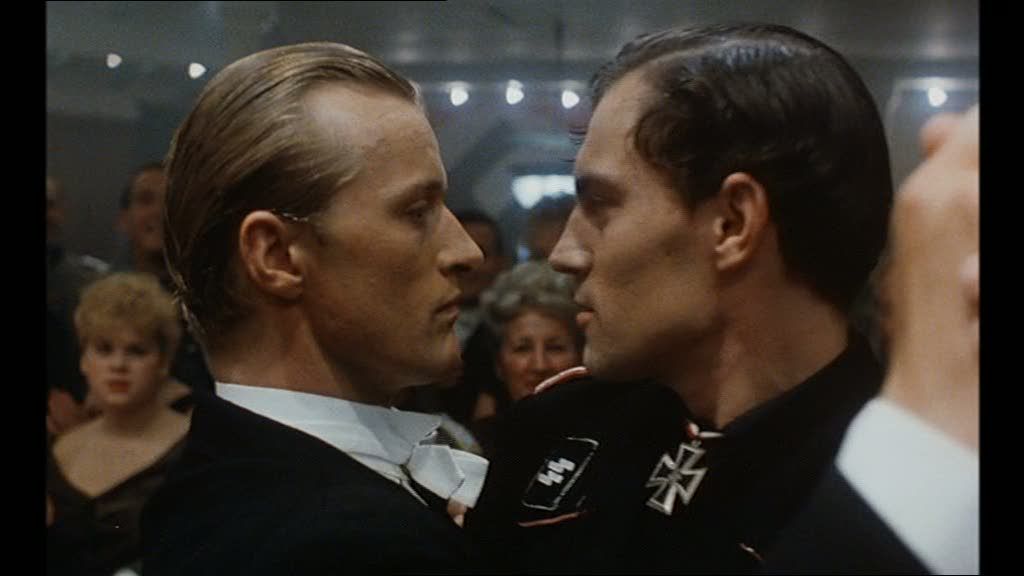
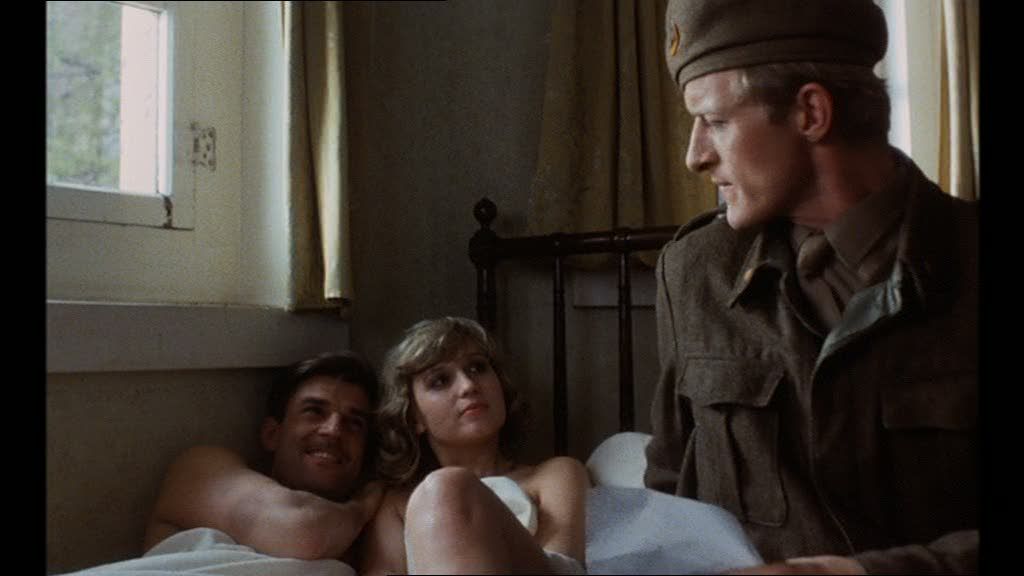
There is a similarly great dynamic at work in London, where Guus and Erik engage in a friendly rivalry to bed down the pretty English military secretary Susan (Susan Penhaligon). Again, a lot happens between the lines, as Susan flirts with both men, inviting Erik under the covers to join them after she and Guus have had very public sex in a second floor window, with Erik down below hilariously trying to prevent the Queen from getting an eyeful. Verhoeven allows a great deal of ambiguity in the way Susan manages the rivalry of these men for her affection: when she conspires to have Guus and not Erik sent on a dangerous mission, is she trying to maneuver the man she wants closer to her, or trying to make the man she already has a hero? Also implicit in these scenes is the homosocial love of Guus and Erik for one another, a love that transcends their sparring over Susan, even when she lays naked in between them. Later, this kind of love between men will bridge even the opposing sides of the war. One of the film's most memorable sequences is the extended tango that takes place between Erik and the fascist soldier Alex, when Erik stumbles undercover into a party for the Nazis. The two men dance together, their faces just inches apart, their hard profiles seemingly on the verge of a kiss, and discuss the vagaries of history that have made them enemies rather than friends.

Soldier of Orange is a typically dense, potent epic from a director who consistently manages to find the difficult and powerful emotions within blockbuster material. This is a deeply personal and contemplative war epic, even as it moves at a brisk, thrilling pace. It satisfies every expectation of its genre, packing its lengthy running time with battles and betrayals and suspense sequences — like the indescribably tense climax on a Dutch beach guarded by the Germans — and yet it is also subtle and humanistic. It's a film about the tight interplay between choice and fate in determining the flow of a person's life during times of upheaval. And it's also a visceral, rousing action picture. Verhoeven is one of the few directors who is able to have it both ways, while compromising neither.

Tuesday, April 21, 2009

TOERIFC: The Serpent's Egg

[This post is prompted by The Oldest Established Really Important Film Club, which will be spotlighting a different blogger-selected film every month. This month's selection is courtesy of Bill from The Kind of Face You Hate. Visit his site to see his thoughts on the film and to join the main discussion.]

To the extent that Ingmar Bergman's The Serpent's Egg has a reputation at all, it is not a good one. The film is mildly notorious, at least among Bergman admirers, as a late 70s oddity from the great director, a lavishly produced English-language epic made in Germany and starring American actor David Carradine alongside longtime Bergman muse Liv Ullmann. It's known as a colossal misstep, weird and boring in roughly equal measures. There's little denying that the film lives up to its reputation: it's a bizarre, unsettling, deeply unpleasant film, a one of a kind anomaly in the Swedish director's oeuvre. At times, it feels more like a Fassbinder film than anything by Bergman, and one wonders if shooting a period epic in Germany inspired Bergman to subtly shift his style towards one of this foreign country's contemporary greats, though something ineffable gets lost in the translation. The baroque, teutonic weirdness of this film, seen through Bergman's dispassionate lens, makes for a destabilizing experience. It's never clear just how one should feel, as the dizzy atmosphere and elliptical storytelling produce a blurry portrait of Germany in the unstable years between World War I and World War II.

The film follows the dazed wanderings of the American circus acrobat Abel Rosenberg (Carradine) after the inexplicable suicide of his troubled brother and fellow performer, Max. Abel falls in with Max's ex-wife Manuela (Ullmann), who works as a cabaret performer to support herself amidst the disintegrating German economy. The film portrays a nightmare world in which men are beaten on the streets while the police walk by as though nothing was happening, where everything is fluid and nothing can be depended on. Abel, a Jew facing increasingly virulent anti-Semitism, is especially adrift in this transitional culture.

Bergman conveys the aimlessness and deadened nerves of this milieu by making a film that's almost relentlessly aimless and deadened itself. Abel and Manuela are lost, clinging desperately to one another, but the slack pacing of the narrative mostly just leaves a lot of empty space, and a lot of room for Carradine and Ullmann's overacting impulses to spill over. The actors indulge in scenery-chewing explosiveness whenever they get the chance, with Ullmann tending towards shrill, over-emotive hysteria, and Carradine veering into convulsive gestures and tourettic verbalizing. His breakdown at a police station is uncomfortable to watch more for the strange, mannered quality of the acting than for the actual emotional state of his character. The same goes for some of Ullmann's loonier outbursts; Bergman not only makes no attempt to control or smooth out the performances but actually seems to be encouraging them to go over the top as often as possible. The unhinged quality of the performances actually makes a weird kind of sense, both aesthetically and narratively, for a film that's all about people losing their grip on reality and succumbing to wild mood swings and disconnected emotional reactions. Knowing this doesn't make the film's more out-there moments any easier to watch, of course.


Despite the uneven tone and staggering narrative, The Serpent's Egg is an interesting film in many ways, not least of which is the way Bergman captures the mood and feel of pre-WWII Germany, building a tremendous studio set of the streets around Abel's neighborhood. The streets seem to be continually rain-streaked and lit, at night, by flickering lamps that reflect off the slick cobblestones and metal street-car rails. Abel wanders through the dark in a fedora and trenchcoat like a badly misplaced noir hero, confused and lost. Along the way, there are striking moments — especially several of the grotesque, lascivious and gender-bending performances glimpsed at the cabaret where Manuela works — but many more dead patches.

During the second half of the film, however, Manuela and Abel enter weird new territory as the plot unravels even more than ever. Manuela and Abel move into a suite of apartments given to them by the courtly but sinister Hans Vergerus (Heinz Bennent), an old acquaintance of Abel's and now an admirer of Manuela's. Once there, Manuela takes a job at a nearby factory while Abel begins working within the labyrinthine medical archives of a clinic, mechanically shifting papers back and forth from one folder to another. Things get even weirder when Abel begins to realize that strange experiments are going on at the clinic, experiments in human pain and terror, essentially warm-up exercises for the atrocities of the Nazis a few years later.

In one of the film's best and most startling scenes, Abel confronts Vergerus in a hidden room within the maze of the clinic's library, where the mad doctor keeps the filmed records of his warped experiments. Vergerus recounts, with a chilling lack of emotion, the pain and psychological torment inflicted on his patients, as he shows Abel grainy black and white film reels documenting these experiments. This scene is a bracing coda, the crystallization of the film's themes about violence and inhuman ideologies. Abel's confused meanderings eventually lead him to a horrified face-to-face confrontation with a purely evil being, a man who prophesizes a not-so-distant future society in which his work will be viewed, not as degenerate and frightening, but as the vanguard of scientific research. It's a bone-chilling prediction of the Third Reich's collective insanity, and it's well worth trudging through the often maddening boredom and indifference of this film in order to reach this fascinating scene. Bergman shoots it mostly with closeups of Vergerus, played with an icy intensity by Bennent, calmly smoking as he displays a catalogue of horrors, a gleam of mild pleasure in his pale blue eyes.

Ultimately, The Serpent's Egg is worth seeing if only for this scene, an unforgettable, terrifying vision of the radical disconnection from morality that led to the Holocaust. Despite the potency of this climax, the rest of the film is loose and frustrating, with flashes of interesting ideas giving way to stale melodrama and uneven acting. This is a true curiosity for Bergman, a disjointed failure with enough sparks animating it that it can't be written off completely.

Thursday, October 4, 2007

10/4: Ballad of Orin


I'm mainly familiar with Masahiro Shinoda from a few of his 1960s contributions to the Japanese New Wave, films which took off from genre premises (samurai, gangsters) and deconstructed them. With those earlier films in mind, Ballad of Orin (literal translation Melody in Gray) from 1977 initially seemed to be a big surprise. This is a much quieter, more evenly paced film than Shinoda's wild, elliptical samurai tales like Samurai Spy. This evenness is present in both the story, which is slow and emotionally understated despite its tragic themes, and the visuals, which are largely static and flat. The story follows Orin (Shima Iwashita), a blind woman who as a young girl became a goze, or itinerant entertainer, one of the few options available for a blind woman in Japan at this time (one of the others, far less appealing, was a prostitute). Orin's life is largely miserable, and the story makes it clear that her misery is a result of traditionalist attitudes, which keep her bound by religion, sexual mores, and a paternal oppressiveness that grants few rights to women. The film is a potent depiction of the Catch 22 of this kind of society, in which women are fiercely punished for society's view of them rather than for any crimes they actually committed. Orin forever remains locked in this paradox, fully believing in her own imagined sins and crimes, never grasping that her society is punishing her merely for the twin "crimes" of being a woman and crippled.

Her life is presented by Shinoda in an interwoven tapestry of flashbacks and contemporary scenes, set in the early 20th Century during Japan's war with Russia. However, the timeframe is not initially apparent, except in very oblique ways like the glimpse of a train station; in all other respects, for at least the first hour, this is a truly timeless tale, located possibly in any era of Japan's history. It's only as the film goes along that Shinoda allows more and more of the modern era to intrude upon Orin's story — and intrude is the right word. Although the oppressiveness of traditional values are presented as the root cause of Orin's misfortunes, the film never presents modernity as a correcting influence or solution. Rather, for Shinoda the modern world seems to be primarily a new form of oppression, a new and different cruelty, and for Orin, accustomed by now to the everyday cruelties she grew up with, this change is not welcome. Modernity enters the film in the form of soldiers, parading through the streets and sent off to war in Siberia, and a steam engine roaring into town, obliterating the sound of the sea that Orin remembers from her youth. But most conspicuously, modernity enters the film in the form of the second half's unexpected murder investigation, in which the police are tracking the man (Yoshio Harada) who has become her guide and protector. The entrance of the character of the detective into the film, with his Western-style gray suit and fedora, is a shocking break of the film's elegiac visual style and open spaces. He seems like he has stepped out of another film altogether, an American noir, and he brings with him the shadowy interiors and stark style of such films — in one memorable scene, his shadow precedes him, thrown long and foreboding upon a wall before he enters the room.

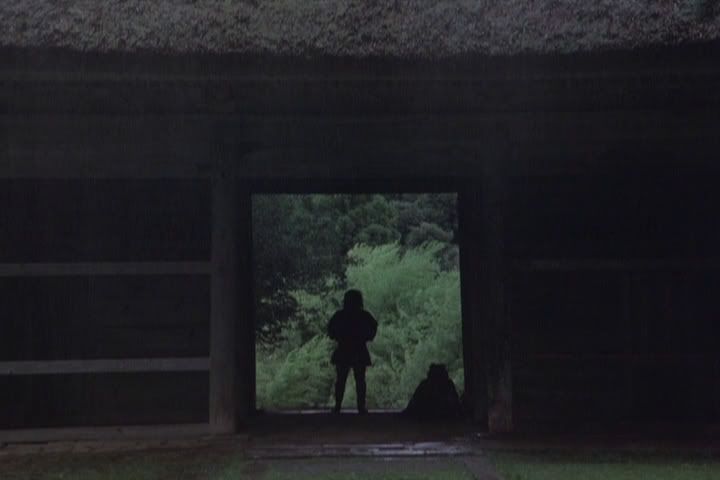
Shinoda takes full advantage of the 4:3 aspect ratio here, creating striking images which have the weight and finality of stasis and stability. For a film about a blind woman, this is a sensually rich film, as though to balance the darkness of Orin's world he has populated it with sensory beauty. Especially early on, he frequently punctuates scenes with disconnected shots of the surroundings — clothes arranged on a shelf, a bubbling brook outside, bright red flowers lying amid the snow. The editing shares something of the elliptical style of Shinoda's earlier films, though it is less frenetic, less abrupt. His use of sound is interesting, too, as he will frequently cut away before a scene is quite over, but will leave the sound running into the next, silent, scene. This is frequently done in between drastic changes of scene, or shifts in time from past to present, so the effect is to establish a continuity and fluidity between all the events of Orin's life. Her life in all its details is as one, a product of the society she lives in, and events across large spans of time or place are linked in ways not apparent on the surface.

This is a complex and powerful film, stunning in its steady accumulation of imagery and the tragic commentary of its narrative. Shinoda handles this potentially didactic material with remarkable delicacy, never allowing it to become a heavy-handed "message" film. Its messages are always contained organically by the story, and by the character of Orin, who's played with wonderful range and quiet intensity by Iwashita (Shinoda's wife, incidentally). Her performance encompasses strength, despair, sensuality, loneliness, and mystery, and she's a wonderfully sensitive actress for depicting the emotional subtleties of this tale. And the film's critique of society's treatment of women is quite radical, especially in its refusal to frame the oppression in the usual traditional vs. modern terms. Shinoda clearly understands societal oppression in a much deeper sense, and is able to draw out a nuanced depiction of the mechanics of this oppression at work on a daily level. This is a truly masterful film, filled with multiple layers and multiple meanings; its placid surface is deceiving. It's a feminist critique, a powerful anti-war outcry, and a simply beautiful and poignant film. This is not to be missed, and it's quite possible to see it in all its glory and visual splendor on the wonderful Japanese DVD, with English subtitles.