Showing posts with label 1982. Show all posts

Monday, April 16, 2012

The Draughtsman's Contract


The nature of power, as played out through a sexual and economic game of class, property and inheritance, is the somewhat obscured subject of Peter Greenaway's masterfully baffling, frequently hilarious 1982 film The Draughtsman's Contract. This is a film in which surface appearances are very much set off against the reality underneath, a reality that can never quite be seen directly, head on, but only glimpsed out of the corner of one's eye: truth, like the living statue that mysteriously moves around the grounds of a rural mansion, rude and naked but mostly unseen by the mannered aristocrats who inhabit this estate circa 1600s England, is so elusive that one is never quite sure if one has actually glimpsed the truth or merely a figment of the imagination. Right from the beginning, Greenaway is hinting at the disconnect between presentation and truth, as during the credits he cuts away to a high society party at which the bewigged, heavily made up guests tell charmingly scatalogical and urinary anecdotes that seem to be very much at odds with their elaborately sophisticated appearances and the bemused titters with which they relate these stories of bodily function. Rarely again in the film do they ever seem to have their guards down so thoroughly, do they ever acknowledge the workings of the body so directly, but even here, their language is so ornate, their refinement so complete, that they manage to make these bawdy tales of diarrhea and peeing vigorously in buckets sound like delightful chatter over tea.

Language is very important to this film, which boasts a marvelously clever script by Greenaway in which every word, every circumspect and torturously polite turn of phrase, disguises some secondary meaning, often a naughty bit of sexual double entendre — lots of appreciative banter about fruit, ripeness, fecundity, and "the maturing delights of her country garden" — or a sly insinuation about someone or other's reputation, or a threat so carefully hidden in banal chit-chat and freighted symbols that its more sinister meaning might utterly pass over the head of the one being threatened. There's a very complex game being played here, hidden away beneath all the ostentatious politeness. The artist Mr. Neville (Anthony Higgins) is invited by Mrs. Herbert (Janet Suzman) to undertake twelve drawings of her husband's lovely country estate, which, she implies, her husband prizes as his property even over his own wife. After much persuasion, the two sign a contract that, in typically circumspect language, promises both sexual and economic remuneration for Mr. Neville's artistic services, and the arrogant young artist installs himself at the Herberts' estate, in Mr. Herbert's absence, for a period of twelve days to complete the drawings, earn his pay, and help himself to the sexual favors of the lady of the house.
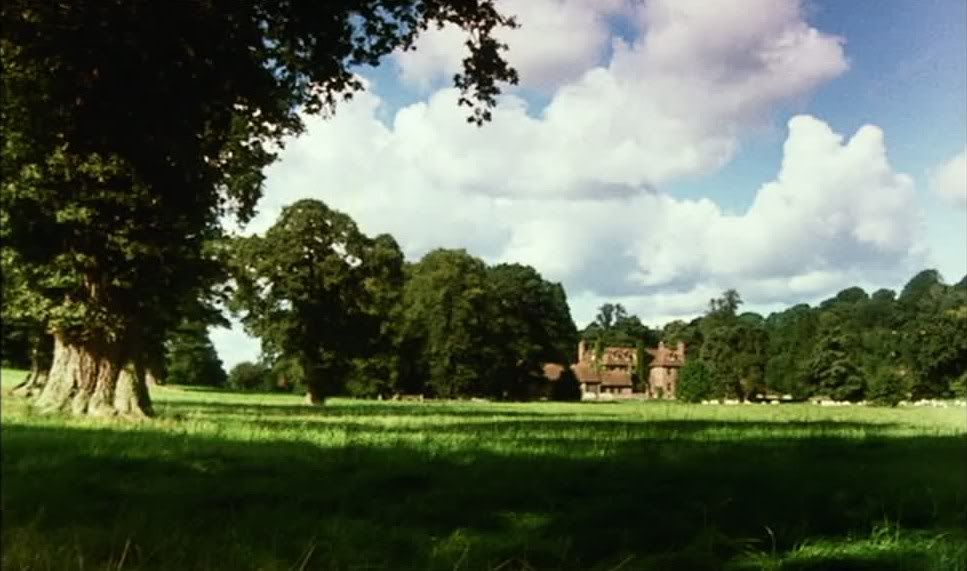

Though Neville believes himself to be the one in control, the one benefiting the most from this arrangement, the reality proves to be quite different from the appearance. There is definitely an uneven balance of power here, but contrary to Neville's confidence in his own prowess, both artistic and sexual, he is not the one with the power. He is lower-class, despite his finery and his polite manners, and none of the aristocrats ever truly accept him into their class even as they welcome him into their homes. And it turns out that they are playing a game at a far higher level than he had imagined, a game that increasingly entangles him helplessly because, not being of their class, he is utterly unequipped to engage in these games involving property and parentage. Very suggestive in this regard is the scene where Mrs. Herbert's daughter, Mrs. Talmann (Anne-Louise Lambert) explains to Neville the identity of a young boy who wanders the grounds under the care of a tutor. He's an orphan, she says, whose father died and mother converted to Catholicism, so he needed to be cared for by relatives here. "An orphan, madame," Neville sputters, "because his mother became a Catholic?" Indeed, and Neville, with his Scottish sympathies and incomprehension of the aristocrats' religious bigotry, simply proves again and again that he does not belong here, that he is not truly a part of this milieu.

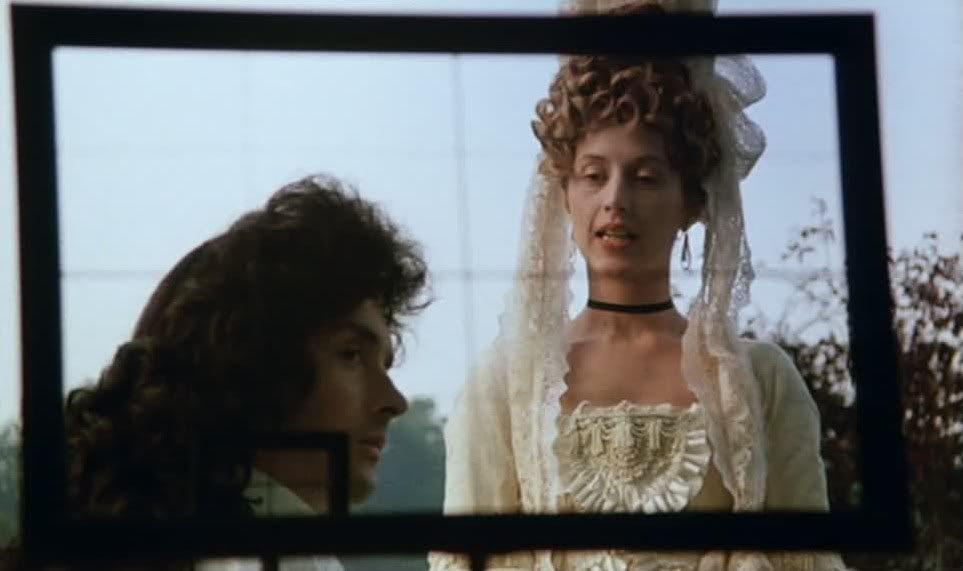
No, he is simply a tool to be used, and his drawings increasingly begin to seem like they are meant to play an important part in an elaborate plot being concocted, possibly by everyone except Neville, behind the scenes. There is considerable debate within the film, amongst the aristocrats who are privy to the drawings' contents, about precisely what kind of an "allegory" Mr. Neville is attempting to convey with these seemingly symbol-laden depictions, and one suspects that Greenaway is trying to excite the same debate regarding the film as a whole. Neville, for his part, continually insists that he simply draws what he sees, that he's merely an objective documentarian of reality, but Greenaway is undermining that artistic innocence, that naïve understanding of how art works. No drawing, no piece of art, can (or maybe should) passively document the world as it is, no matter how mechanical and purely visual Neville tries to make his art with his rigidly selected views, his viewing grid that breaks each scene into carefully composed rectangles, his totalitarian insistence that his views be uninterrupted, everything laid out exactly as he demands.

Like Mr. Herbert, who'd shaped his land into a structured, carefully manicured and maintained geometric layout in order to tame nature itself, Neville believes that he can control the world, that he can dictate what he sees and doesn't see, and thus what will appear or not appear in his drawings. But circumstances and the subtle interventions of various unknown conspirators shatter this illusion: his work is not merely innocent documentation, and his static, controlled views are increasingly disrupted by changes mysteriously wrought from one sitting to one another, clues planted, bits of evidence suggesting various covert conspiracies and activities, details pointing to murder or adultery. In other words, the carefully laid out gardens, so meticulously planned by Mr. Herbert and so thoroughly documented by Mr. Neville, are disordered and littered with evidence that the placid surface of things in only a thin, all too easily broken barrier separating polite society from all the messiness, dishonesty and ugliness of life, which keeps impolitely depositing obstructions into Neville's view, forcing him to make concessions to change and impermanence and imperfection rather than being able to craft, uninterrupted, a static, lifeless, unpopulated vision of the estate's grounds, blissfully undisturbed by any actual evidence of life or humanity.

The film is formally laid out in such a way as to both superficially confirm Neville's seeming mastery and subtly undermine it. Greenaway sticks almost entirely to static, carefully composed shots, often shot at least in part through the viewing grid that Neville uses to impose geometric order on what he sees so he can render it in his drawings. And yet Greenaway undercuts this rigidity at every turn, constantly having Neville's view obscured or interrupted by intrusive figures walking across his field of view, marring the unmoving beauty of the landscape. At one point, the director holds a shot of an unpopulated landscape long enough for the sun to be hidden by clouds and then break free, so that a long dark shadow passes across the green grass and then vanishes again, even the sky itself introducing movement and change into what Neville would like to freeze and order. When a thick gray fog rolls across the estate, Neville is unable to work, pacing impatiently back and forth while he waits for his view to clear again; if sinister aristocratic conspiracies don't undercut his dominion, then the elements conspire to remind him of his helplessness. Michael Nyman's enthralling score, appropriately enough, embodies the same dichotomy, combining courtly elegance with a propulsive, lively quality that suggests all the skullduggery and mystery lurking within the film's surface depiction of aristocratic refinement.

Greenaway's love of lists, as seen in his early avant-garde shorts and his exhaustive, exhausting first feature The Falls, persists here in the narration that meticulously describes the conditions for each of the twelve drawings. So perhaps, to some extent, Greenaway is poking fun at his own pretensions to artistic control, his own fussy obsessive-compulsiveness about naming things, about grouping objects and people, sights and sounds, into categories and descriptions, creating order through art. Key to the film is the question of the artist's responsibility to do more — as Greenaway, certainly, always has — than simply document and observe.

Friday, May 6, 2011

Lettre à Freddy Buache/Changer d'image


Commissioned to make a film about the Swiss town of Lausanne on the occasion of the five-hundredth anniversary of the town's founding, Jean-Luc Godard responded in the form of a videotaped "letter" to his longtime friend and associate Freddy Buache, the founder and director of the Cinémathèque Suisse. Lettre à Freddy Buache is basically a film about Godard's refusal to make the film, or about the failure to make the film, or even more pointedly, about what Godard predicted would be the perception of his failure. Speaking in voiceover, Godard adopts an intimate, conversational tone appropriate to a letter to a close friend. His narration is almost conspiratorial, including by implication Buache, and the eventual viewer of the film, in his musings on how best to represent or not represent a particular place.

The film alternates between three basic types of footage: Godard in his editing room listening to records and playing with sliders and buttons on audiovisual equipment; scenic tracking shots of the Swiss countryside in which Godard's camera restlessly wanders about as if in search of the one right image; and images of people walking around the city, drastically slowed down with the choppy slow motion video manipulation Godard had developed in his late 70s video experiments and especially in his then-recent 1980 return to cinema, Sauve qui peut (la vie). The footage of Godard himself emphasizes that this is a personal response, not an impersonal documentary or generic tribute but the work of an artist who is thinking and shaping his material. As in much of Godard's post-1967 oeuvre, the film is very much rooted in technology, in the reality of the editing methods applied to the footage, and in the exigencies of shooting. At one point he inserts a sequence of himself arguing with a local police officer who hassled the crew for stopping by the side of a highway to film. The policeman tells them that they can only stop for emergencies, and Godard's reply — delivered in a tone of voice that suggests it's the only rational response — is that this is an emergency, that the light would soon be gone and, with it, the opportunity to capture this particular image. For Godard, this is undoubtedly a moral question; it is vitally important to find the right images, to capture a particular moment before it is lost forever, and the failure of the police officer to understand that urgency is, from Godard's perspective, the failure of much of society to understand the importance of cinema, the potential of cinema, and by extension the responsibility of the artist to think, to document, to express his or her ideas.

The other two categories of images here are thus embodiments of Godard's thought process, his uncertainty about whether a place can best be represented by its landscape — its light and its colors — or by its people. In his musings, which have the quality of thinking aloud, drawing connections to Picasso or Wittgenstein, Godard suggests that, in filming Lausanne, there exists tension between the greens and blues of nature — the sky above and the foliage below — with Lausanne itself in the middle, gray and rocky, made of stone and concrete, manmade buildings sandwiched between a bright blue sky and the lush greens of nature. It's a perverse and implicit rebuttal of the commission's purpose: asked to commemorate the founding of a town, Godard all but laments that it was ever built, his sweeping images of natural splendor jutting up against the boring grays of the city itself.

Instead, Godard suggests that the soul of the place, the thing worth commemorating and talking about, is the people who live there, and his slow motion images of people captured on the streets have a sensuous quality that's a parallel to his gorgeous tracking shots of cloudless skies and the shade under dense trees. These images have a dual purpose implied by the film's final text, an onscreen dedication that calls this short "en souvenir de Robert Flaherty et Ernst Lubitsch." In other words, Godard's images of people arise both from the ethnographic impulse to observe and study, and from the desire to tell stories, to create fictions and narratives from people's faces, their movements. It's this tension, Godard suggests, that is valuable and worth exploring, and that's why he couldn't make a film about Lausanne and made this instead, a film in which Lausanne is more or less a departure point for the filmmaker's ideas on form and the reality/fiction dialectic.


Changer d'image was another commissioned project for Jean-Luc Godard, a short film prompted by the one-year anniversary of the election of the leftist French president François Mitterrand. Godard, naturally, takes this subject as the implicit basis for his subsequent film, and never explicitly mentions anything about Mitterrand or French politics or the occasion being commemorated. Instead, the commission seems to have made him consider the subject of "change," broadly speaking, and he sets out to examine not only what it means to change, but how to represent and envision that change in the form of images, of art. In other words, like the roughly contemporaneous Lettre à Freddy Buache, Changer d'image is not, strictly speaking, the fulfillment of a commission but an essay about how to fulfill the commission, an essay on the question of whether it can even be fulfilled at all.

To tackle the problem, Godard turns by analogy to his experience in Mozambique during the early 1970s, where he was enlisted to advise that country's new Marxist government on their television plans, and to produce original content that would create a new, radical form of television. The project never went anywhere, and Godard's voiceover analyzes the ways in which political upheavals in that country conspired with the difficulty of the project itself to prevent his success. He quite literally beats himself for the failure, showing images of himself, shirtless and strapped to a chair, being beaten and tortured by someone who's questioning him about cinema and television. It suggests how Godard sees his position with respect to governments and the other institutions and organizations that ask him to create what amounts to art on demand: as a torture victim being asked questions he can't possibly answer. He's holding up his various failures and aborted projects, wondering why it's so difficult to change things, to create something new.

The film opens, in a poignant and stripped-down visualization of that difficulty, with Godard seated, his back to the camera, in front of a white screen. This image persists throughout virtually the entire 10-minute film, sometimes alone, sometimes superimposed with others. It is as though the director is facing a quite literal blank canvas as he wonders aloud how to fill it, while the voice of an unseen woman questions him about change. He seems uncertain, except that he knows what the image of change is not: it is not the televised news, the endless debates and discussions of politicians talking about reform, a word that suggests slow and incremental alterations whereas "change" is harsh and speedy. After a while, the question-and-answer format is replaced by a third-person voiceover that refers to Godard, the director, the artist, as "the idiot," a variation on the similar roles he'd play as the holy fool in later films such as King Lear or Keep Your Right Up. Godard sees the artist as a fool, an idiot, because he believes in change, in the possibility of creating images that foster or document change, even though it's a quixotic and near-impossible task. But the artist keeps striving, through self-flagellation and the burdens imposed from outside, to create change.

This romantic image of the artist-filmmaker is offset by the film's final lines, an anecdote Godard tells about his grandfather driving the young Godard and his siblings around. The grandfather always drove very slowly, and the children in the back always shouted at him to go faster, to change gears, the cries devolving eventually to "change, grandfather, change," with the grandfather simply responding with a petulant whine. The film abruptly cuts off in mid-whine, a high-pitched sad sound of a grumpy old man resisting change, and Godard's implicit question to himself is: has he become the grandfather, or is he still the child in the back seat shouting "change," even knowing that his words are fated to have no effect?

Tuesday, July 20, 2010

Cat People (1982)


Forty years after the original 1942 Cat People, directed by Jacques Tourneur under the guidance of sophisticated horror producer Val Lewton, Paul Schrader remade the seminal horror classic. Schrader's Cat People nods to the original in many ways, following its basic premise and even recreating a few key scenes in homage to Lewton's shadowy, evocative horror, but in most ways it's quite a different work. Schrader minimizes the horror of the premise, pushing it even further into the background than Lewton, who often used his horror frameworks as mere excuses to explore deeper subtexts, ever did. Schrader is interested in the baroque eroticism of the story more than anything: the idea that there exist people who, when they make love, are transformed into vicious black leopards, and must kill before they can resume their human forms. Schrader uses this outlandish set-up to create a lush, absurd, sexually ripe film in which sex is dangerous and shiver-inducing, in which the promise of release carries with it an electric charge of terror.

Nastassja Kinski, as the virginal young Irena, is perfectly suited to this aspect of Schrader's vision; she brings to the film a raw, sultry sensuality that convincingly conveys the impression that she might bite or claw you at any moment, as easily as she might kiss you. At the film's opening, she has come to New Orleans to visit her long-estranged brother Paul (Malcolm McDowell, radiating nearly as much deadly energy as Kinski), since the pair were raised in separate foster homes after the death of their parents when they were very young. Schrader gets a lot of mileage out of these two, particularly from the weird sexual tension between them, as Paul insists that they need to make love, that in fact they can only make love with one another. The film sets up a divide between the strange sensuality of Paul and Irena and the ordinary world, as represented by the zoo where Paul, in leopard form, is captured for a time, and where Irena gets a job thanks to the zoo's curator Oliver (John Heard), who falls in love with her as soon as he sees her. As in the original film, Irena's otherworldly sexual energy is juxtaposed against the girl-next-door appeal of Oliver's co-worker and current girlfriend Alice (Annette O'Toole), who wears braids and is girly and playful, a stark contrast to the simmering, pouty Irena.

It's a familiar dichotomy, the good girl and the bad girl, the familiar and the foreign. In the original film, it was the fear of literal foreignness that Lewton was exploring, but here it's a more metaphysical fear/attraction to the unknown, the mysterious and frightening. The film alternates this blossoming sexual tension with dark humor and moments of suspense and horror, but Schrader never really tries to resolve the film's different moods and modes into a coherent whole. Instead, the goofy humor — like an ape intently watching a TV soap opera, or an eccentric cab driver who suggests that the only zoo worth visiting is the Bronx Zoo — is allowed to jar uncomfortably against the truly grisly bursts of gore and the open sexuality. This becomes especially apparent when a zoo orderly, the primary fount of comic relief in the film's first half, meets a particularly gory end in the jaws of the leopard.


The film lopes along after this, its plot never quite making sense, and never seeming to care whether it does or not. Schrader is more concerned with making individual scenes vibrate and throb with the potential of violence or sexual bliss, and whether it all fits together in the end is at best a secondary concern. Paul drifts in and out of the film at will, lurking in the shadows, watching from the trees, smashing through windows and finally being killed and reborn in a way that evokes David Cronenberg's body horror effects — a loose end that's never picked up again as the film focuses more singularly on Irena in its latter stretches. There's something feral and frightening about Irena, virginal and yet so sensuous, even (or especially) when her mouth is smeared with blood. Once she accepts her nature, Kinski plays Irena as though she's constantly stalking her prey, even in human form; her walk, her posture, the expressions on her face become cat-like. Even her sexuality becomes predatory, and she manages to make disrobing seem like a threat, slinking through the shadows, the muscles in her back twitching as though she might pounce at any moment.

In making the film all about mood, about the resonances of the underlying themes, Schrader is in some respects drawing on the example of Lewton, whose films always made the tangible horror secondary to the psychological and emotional subtexts of the stories. Schrader's film draws on the original Cat People in more direct ways, too, with homages to specific scenes. Of these, the most obvious is the famous pool scene, which Schrader recreates more or less intact: a young woman taking a swim when the lights go out, and she hears noises in the darkness suggesting a big cat stalking around the borders of the pool. This is Schrader's most complete tribute to Lewton, beautifully capturing the edgy and haunting atmosphere of the original, heightened here by the lovely green and blue hues of the lighting, and adding a hint of sexual frisson as the topless Alice floats in the center of the pool, bare and vulnerable in the gloom. That's yet another contrast: Schrader makes the pale, fleshy Alice seem soft and prey-like in her nakedness, whereas when Irena takes off her clothes she only becomes more predatory, as when she takes a naked stroll through the woods and winds up on all fours, chasing a rabbit with a hungry gleam in her eyes. This dichotomy suggests the two dominant tropes of movie femininity, the woman as victim and the woman as dangerous femme fatale; Schrader doesn't so much investigate these opposing stereotypes as present them in their raw form, for equal parts contemplation and delectation.

Schrader's other tributes to Lewton are more matter-of-fact, like the sinister and cat-like woman who addresses Irena as a sister and then disappears from the film, a source of unresolved mystery just as the similar figure was in the Lewton Cat People. Schrader's tribute to the famous bus scene in the original is the only homage that falls flat, that sticks out as a naked tribute and nothing more, because Schrader can't recreate the sudden thrill of terror that Lewton achieved just by having a bus abruptly stop in front of a fleeing young woman, making a noise very much like a leopard's growl. In most other ways, though, Schrader doesn't even try to compete with Lewton, a wise move since the original Cat People is a near-perfect horror film, a rich and evocative work that maintains its ability to elicit deep chills even today. Schrader's film, despite its obvious debt to the original, strikes out in a different direction, amplifying the sexuality and violence underlying the original story, allowing these dangerous forces free reign. If the resulting film is messy and jagged, with loose ends dangling shredded and bloody as though a leopard had taken a big meaty bite out of the script, that's to be expected from such a raw work. Schrader risks, and occasionally falls headfirst into, silliness and tackiness in order to get at the silly, risky, frightening, exciting feelings of love and lust.

Wednesday, February 25, 2009

Querelle


Rainer Werner Fassbinder's final film was the bizarre, abrasive and often unbearably silly Querelle, an unsettling final note in a brief but prolific career defined by the director's near-total disregard for conventions. An adaptation of a novel by Jean Genet, this is Fassbinder's most off-putting film, his most purposefully Brechtian in the distance it creates between the audience and the narrative. In fact, Fassbinder erects a nearly unbridgeable gap between the viewer and the material, a bottomless gulf into which all attempts at understanding or approaching this essentially unlikeable film must fall. The film's staging is exaggeratedly theatrical and campy, its action taking place on stagey sets with bright orange backgrounds and homoerotic architecture, in a port city whose walls are buttressed with phallic statuary. It is a gay dreamworld, a brightly colored fantasy in which women are almost entirely absent and muscular sailors, policemen and laborers stalk each other, seeking violence and sex in this city's streets and brothels. Fassbinder does everything he can to keep his audience at arm's length: the grotesque high camp of the mise en scène; the uninflected performances of the multilingual cast, excacerbated by rough, echoey dubbing; the awkwardness of the dialogue, with characters delivering stilted monologues on their inner states in weighty, tortured language. It's all contrived to create a thoroughly unpleasant, disturbing experience: despite the bright colors and ridiculous imagery, the tendency to dress up men in uniform like ersatz Village People, the movie is just no fun at all.

In keeping with this emphasis on Brechtian surfaces, the film's narrative is presented with a flat, affectless quality that levels off the various strands of the story, eliminating the drama and emotion otherwise inherent in it. Querelle (Brad Davis) is one of several sailors who arrives in a raucous port city when his ship put into the harbor. The real story of the film, beneath all its various threads and diversions and impenetrable scenes, is the initiation of Querelle into homosexual desire, first with the hulking brothel owner Nono (Günther Kaufmann), then with the macho, leather-clad cop Mario (Burkhard Driest), and finally with the first man who he feels genuine love and affection for, the workman Gil (Hanno Pöschl). Throughout it all, however, the subtext of Querelle's developing sexuality is his relationship with his brother Robert (also played, tellingly, by Pöschl), with whom he shares a fierce, violent rivalry and affection. When the two men greet each other at the beginning of the film, they embrace and begin simultaneously punching each other in the stomach, a gesture of love and hatred intertwined. Querelle's attraction to Gil thus stems from two sources. The first is the men's shared criminality, since both have committed murders: Gil killed a friend who would not stop taunting and ridiculing him for his homosexuality, while Querelle killed, for unexplained reasons, a fellow sailor. Querelle allows Gil to take on the responsibility for the latter crime as well, but he feels bound to the man because they have both shed blood. More obviously, however, they are bound together by brotherly affection: Querelle transforms Gil into Robert by pasting a mustache across his upper lip, a disguise that erases the only distinction between his brother and the man he loves.

This is, to say the least, some heavyhanded symbolism; Fassbinder is painting with very broad strokes here. This is undoubtedly his most naked and unfettered portrayal of gay desire, but it seems to be a vision borne more out of despair than love or satisfaction. It's a film, basically, about the impossibility of love, a film whose message could be summed up by the dirge-like pop tune sung by brothel mistress Lysiane (Jeanne Moreau, the film's sole female presence): "each man kills the thing he loves." This is a phrase that could easily provide a summation for much of Fassbinder's oeuvre, so often centering around the destructiveness and violence of love, the painfully unfulfilled needs that we all feel. There is usually in Fassbinder's films, even in those that deal explicitly with gay desire (Fox and His Friends, In a Year With 13 Moons, The Bitter Tears of Petra Von Kant), a sense that the issues he's dealing with are universal, that gay desire and straight desire are united in the painful feelings and complicated betrayals they involve. Fassbinder's characters suffer and yearn and struggle not because they are gay or straight, but because they're human, dealing with the emotional torment that Fassbinder saw as fundamental to existence.


Querelle, to some extent, is the only Fassbinder film that is entirely gay, where straight desire and straight experience can find no foothold, no ground for comparison. Even a great actress like Jeanne Moreau seems wasted, her role as a woman to be ignored and cast aside, a pawn for the men. And yet the gay imagery that Fassbinder chooses to employ here is caricatured, almost stereotyped, all leather and homoerotic sailor boys going around everywhere barechested, bathed in the glistening, pastel lights that Fassbinder strobes across them. The campy stylization results in some stunning and potent images — the choreographed, balletic knife fights that look like something out of a surrealistic West Side Story; the intensity of the sex scene between Nono and Querelle, filmed in sweaty closeups — but the overall effect is incoherent. It's all unavoidably silly and campy in the worst way, continually distracting from whatever Fassbinder's trying to say with this film.

It's obvious that this is a deeply personal film for the director, coping with great loss at the end of his life, but it is impenetrable to the viewer: Querelle presents an inward-looking dreamworld whose meaning and mystery are hidden behind an opaque, glittering surface. The film is never less than beautiful to look at. Fassbinder's mastery of color was intact, and the film is awash in candy-colored lights that create complex areas of interlocking color within each frame. Visually, the film is most reminiscent of the director's sublime Lola, made just a year earlier, or to the nightmarish two-hour epilogue of his epic TV series Berlin Alexanderplatz.

But whereas in Fassbinder's earlier films his mannered stylistic touches often concretized the emotional subtexts of his characters and stories, expressing in light and color the inner essence of his tragic heroes, the style in Querelle seems to be expressing only itself. Of the actors, only Davis expresses anything beyond a deadpan blankness, letting brief flashes of personality escape in the hint of a mischievous grin. Everyone else seems deadened, barely even awake, and their zombified stares and sleepwalking mannerisms make the film's glossy surface seem like so much superficial flash, signifying nothing deeper. Fassbinder is continually subverting any possibility of emotional engagement, peppering the film with intertitles quoting from various sources, commenting obliquely on the story. Moreover, the voiceover, which recites from Genet's source novel, is — at least in the English version — so disinterested and stilted that the narrator hardly seems to realize what he's even saying.

As Fassbinder's final work before his death, Querelle is an interesting dilemma for admirers of the great director: a seemingly impenetrable film that Fassbinder apparently intended to be his final statement to the world. It is, of course, appropriate that Fassbinder last communique should be such a confounding, destabilizing work, one that challenges even the modes of expression established by his most difficult previous films. Fassbinder's final film is one of his least characteristic, and possibly his least successful as well. It's a flawed, messy, but nevertheless sporadically intriguing work, a glossy gay fantasia that Fassbinder offered up as the final image torn from the depths of his tortured mind.