Showing posts with label 1987. Show all posts

Wednesday, March 2, 2011

Under the Sun of Satan


Under the Sun of Satan, Maurice Pialat's adaptation of a Georges Bernanos novel, is a dark, mysterious work about a parish priest who struggles with his faith, trying to understand God's plan for him. Donissan (Gérard Depardieu) is a man prone to self-doubt and confusion. He sees himself as a simple man, a strong farmer type with a bulky body that makes him seem built for a life of unthinking manual labor. But a simple man would not question things the way Donissan almost compulsively does. His religious feelings have made him weaker than he would otherwise have been: feeling that he is supposed to serve God in some way but not knowing how, his life becomes aimless, and he punishes himself with flogging and hairshirts, those traditional implements of Catholic guilt and self-mortification. He is an ineffectual priest, unable to provide comfort to his parishioners because he himself is so plagued with doubts. He is guided by a mentor, Menou-Segrais (played by Pialat himself), who isn't much more effective, though his own doubts and weaknesses seem to have calcified and settled in his old age.

This is a rather scathing portrait of what religious feeling does to those who possess it. Both Donissan and Menou-Segrais, contrary to the conventional understanding of religion as a balm for fears about life and death, are haunted by their religion. Rather than settling their minds, their thoughts about God only drive them deeper into confusion. What does God want from them? What is their purpose in life? Why are sin and suffering all around them, and why can they do so little to ease people's pains? These questions gnaw at them, deepening their misery. Donissan seems closest to God when he is in physical pain: Pialat shoots the priest whipping himself in a small room where the sunlight from an open window creates a hazy, pale light, and Donissan's exertions leave him in poses of religious ecstasy, his arms spread wide like Christ, his head tilted back toward Heaven, the light washing over him as though he was being cradled in God's arms. It's beautiful — but also awful to think that this religious ecstasy is a merely an endpoint of pain, that Donissan is erasing his physicality, his strength and corporeality, in order to attain these postures of sainthood.


The style of the film, in examining these crises of faith and suffering, is stark and rigorous. Pialat's images are often dark but always clearly defined; even the shadows are crisp and hard. The most striking sequence is Donissan's walk from his parish to a nearby community where he's supposed to be visiting. As he sets out, Pialat films the priest walking through wide open fields, lush with greenery, the empty landscape stretching off towards rolling hills in the distance. The priest's black form is the solitary blotch on these empty landscapes, so beautiful and serene. But in the midst of all this beauty, Donissan is blind to his surroundings, suffering internally, afflicted by his doubts and self-made torments. He looks everywhere for the glory of God but doesn't see it in the gorgeous land he walks through, and Pialat's tranquil long shots seem to be mocking the priest, celebrating the beauty of nature even as the priest stumbles and staggers, weighed down by invisible burdens. At nightfall, these beautiful landscapes become dark and eerie, bathed in blue light, as Donissan is joined by a mysterious stranger (Jean-Christophe Bouvet) who appears on the road behind the priest.

This man, who is initially courtly and slowly becomes quietly sinister, is of course the Devil, tempting the priest to divert from his path, preying on the holy man's confusion about God and goodness. The scenes between Donissan and Satan play out in this increasingly dark blue glowing night, and there's an element of homoerotic seduction in Satan's overtures towards his prey. Satan wears Donissan down until the priest is staggering to the ground, unable to resist as the Devil hovers over him, kissing him once and then wiping his mouth afterward, viscerally disgusted by that small touch with humanity: a nice touch, that. The resolution of this encounter with Satan is that the Devil curses the priest with the kinds of powers ordinarily associated with God: visions and insight, the ability to heal and perform miracles. The result is that the priest further blurs the line between good and evil, between God and Satan, performing works in God's name with power derived from the Devil.

Of course, these "miracles" only bring more misery, particularly when Donissan intervenes in the life of the sixteen-year-old Mouchette (Sandrine Bonnaire), a local girl who sleeps with a number of older men, casually giving herself away even as she knows that she's being used. Bonnaire delivers a typically intense performance as this intentionally provocative young girl, who knows the effect she has on men and revels in it, even as it leads her towards destruction. In subtle ways, her self-destructive torment is a mirror image of Donissan's religious suffering, another form of punishing oneself unnecessarily. As a consequence, Mouchette is unpredictable and emotionally volatile, wavering between flirtation and rage. In one scene, after a dalliance with one of her lovers, she lies on the couch, her clothes in disarray, reclining with her body splayed out like a Renaissance nude, very self-conscious of her provocative pose and yet also looking relaxed in her sprawl.


In another shot, Pialat's camera follows Mouchette down the hallway from her bedroom to the bathroom. At the other end of the corridor from her is a a half-open door looking in on the bathroom, a striking composition of the cracked door, the white walls of the bathroom, a few shades off from Mouchette's gray dress, the mirror above the sink. The camera follows Mouchette, but towards the end of the hallway she wavers away from the straight line she'd been walking, stepping away from the bathroom towards a room off to the side, looking in on an empty bedroom, likely her parents' room. The camera follows her gaze into the room, but is slow in turning back to the right, back to the bathroom, as she returns to the hallway. It is as though the camera had expected her to follow this path rigidly, to walk unhesitatingly towards her fate, but Mouchette subverts destiny, if only temporarily, by wavering from the line laid out for her. Once it becomes clear what Mouchette was retrieving from the bathroom, and what she intended to do, the purpose of this shot, initially so mysterious, becomes potent and freighted with meaning. It is a remarkable moment, that brief hesitation, embodied in the temporary confusion of the camera, the instrument of destiny, as this woman looks away from her seemingly ordained act, stepping off the expected path if only for a moment.

That's what the film is about, under the surface: destiny, fate, free will, chance. There are many words for it but they all reflect humanity's confusion about the purpose of life, and the many theories that seek to give a name and a purpose to what drives our lives from behind the scenes. Donissan is an incarnation of that confusion, unsure if he's being driven by God or by Satan, terminally confused about where his impulses come from. When he is moved to revive a dead child — convinced that a mere word from him could bring the boy back to life — he wavers, unsure if the impulse to save the child originates above or below. He feels he is caught in a struggle between Heaven and Hell, but unable to differentiate them, he questions everything. In its subtle way, the film is a devastating portrait of the fruitlessness of religion: the translation of the world's complexity and moral ambiguity into the terms of a war between God and Devil only confuses the issue, tries to force so much nuance into simplistic black-and-white dichotomies. There is no simple container for the emotional fire of Mouchette, who is ultimately destroyed by Donissan's misguided attempt to "help" her.


Under the Sun of Satan is a bleak but darkly beautiful film, haunting and seething with understated anger. Its potent emotions are continually straining against the cool, calm rigidity of Pialat's sharply defined aesthetic. Even the music seems constrained, boxed off: much of the film's sound is purely diegetic, but every so often the heavy, melancholy strains of a classical piece by Henri Dutilleux rise up on the soundtrack. At these points, the diegetic sound is entirely cut off, even if someone is talking, the music drowning out the noise of the world in its overbearing way. With its often noirish emphasis on light and shadow — not to mention its surprisingly dapper Satan in a trenchcoat and hat — the film explores the typical noir theme of a man struggling with his morality and the cruelty of the world around him.

Monday, January 25, 2010

4 Adventures of Reinette and Mirabelle


The title characters of Eric Rohmer's 4 Adventures of Reinette and Mirabelle can be seen as Rohmer's incarnation of his New Wave contemporary Rivette's Celine and Julie. Reinette (Joëlle Miguel) and Mirabelle (Jessica Forde) are, in fact, the Celine and Julie of the mundane. Their "adventures," divided into four segments as the title suggests, are not fantastical or magical, as in Rivette's film, but prosaic. If Rivette's film is all about wonder and fiction, about playing games and going to the cinema to experience (and manipulate) stories, Rohmer's film is about the more ordinary adventure of forming and keeping friendships. In the first of the film's four segments, Reinette, a painter living alone in the country for the summer, first meets Mirabelle, a student from the city whose bike has a flat. Reinette repairs the flat and the two girls slowly become friends as they spend the next several days at Reinette's rustic home. While there, Mirabelle learns about farming and country living, and the girls try to wake up just in time for the so-called "blue hour," the single moment every morning when there is total silence. This conceit, in which the natural world provides nearly spiritual catharsis, is reminiscent of the driving force behind The Green Ray, in which the heroine's romantic quest is symbolized by the desire to glimpse a fleeting phenomenon that sometimes occurs just at sunset.

Although Rohmer transcribes the basic set-up of Celine and Julie Go Boating from the mystical territory of Rivette's film, Rohmer does preserve the sense of charm and humor that characterized his obvious influence. His heroines are bright, pretty young girls whose adventures are always light-hearted and marked by a sense of fun and playfulness, and above all by an openness to the possibilities that present themselves. Each of these four segments revolves around a new set of ideas, a new set of opportunities for these girls to interact with one another and the world around them in ways that reveal and explore their conflicting moral perspectives and priorities. Rohmer is examining the ways in which, from a common bond of friendship and affection, these new friends probe their different outlooks on life and morality. It's a typical Rohmer subject, starting from the dawning of a friendship and then revealing, in one incident after another, just how different these girls actually are in how they think about the world and each other.


In the film's second segment, Reinette has taken Mirabelle up on the latter's offer to come to Paris as her roommate while Reinette enrolls in art classes. It's the film's most straightforwardly comic segment, as Reinette has to deal with a rude waiter (Philippe Laudenbach) whose patter and arbitrary restrictions are absurd and frustrating. Reinette tries to pay him, but she only has a large bill that he insists he can't break — and since she doesn't have anything smaller, he treats her as though she's unable to pay, trying to stiff him, and even suggests that she was the same girl who had run out on him without paying on a previous day. This is especially maddening to Reinette, because as it emerges throughout the film, one of the principal differences between her and Mirabelle is the two girls' respective attitudes towards regulation, justice and order. Reinette seems to believe, implicitly and unquestioningly, in the rightness of the law; she believes that bad acts will/should be punished and that goodness will be rewarded, and that the rules should always be followed. Mirabelle, on the other hand, is more of a free spirit, unconstrained by such restrictions and aware that the world is often unfair, that Reinette's clichéd certainties don't always pan out. Lacking her friend's faith in justice and rules, she doesn't feel that same obligation to law and order. So while this is a genuine dilemma for Reinette, once Mirabelle arrives, the answer seems simple to her: the waiter is a jerk, so the girls take off, with Mirabelle in the lead dragging her friend along.

This theme, the subtext in this comic tale about the waiter, comes to the fore in the third segment, in which the two girls encounter panhandlers, swindlers and a kleptomaniac. These incidents provide the friends with an opportunity to discuss doing good, punishing bad, and the proper way to deal with breaking the rules. The central incident of the story is Mirabelle's observation of a shoplifter (Yasmine Haury) at a local market. Rohmer takes an interesting approach to this incident, first showing it in a wordless sequence as Mirabelle follows the shoplifter and the two store security personnel (cameos by filmmaker Gérard Courant and Rohmer favorite Béatrice Romand) who are keeping an eye on her. It's wonderfully staged, with a keen sense of comic timing as the shoplifter is trailed by the store guards who are in turn trailed by the curious Mirabelle, all three groups walking across the frame in sequence through the market's aisles. Mirabelle then recounts the whole story to Reinette — including the part where she cleverly helped the shoplifter get out of the store without getting caught, although she was then unable to give the woman back her ill-gotten goods. The scene essentially plays out twice, once visually and once in words, so that Rohmer can show the reactions of Mirabelle (bemused) and Reinette (horrified) to this anecdote.

Basically, the shoplifter's tale provides an opportunity for Reinette to discourse on right and wrong; she can't comprehend why Mirabelle would intervene like that to help a woman get away with stealing. Later, her outrage finds another outlet when she misses her train and winds up hanging around the train station for an afternoon, observing the swindlers and panhandlers doing their work. Ironically, Reinette herself is placed in the same position, since she needs change to make a phone call, but she doesn't seem to realize that she's doing the same thing these beggars are doing, asking strangers for money. Then she accosts a swindler (played by Rohmer regular Marie Rivière) who's giving passers-by a story about having her purse stolen. Here, Reinette's abstract morals are confronted with a reality more complicated than she'd expected: the swindler breaks down and cries about her troubled life and her desperate need for money, shaming Reinette out of her comfortable moral superiority.


The final segment continues this emphasis on economics and the struggle for money, as Reinette tries to sell one of her paintings, hampered by her rash bet that she can maintain a vow of silence for an entire day. Class is one unspoken subtext running through the film, actually, even though of all the French New Wave greats Rohmer is often thought of as the filmmaker least concerned with such socio-political matters. But in this fourth section Reinette is struggling to make her rent, afraid that she'll have to go back to the country since she's unable to make a living in Paris. Instead, she goes to see a pompous art dealer (Perceval le Gallois star Fabrice Luchini) who spits out so much overly analytical nonsense about her painting that, at first, he doesn't even realize that she's not talking. Nevertheless, he's the one in the position of power, and only the intervention of Mirabelle, rebellious as ever, is able to destabilize things and switch the upper hand to the younger, less financially secure girls. (The film's final line, then, is a wryly ironic reminder that even this small victory has no real impact on the capitalist, who ultimately retains his power and his profit.)

This is an especially rich film, with a wealth of substance and depth in the way it explores a burgeoning relationship and all the moral, political and philosophical ideas that flow between these two intellectually curious and lively friends. Rohmer focuses on his titular heroines in a playful way, reflected in the primary colors that flow through the film, often in the girls' clothes — most often bright red and blue — and the striking static compositions. The film's visual aesthetic shifts from the warm natural palette of the opening scenes, with fields of tall grass swaying in the wind and thin veils of drizzling rain, to the more minimalist austerity of the city, where the girls, in their simply colored outfits, are often set off from the bare white walls of their apartment. Above all, the film is a quiet delight, possessing a more directly humorous sensibility than Rohmer usually displays. Several scenes here play out as skits, especially Mirabelle's final showdown with the art dealer, in which she overpowers him with the sheer profusion of her chatter. That's a distinctly Rohmerian ending, if nothing else: victory is achieved through an excess of talk, even if the film as a whole is equally defined by its quieter, more graceful moments.

Thursday, June 18, 2009

TOERIFC: Someone To Love

[This post is prompted by The Oldest Established Really Important Film Club, which will be spotlighting a different blogger-selected film every month. This month's selection is courtesy of Ray from Flickhead. Visit his site to see his thoughts on the film and to join the main discussion.]

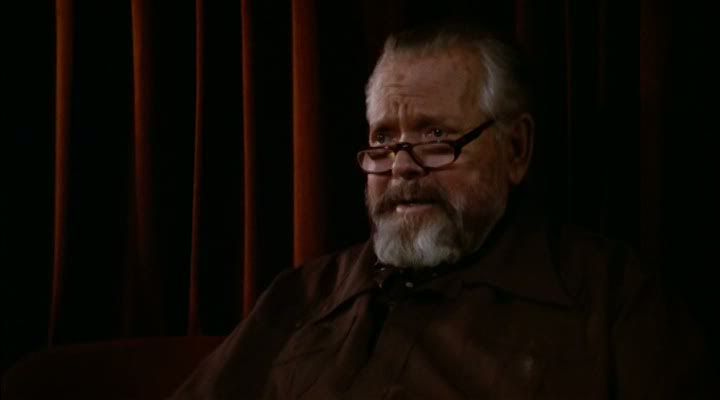
Towards the end of Henry Jaglom's Someone To Love, Orson Welles, playing an unnamed father figure who arrives mysteriously on the scene to dispense wisdom and prophecies of doom, asks the film's main character Danny (played by Jaglom himself), "why have you imposed this peculiar misery on your friends in a noble institution like the theater?" It's tempting to extend Welles' question, to expand upon it, to ask Jaglom, why have you imposed this misery on your audience? Because Jaglom's film is undoubtedly among the most painful cinematic experiences imaginable, an extended two-hour prediction of the most self-obsessed sitcoms that would arise in subsequent decades to take over the airwaves. Like a particularly unfunny and maudlin episode of its spiritual successor Friends, Jaglom's film spends virtually its entire running time wallowing in the miseries, insecurities and whiny banter of a group of aging show business types, all of them gathered in a dilapidated theater on Valentine's Day by Danny, who wants to create some kind of film/performance art/psychology hybrid by experimenting on his friends and acquaintances. His conceit — and by extension, Jaglom's — is that there is something about his generation, these aging boomers who grew up in the 60s, that makes them particularly susceptible to the condition of loneliness and an inability to make lasting romantic connections. So he gathers together everyone he knows who is going to be alone on Valentine's Day and invites them to a party, which in fact turns out to be some kind of group therapy session where he asks them all about why they're alone, how they feel about being alone, what they think causes them to be alone, and so on.

Yes, it's exactly as aggravating as it sounds, and exactly as solipsistic. Jaglom's work isn't funny enough to be a comedy, and it isn't exciting enough to be a drama, and its characters aren't developed fully enough for it to really work as the kind of Cassavetes-style fly-on-the-wall realism to which it so desperately aspires (Jaglom even namechecks Cassavetes at one point). The result is that nothing really cuts too deep, or makes one laugh, or creates any interesting tension. There are occasional ideas and lines of dialogue that have some heft, a frisson of intellectual vigor and insight into the lives of these people. At one point, Danny delivers a great speech about how the biological origin of loneliness must be intended to drive us towards each other, just as the feeling of hunger drives us to eat. At times like this, Jaglom cuts to the core of the issues he's dealing with, really engaging with his themes at a primal level. The same can be said of Welles' entire cameo appearance, both because Welles is such a powerful actor that his mere presence elevates any film, and because Jaglom gives this father figure some of the film's best material: an edgy, probing investigation of the effects of feminism and the sexual revolution on the nature of modern romantic relationships.

So it's not like the film is intellectually or emotionally bankrupt. There's undoubtedly substance to Jaglom's inquiry into romance, and one senses his sincerity. But he tends to bury his insights in a morass of chatter and nonsense, in a neverending torrent of regurgitated clichés. This might be bearable if the silliness and banality of the dialogue emerged in some way from the characters, if it felt organic to them, but the characters are mostly such flat, cardboard constructions that it's hard to get any sense of them as people at all. Moreover, most of the acting is at such a stagey, mannered, contrived level that it's constantly breaking the fourth wall, even when Jaglom isn't intentionally breaking it by hauling up all kinds of camera equipment onto the stage and having his actors speak to the camera as part of the film within the film. All this artifice is just another hurdle to leap in trying to get closer to Jaglom's ideas and characters (a futile effort, I'm afraid). Even Danny and his afraid-to-commit girlfriend Helen (Andrea Marcovicci), ostensibly the main characters, don't really develop beyond a very surface level: their whole dramatic arc throughout the film can be summarized as Helen being afraid to give up her independence by letting Danny spend the night in her apartment, and by the end making a slight concession that she may change her mind someday. Jaglom is after profound themes and big ideas, but he approaches them through the most mundane route, through the kinds of utter trivialities that could only be of interest to the most committed of solipsists.


Jules Feiffer, a dabbler in film and a masterful cartoonist and playwright, has pretty much perfected the kind of inquiry that Jaglom is after here. In his script for Mike Nichols' bracing Carnal Knowledge, and in countless cartoons for his now-ended weekly newspaper strip, Feiffer has traced the antagonisms and insecurities and self-erected barriers that plague the relationships between men and women in the modern age. Jaglom's dialogue constantly recalls Feiffer, and it's not a favorable comparison. These characters, who speak in self-aware psycho-babble and jittery self-analysis, are the kind of people who Feiffer would satirize and deflate, with merciless wit, in his best cartoons about the gender wars. Jaglom, on the other hand, doesn't want to poke holes in his characters, maybe because he's one of them, so he spends the bulk of his film indulging their whims, listening to their whining, allowing them to spill their utterly prosaic souls. And then, in order to have it both ways, he ushers in Orson Welles to take the piss for a while, to call them out for being whiny and annoying and self-obsessed. It's a welcome change of pace, and Welles basically says everything that any impatient viewer was probably shouting at the screen well before the hour mark, but it doesn't quite take the edge off the film's overall indulgence of such solipsism.

Ultimately, though, what hurts the film the most is not that one is forced to spend so much time with people who only want to look in mirrors, but that Jaglom lacks the cinematic panache — or the inclination — to do something interesting with this cast of bland characters. He's a poor man's Woody Allen, a poor man's Eric Rohmer, a poor man's Jules Feiffer. He's got all of Allen's neuroticism and insecurity, without the humor and visual craftsmanship. He's got Rohmer's inclination towards endless talk, without the French master's wit, emotional subtlety and pictorial sense. He's got Feiffer's archetypal themes and subjects without the insight and satirical bite. Worse, his filmmaking itself is amateurish and uneven. His cutting is inept, displaying all the distracting attributes of a theater director working in film: especially, the awkward reaction shots in which people, supposedly watching something happening nearby, seem to be in an entirely different room or maybe a different building. Sometimes Jaglom's looser moments, mostly involving the camera crew within the film, evoke Cassavetes with the informality and spontaneity of the aesthetic. More often, though, Jaglom's visual sense is stagebound and unimaginative, a perfect complement to his banal writing. It's impossible to watch this film without thinking of all the better films in this general style that one could watch instead. These comparisons are perhaps unfair to Jaglom, but mostly they're a function of boredom: if he'd given his audience something interesting to watch or to think about, they wouldn't have to think about other, better films instead.

Saturday, May 16, 2009

King Lear


To be or not to be? No. No thing. Nothing. That is not the question. The question is: to see or to hear? To show or to tell? Reality or image? Sound or silence? Or both? For Jean-Luc Godard, if Hamlet is the theater, King Lear is the cinema, so he abandons that "to be or not to be" stuff and focuses instead on the story of an old man and his daughter. The old man is sound, hearing. Lear, ear. The daughter is the image, what is seen. The father insists on words: he has specific things he wants to hear. But the daughter will say only "nothing." She can give, will give, only herself, her presence, her body: image, reality, but not sound. Leave it to Godard to find in this old play the elements of the cinema, to reconstitute the story of King Lear and Cordelia as the eternal conflict between sound and image, those interlocked but opposing forces that have tangled and wrestled their way through Godard's entire oeuvre, from the 60s onward.

Godard's version of Lear is a dense and allusive (not to say elusive) reworking of Shakespeare's play — a patchwork assembly reflected in the struggles of the historical researcher William Shaksper Junior the Fifth (theater director Peter Sellars) to reconstitute the lost works of his famous ancestor after a nuclear disaster destroys all of the world's culture. Godard, obsessed as always with resetting things to zero, imagines a post-apocalyptic world in which people and places are pretty much the same but culture and art have vanished. It's up to intrepid researchers like Shaksper — and Godard's own alter-ego Professor Pluggy — to set things right, to rediscover the combinations of elements by which stories can be told. Professor Pluggy might be an absurd concoction — a cinematic prophet with hair made of audio-visual cables, a cigar perpetually in his mouth, and a mumbled, slurred diction that makes him sound like he's narrating the film while eating breakfast — but he's the one who introduces Shakespeare's descendant to the idea of the image. It's Pluggy who allows the recreation of King Lear to progress beyond the stage of the word, beyond just writing.

Indeed, Godard's distrust of the written word is apparent from the opening section, his savage mockery of Norman Mailer, who wrote the original script for this film, re-envisioning Lear as a gangster picture, with Mailer to play Don Learo and his real daughter Kate to play Cordelia. Godard sarcastically calls Mailer "the Great Writer" and, while he replays the several repetitive takes the writer actually completed before storming off the film, Godard/Pluggy's voiceover deconstructs Mailer's contribution and the writer's failure to engage with the cinematic process, continuing to think in terms of words even after filming begins. But of course Godard saves his best takedown of Mailer for his sendoff, saying that the Great Writer leaves by airplane, Mailer and Kate flying first class, Kate's boyfriend flying economy.

With Mailer and his daughter gone, Burgess Meredith and Molly Ringwald play Lear and Cordelia for the remainder of the film, which amounts to film actors replacing people who were basically playing themselves: image replacing reality. This is one of the film's dominant themes, the interactions between the various layers and elements that go into creating a work of art. In one scene, Shaksper finds the wanderer Edgar (Leos Carax) in the woods, while his voiceover says that he finds Edgar and his girlfriend Virginia, but that the girl isn't there. And indeed, she isn't; only Edgar is onscreen, and Virginia (Julie Delpy) won't appear until later. This scene seems to be a throwaway, one of the many humorous non sequiturs scattered throughout the film, but it's also tied in with Godard's interest in dealing with words and images as opposing forces. The image shows, unequivocally, Shaksper meeting Edgar, but the voiceover suggests something stranger, something surreal and impossible to visualize: Shaksper meeting Edgar and a girl who isn't there. It's a simple scene, a joke even, but it's also a rumination on the differences between images and words. Words can lie, can be abstract or complex or have ambiguous meanings, but an image tells the truth, an image represents a thing in a straightforward way. Which is still not quite the same as documentary reality, as Godard proves by running the film backwards at one point, creating a strikingly beautiful image of a hand carefully placing petals back onto a stripped-bare flower.

This is one of Godard's many films in which he attempts to reconfigure the cinema from a razed ground zero. To that end, banks of video monitors toy with images, reminders of Godard's late 70s experiment Numéro deux, already over a decade old by the time he made his Lear. The soundtrack is even more unstable, constantly being disrupted, looped, turned back on itself: the sound slows down into a distorted warble, or breaks down, becomes repetitive. It frequently sounds as though a tape is being treated so badly that it's tearing apart, being warped and crinkled. The manipulations of sound are extreme. Indeed, everything is extreme here, from the bizarre cast — Woody Allen even makes a cameo at the end as an editor who stitches film together with a needle and thread — to the fragmentary quotations of the Shakespeare play to the near-slapstick gags scattered throughout the film. This masterful but underseen film is Godard's dense, typically playful attempt to break cinema down into its constituent elements, to treat this hybrid medium like a warring family, and to attempt to reconcile father and daughter, fiction and reality, image and sound.

Wednesday, March 4, 2009

Law of Desire


Pedro Almodóvar's Law of Desire is a very strange movie, perpetually stuck between genres and never quite settling into any one mode for long enough to make a real impact. It's often entertaining — and even more often so bizarre that it's at least hard to look away — but in the end only isolated moments linger beyond the ephemeral moment. It's a dark comedy that isn't actually very funny, a melodrama so ridiculous it challenges even daytime soap standards of believability, a half-hearted murder thriller whose villain is one of the film's goofiest characters. And so on... Through all this wackiness, Almodóvar never quite dismisses the possibility that he actually means for this to be a moving drama, but then he'll follow up a genuinely touching moment of emotional depth with something so silly that it becomes impossible to take anything here seriously. It's a confused (and confusing) pastiche, and admittedly a rather fun whirlwind ride despite its flaws.

Almodóvar changes the seeming story as often as the film shifts moods, but it's basically about the famous gay film and theater director Pablo (Eusebio Poncela), who pines for his absent lover Juan (Miguel Molina) even as he starts up a fiery new relationship with the clingy, insistent Antonio (Antonio Banderas), who maintains that he's always been straight but who jumps wholeheartedly into this gay relationship anyway. The film sometimes seems to be about this romantic triangle, with Pablo still in love with Juan, angering the possessive Antonio. And sometimes the film is about Pablo's sister Tina (Carmen Maura), a transsexual who stars in his films and plays. Frankly, whenever the focus is on Tina, this suddenly becomes a much more interesting film. The young Banderas, still several years from his Hollywood breakthrough, brings a playful nuttiness to his part, and he's fun to watch, but Maura's tempestuous, flighty performance is a true wonder. Tina is a rich, unforgettable character, much more nuanced and memorable than Pablo, the film's ostensible protagonist, or anybody else in the film; she steals the film from everyone. Her backstory is complicated and absurdly melodramatic, and doesn't spill out until towards the end of the film, but what's obvious throughout is that she's a damaged woman who's given up on romantic, sexual love long ago. Instead, she pours herself into her love for her brother, and for the little girl she's adopted, the feisty Ada (Manuela Velasco).

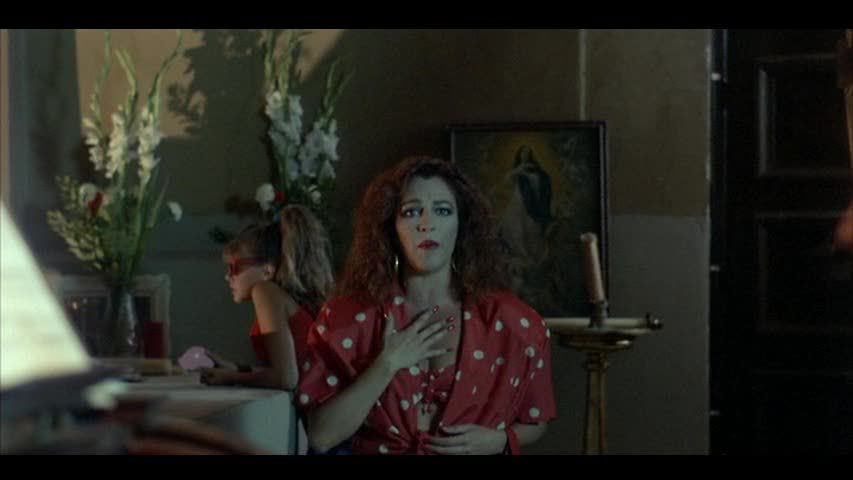
Tina possesses surprising depths of religious feeling, even if she does practice a religion pretty much of her own making: she and Ada build a lavish shrine to the Virgin Mary in their living room and pray to the statue for very personal intercessions, all of which, from Ada's wide-eyed point of view, promptly come true. The film's sense of spirituality is as cock-eyed as everything else about it, but there's a certain profundity to the scene where Tina, entering a church where she sang as a young boy, abruptly bursts into operatic song, singing along soulfully with the priest at the organ. It's in Tina that the film's emotional core is located, in her poignant feelings about her tortured past and her distrust of men. Her history suggests that she's Almodóvar's version of Fassbinder's Elvira from In a Year With 13 Moons (she even gets her sex change in Morocco, like Elvira), but she's ultimately much more comfortable in her skin, and her chosen gender, than Fassbinder's character. She's a real woman in every way, and of course it helps that she's played by a real woman, too. Almodóvar even makes this into a subtle joke when he introduces Ada's biological mother, played by the very convincing real-life transsexual Bibiana Fernández, who is only given away by her deep bass voice, with its surprising resonances emitting from her distinctly feminine form. The "real" woman plays a transsexual and the real transsexual plays a mother, one of the many ways in which Almodóvar slyly pulls the rug out from under things.


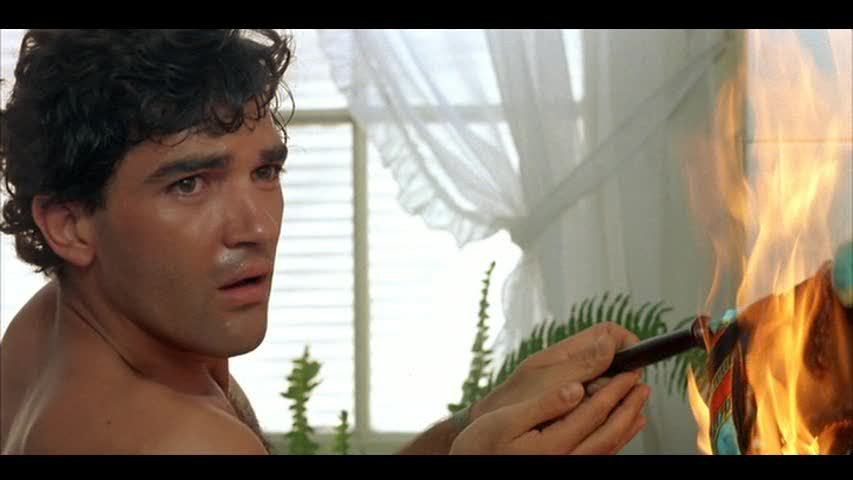
If Tina's story is often moving and beautiful and funny, the rest of the film sometimes seems to be struggling to come up with something equally compelling whenever she's not on screen. Poncela is wanly effective as the reserved, egotistical Pablo, dealing with two men while trying to bring together his latest project. But his story just isn't that interesting, and it goes completely off the rails in the film's second half when Antonio's increasing obsessiveness introduces some low-key thriller elements, even as the melodrama begins spiraling out of control. By the time Pablo winds up in a hospital, a total amnesiac after a grief-stricken car accident, one can only laugh at the craven silliness of the plotting. Even less explicable is Pablo's late-blossoming love for the batty Antonio, which renders the over-the-top final scenes utterly laughable — and really, what other response is there when Pablo's emotional outburst seems to cause the spontaneous combustion of his typewriter and Tina's shrine to Mary? It's as though the film has suddenly and incongruously morphed into one of those action movies where something is required to burst into flames in every scene, whether it's plausible or not.

The film is undoubtedly a mess, but an entertaining mess at least, and Almodóvar's visual style is never less than striking. He crams the film with playful stylistic touches, like the fade from a closeup of Pablo's eyes to the spinning wheels of his car, the hubcaps aligning perfectly with his pupils. There's also the sensual beauty of a wonderful scene where Tina, Pablo and Ada walk beneath the glistening arc of a hose's spray, marveling at the ethereal beauty of the water's perfect arc until Tina demands that she be soaked by the spray. The trio are a rough surrogate family, decidedly non-traditional but more loving and stable than the supposedly more conventional family Tina and Pablo had as kids themselves. Even while trapping this makeshift family within an increasingly outrageous and silly narrative, Almodóvar shows great respect for their nobility, their strength, their emotional riches. The film often seems on the verge of falling apart, but Tina, funny and fierce and independent and one of the cinema's great characters, never does.

Wednesday, October 3, 2007

10/3: Radio Days


It's often been said that Woody Allen's version of New York is strictly a pretend New York, a world that exists only in his mind and is populated by exaggerated versions of real-life people. Strangely, this is most often said as a criticism. In fact, this aspect of Woody's work has given him many of his best films, and I think it's fair to say that he embraces the fantasy of his vision of New York. His best films have the air of nostalgia for a time that never was, a mix of poignancy and wit that makes these stories feel incredibly real as a whole, even as we realize that the individual details are greatly exaggerated or skewed. Nowhere has this been more true in his oeuvre than in Radio Days, his loving and deeply moving tribute to the dramatic importance of the radio in his childhood. Radio Days is narrated by Woody, and structured as a series of vignettes about radio celebrities and anecdotes about growing up in the radio era, with Woody's childhood stand-in (a very young Seth Green) and his extended family at the center. Nostalgia and remembrance have always been central to Woody's aesthetics, and this is his best distillation of those themes yet.

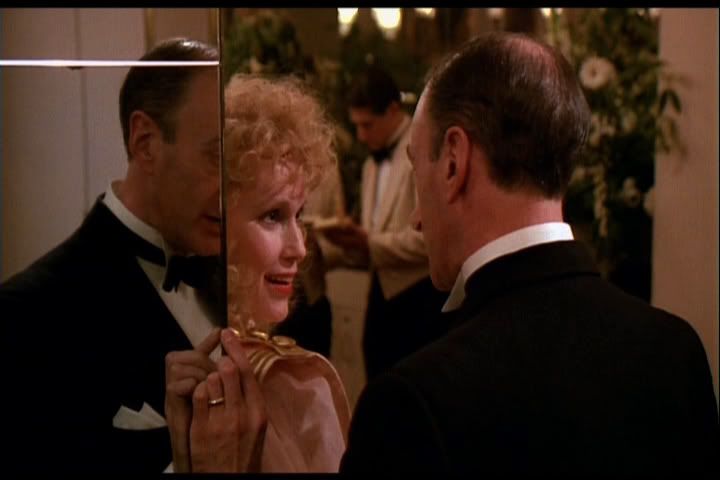
This is another extremely warm film from Woody, building on the bittersweet atmosphere of Hannah and Her Sisters, balancing poignant reminiscence with a distance and humor that keeps it from becoming too sentimental. There are too many great scenes to name here, and Woody's wry narration holds everything together whether he's recounting a glamorous celebrity legend or a charming childhood memory. The opening scene, in which two burglars find themselves as contestants on a radio show in the midst of a robbery, sets the tone of gentle absurdity that winds through the film. Several of the stories reappear throughout the film, providing at least some through-line for the narrative. Mia Farrow gives a great turn as the wannabe star Sally, yet another chameleonic performance as she puts on a thick and squealing New Yawk accent. And the family that forms the film's centerpiece is teeming with wonderful caricatures. Dianne Wiest shines as ever as the spinsterish aunt who dates a succession of losers but can't seem to find a good guy. Julie Kavner and Michael Tucker are great as Woody's parents, affectionately bickering and sparring and poor, but with a clear love for one another. Best of all is Josh Mostel as Uncle Abe, who has a connection in the fish markets and thus keeps the family constantly supplied with more fish than they'd ever want. He has a wonderful scene when he sets out to tell off the communist next-door neighbors for blasting their radio and working on the sabbath; he winds up coming back spouting communist rhetoric and decrying religion instead. There's a wealth of such incident and character here, all of it packed with detail and nuance, humor and emotion.

This is yet another entry in a near-unbroken string of masterpieces Woody Allen made throughout the late 70s and 80s. Am I getting tired of saying that yet? Not really, if it means I get to keep seeing such wonderful films. Radio Days looks at the past through the filters of nostalgia and imagination, looking at the world as it was from a child's eye view. It's a world where German submarines cruise just offshore, the sexy substitute teacher dances naked in her window, and mob hitmen turn witnesses into radio stars instead of whacking them. There's so much going on here that it all flies by in a dizzying whirl, a 90-minute trip into an imaginary past and a visit with its wild denizens. When the final scene, the delirious New Year's bash on the roof of a Manhattan club, finally closes on the empty roof and a few stray snowflakes falling, it produces a simultaneous feeling of satisfaction and sadness over the loss of this bygone era and all it represented.