Showing posts with label 1993. Show all posts

Wednesday, November 7, 2012

The Eye of Vichy


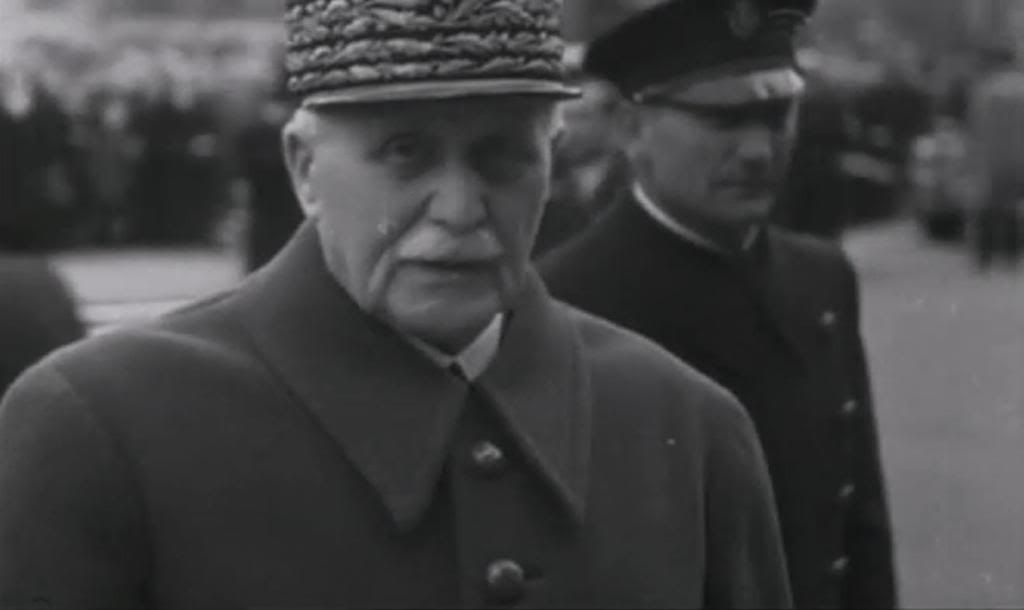
Claude Chabrol's The Eye of Vichy is a fascinating documentary that collages together newsreel footage and propaganda films from the Vichy era in France. This compilation of materials shown in French theaters between 1940 and 1944 is presented almost without comment. A narrator introduces the film with a condensed history of World War II leading up to the invasion of France and the establishment of the Vichy regime, and thereafter the narrator mostly falls silent except for providing occasional snippets of historical context. The film is thus constructed primarily from Vichy's own transmissions, the propaganda and slanted news shown to French citizens during the war. As the text at the beginning of the film says, this is France not as it actually was during this period, but as the government wished people to think it was. This is a montage of primary sources that lays bare the lies and distortions that served as a cloak for the Vichy government's sinister collaboration with the Nazis.

Much of Chabrol's fictional oeuvre is concerned with probing the pathetic absurdity and ugliness of the surface presented by bourgeois culture; his films simultaneously document the appearance and the filthy reality underneath. This documentary, otherwise so different in form and content from the rest of Chabrol's work, actually has a similar thematic focus, using the Vichy regime's self-presentation to pick at the ugly truths that are never quite obscured by the gloss of propaganda. One of Chabrol's guiding principles in his films has always been that one can tell a lot about a culture by the lies it tells (about) itself, which is why he has always been so successful in deconstructing and ridiculing bourgeois culture. Here, he turns that same incisive eye for the significance of lies on an entire government founded on lies. This seemingly straightforward presentation of those lies, with only limited overt commentary, reveals a great deal about the workings of Vichy France.

Much of the propaganda collected here is of the usual sort, idealizing and idolizing the new rulers of France — even if sometimes they're replaced, without ceremony, weeks later — and presenting rosy depictions of Franco-German harmony. One particularly twisted piece, intended to discourage French dreams of liberation, is a cartoon in which the Allies are depicted as Mickey Mouse, Popeye and Donald Duck, planning to bomb France while the British broadcast duplicitous messages of peace. Chabrol mostly lets the material stand on its own, only occasionally correcting the particularly subtle lies. The propaganda is so crude and obvious that, for the most part, no comment is needed.

At times, the propagandists can even be startlingly open about the horrors of the situation. One newsreel speaks of Resistance fighters killing two French officers, and says that 50 men have been killed in reprisal, and that 50 more will be killed tomorrow if the culprits aren't caught. It's so offhanded, so casual in the way this propaganda piece admits to mass killings — and who did they kill, exactly? Obviously, in the name of inspiring fear, the regime sometimes admitted to its own violence and repression.
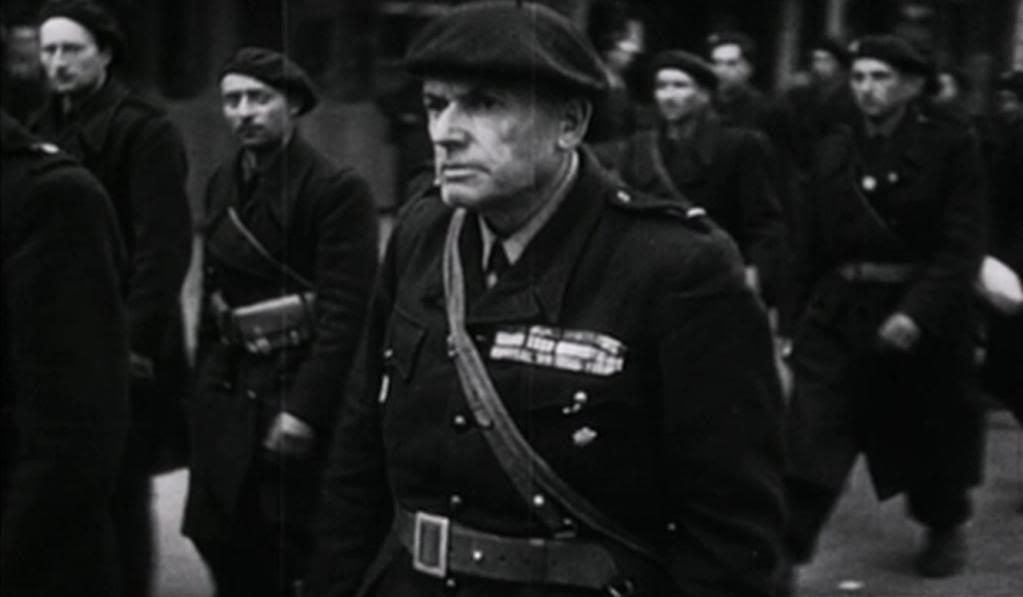

Indeed, one striking feature of this footage is how often the propaganda echoes, almost subconsciously, the atrocities committed by the Nazis and their allies. The newsreels repeatedly show trains running between France and Nazi Germany, but of course these are not the trains loaded with Jewish prisoners, destined for the concentration camps. Instead, the films show trains leaving for Germany full of French unemployed people, supposedly going to Germany to work, waving goodbye with a smile as the train rolls out of the station towards the east. The trains also bring back French prisoners of war from Germany, with sentimental scenes of returning soldiers embracing their wives, childrens and dogs. In another sequence, made shortly after Germany's invasion of Russia, the French propaganda abruptly turns on the Bolsheviks with an exposé of a Soviet embassy in Paris, revealing the hidden passages and peepholes and, chillingly, some seemingly innocuous stoves that the news announcer compares, apparently without shame or irony, to crematorium ovens.

Later in the film, in one of the few overt examples of Chabrol's editorial commentary, Chabrol juxtaposes images of happy French children heading to the countryside on vacation with a dry recounting of the numbers of Jewish men, women and children arrested and shipped to camps during the same summer. The sequence continues with a documentary on the wartime gas industry in France, and another on the recycling of hair from barbershops into raw material for clothes. The narration continues to explain what the films, of course, do not, that during this period Jews were being sent en masse to Auschwitz for "immediate extermination," their bodies burnt up in ovens, their heads shaved, their possessions stripped and stolen from them before their deaths. The sequence is chilling, with the dispassionate voiceover probing the unspoken truth that Vichy hid in favor of these dry industrial documentaries, the imagery of which is nevertheless eerily resonant with the real state of things.

Another informational piece collected here celebrates the destruction of old, pre-war films to make shoe polish and nail polish, showing images of pre-war film stars melting down, piles of film stock being thrown into processing machines that turn them to muck. That disregard for celluloid must have especially galled the cinephile Chabrol, but more than that it represents an antagonistic perspective towards history and culture, a wish to erase the truths of the past and replace them with the new, manufactured history of the Nazis and Vichy. The new authoritarian regimes of the fascist block exerted complete control over the image, and any images that could not be controlled were simply destroyed. Chabrol's film is a potent and informative rejection of that ethos: rather than destroying the images of this hateful past, he assembles them into a historical record of repression and denial, incontrovertible evidence that some might like to see burnt up, recycled for consumer products. If Vichy tried to erase the past and lie about the present, this film presents these images for all to see, preserving rather than destroying the past.

Monday, April 4, 2011

The Tree, the Mayor and the Médiathèque


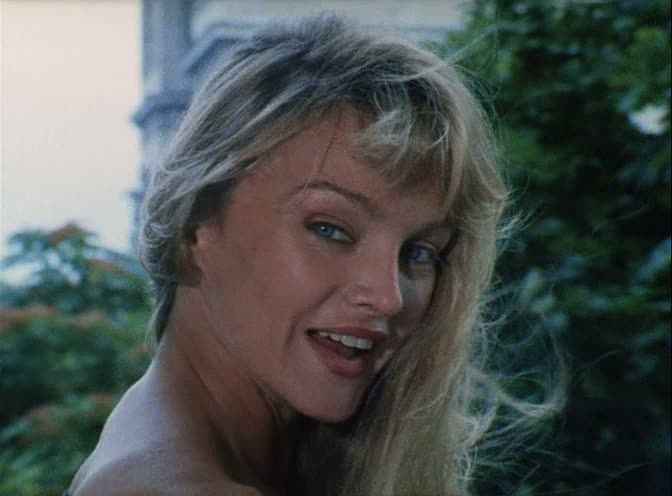
Eric Rohmer's The Tree, the Mayor and the Médiathèque is a charming country film, a kind of political romance centering on a rural mayor's plans to build a comprehensive cultural center in a small rural town with a declining agricultural tradition. The mayor, Julien (Pascal Greggory), is a socialist who believes that his bold plan for a big center combining a theater, a cinema, a sports complex and a library will revitalize the countryside. Not everyone agrees, from his novelist girlfriend Bérénice (Arielle Dombasle), who's skeptical of the project's ambition to be modern while blending into the country, to the local schoolteacher Rossignol (Fabrice Luchini), who's mortified by the project's prospective erasure of a whole tract of beautiful green land. The film consists largely of a series of conversations, between these characters and others, that become debates on the oppositions of right and left, city and country, progress and conservation, tradition and modernity.

Julien's project, his grand ambition to reshape the country, is posed as a leftist idea, as a way to invigorate a countryside that's been decimated by the changes of industrial agriculture — the few small farms left are struggling and it's obvious that many more will have disappeared within a few more years. Thus Julien can position the ecologists, the nature-lovers and conservationists, as "reactionaries" in his political vocabulary: the left wants to develop the country, to institute progress, while the right gets hung up on a few trees that would be uprooted, a few picturesque views that might be tarnished. It's a neat reversal, one that illustrates just how fluid the definitions of right and left can be, and how inadequate such dialectics can be for encompassing the complexity of real politics. The magazine editor Régis (François-Marie Banier) and his reporter Blandine (Clémentine Amouroux) also identify as leftists, but they have very different visions of this leftism from one another and from Julien. Régis is a political dogmatist who seems to think in terms of taking sides, and thus looks on Julien's local politics as a distraction from the broader theoretical dialectics that define political philosophy on a national scale. Blandine, on the other hand, keeps her own opinions largely to herself, arguing first one way then another, a true journalist who seeks to clarify and identify the views of others.

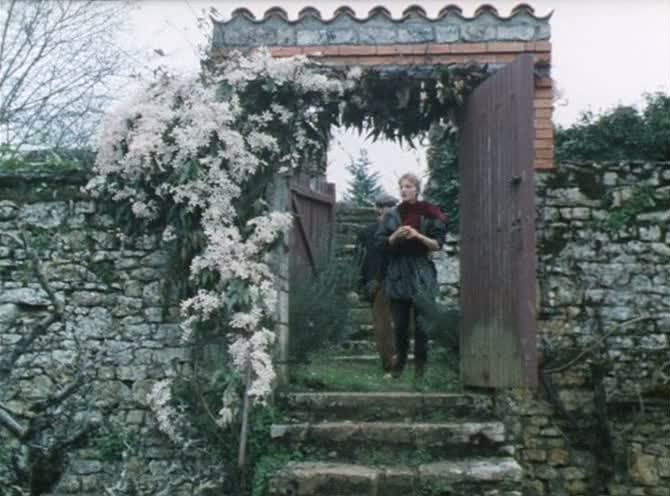
These conversations circle around the same issues again and again, using this small local issue as a focal point for discussions that are often very dense and theoretical but never dry. There's something charming, even playful, in the film's endless dialogues. In the early scenes, Julien walks around his garden estate with Bérénice, explaining his project to her as they examine the plants, flowers and vegetables growing on his expansive grounds. The two are talking about abstract and political issues, debating the importance of the proposed cultural center and quibbling over the authenticity of a modern building that would be styled to blend in with the aged local architecture, even appropriating stones from disused local buildings. Their conversation is thus impersonal and political, at least on the surface, but the way they talk to one another is flirtatious and charming, as though they're courting one another through talk that seemingly has nothing to do with romance or love. The quick-witted repartee is fluid and spontaneous, establishing the comfort of these lovers with one another and their intense interest in one another: they're talking about rural development and local electoral politics, but the subtext is much more personal.


Just how personal is revealed in Bérénice's references to the beach: "I don't do anything at the beach either, but I don't get bored there." Sure, because for Rohmer the beach is the site of sexual intrigues, of dalliances, of fleeting loves and summer romances — the territory of Pauline at the Beach or the sensual opening of A Winter's Tale. Of course, Dombasle herself was a star of Pauline at the Beach, and Greggory was in the film too, so the reference seems especially self-conscious, an acknowledgment that, as in many of Rohmer's films, these particular actors have been chosen for the continuity they provide with the director's previous work. The rural paradise of this film is thus connected to the seaside retreats of past films, and these characters who charmingly chat about politics are associated with other Rohmer heroes and heroines who were more overtly concerned with love and sex.

Rohmer also uses the landscape itself as a counterpoint to all these words. Julien can be very eloquent about the appeal of his project, very convincing, but his vision of reinvigorating the countryside is continually belied by the vigor all around him. The beauty of the country, its peace and warmth, seems to be mocking his belief that anything further is needed. The early scenes when Julien walks around the garden with Bérénice are especially bucolic and lovely, but the whole film is an ode to greenery and lushness, as the bright hues of the countryside provide an evocative backdrop to the characters' perambulations. It's as though the landscape is conspiring to subtly support the perspective of Rossignol, with his passionate, verbose defenses of unspoiled natural beauty. (Luchini, another Rohmer veteran, delivers a lively performance as the schoolteacher with an activist's angry conviction and a defeatist's pessimism.)

By the end of the film, it's obvious that Rohmer is having a bit of fun at the expense of political conviction itself, suggesting that "the people" about whom everyone purports to care so much will just continue to make their own way through life while grand political ambitions thrive or fail with little concrete impact. Julien is pompous and loves to hear himself talk, and a big part of his project is certainly the feeding of his own ego. Rohmer absolutely demolishes the character in a scene where he stomps back and forth, delivering a grandstanding political oratory to a ten-year-old girl who has just thoroughly out-argued the politician. But Rohmer doesn't eliminate the character's appeal; Julien is at least refreshingly unconcerned with being the "right" kind of socialist or politician, an issue that concerns the much more dogmatic Régis a great deal.


That dogmatism is a leftover of the sectarian squabbling of '60s leftists, even though Régis himself castigates that very mentality. At one point, Régis makes reference to the "totalitarianism" and Maoism of 1968, which seems to be a bit of a jab at Godard and the other New Wave filmmakers and youths who fully embraced the radicalism of that era. It's also an acknowledgment that all extremism — all idealism, perhaps — is ultimately totalitarian to the extent that one wants to impress one's own vision of the world onto others. Everyone in the film keeps arguing for their own way of thinking, their own perspective, based on their relative weightings of the values they hold dearest, without pausing for a moment to consider other ways of thinking, other possibilities.

That's why it's so refreshing when Blandine, gathering material for a story on Julien's project, doesn't just talk to Julien and Rossignol, but wanders around the rest of the village, talking to farmers and local residents, asking them questions that are more theoretical than directly about the project itself. It turns out that people have their little dissatisfactions and their big problems, that they have some small ways they could imagine improving things, that they're as stumped as the politicians about the big issues, and that none of these people align neatly with the clichés imposed upon them from outside. After all the circular debate and philosophical blather of Julien and Rossignol and Régis, it's great to hear real people talk about their real lives, and these sequences have the quality of a documentary interlude spliced into the fictional film. The locals provide an alternate perspective to the more dogmatic competing ideologies of "progress" and "ecology" represented by Julien and Rossignol, respectively. The women, too, provide a counterpoint to the men, as both Bérénice and Blandine play the role of "devil's advocate," the latter quite literally in her role as a reporter asking questions, and the former more subtly as she deflates Julien's ambitions with deliberate provocations while playing the part of the unapologetic urban woman of the world.

The film ends with what's basically a shrug, as the project falls through and country life returns to normal. The finale takes place at a park where the locals are holding a community fair, everyone picnicking and having fun, children running around, playing games, the beauty of nature surrounding them all. In the midst of this idyll, all that's left for the principal characters to do is to sing, to face the camera in some of the film's very first closeups, brazenly breaking the fourth wall as they narrate this saga's disappointments and lessons in song. It's a wonderfully unexpected finale, playful and flippant, but also so very wise. Sometimes, it's far better to cast all the politics aside, to play in the meadows and sing. At the end of the film, these characters put aside their debates and their rhetoric and allow themselves to be seduced by the sensual pleasures that had been wrapped around them, verdant and ripe, throughout the film.

Wednesday, April 15, 2009

Films I Love #27: Three Colors: Blue (Kryzysztof Kieslowski, 1993)


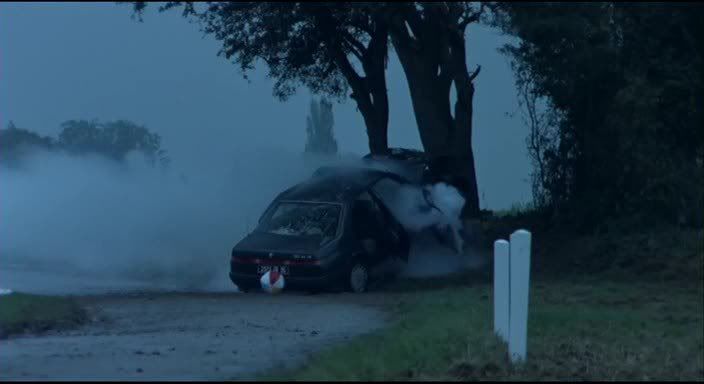
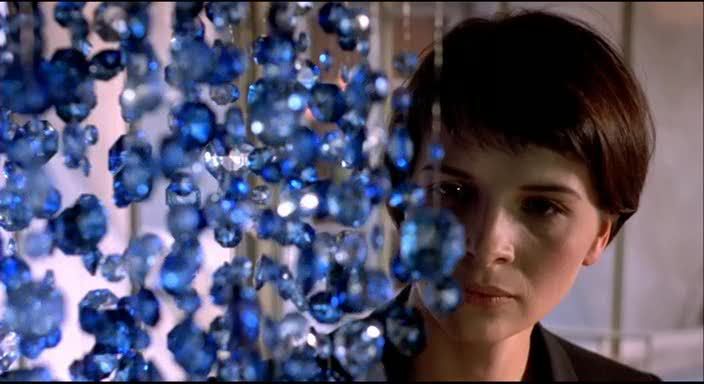
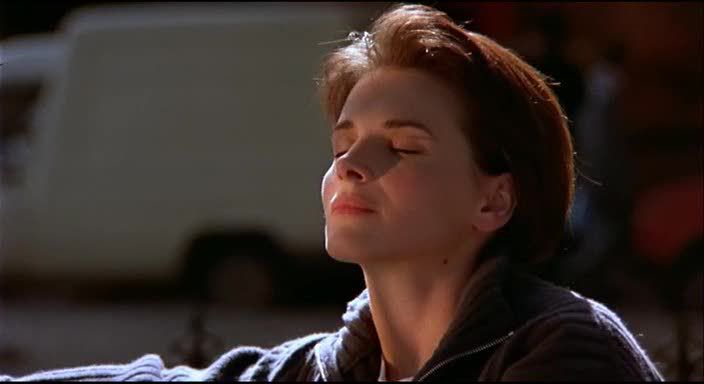
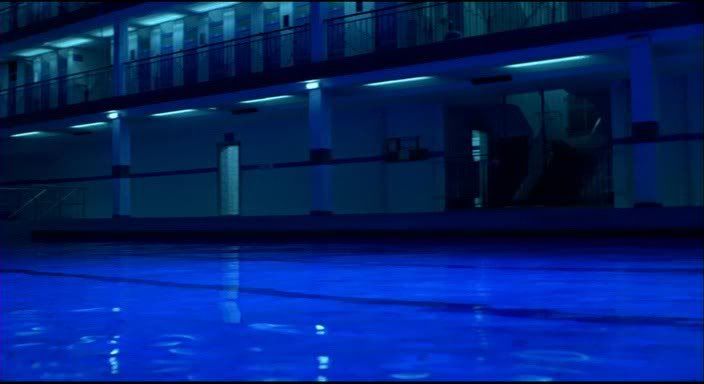
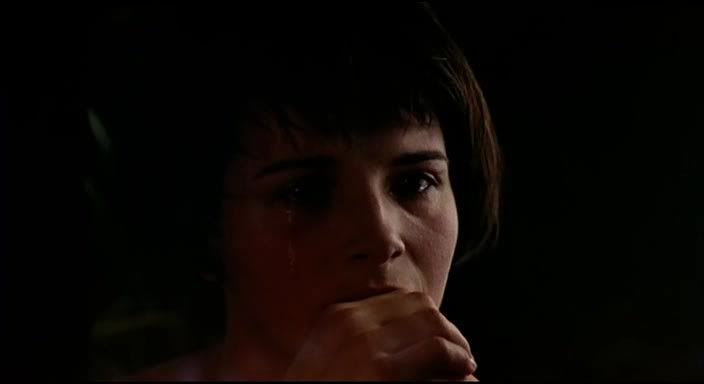
Blue, the first film in Krzysztof Kieslowski's Three Colors trilogy, is a gorgeous, understated film about the grief of a young woman, Julie (Juliette Binoche), after losing her husband and daughter in a car accident. It's a tender, quiet, meditative film, chronicling Julie's withdrawal from, and subsequent reemergence into, the world. The film is richly sensual, tracing the ways in which the sheer physicality of life draws Julie slowly, inexorably out of her introspective despair. In the devastating absence of those things that had previously given her life its meaning, Julie finds comfort and then a new kind of meaning in the sensual experience of the world, in the simple enjoyment of ice cream and coffee, in night-time swims at a pool of an unearthly deep blue, in the feel of golden sunshine warming her face on a nice day. Kieslowski experiences these things with Julie, luxuriating in the texture of coffee soaking up into a sugar cube or the crystalline blue of the wind chime ornament hanging in her room. It is a haunting, gentle film, driven as much by moods (and emotive classical music) as by incidents. Its plot meanders casually in the background, affecting Julie in quiet ways but never disturbing the film's surface calm.

Monday, November 24, 2008

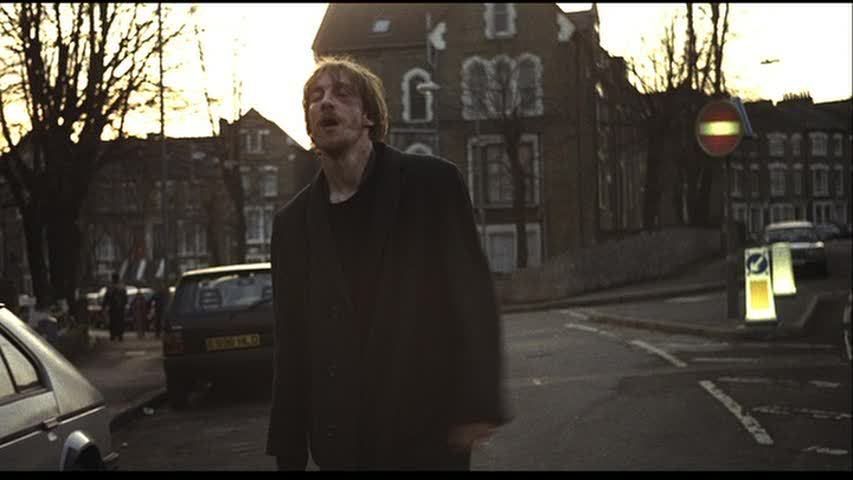
Films I Love #8: Naked (Mike Leigh, 1993)


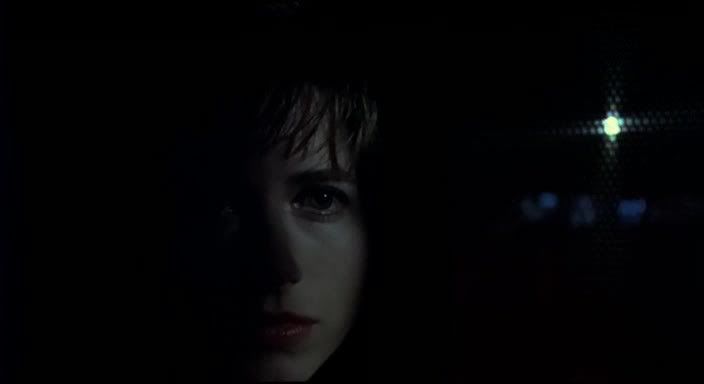
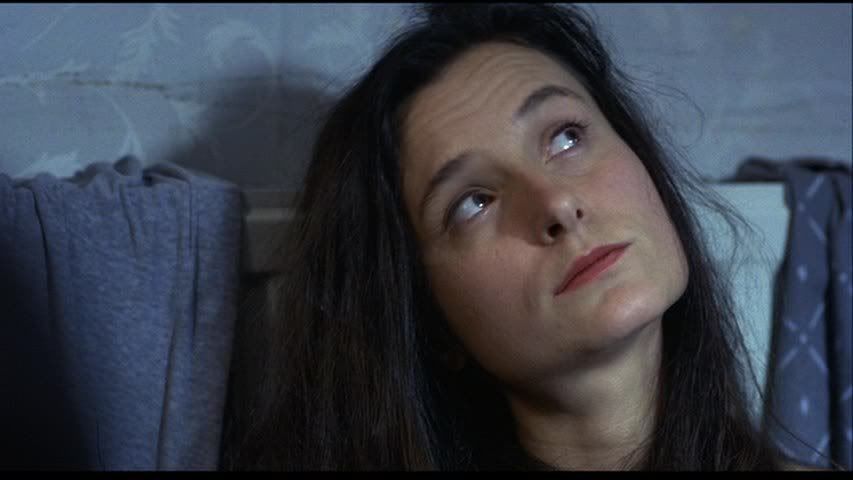
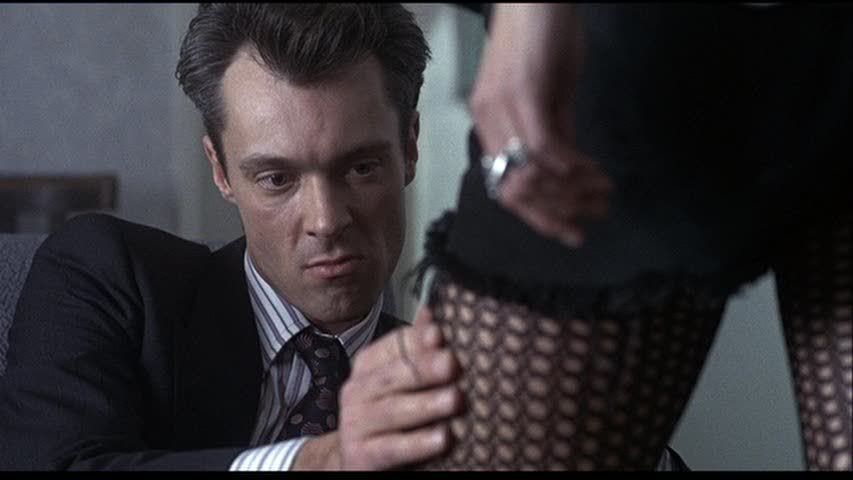
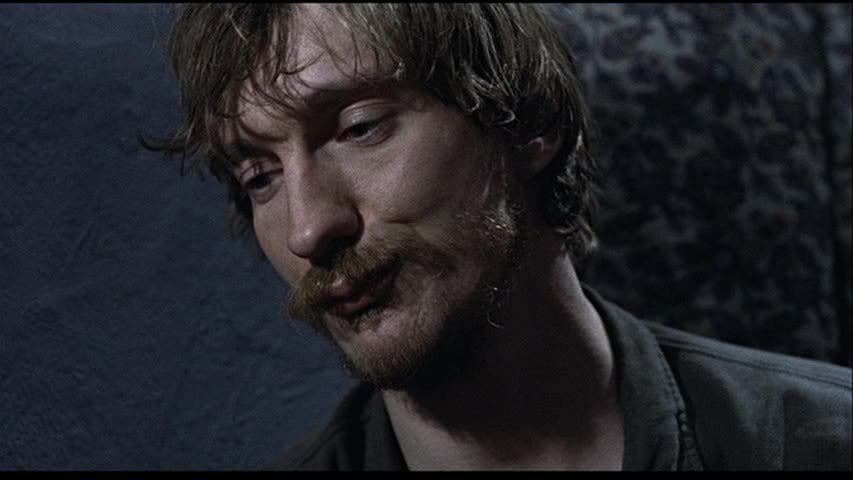
Johnny (David Thewlis), the homeless, wandering central character in Mike Leigh's Naked, issues a profound challenge to audience identification right from his first appearance on screen: in the opening minutes of the film, he violently rapes a girl against an alley wall, fleeing afterward through shadowy streets until he stumbles upon an unattended car he can steal. He is, to say the least, not an especially likable protagonist, but Leigh nevertheless trains his camera on him, sticking with him and the other downtrodden characters he encounters on his rambling adventures. Johnny doesn't necessarily get any more likable, but he does become more sympathetic, more complex, even in some strange ways taking on the voice of the film's moral compass. In an urban wasteland that offers few opportunities — and none that the restless, angry Johnny would want to consider — Johnny's half-crazed rants about political exploitation, homelessness, and the fulfillment of apocalyptic biblical prophesies in the form of the bar code begin to sound, if not reasonable, then at least understandable, a natural extension of this landscape. The film is anchored by Thewlis' fearless performance, investing tremendous energy into the unhinged Johnny, drawing out both his undirected universal anger and his surprising (if often short-lived) moments of warmth and tenderness towards his fellow down-and-outs. Leigh's camera lingers on Thewlis and the other actors for revealing close-ups that capture this expressive troupe of born character actors (Karin Cartlidge, Lesley Sharp) at their most unveiled and even transcendent. The film's probing, mordantly funny social critique of working class London is by turns sharp — a wonderful sequence with a bored night watchman (Peter Wight) who refuses to believe that he has no future — and utterly brutal, a hammer to the head — the creepy, sexually sadistic landlord (Greg Cruttwell) whose profound sense of smug upper-class privilege makes him a much more dangerous evil than Johnny's more diffuse outbursts of misdirected violence.

Monday, August 4, 2008

Hélas pour moi


Jean-Luc Godard's Hélas pour moi opens with the title "based on a legend," while a voiceover recounts a story that has the rhythms and symmetry of myth: a certain ritual is passed down from generation to generation, with each subsequent generation forgetting more and more parts of the ritual, but finding that it still achieves its intended purpose even in debased form. Finally, every detail of the ritual has been forgotten, and the only recourse left to the last generation is to tell a story about the ritual. It's a progression from action to thought, from the world to the abstract, from the spiritual to the theoretical. This is Godard's treatise on the idea of history as myth, a fitting way to open a film which takes as its premise a story from Greek mythology. This opening speech is melancholy and moving, the weary proclamation of a man saddened by the disconnection from spirituality implied in these words. And yet it's also a somewhat hopeful sentiment, emphasizing the importance of stories (and by extension art) to a culture increasingly out of touch with its history and its spiritual roots. The similarity in the French words histoire (history) and histoires (stories) is more than semantics or wordplay for Godard; it's a deeply symbiotic relationship in which the essential single truth of history fractures into multifaceted storytelling and endless variations on stories. It's this resonance that caused the filmmaker to title his historical video project Histoire(s) du cinema, indicating the tension between historical truth and cinematic narrativizing, and it's a resonance that is every bit as present in this film.

As this meandering introduction should make clear, Hélas pour moi is a typically confounding and multi-layered late work from Godard. The promise of the opening titles, the "legend" on which the film is ostensibly based, only emerges slowly from a dense web of allusions, quotations, and overlapping verbal confusion. It is only after roughly an hour of this material, in which characters come and go in seemingly random vignettes, that the actual story takes shape: a story of a god visiting Earth in the guise of a man, adapted not from any Christian fable (though this is unmistakably a Christian god) but from one of many myths in which the Greek god Zeus took on disguises in order to make love to a mortal woman. It's a perfect framework for Godard's characteristically gnomic exploration of spirituality, love, and storytelling — this last theme a perverse joke from a filmmaker who has never been as obtuse or willfully obscure as he is in this film. The film is structured around a large cast who are largely indeterminate in their relationships, roles, and purposes. There are a group of students and their professors, a video store owner and his staff, a tennis star (Jean-Louis Loca), a doctor (Marc Betton), and many others, who wander in and out of the film, speaking in philosophical and political fragments mingled with overly polite chit-chat. There is perhaps no film in which the words "Monsieur," "Madame," and "Mademoiselle" appear more frequently, because characters are continually greeting each other in passing, with a formality and a head nod, as they roam from one ambiguous scene to the next, often accompanied by Godard's sideways tracking shots. The only concession to the likely adrift audience is the investigator Abraham Klimt (Bernard Verley), who in trying to figure out what exactly is going on here mirrors the journey of the audience into Godard's baffling film.

The narrative only achieves clarity and coherence in the final half-hour, in which Godard finally winnows the cast down to mostly just two: Simon (Gérard Depardieu) and Rachel (Laurence Masliah), a married couple who get in their first fight when Simon decides to leave on a business trip. Along the way, he is possessed by a deity (Harry Cleven), a shambling nomad with long hair and a raspy, distorted voice, a character who existed on the edges of the film previously, occasionally narrating scenes with his voicebox-processed speech. In a remarkable shot, Godard has this very ordinary icon of God sneak up behind Simon. Simon's face fills the frame in close-up, while the god is hazy and out-of-focus in the background; as he steps up behind Simon, he puts his hat on the other man's head and then ducks down behind him, and a low-budget possession has taken place. Simon has been taken over by the spirit of God. Such unassuming miracles are not only a budgetary necessity for Godard, but an expression of his very practical understanding of spirituality as something intimately connected with the physical world, rather than beyond it. This very physical, human spirituality earned him accusations of profanity and blasphemy for Hail Mary, in which his retelling of the story of the Virgin Mary explored very similar issues of carnality, religious feeling, and human love. For Godard, spiritual and physical love are, if not exactly the same thing, then very closely related — the love of God for humanity is redefined as the love of two people for each other. In one scene, Rachel expresses this connection when she identifies the gesture of an embrace, locking one's hands together around a lover's body, as being the same as the folded hands of prayer.


Godard's spirituality is also expressed in his appreciation of natural beauty, so it is appropriate that this is one of Godard's most landscape-obsessed films. Some of these landscapes recur at intervals. A single curvy stretch of road, a thin snake of concrete amidst a sea of green dotted with bright red flowers, appears several times, at various times of day, its lonely beauty altered by the quality of the light that illuminates it. Time is an undercurrent in all of Godard's most recent work, and here especially he is more concerned with time at a micro-level, rather than the historical sense of time that animates his more politically motivated films. In one scene, a woman's face is initially illuminated by bright, white light, an overexposed image that is soon softened through digital manipulation that restores a more natural daylight aura, and then continues dimming into a blackened twilight where the woman's face is obscured in shadows. This is cinema as time, the artificiality of cinematic techniques recreating the passage of a day from noontime glare to evening's shadowy gloom. There is an emotional quality to Godard's treatment of time, as when God, posing as Simon, tells Rachel that mortal creatures first smiled when they understood the concept of time — and by extension, gained the knowledge of mortality. This is a frequent theme in Godard's cinema, how pleasure is intimately linked with death. Godard, always intrigued by opposites and dialectics, instinctively knows how impending mortality intensifies human emotion. This is, perhaps, what an immortal god could never understand about his creations.

Godard's use of landscape is also intriguing to the extent that he repurposes nature as a frame for the film's sometimes obscure human drama. Godard uses insert shots of landscapes, sunsets, and flowers as structural foundations, oblique connections between scenes within a structure whose overall boundaries are anything but clear. But he also uses the natural world to provide frames within the frame. Trees are especially important in this regard, frequently appearing as dividers. Godard shoots many scenes from around, behind, or between trees that frame the action, cutting up the film frame into smaller divisions created by natural boundaries. In some shots, an explosion of leaves from a tree branch obscures a corner of the landscape, while in others the intervals between trees seem to represent cells of film. This is especially true of an otherwise puzzling and non-narrative scene in which a group of people walk through a forest, led by a young boy. The shot starts frozen, completely still, with the boy visible between the vertical stalks of two trees. As he walks forward, Godard's camera begins to pan to the left to follow the boy, as behind him some more people walk into view; they were previously hidden behind the framing trees. As the boy and his followers walk to the left, with Godard's camera tracking them, trees placed at regular intervals define open spaces in which the people can be seen. The effect is like letting one's eye trace along a strip of film in sequence, watching an action develop from one frame to the next. It is cinema capturing the cinematic in the natural world.

This is really a tangent in a film structured around tangents, but the playfulness and subtlety with which this idea is executed is typical of Godard at his best. Always inscrutable and often confusing, his elliptical, layered verbal and visual aesthetic is the product of a restless imagination that tends to think in circles and patterns rather than in straight lines. The result is a film dense with meaning and content, which will obviously reward subsequent viewings by opening up in greater depth. Hélas pour moi is one of Godard's most confounding late films, but its formal beauty and thematic richness more than make up for its occasional incoherence.
Monday, June 9, 2008

Manhattan Murder Mystery


Manhattan Murder Mystery is clearly a film particularly dear to director Woody Allen, for a multitude of reasons. Allen had long nursed the idea of making a comedic murder mystery set in New York City and involving ordinary people stumbling into danger, a plot that had been gestating ever since 1977, when a similar narrative thread was dropped from the already lengthy Annie Hall. And of course the film is notable for marking the return of Diane Keaton to Allen's films, in a starring role for her ex again for the first time since Manhattan. Allen obviously gets a lot of pleasure out of starring opposite Keaton again, falling back into the familiar pattering dialogue that nobody does with Allen quite as well as Keaton, not even Mia Farrow. It's hard to tell what Woody's enjoying more in this film, finally getting to film what was obviously a pet project for him, or finally getting back his best comedic foil.

Ironically, Allen and Keaton play a very comfortable couple who have fallen too deep into familiar routines, and both of them are feeling the onset of dullness and dissatisfaction, even if neither quite realizes it. Woody clearly takes great delight in taking this stock couple, seemingly carbon-copied from any number of his earlier films, and throwing them into the midst of a murder plot ripped straight out of a film noir, though the full contours of the mystery don't become obvious until the very end. On one level, the film deals with some rather typical issues for Allen, namely the discontent and restlessness that often crops up in lengthy monogamous relationships, as Keaton and Allen are drawn away from each other by other people. Keaton gravitates, innocently at first, towards the couple's divorced friend (Alan Alda), who seems far more adventurous than her skittish husband, and who actually takes her seriously when she starts to believe that their next-door neighbor (Jerry Adler) has murdered his wife (Lynn Cohen). Alda even excitedly seizes on the mystery, both for its latent thrills and for the chance to get closer to the woman he not-so-secretly covets. Meanwhile, Allen is similarly tempted by a worldly authoress (Anjelica Huston), who offers him more sedate, cerebral thrills by teaching him how to play poker, in a hilarious scene where Woody captivates all attention simply by the way he holds and continuously reshuffles his hand of cards. These relationship hijinks increasingly take a back seat, though, as the murder mystery itself takes over the film, gently nudging the characters further and further from the familiar territory of a Woody Allen dramatic comedy and into the midst of a noir thriller.
This subtle metafictional playfulness, in which the film and its characters are steadily shifted from one cinematic world to another, is paid off brilliantly in the film's series of cinematic references, culminating in the full-on pastiche of the climactic scene. The Keaton/Allen dynamic in the early scenes, as they spy on their possibly murderous neighbor, definitely recalls Hitchcock's Rear Window, with the distance of spying reduced, in cramped modern Manhattan, from across a courtyard to across the hall. Especially great is the sequence where Keaton gets trapped inside the neighbor's apartment, and her frantic demeanor strikes a delicate balance between playing it for laughs and generating real tension; Allen wants to gently spoof these mysteries even as he revels in their suspense and vicarious thrills. Even more obviously, the world of the 40s and 50s noirs provides the aesthetic building blocks for Allen's mystery caper, and two films in particular stand in as metaphors for the shifting aesthetics of the film as a whole. Early on, the central couple and some friends go to see Billy Wilder's Double Indemnity, one of the archetypal masterpieces of the genre and one of the best examples of noir's twisty plotlines, multiple betrayals, and moralistic overtones. It's a true classical noir. But Allen's other cinematic touchstone, cleverly incorporated into his film's dazzling climactic scene, is decidedly less traditional: Orson Welles' bizarre and slapdash The Lady From Shanghai, which makes only token nods towards plotting in a frantic race towards its marvelous funhouse finale. These films represent two extremes of the noir aesthetic, and of film storytelling in general, one in which narrative is everything and the story drives the characters, and another in which narrative exists only as a loose framework, while the real interest lies elsewhere, perhaps with the character psychology and the look of the film. Welles' film gets recycled for the finale of Manhattan Murder Mystery, with Allen's hilarious and ingenious multi-leveled recreation of Welles' infamous funhouse mirror sequence. The characters even parrot lines of dialogue, as images from the black and white film are projected in multiple mirrors that fragment the screen. "I'll never say life doesn't imitate art again," Allen breathlessly mutters when it's all over, and it's a great homage in addition to being a thrilling sequence of its own. It's also a great joke, in that life winds up imitating even the most unlikely and exaggerated of art, the pieces subtly falling into place for a cleverly reconstituted version of Welles' wildly stylized final scene.

In addition to being an exceedingly clever metafictional riff on the film noir, Manhattan Murder Mystery is a visually intriguing film in its own right, even when it's not incorporating nods to Welles or Hitchcock. The characters in the film are constantly conspiring, breaking into groups with heads nodded towards each other and plotting, and even the camera gets in on the mood of conspiracy. The darting, swooping camera familiar from many of Allen's films with DP Carlo di Palma here seems even more playful and purposeful than usual, ducking around corners and playing games of hide and seek with people and objects. In true noir fashion, the scene is often set devoid of life, just waiting for the hero or the murderer to creep onto the screen and skulk through the shadows. The joke is that di Palma deploys this trick even in brightly lit apartment interiors or in wide-open public places. In several scenes where Keaton and/or Allen snoop around their neighbor's rooms, the camera stalks between rooms, swinging back and forth to obscure and reveal the spies, the camera peeking around walls to catch just a glimpse of movement or swinging away suddenly as though to reveal a clue that never does appear. The camera's movement frequently plays with expectations, particularly the familiar mystery convention that the snooping detective always gets caught by the suspect. The sweeping arcs of the camera frequently hint at this scenario, teasing the audience by setting up a danger that never comes, that is only suggested by camera movements that we've come to think of in a certain way. It's as though the camera is playing its own metafictional game with the material, adapting the style of the noir even when it's not particularly appropriate to the scene in question, or when the expected noir payoff is not forthcoming.

Such games of visual hide and seek are also frequently a vehicle for the film's humor, and particularly for Woody's verbal tirades of puns and non-sequiturs. In one scene, Keaton and Allen are strolling around a fountain in a public park. The camera swoops in the opposite direction as they walk, with Woody stammering through his usual nervous patter at rapid-fire speed. After a while, the fountain obscures the couple as the camera continues to track around it, and Woody's constant stream of dialogue continues to flow on the soundtrack until the camera dodges around the fountain and reveals the two of them again. Woody even utilizes complete darkness for a few scenes, both bedtime conversations where the lights turning on and off hardly check the couple's banter, and for a madcap dash through a pitch-black basement where a murderer may be lurking, the whole thing more heard than seen, except for brief flashes as Woody frantically lights some matches. This aesthetic of obscuring is carried over more broadly into the film as a whole, most noticeably in the way characters (particularly Woody himself) are frequently filmed with their faces turned away from the camera. Indeed, Woody's character is practically introduced in this way, stammering out jokes as he rides up in an elevator with his wife and the couple from next door, the whole time with his back to the camera. Elsewhere, Woody's turned back represents his anxiety, as he peers nervously around for signs of danger while Diane Keaton makes a phone call, or else his total disinterest in the mystery, signaling his disconnection from his wife and her interests. The fact that Woody is so often offscreen, shrouded in darkness, or turned away when delivering his patented humor suggests that he is stepping back from his movie persona a bit, distancing himself in some way, perhaps only to better serve the noir material.

Manhattan Murder Mystery is a truly charming and hilarious film from Allen, a moving tribute to some of his cinematic favorites, even as it imagines what some of his own stock characters might behave like if thrown into a very different kind of movie. Murder has always been a fascination for Allen, but here he treats it very differently than in his darker ruminations on the subject. There is none of the moral hand-wringing and philosophical inquiry of Crimes and Misdemeanors or Cassandra's Dream, where murder is very real and disarmingly prosaic, with real consequences, both psychological and physical, for the people involved. Here, Allen opts instead for an examination of movie murder, a send-up of Hollywood's accumulated decades of fantasies surrounding murder, detectives, and the "perfect crime."