Friday, June 6, 2008

Turkish Delight


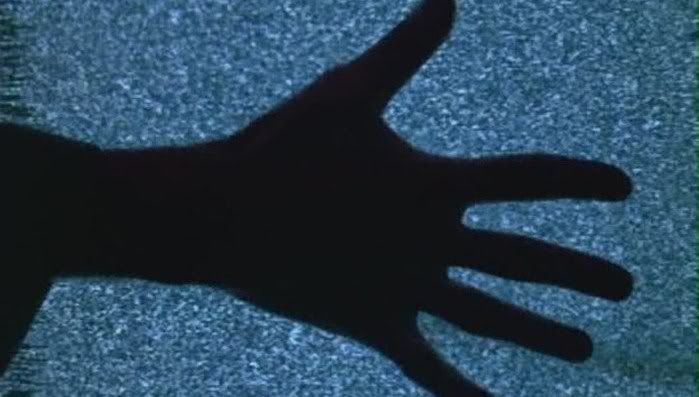
Paul Verhoeven's Turkish Delight is, it seems, the notorious Dutch director's idea of a Hollywood-style love story. Boy meets girl, they fall in love almost immediately, they marry. This is a very basic narrative, except that Verhoeven is determined to undermine, question, and indeed vomit all over the expectations, generic conventions, and emotional limitations inherent in this kind of story. For one thing, the boy/girl story as described above is not the entire arc of the film, as it would be in most romantic comedies. The film opens with a lengthy sequence of disturbing violence and sexuality, a raw, rapidly edited assault on the senses that establishes the protagonist, Erik (Rutger Hauer) as a thoroughly unlikeable, vicious, frightening, possibly murderous lecher. And the film ends with a long descent into tragedy and melodrama, in which this despised figure becomes instead an object of sympathy and surprising affection. The rom-com arc, complete with the "cute meet" (she picks him up as a hitchhiker), thus forms only the film's central segment, sandwiched improbably in between much darker territory. Verhoeven's major theme here is mortality, which makes it fitting that his narrative continually bypasses any and all conventional "endings," driving home the point that movie endings are at best artificial, at worst deceptive.

The film's structure sets up certain expectations right from the start. It opens with Erik at his self-destructive worst, wallowing in his trashed apartment and engaging in violent fantasies even as he has rough, dismissive, demeaning sex with countless women who he picks up casually on the streets. The film then flashes back two years, to the start of his relationship with the lovely Olga (Monique van de Ven). Conventional plotting expectations would lead one to believe that this story will, in true circular fashion, lead directly back to the opening scenes, which would promptly resolve themselves along with the film. Verhoeven, though, has no interest in convention except as something to subvert and twist. Not only is the flashback mid-section much more involving than one would expect, with a sweetness, warmth, and emotional complexity barely imagined from the opening, but by the time Verhoeven brings the narrative back around to the opening segment, the story is not brought to a hasty conclusion, but keeps going long beyond this expected ending point. Verhoeven sets up a kind of "origin of tragedy" story, in which events in a flashback lead up to a miserable present briefly glimpsed at the beginning of the film. It's a conventional cinematic storytelling device, one which Verhoeven subverts by extending the film long after the flashback catches up with the present again, pushing the characters through still more emotional states, more scenarios. By doing so, Verhoeven rejects artificial plot constraints and makes his film more like life itself, in which chains of causality are not so neat, and in which the messiness of living and relationships often spill over in unexpected ways.

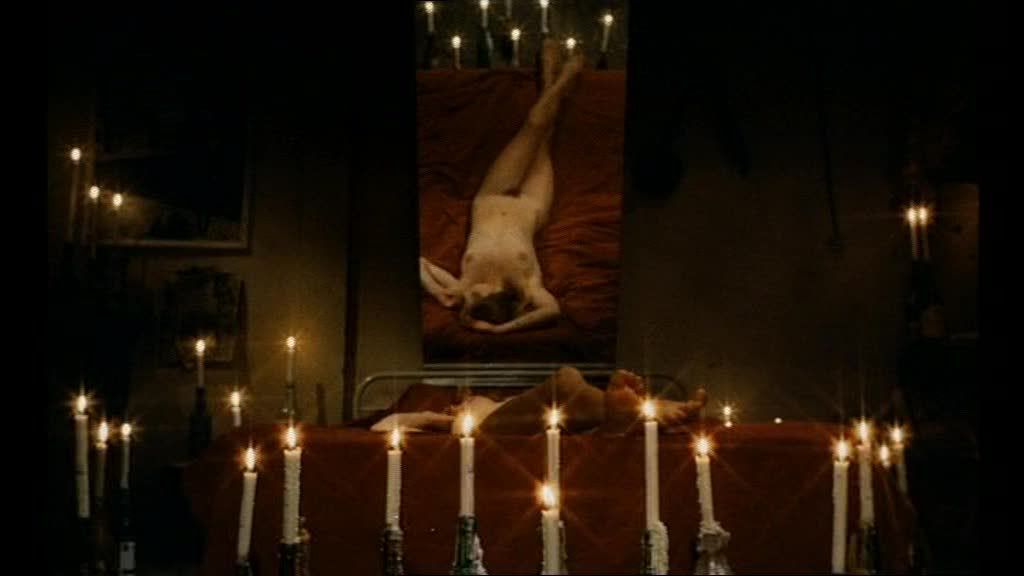
This is not the only way in which Verhoeven's film is messy. The director has a fascination with bodily processes, with sensuality in all its forms, and at its most giddy moments the film is one of the most potent, irresistible tributes to the pleasures of the sensual life. Erik's love scenes with Olga, in stark contrast to the often brutal ones with unnamed women earlier in the film, are surprisingly tender, passionate, and even sweetly romantic in their own crude way. Verhoeven doesn't shy away from such things, batting his eyes coyly as conventional rom-coms do, but splatters the screen with the messiness of human bodies smashing against each other. His idea of sweetness is often shot through with crudity, with rage, with sadness, with humor, scatological and otherwise, and even sometimes with violence. The romance of Erik and Olga is troubled by many things, not least of which are Erik's budding misogyny and temper, Olga's flighty nature and attachment to her shrewish mother (Tonny Huurdeman), and the fact that these two really don't even know each other by the time they get married. This last bit is something of a subversion of rom-com conventions itself, in that Verhoeven presents a dramatically truncated version of the love story arc. Olga and Erik are fucking and declaring their love within less than a minute from the time they first appear onscreen together. Their whirlwind romance happens so fast, in such a blur of images and short scenes, that it isn't until the wedding is over and the couple is left alone together, that the audience begins to realize the extent to which they are ignorant of everything about each other. They came together on the sheer force of physical, sensual attraction, and everything else is somehow incidental.

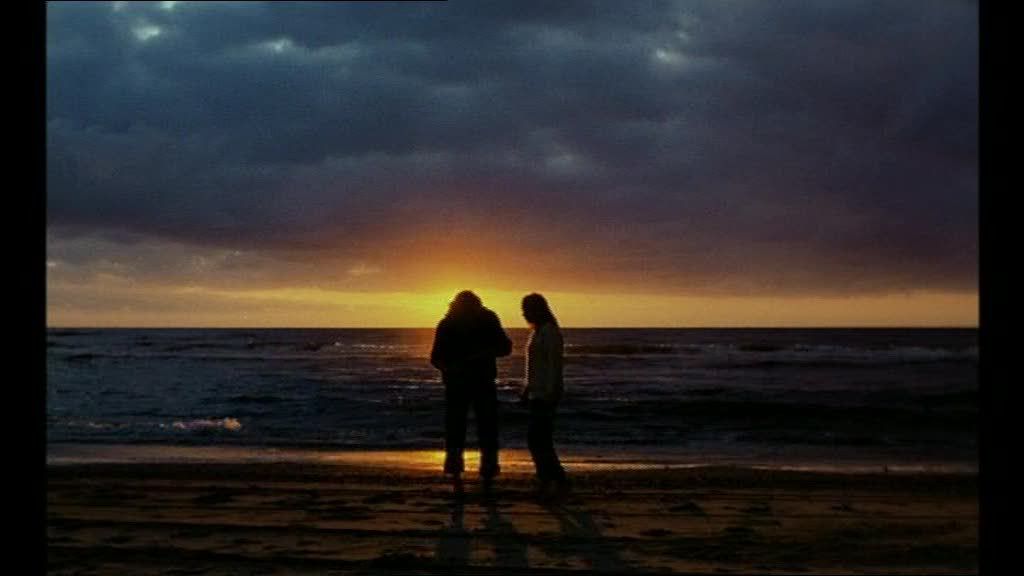
As a result, the film's best scenes are the ones in which Verhoeven documents the heady but not frictionless early stages of this relationship. A scene where the pair walks across the beach at sunset parodies and mirrors similar scenes in countless other love stories, but Verhoeven films it with such energy, with such reverence for the colors of the sky and the running, laughing silhouettes of the lovers, that it is a poignant and powerful moment nonetheless. Even better is the scene where a lovers' quarrel turns into a reconciliation in the middle of a downpour, the couple sitting on the curb in the middle of the rain, their clothes soaked through, laughing and drinking wine and embracing. Its the kind of genuine, sensual moment that can be seen in diluted form in countless films; Verhoeven gives the scene its rightful power by allowing the actors to really stretch out with a range of emotions, from rage and overpowering sorrow to the most ebullient joy. This emotional openness, so often leveled off and subdued in Hollywood variations on this plot, gives scenes like these the joy and beauty that they should have in a love story.

Verhoeven is a director who thinks emotionally in terms of his images, and his characters often express their emotions not only through the subtleties of performance, but in physical, visual ways. In a stunning scene where Erik learns that Olga is cheating on him, at a drunken dinner party worthy of Fassbinderian melodrama, the orange hue of the lights turn the entire assembled cast into an undifferentiated mass of laughing faces, all subtly ridiculing Erik right to his face, flaunting his lack of control over Olga's desires. At the end of the scene, Erik stands and literally vomits all over his wife and mother-in-law, spewing his emotional reaction to their betrayal in the most physical way possible. This visceral fascination with bodily processes and waste carries over throughout the film, as defecation recurs as an image again and again. In an earlier scene, Erik picks through Olga's feces to reassure her that she is not bleeding; this is, again, Verhoeven's idea of tenderness and love, a love that doesn't even flinch at getting down and dirty with the waste products from the lover's body. Shit is also a harbinger of death, though, its red color signifying for Olga that she may have cancer like her mother did. When her father (Wim van den Brink) is dying, the extent of his sickness is signaled by the bodily fluids, shit and piss, all leaking through the bottom of his soaked-through bed into metal pans arranged below, filling the room with a stench of death.

Later in the film, Erik watches his mother-in-law's dog take a shit by a tree stump, after which the old lady dutifully wipes the dog's rear with a tissue, in a scene that seems entirely unmotivated beyond its exposure, yet again, of the universality of bodily processes. No matter the differences, Verhoeven seems to be saying, in these crucial ways humans and dogs are exactly the same: they eat, they shit, they fuck, they die. To this end, animals comprise a small but important role in the film. There's also a dog who eagerly licks up the fluids left behind when, at Erik and Olga's group wedding, one of the brides goes into labor and has to rush off, leaving behind a puddle and a bloody stain down the back of her white dress. And after the couple's breakup, Erik cares for and rears back to health a seagull who he accidentally hits with his car, a process that includes the decapitation and gutting of fish for food, which Verhoeven shows in closeup of course. These images are given a nearly equal footing with the film's depictions of equally messy and sloppy human body functions, emphasizing the continuum of nature and our place in it.

This includes, of course, mortality, and Verhoeven doesn't flinch away from candid depictions of death and our reactions to it, any more than he does from sex or scatology. In that respect, the long sequence that deals with the death of Olga's father is one of the film's most important stretches, with Verhoeven's typically earthy interest in the process of dying, and his wry, darkly comic commentary on the ways in which bourgeoisie society attempts to deal with death. In this, as in many other respects throughout the film, Olga's mother is Verhoeven's main vehicle for his satirical jabs at the hypocrisies and moral blind spots of polite society. In a hilarious and ridiculous scene, this woman has many pictures taken of her husband as he lies in his coffin, then asks for one more, posing by his side and mugging for the camera as though they were just a couple of tourists getting their picture snapped. The ridiculousness of this scene is compounded when it transpires that this last snapshot, printed up in tasteful black and white, is handed out at the end of the funeral service as a souvenir. Of course, it's Erik who angrily rejects this disrespectful offering — he prefers more meaningful and earthy souvenirs in general, snipping bits of hair, pubic or otherwise, from all his sexual conquests — and it's Erik who also seemingly senses the greater significance of the funeral service itself. In the midst of it, when the coffin is solemnly descending into the floor on a mechanical lift, he imagines Olga's father, a fun-loving and energetic old man, perched on top of the coffin in his armchair, belting out a song and drumming his hands on the side of the chair. Erik, a sensualist to the last, recognizes that a funeral for such a vibrant man should never be turned into such a maudlin, dreary affair.

If this is one side of Verhoeven's examination of death, the other is the fascination with death's imagery, and especially the idea of decay and recycling, as epitomized by images of both maggots and trash. The maggot's role in death is first broached in an early scene where Erik is commissioned as a sculptor to create religious statutes, including a representation of Jesus' resurrection of Lazarus from the dead. Erik carves this statute with such realism and such attention to detail that visible on Lazarus' legs are the maggots crawling from his dead flesh. When confronted with this excessive detailing by the irate project supervisor, Erik refuses to change his work, declaring that Lazarus was dead, and he was only being true to the reality of what would've happened. Later, Olga receives a call that her father is dying, interrupting a playful love scene with Erik in which he'd been rubbing a bouquet of flowers across her naked chest. After the phone call, when he lifts the flowers from her skin, they leave behind a trail of writhing, squirming maggots and worms slithering across her breasts. The worms recur again, after Olga leaves and Erik is wasting away in his apartment, where open jars and pieces of meat fester and teem with maggots. And just as the maggots represent the recycling processes at work on dead flesh in nature, the film's final shot presents the man-made equivalent, the recycling of the trash heap and the grinding gears of a garbage truck, mashing up the last remnants of a life lost.

Turkish Delight is, as I've come to expect from Verhoeven, an incredibly complex film in the way it deals with its characters and their emotions. It's a film that virtually challenges the audience to find a proper reaction, and the emotional tenor changes so frequently that one can never stabilize one's response. The "proper" reaction is exactly what Verhoeven intends to subvert, along with the easy judgment, preferring a more spontaneous, visceral response. This film requires thinking with the gut as well as the brain. Erik in particular is a very problematic and complicated figure, a despicable man in many, many ways — he even commits a shocking rape — but he's also at times a remarkably sympathetic character, especially in the film's final act, in which his demeanor mellows from overpowering rage and brutality into melancholy and quietude. The fact that Verhoeven stays with the narrative to this point, that he allows his characters to keep going beyond the circumscribed arcs of conventional love stories and melodramas into richer emotional ground, is the most obvious evidence of the film's commitment to its program of subversion. The contrast of emotions, the wild tonal shifts from dark comedy to harrowing violence to warm and sexy love story to tear-jerking tragedy, keep the audience constantly off-balance. It's a stunning film, shocking even more for its raw, messy emotionality than for the copious sex and nudity spread across its frames.

Wednesday, June 4, 2008

The Nun


Jacques Rivette's The Nun, his second film, is one of the director's most inscrutable works for the perverse reason that it's one of his most straightforward. On the surface, The Nun is a remarkably austere film, a harrowing tale simply told, with little of the theatrical games and self-consciousness of Rivette's debut, Paris nous appartient, released a long six years earlier. The film follows the hapless Suzanne (Anna Karina in one of her most stunning performances) as her unloving family thrusts her forcefully into a convent after telling her that she is an illegitimate child and a drain on their resources. With no desire to commit herself to religion, Suzanne flounders, and after a brief respite while under the tutelage of a friendly, sympathetic Mother Superior, she is brutally oppressed, tortured, and ridiculed once this kindly maternal surrogate dies. In fact, in short order Suzanne's mother dies, she learns that she has a real father only to learn that he is also dead, and then she loses her one friend and mentor at the convent. The remainder of the film, and of her life, is misery of the worst sort, leavened only by her faint hopes for freedom and her enduring faith in God despite the certainty that she is not meant to be giving her life to him.

God is an unfathomable presence in Rivette's film. When Suzanne arrives at her first convent, the Mother Superior tells her in sympathy, "Our God is a hidden God. He comes like a thief, without announcing his presence." If God ever steals silently in and out of the scene within this film, it happens without anyone noticing. There is a great deal of prayer, but no answers, least of all for poor Suzanne, who maintains her faith through even the most cruel treatments. Rivette treats this scenario, adapted from a novel by Denis Diderot, with a stark, sparing hand, giving the film a minimalist atmosphere that's very much in keeping with the spartan accommodations of the nunnery. The film opens, before the credits, with an acknowledgment of Diderot's novel, and a brief summary of the conditions in 18th Century France, in which the story is set, and especially the nature of convent life and its various faces. This academic, historical introduction sets the stage for a kind of exposé of life in a religious order, and that's exactly what Rivette delivers, even if he is a few centuries too late to be current.

To the extent that Rivette submerges himself in the mechanics of this story, The Nun is simply what it appears to be: the sad account of a young girl whose life is snatched from her hands again and again. It's a story about the loss of control, the ways in which societal forces, both economic and religious, conspire to maintain a dictatorship over the individual and to suppress free will. Suzanne is never able to truly make a choice on her own, a point that is underscored in the denouement, in which "freedom" proves to be a bitter triumph for Suzanne, who is still tossed from one fate to the next with no control over her own destiny, not until her very final moment. The film questions the very notion of free will, not only in a religious context, but in society as a whole — Suzanne has no greater freedom in secular life than she did locked within the convent walls. Even the look of the film is circumscribed, and Rivette loves to film scenes with wooden screens dividing characters from one another, breaking up the screen into tiny boxes just as the nuns' "cells" divide them from one another. Human contact is suppressed at every turn, as is human feeling, which Suzanne seems almost unaware of, her naivete so complete that she doesn't even grasp what's going on when those around her make sexual advances on her, as several supposedly chaste characters do.

Suzanne's long and painful journey offers several different varieties of the lack of freedom. At first, at the Longchamps convent under the kind eye of Madame de Moni (Micheline Presle), Suzanne's lack of freedom is simply the unavailability of other options, the constriction of movement to within the convent's walls. With this benefactor's death, Suzanne's confinement becomes more extreme, as the tormenting of the jealous other nuns becomes more and more ferocious, culminating in a lengthy sequence in which Suzanne, starved, barefoot, filthy, her clothes in tatters, is locked in her room and driven to near-madness. This is a profound loss of freedom, but even when she is rescued and sent to a new convent, she pushes up against new types of boundaries, as she is slowly woven into a web of sexual predation and jealousy by the charming, worldly Madame de Chelles (Liselotte Pulver), who seems to be presiding over a harem of lesbian nuns. Finally, even Suzanne's true freedom from the habit altogether, following her moonlit escape with a similarly discontented monk, leads her to realize just how unprepared she is for the world. Her innocence thrusts her into one unwelcome circumstance after another, and ultimately she has no more control over what happens then she did in the cloister. Throughout all this, Karina delivers the performance of a lifetime, a true classical star turn that ranges freely across the emotional gamut.

If Rivette largely allows the story to stand on its own merits (and on the strength of Karina's portrayal), his directorial hand can nevertheless be glimpsed in more subtle ways. Foremost among these is the deployment of the soundtrack, which in many ways plays off the stark minimalism of the sets, design, and storytelling. The score itself, composed by Jean-Claude Éloy, is perhaps the only modernist touch in a film otherwise committed to the historical reality of the mid-1700s. Éloy's dissonant, percussive score is used sparingly, but its clanging rhythms and sharp atonal strings create acute tension when rubbing against the period settings and costumes. Whenever it crops up, usually with an abruptness and randomness that never fails to disrupt the scene, this score provides a reminder of the artificiality of the film's construction, pointing towards the artifice in a way that a more traditional score never could, even though all scores are equally artificial contrivances. Rivette also uses the sound of church bells, more naturalistic and intrinsic to the story, in a similar way by amplifying their dissonant, clanging qualities, layering on thick swaths of chiming noise. These bells even appear when they seemingly have no physical source, further undermining the realistic nature of the soundtrack. In an early scene where Suzanne confronts her mother in their home, the bells abruptly begin ringing at an extreme volume, causing the two women to shout at each other simply in order to be heard; but where are these bells coming from, if the women are in an upper-class home rather than a church? It's in moments like this that Rivette uses the soundtrack to nudge at the placid surface of his period recreation, and his attention to sound design points all the way forward to his latest film, Don't Touch the Axe, which represents the full flowering of his ideas about the deconstructive potential of noise.

Rivette's touch can also be felt, even more subtly, in the judicious use of some very disorienting and unusual cuts, using editing to further disrupt and interrogate the conventions of the historical drama. For the most part, the film's visual aesthetic is as smooth as its settings are minimal. The camerawork is fluid whenever it's not static, and the film is characterized by its slow forward and backward tracking shots, zooming slowly into a scene or slowly out of it to encompass a larger space. But in other places, Rivette's editing and his treatment of space and movement are more angular, as dissonant and jarring as Éloy's score. There are small touches of the characteristic Nouvelle Vague editing techniques, most famously pioneered by Godard in his first feature Breathless but largely absent from this film despite Rivette's close association with those filmmakers. Only in brief flashes does Rivette use his cuts to purposefully break traditional cinematic rules about line of sight, cutting on motion, and matching the angles on cuts. But the sparing use of the technique only makes its application all the more bracing in those scenes where it does occur, like a late scene where Suzanne spends a fretful afternoon in her chambers praying and thinking. Rivette chops this scene up into fragments, cutting in the middle of Suzanne's movements, switching angles unexpectedly, banking on audience expectations of the next shot and purposefully subverting them. As a result, Suzanne seems to jump around the room as though teleporting, the severe disjunctions in her motion and position creating a very unusual sense of space and time. Limited to select scenes rather than spread out across a whole feature, the technique is even more revolutionary and jarring than it is in Godard's films, where after a time it comes to seem like the norm.

The Nun is a remarkable second feature for Rivette, a film that, as with all of his work, functions on multiple strata: as a historical drama; as a deconstruction of historical dramas; as a treatise on religion, freedom, and individuality; as a literary adaptation; as a commentary on the process of adaptation; as a simple story and as the layers of association and meaning hidden within it. For Rivette, there is no such thing as a truly straightforward story, even when he's playing it straight on the surface. It's this multiplicity of approaches and ideas, all contained within a deceptively simple and minimalist framework, that characterizes Rivette as a filmmaker, and it's what makes The Nun such a thoroughly satisfying masterwork.

Tuesday, June 3, 2008

To Have and Have Not


If Howard Hawks' low-key WWII thriller To Have and Have Not seems a bit too much like Casablanca for comfort, the film goes a long way towards making up for its lack of originality in the accumulation of small details and the fine central performances that Hawks brings to the film. Obviously contrived as an attempt to restage Bogie's iconic turn as Rick, this "sequel" once again sets down Humphrey Bogart in the middle of contested wartime Martinique, this time as the fisherman-for-hire Harry Morgan, doing his best to stay out of the increasing strife between Vichy sympathizers and the "Free French." I'd normally summarize some more of the plot here, but Hawks seems largely unconcerned with it, so I'll just go ahead and admit that so was I. There's something about a rebel (Walter Szurovy) who needs to be ferried into Martinique, and for some reason his on-island allies decide that Morgan is just the man for the job. There's a daring escape from a Gestapo patrol boat, and an inquisitive and leering Gestapo captain (Dan Seymour) who's putting the screws to Morgan to find out what he knows.

With all this at stake, both for Morgan and Martinique as a whole, you'd never know it from the film's meandering, laidback pace — despite the trappings, this isn't really a suspense film, or a spy film, or a wartime thriller. It's a showcase for Bogie, and especially for his sizzling onscreen romance with first-time actress Lauren Bacall, sauntering onto the scene as the young girl on the run from her past and adrift on her own. Bacall is the film's real star, delivering a stunner of a performance that threatens to make even Bogart recede into the woodwork altogether. As soon as she slithers into Bogart's room for the first time, uninvited and interrupting a frantic conversation concerning the Resistance fighters, she takes over the film with her sheer presence. She just wants a light, but she might as well have said, "Hey, forget all that spy stuff, look over here." Even the way she asks Bogie for a match, her mouth twitching suggestively and her hips nestling against his doorframe, telegraphs her raw intensity and sensuality. Her chiseled marble face, already looking wise beyond her years, is a fount of subtle emotion, and she invests her cipher of a character with far more depth and complexity than the writing deserves. Just looking at her, the way she carries herself and the way she speaks and the way her eyes move, is to know something of her story and what she's like. Her sidelong glances, cast back over her shoulder, freighted with hidden meanings, carry a static charge that can't help but energize anybody hit with that blazing stare.

Bacall manages to carry her character, "Slim" (a typical Hawks nickname), through even the script's unusual excess of misogynistic tripe, which seems a bit much even for a Hawks film. It's not enough that the film is populated with one "silly dame," it has to add a second (Dolores Moran as the frail wife of the French Resistance fighter), and has both of them confess to Bogie that they're "making a fool" of themselves in front of him. These women both seem eager to apologize to this man they hardly know, and the film's weaker moments require a real suspension of disbelief to see the rock-hard Bacall making gestures of contrite acquiescence towards her leading man. It's slightly more bearable when it's Moran in this role, playing a one-note weak woman who faints at the slightest provocation despite her initially hard aura. The whole second woman thing is silly to begin with, so much so that even the two leads seem to realize it, and consequently Bogie downplays his reaction to this interloper even as Bacall downplays her jealousy. The result adds some pleasant friction to these scenes, and even comes close to redeeming the contrivance altogether.

Elsewhere, there's the usual undercurrent of Hawksian machismo, a sense that women shouldn't get in the way of men's stuff, and that the men who allow such intrusions are somehow cowardly and weakened by it. The script requires Bogart, who's clearly outmatched by the fiery Bacall, to nevertheless get the best of her, seeing right through her and condescending to her at every turn. Only Bacall's innate toughness allows her character to come through it unscathed, and as a result it's hard to take Bogart's bluster too seriously in relation to her. Instead of two equals sparring, it seems more like Bogart's putting up a masculine front in an attempt to save face. But it's a vain effort, and once he finally gives in to Bacall's charms, the game is lost. After one passionate clench, she tells him to go shave and gives him a playful slap on the cheek, a bit of S&M foreplay that mirrors an earlier scene where the Gestapo slapped around the completely unfazed Bacall as Bogart watched.

The film also offers up one other uncontested pleasure on the acting front, and that's the surprisingly nuanced turn from Walter Brennan as the hopeless old drunk Eddie. Brennan played the grizzled old coot, the comic relief sidekick, in countless movies, practically making a career out of it, but this performance is something of a revelation for anyone tempted to dismiss him as limited in range. Eddie's character is well within Brennan's comfort zone, a washed-up drunk who was, Morgan says, once a great fisherman, but is now just about useless. Brennan infuses this character with a ragged charm, a rambling, discursive wit, and an incredible amount of pathos. He's a man who knows he's used up, who clings to his last loyal friend with a puppy-like dedication and obedience. And yet he's also a soulful, complicated character, displaying flashes of a shrewdness that must be a carryover from his youth, and a sense of humor that's all his own. His frequently repeated joke, "was you ever bit by a dead bee?" coaxes some subtle repartee out of Bacall, who distinguishes herself by playing along with the old man instead of just dismissing him like everyone else does. In the two brief exchanges they have together, which mirror each other towards the start and end of the film, Brennan and Bacall prove why they're the film's true linchpins, as Bogart just stands off to the side and smirks.

Hawks is wise to let these fine actors just do their thing, and he's also wise to keep the focus as far off the plot as possible — the action happens in fits and starts only, with long scenes of moody, atmospheric stasis in between. Especially characteristic of Hawks are the many scenes that take place clustered around the piano in the local hotel. It's here that Bacall delivers a trio of sultry, low-voiced torch numbers, and where the local pianist (Hoagy Carmichael) croons out a handful of smarmy ballads. Hawks loves this kind of scene, with musicians and audience alike gathered around the piano, as many people crammed into the frame as possible, fostering a sense of warmth and camaraderie that is very dear to Hawks' heart. Variations on this scene recur frequently in his films, most notably in Only Angels Have Wings, though none of the scenes here have the poignancy, urgency, or depth that the similar scene possessed in that film, where the gathering at the piano took the metaphorical place of a drunken wake for a dead friend. Here, these scenes are just atmosphere, helping to infuse the film with a distinctively Hawksian character but not adding up to much otherwise. The same can't be said, fortunately, about a similarly crowded scene around the bedside of a man with a gunshot wound as Bogart attempts to remove the bullet. Hawks orchestrates this scene with surgical precision, culminating in a shot where Bacall stands in the foreground, holding a bottle of chloroform and fanning away the fumes, as across the prone body of the patient sits Bogart with scalpel in hand, two assistants holding a lantern and a water basin over his shoulders. This careful clustering also creates that tight, cluttered image that Hawks loves so much, though here the deliberate arrangement of the figures and the tensions that all focus on a single point as small as a bullet, create a scene of lasting power.

Despite its limitations, this is a sharp, smart film from Hawks, one that completely dispenses with its ostensible subject in order to squeeze in as much of the good stuff (Bacall!) as possible. Hawks presumably recognized the film for what it was, a somewhat cynical remake of a film that had, after all, only been out two years earlier with the same actor in the lead. And instead of taking it seriously, he decided to take to the margins and just have fun with it, letting Bacall's saunter and Brennan's wit take over the film. This holds true even down to the final shot, in which the central trio walk off into the foggy night together towards unknown adventures. Bacall executes her exit with as much aplomb as her entrance, slithering offscreen with a playful sway to her hips and a smile on her face, as Brennan agreeably bops his shoulders in sympathy. In keeping with the film's wry spirit, this trio doesn't just walk off into the fog; they dance off.

Monday, June 2, 2008

The Ossuary/Dimensions of Dialogue


Jan Svankmajer's The Ossuary hinges upon an essential dialectic that is at work at every level of the film's construction. It's a dialectic between the past — represented by the amassed bones of mankind's countless dead — and the present, the living. Between the closed book of history, its story already written, and the in-the-moment nature of modern politics and socio-political action. And perhaps most importantly, on a cinematic level, between the image and the soundtrack. Svankmajer's film is set at the Sedlec Ossuary in Kutná Hora, a macabre masterpiece of design in which the entirety of the chapel's interior decorations, from altars to goblets to wall hangings to a tremendous chandelier, were constructed from human bones. It's a horrifying work of art, carved entirely in the remnants of the dead, meticulously arranged into an ossified testament to mortality.

Svankmajer's task for this film was simple enough, to craft a straightforward cultural documentary about the famous tourist site, its history and the jaw-dropping images that could be seen within its walls. The result, though, is anything but straightforward. From the very beginning, Svankmajer signals the importance of sound to his aesthetic, as the soundtrack introduces a series of metallic grinding noises from a bicycle chain. This kind of scraping, rattling, grating noise forms a central element in the film's soundtrack, as though to suggest the rattling of bones through an accumulation of similar noises. Even the ossuary's cranky old tour guide, who provides a crotchety commentary throughout a tour of the chapel interior, is characterized by a dry, brittle, croaking voice, complementing the scrape-and-rattle orneriness of Svankmajer's soundtrack.

Moreover, the tour guide provides the perfect outlet for Svankmajer's satirical outlook on this material, and he takes every opportunity to contrast her discursive commentary and hectoring with the cold reality of the images from the ossuary. The tour guide's monologue encompasses some of the history of the chapel, who was buried there, and its official status as a sanctified mass grave, but she is much more concerned with matters of money. Not only is she a shameless shill for the site's (apparently many) for-sale items, including replicas of family crests of prominent families buried there, but she also hands out stiff fines for even the least suggestion that someone has touched anything. The film ends with her enraged screaming at a seemingly befuddled young boy who she keeps accusing of touching the bones, furiously demanding money as penance. "Me?" he asks plaintively, a bit astonished. This woman, never seen throughout the film, only heard, is also inordinately concerned with the fact that the chapel's centerpiece and grandest construction, a massive chandelier of human bones, once fetched an offer of 100,000 American dollars for its sale. It is not enough for this woman, indicative of tour guides the world over, that this absurd, hideous, and fascinating art object simply exists, that it was made and toiled over and still hangs hundreds of years later. For her, this chandelier's grandest facet, its most memorable aspect, is the money it could be worth — or even better, the money that was declined in order to keep it, which suggests an even greater worth, possibly even incalculable.

This focus on monetary worth and petty economic bullying ironically makes this woman, living in the heart of Communist Czechoslovakia, an icon of capitalist excesses. It's apparent that one intent of Svankmajer's project in this film was the exposure and critique of a great Communist lie, namely that the elimination of capitalism was also the elimination of materialism. Rather, this woman's hectoring monologues make a marketplace not only of art, but of mortality itself, which becomes a mere spectacle to be consumed and perhaps commemorated with trinkets. Against this flippant outlook, Svankmajer chooses to simply juxtapose the horror, and the horrible beauty, of the ossuary, with its remarkable designs and assemblages. His images from within the church are arranged into rapidly edited montages that suggest an overall image of clean, purified death, an impression that Svankmajer counterbalances with an early shot of a snail slowly pulsing along the inside of a skull's eye socket. The ossuary is an attempt to tame death, to create art with death's leftovers, but although the church's construction possesses a strange beauty, its every facet serves to remind of death, to amplify death's awful power. The sight of so much death in one place, so artfully presented, is frankly terrifying and awe-inspiring. Svankmajer captures this fierce beauty in only a handful of long shots, in which the bone-lined walls of the chapel are almost overwhelming in their grandiose accumulations. The rest of the film takes on a much closer perspective, editing together brief shots of small portions of the overall design, focusing on individual details. The aura of mortality is no less horrifying for its specificity, though; in fact, the detailed examination of the multitude of individual bones that went into making each of the church's decorations only drives home the individuality of the people who once animated those bones.

In relation to this remarkable chapel, and the remarkable way that Svankmajer's abrasive montage amplifies its horror, the banal commercial blathering of the appointed tour guide are revealed as petty and inconsequential, attempts to wring every cent from a population herded like cattle until mortality overtakes them. In the context of Communist Czechoslovakia, this was a radical statement on the economic stranglehold of the state, a satirical commentary that did not escape the attention of the Czech censors, who promptly replaced Svankmajer's chosen soundtrack with a jazz song. In the original version, however, The Ossuary remains a remarkable film, a treatise on human mortality and the various attempts to control, escape, and even profit from it.


In Dimensions of Dialogue, Jan Svankmajer presents three different wordless, abstracted visions of human communication and interaction, and the various outcomes that can result from such encounters. This is a darkly funny, but ultimately pessimistic, film on the impossibility of true communication. The film is divided into three segments, each preceded by a title; the first segment presents a "factual dialogue." In this scenario, three abstract creatures, assembled from a variety of bits of matter, take turns devouring and disassembling each other within a circular food chain that results in an increasing level of homogeneity and de-individuation. The three creatures each represent a different aspect of human society and life: an "organic" creature composed of fruits and vegetables; a "mechanical" one assembled from tools and gears and bits of metal; and a "scientific" one with its body covered in books and tools of learning and scholarship. These three assemblages stand in for three layers of society, from humanity itself at its most basic, organic level, through to the mechanical and intellectual processes by which humankind interacts with each other and the world around them.

Needless to say, the process in this first dialogue by which these three aspects of humanity continuously devour and vomit each other back out again does not present an optimistic image of human relations. In this recursive food chain, organic matter is devoured and regurgitated by machinery, masticated to make it finer for digestion, and also dissected, pulled apart in an effort to understand it. This is a continual theme of this section, the way that attempts at understanding inevitably lead to the destruction of the thing under examination. This theme recurs in the way that the "scientific" representative devours and dissects the "mechanical" being, literally crushing the manufactured output of mankind flat between the pages of a book. Finally, the books themselves become fodder for the newly reconstituted organic matter, which tears them to shreds in an effort to elicit every shard of knowledge from within them. This process is repeated several times, and with each iteration the three creatures become less and less defined, more battered and worn as their constituent parts have been chewed up and spit out over and over again. As the segment progresses, it becomes clear that this process is a gradual evolution towards three increasingly similar beings, which begin to look more and more human as their parts are chopped up into smaller and smaller bits, their edges smoothed and their formerly heterogeneous surfaces mashed into a fine, fleshed-colored paste. By the end of the section, all three creatures are molded from clay into generic human forms. This self-devouring destruction and dissection is thus a process that leads to the creation of humanity as it is today, still trapped in the same circular path.

The second segment of the film is entitled "passionate dialogue," and it represents every bit as much of an ugly view of humanity's possibilities for true dialogue. If the first segment presented learning, creation, and nutrition as ultimately just three different forms of destruction, this segment adds love, sexuality, and procreation to the list. The film opens with two near-identical clay forms sitting across from one another across a table, the only difference between their otherwise streamlined bodies and identical bald heads the presence of breasts on one of them, delineating gender. This romantic couple joins together for a kiss, the clay of their individual bodies slowly melding together, melting against each other's identical clay flesh, until the individual forms are erased in a fluid, oddly sexualized flow of abstract forms and momentary glimpses of a head thrown back in passion, a knee crooked up at an angle, a hand caressing a back. As in the first segment, interaction leads to the loss of individuality, but at this point sexuality seems to be a much more hopeful melding, a chance to create something new and beautiful from the merger of two individual forms.

This optimistic interlude is fleeting at best, however, and when the sex is over the two clay forms separate into two again, with one crucial difference: a single lump of clay sitting on the table between them, seemingly leftover material from one or the other, or both combined, now permanently separate and lost. Sexuality, for Svankmajer, is a beautiful moment, after which both people involved lose a piece of themselves — combined in the creation of a child possibly? — which can never be re-integrated or regained. And if the lump of clay leftover represents the joint creation of a child, then Svankmajer certainly doesn't have an especially sunny view of parenthood, given the fact that the two former lovers increasingly turn against each other in the aftermath of their union, first using the lump of clay as a weapon against each other and then literally tearing each other apart with claws and fists. This is a stunning sequence, as Svankmajer's blank-faced creations execute a complete cycle from love and union to rage and brutality. At the end of the film, the two bodies are once more melded into one undistinguished mass of clay, but the connotation this time is not union but mutual destruction.

In the final segment of the film, "exhausting dialogue," Svankmajer takes his concept of human incompatibility and the absurdity of attempts at communication to its not-so-logical extreme. This is the film's apotheosis, in which a pair of disembodied heads (with realistic eyes bulging out of their clay heads in bug-eyed stares) face each other across a table. The two heads take turns sticking out their tongues at each other, each one presenting the other with an object to use. At first, the two present each other with mutually compatible objects, so that their interaction is almost as harmonious at first as the sexual union that opened the second section. When one presents a pencil, the other offers a sharpener; when one emits a slice of bread, the other butters it with a knife; when one has a shoe, the other has the lace to wind through its holes and tie in a neat knot. As long as the duo are able to match their objects' functions in this way, the interaction between them goes smoothly and results in a mutually beneficial outcome. But the rest of the film serves the purpose of demonstrating just how rare and unlikely such peaceful coexistence really is.

Once the two heads have run through the possibilities of combining their respective objects in the intended ways, they begin a series of less fortuitous encounters, in which the pencil sharpener shreds the bread to bits, the knife spreads butter on the shoe, and the toothpaste tube sprays wildly as the shoelace wraps itself around the tube and ties itself into a bow. This surreal disjunction between intended function and context results in increasingly absurd and undesirable results, underscoring the extent to which the first set of positive outcomes were essentially random happenings with relatively low probabilities in contrast to the sheer number of incompatible combinations available. As a metaphor for human relations, it's a visually striking and perhaps frighteningly apt one.

In fact, the entirety of Dimensions of Dialogue is as visually sumptuous as it is thematically bracing. Each segment offers a very different visual experience along with its unique perspective on human relations, from the cluttered automatons of the first segment, continually breaking up into chaotic digestive processes, to the eerily streamlined clay forms of the second and third segments. It's also a startlingly funny film at times, especially in the absurdist extremes of the final section, even as the hope it holds out for human compatibility is alarmingly small.