Friday, April 3, 2009

Whirlpool


Otto Preminger's weird, disjointed Whirlpool is an intriguing mess of a film, part film noir, part psychological case study, an unflinching examination of marriage, fidelity and the ways in which rigid ideas about gender and propriety can cripple and deform relationships. Ann (Gene Tierney) is seemingly a model wife to her psychiatrist husband Bill Sutton (Richard Conte). She's pretty, loving and devoted, and he's proud to be married to her — and even prouder, he tells her, when he sees how people gape at her at parties, awed by her beauty and envious of him for being her husband. For her part, she feels grateful just to have him, and is sorry that she can't do more for him. She regrets that she isn't intelligent enough to have a conversation with him about his work, and he just pats her paternally on the head and tells her he wouldn't change a thing about her — a condescending gesture that's also sort of an insult, an acknowledgment that he agrees she isn't on his level intellectually. Their marriage, so admirable and loving on its surface, is warped by an inability to communicate, by Ann's desperate desire to maintain this illusion. Beneath her façade, she's miserable. Feeling constrained and hemmed in, she asserts her freedom through acts of kleptomania, shoplifting even though she and her husband have more than enough money to buy almost anything she could want.

Unfortunately, Ann's shoplifting brings her to the attention of the disreputable hypnotist and con artist David Korvo (José Ferrer), who uses her weakness to gain control of her, worming his way into her life. Ann believes she's sick, but unwilling to go to her husband and shatter his perfect image of her, she turns to Korvo to cure her of her kleptomaniac outbursts, her headaches, her insomnia. Tierney plays Ann like a blank slate, a vacant Barbie doll just waiting to have her head filled with anyone else's ideas. Even before Korvo begins hypnotizing and manipulating her, she is in a sleepwalking daze, her pretty face as inexpressive and blank as a doll's, her eyes staring off vaguely into the distance. She seems completely devoid of substance or vitality, her every movement and facial expression carefully studied and deliberate, her face a mask. She is crafted from something hard and cold and inanimate, anything but flesh.

This is a strikingly cynical portrait of the "happy" marriage: the husband mainly concerned with how jealous other men are of him, the wife trying her best to maintain the public image of their ideal union. This fragile situation makes it very easy for the sinister Korvo to use Ann towards his own ends, namely to dispose of his troublesome former lover Theresa (Barbara O'Neil), who has been threatening to expose his crimes. His complicated plot to frame Ann for Theresa's murder is where the film begins to fall apart, where the threads of the screenplay start to fray. The whole thing is so obviously ridiculous, so convoluted and yet transparent, that it requires a prodigious ability to suspend disbelief just to go along with it on even the most superficial of levels. Korvo's a fine villain, slippery and slimy, and Ferrer's performance is appropriately despicable. He slithers into Ann's life, insinuating himself into a position of power over her with his sinister grin and thin, rodent-like face.
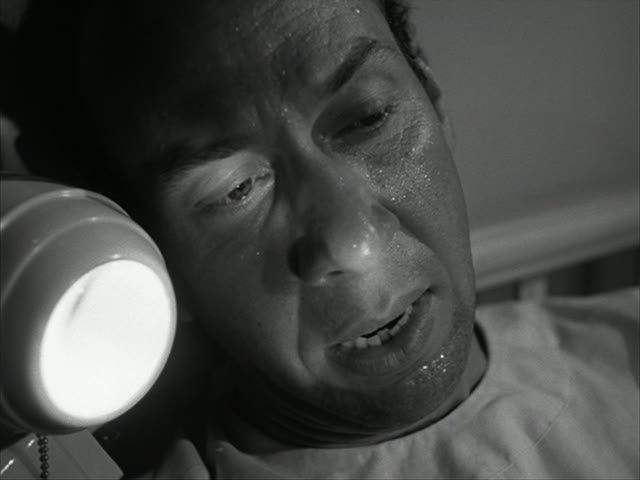

This makes it doubly unfortunate that the film wastes such a good villain on such a shaky plot. For a guy who's supposed to be a clever manipulator, it's bizarre that his scheme includes planting crucial evidence against himself at the crime scene, hypnotizing Ann into hiding it when he could have just as easily made her destroy it. By the same token, his alibi for the murder — a gall bladder surgery — seems clever when one suspects that he's faking it, or that he's hypnotized a doctor into giving false evidence. It becomes less clever once one realizes that Korvo actually subjected himself to a genuine operation, and that his brilliant scheme requires him to hypnotize himself into not feeling pain, so that he can sneak out of the hospital to perform his nefarious deeds. The script is a mess, one of those absurd Hollywood concoctions that provides only the barest of rational explanations for its twisted narrative. Even at the finale, it's by no means clear that Ann has actually been cleared of Korvo's crimes, but the kindly police inspector acts as though everything's been resolved and she's free to go. By that point, so much other ludicrous business has been required by the plot that this seems like a relatively minor logical hole.

The fractured, often nonsensical plot is a large hurdle to get over in enjoying this film, but Preminger's typically calm, assured direction smooths out some of the more egregious wrinkles. His darting, swooping camera helps define the relationships between the characters, as in the scene where Ann is first hypnotized by Korvo, and the camera makes a slow rightward move, a short arc that ends with a perspective looking past Korvo's shoulder and slightly down at the staring, distant Ann. The camera calls attention to what's happening, to Korvo assuming a dominant position over Ann, looming above her as he takes control of her. In a later scene, Preminger signals Korvo's tightening grip on Ann by literally tightening the shot, slowly inching the camera in until the two are packed closely together within a constrictive frame, their intimacy forced not only by Korvo's shady maneuvers but by the borders of the image itself. Preminger's formalist sensibility continually asserts itself, his purposeful blocking delineating the ideas and relationships within the film even as its script collapses into incoherence.

He's at his best in visualizing that which goes unstated, the emotional underpinnings of the story lingering beneath the surface. This tortured script doesn't actually leave much unsaid, but Preminger's subtle sensibility is still present. There's a wonderful short scene in which the police lieutenant (Charles Bickford) wakes up in the middle of the night, unable to sleep from thinking about the case. It's a simple scene — the lieutenant just calls his precinct and gives out an order — that for another director would be a practical formality, a quick, necessary transition. Preminger sees more in it, sees the policeman's grief over his dead wife and the direction in which his sadness might lead his thoughts. Preminger carefully frames the shot to accentuate the photo of the wife in the background, her presence just behind the policeman calling up the unspoken undercurrents of his decision to allow Ann and Bill a chance to prove her innocence and redeem their marriage.

All the same, this is undoubtedly minor Preminger, one of the weakest films of his stint at Fox. The film starts with an interesting premise, and it's fascinating to watch Ferrer's sinister Korvo interacting with Tierney's blank-faced portrayal of a blank non-entity. The ending's confused jumble is weirdly compelling partly because Ann doesn't actually seem to have changed much: she has the same blank stare, the same zombie-like intonation, when she's coming out of her trance as when she went into it. This injects an element of uneasiness into the ending's supposed marital reconciliation, suggesting that the only changes are on the surface, while the deeper problems remain. The film is a failure as a whole, but its disarmingly frank subtextual commentary on marriage and appearances, along with Preminger's crisp visual treatment of the material, makes it at least worth a look.

Thursday, April 2, 2009

Gaslight


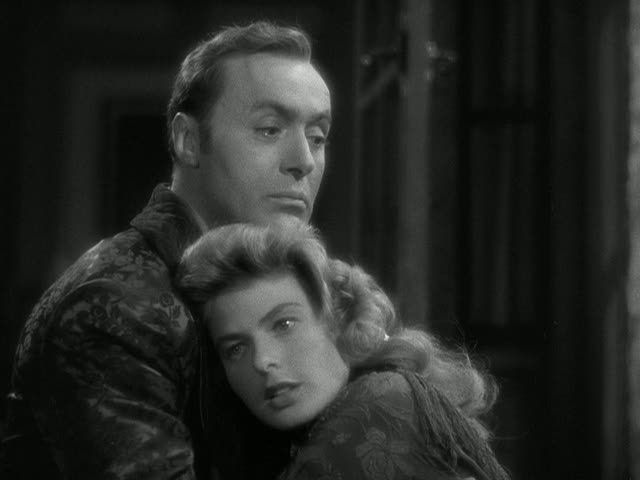
George Cukor's Gaslight is a claustrophobic Gothic suspense piece, a haunting psychological thriller about marital control and manipulation. The beautiful young Paula Alquist (Ingrid Bergman) is devastated by the grisly murder of her aunt Alice, a famous opera singer who had raised Paula from birth. Shocked and wounded, Paula leaves behind the London house where she grew up and goes away to study music like her aunt. She soon enough finds happiness in the arms of the charming pianist Gregory Anton (Charles Boyer), and the couple are married and return to the home where Alice was murdered. Paula is convinced that with her new husband she can finally forget the horrors of the past and create a new life there for them. However, once they arrive, Gregory's demeanor changes almost instantly. He begins assuming tighter and tighter control over Paula's life, forbidding her from having any visitors or going out and, through an accumulation of small incidents and details, slowly convinces her that she is going mad.

The film places its audience in a situation analogous to Paula's, trapped and tortured and manipulated by the overbearing Gregory. His vice-like grip on her mind is infuriating, and the film is frustrating to watch — a measure of how effective it is in conveying the cruel manipulations of its villain. Boyer is terrifying and sinister, with his rigid formality occasionally breaking down, revealing flashes of the monster beneath his cultivated façade. He projects quite a lot through the simple narrowing and widening of his heavy-lidded eyes, which slim down into thin slits and then suddenly open into an intense, fiery glare. It's a nasty, finely tuned performance, but it's certainly not much fun to see him reducing the noble, lovely Bergman into a cowering, stammering, confused mess, unsure of her own mind, half-convinced that she's losing her sanity.

Of course, it is never in doubt for the audience what's really going on: Gregory is the one who murdered Alice, and he's now manipulating the dead woman's niece for some obscure purpose of his own. His guilt is all but confirmed by the way he reacts, early on, to the discovery of a letter sent to Alice just two days before her death. It's an obvious cue, and the audience instantly knows what Paula will take the entire movie to discover: this man is a purely evil murderer. As a result, Gaslight is a form of highly refined cinematic torture, watching the disintegration of this lovely woman's mind and all the while knowing exactly what's really happening. The suspense in the film arises not from any mystery about what's going on, but from the simple, stomach-churning tension of the situation, as well as the unspoken questions bubbling just beneath the surface at every moment: when will Paula wake up? When will she realize what's going on? Cukor toys with this release, and there's a great scene where Paula, finally fed up with her husband's iron fist, devises a minor revolt by resolving to go out for a party. Bergman's sly, proud smile at herself in a mirror, dressed in a lavish white gown, is a reward for the audience and herself for enduring this torture.

This victory is short-lived, however, and ultimately the film's most frustrating quality is that it doesn't allow Paula to solve her predicament herself. She remains, throughout almost the whole film, the helpless, weak, easily controlled woman she seems to be right from the start. It takes the deus ex machina intrusion of a knight in shining armor, the Scotland Yard assistant inspector Brian Cameron (Joseph Cotten), to finally shake Paula out of her stupor. Cameron is awkwardly inserted into the plot, simply appearing at intervals spying outside the couple's home, led on only by vague intuition. His role in the film denies the audience the satisfaction of a more feminist resolution: Paula fighting back for herself, redeeming herself. The film subjects Paula to such extremes of suffering at the hands of a man that even the suggestion of a newly blossoming romance between Paula and Cameron at the denouement is somewhat distasteful — no sooner is she free of her murderous, monstrous husband than she seems to be gravitating towards a new coupling to replace her destructive marriage. Cameron's presence in the film succinctly states the limitations of classical Hollywood: even in a film about the horrors of romance, the film can't manage to present a more compelling solution than simply a better romance.


Still, despite Cameron's part in triggering Paula's belated recovery of her identity and strength, the ending does provide a stunning and deeply satisfying showdown between Paula and her tormentor. Before he's hauled off by the police at the end, Gregory is displayed to Paula trussed up and tied to a chair, their positions finally reversed, with Gregory at last helpless before his wife. True to form, he tries to manipulate her into freeing him, but discovers that he has lost his hold on her. In a marvelous scene, Paula taunts and cajoles him, bitterly mocking him, teasing him with the possibility of freedom before turning him over to the police. The film is a barbed satire of society's contempt for women, and particularly the tendency to reject their concerns, to label them mad, to threaten them with the asylum. Paula's final opportunity to turn the tables on her husband is thus especially satisfying in that she's able to turn his words back on him, to take the words that he used to control her and turn them to her own purposes. It's a complex and potent scene, and Bergman's performance, sensitive and multi-layered throughout the film, is here extraordinary, a masterful display of passion and long-delayed rage spilling over.

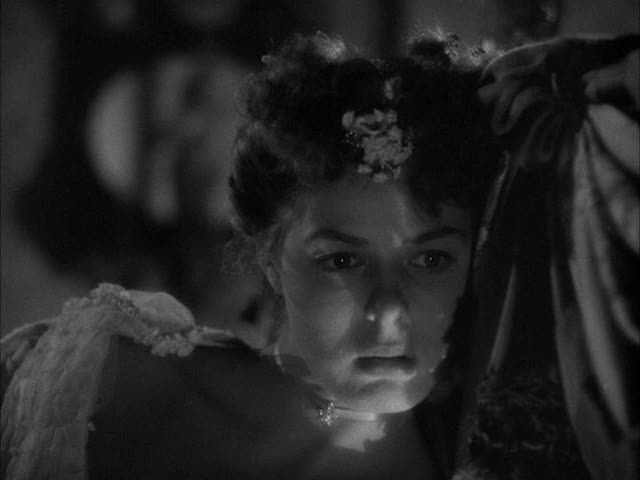
Cukor lavishes attention on the film's atmosphere and setting, perfectly capturing a vision of period London: flickering gaslight lamps, foggy gray streets with rain-streaked stone walks, velvety shadows draped over every surface. In this respect, Bergman's face is treated as a surface as well, brushed with the warm glow of the lamps, the shadows tracing along the rounded edges of her cheek bones, the light playing within the depths of her wet, expressive eyes. Cukor frequently highlights his main actress in closeups, often lingering on nearly silent shots of her simply looking around. The direction is finely attuned to the nuances of her performance, the movement of her eyes, the way she holds her face, the subtle touches with which she fleshes out her character and makes her suffering palpable. Even when the focus isn't on Bergman, nearly every frame of the film is sumptuous and enveloping, a study in the oppressive, womb-like atmosphere of this dark, shadowy house.

Cukor's attention to detail, coupled with the great performances of the two leads, makes it easier to overlook the film's shortcomings, but it's undeniable that the script is a silly and contrived piece of work. With the exception of the confrontation between Paula and Gregory, the final act dissipates the film's eerie atmosphere into banality, particularly once Gregory's motivations for what he's done become known. On the plus side, the airless claustrophobia of the plot is relieved slightly by the sporadic presence of a trio of fine character actresses in bit parts: the house's near-deaf cook (Barbara Everest), the couple's gossipy, murder mystery-loving neighbor (Dame May Whitty) and the tart, snippy young maid (Angela Lansbury in her first role; though why Gregory would show her the least bit of amorous attention with Ingrid Bergman right upstairs is one of the film's most insoluble mysteries). Gaslight is at times frustrating and doesn't go far enough in exploring its ideas about marriage and gendered power struggles, but it's nevertheless a dark, interesting chamber thriller.

Bluebeard


In Edgar G. Ulmer's Bluebeard, the Poverty Row auteur crafted a strange, eerie piece of extreme low-budget horror, centered around the titular murderer, an artist who strangles his models to death after painting them, throwing their corpses into the Seine River. Gaston Morrell (John Carradine) is both a painter and a puppet artist, a performer who puts on elaborate stagings of the tale of Faust with his puppets. His paintings are more of a sinister and deadly hobby, as well as a source of income — his Mephistophelian business manager (Ludwig Stössel) sells the resulting paintings at a great profit. However, Morrell is moved to give up painting — and thus also his sinister sideline — by the appearance in his life of the lovely Lucille (Jean Parker), a dress designer who agrees to create new costumes for Morrell's puppets.

There is little mystery or true horror in this tale, as Ulmer, in his characteristically blunt way, establishes early on that Morrell is without a doubt the killer. He's shown murdering his assistant, Renee (Sonia Sorel), when the girl begins to wonder what has happened to all the women for whom Morrell would leave her for days or weeks at a time. The film is sexually frank for its time, and it is heavily implied that Morrell has been going to bed with his models in addition to simply painting and killing them. One wonders at times if anyone from the censorship boards ever even watched this film, particularly in the early scene where the police fish a woman's corpse out of the Seine and the wet dress clinging to her body reveals the bare flesh beneath — a haunting scene that confirms the sexual component of Morrell's murders.

Morrell is obsessed with ideas about sexuality, about purity and sin. As he reveals in the film's talky conclusion, his murderous rage was first triggered by a woman who he painted while he was helping her recover from an illness — inspired by the purity and beauty he saw in her eyes, he painted her as a saint with a glowing halo on her head. After her recovery, however, he was horrified to learn that she was a prostitute, a crude and impure woman, nothing like the unblemished portrait he'd made of her. The film makes the dichotomy between the Madonna and the whore central to its theme: Morrell goes mad because he cannot handle having his pristine images soiled by the complexities of reality. Preferring art to life, he loses control of himself and becomes a relentless killer. The film also deals with prostitution and vice in a comedic scene in which a police inspector (Nils Asther) interrogates a woman who had served as an artist's model but had, it seems, lately turned to other work. The script dances cleverly around the subject of that "other" occupation, but it's apparent that the whole conversation between the policeman and the girl is about sex, about prostitution. It's funny principally because the girl herself is unperturbed. She's openly flirtatious and says just what she means; it's the inspector who's uncomfortable with the subject and keeps cutting her short, trying to turn the conversation in another direction. He's a censor, not allowing an open and honest discussion of sexuality to take place, stopping the conversation at the surface level of euphemisms.

Here and elsewhere, the film playfully mocks male insecurities about female sexuality. The women in the film are open and charming and assertive, while the men are ineffectual and timid. When Morrell speaks to Lucille, he tries to maintain a cordial coldness that simply comes off clipped and awkward. He's a vicious murderer, but he's also a fairly sad, overly naïve guy who doesn't know how to talk to girls. At one point, he comes to visit Lucille, who is with her sister Francine (Teala Loring). Francine is getting dressed, shielded behind a thin dressing screen, but she urges Morrell to step inside, not to be shy, despite Lucille's statement that her sister is "not decent." Francine's eyes peek coyly over the top of the screen, the only part of her body visible, and Ulmer playfully highlights the sexual tension of the scene by having her step out from behind the screen just at the moment that she's fastening her shirt closed.


In this way, the film is continually calling attention to sexuality and feminine allure. If it is not a mystery or a horror film, it is in its weird way a kind of creepy love story, the tale of a man who falls in love to such an extent that he is moved to give up his profession for the love of a woman. Carradine's performance is exceptional, capturing the layered qualities of this urbane killer: by turns charming and distant, kindly and terrifying, icily murderous and tortured by his deeds. His role requires him to shift fluidly from outward calm to the pop-eyed stare he focuses on his victims, a crazed expression that Ulmer accentuates with closeups. Equally compelling are Parker and Loring as the sisters who cross paths with Morrell: the bold, independent-minded Lucille as the object of his affection, and Francine in her amorphous role as a police assistant of some kind, helping with the investigation of the Bluebeard killings.

As is typical of Ulmer and his minimalist productions, the plot of Bluebeard is almost indifferently handled, with frequent jarring cuts and a generally brisk pace that hurtles from one incident to the next with little connective tissue. The film very much displays its ragged edges: Ulmer shows only that which is absolutely necessary to either the plot or the atmosphere, omitting everything else with brutal economy. The film lasts just over an hour, and hardly a minute is wasted, though at times Ulmer's tendency towards economy sabotages the dramatic tension of the story. The conclusion, in particular, feels oddly rushed and overly talky, packing dense exposition into a few quick minutes, explaining the killer's origins and motivations before the perfunctory final battle that brings the film full circle: its last shot of the buildings along the Seine mirrors exactly its first shot.

Elsewhere, however, Ulmer's Gothic visual sensibility provides plenty of striking images to distract from the minimal, fractured narrative. The sewers beneath Morrell's house, where he dumps the bodies of his victims, are shadowy and gray, and Ulmer's camera follows black cloaked figures creeping through the darkness on sinister errands. In another scene, Morrell stares at the shadows of his puppets reflected on the wall in front of him, suspended in the air, awaiting his control, looking like a line of tiny hanging victims above his head. The film's plot might be simple, and its aesthetics sometimes crude and rough, but it is at the same time a stylish, intelligent treatment of sexuality and violence.

Wednesday, April 1, 2009

Films I Love #25: Sunset Boulevard (Billy Wilder, 1950)


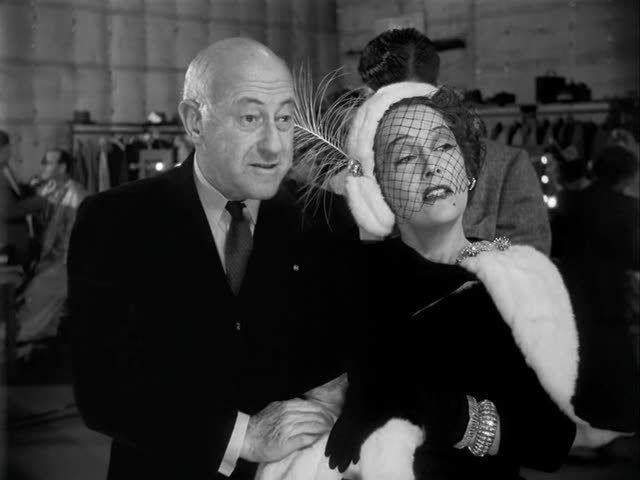
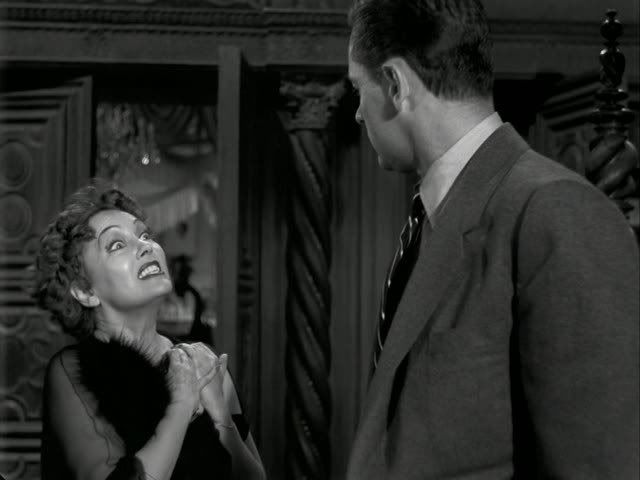
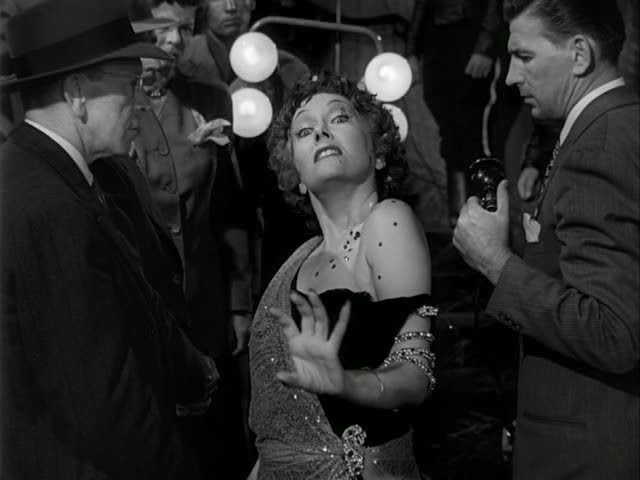
Sunset Boulevard's Norma Desmond (Gloria Swanson) is quite possibly the greatest of Hollywood cinema's many self-parodic characters. Norma is an antique of the silent age, one of the many great stars of the silent era who, too invested in the expressive melodramatics and gestural acting of silent cinema, simply could not make the transition to sound. If anything, though, Billy Wilder's darkly comic masterpiece only proves that silent film's acting conventions work just as well in the sound era, lending some credence to Norma's grand pronouncement, "I'm still big, it's the pictures that got small." Swanson's Norma is a sad, creepy creation, stalking through the film with her hands twisted up into Nosferatu-like claws, a true (silent) movie monster. She's obsessed with the past, and she sees her second chance in down-on-his-luck screenwriter Joe Gillis (William Holden), who's broke and ready to give up on his Hollywood dreams altogether when he accidentally becomes involved with Norma. The cynical Gillis sees in her a chance for money and comfort, even though he knows her ludicrous proposed script, a lavish Egyptian fantasy she's been crafting for Cecil B. DeMille, has no chance of getting off the ground.

This is certainly one of the great Hollywood satires, a moving ode to those figures left behind in the wake of progress, including the director Erich von Stroheim, who appears as Norma's former lover and director, now reduced to her doting, eternally loyal butler — an arc that mirrors Stroheim's own fall from Hollywood's graces. By the same token, Wilder inserts cameos of several prominent real-life actors whose careers really were, like Norma's, sabotaged by the dawn of sound: Buster Keaton, Anna Q. Nilsson and H.B. Warner. But the heart of the film is Norma herself, mad and exaggerated and yet compulsively watchable, even her dementia reminding us of the power of gesture, of the way silent actors relied on their faces, communicating physically rather than verbally. Norma's constantly performing, whether she's donning Charlie Chaplin drag to do a silent comedy bit or exploding into teary melodramatics. She's always on screen in her mind, always in character, always ready for her closeup.