Monday, May 4, 2009

Le bonheur


Agnès Varda's third feature, Le bonheur, is a cheerful, sunny, colorful film, a vibrant and ambiguous fable about love, fidelity and the search for happiness, all of it scored with the richly emotional music of Mozart. It is a stunningly provocative film, offering up few answers to the thorny questions it raises about its protagonists and their attempts to create happy lives for themselves. The film opens with an idyllic portrait of married bliss, with real-life couple Jean-Claude and Claire Drouot playing François and Therese. They are happily married and in love, and they have two adorable children (played by the Drouots' real-life kids Olivier and Sandrine). They are an affectionate, playful family, exchanging kisses and hugs frequently, laughing and enjoying sunny Sundays spent in the forest, walking and lounging in the grass and picnicking. Varda's imagery is sensuous and brightly colored, and the riverside tableaux of the opening scenes recall Impressionist landscapes with their blurry, pointillist colors and lush natural scenery. This idyll seems too perfect, too fantastic, as though it had merely been constructed to be broken, and Varda herself skewers this sunlit fantasy when the family returns from their vacation: Jean Renoir's Picnic on the Grass, playing on a TV, suggests that the kind of cheery, uncomplicated romance portrayed here exists primarily in the movies rather than in reality.

And yet for much of the film this idyll is undisturbed. François begins casually flirting with Émilie (Marie-France Boyer), a young woman who works at a telegram office near the shop where he serves as a carpenter. Their flirtation seems innocent, natural, and irresistible, and almost entirely unrelated to François' home life. Soon, he is engaging in an affair while remaining utterly happy at home — if anything, he is even happier, since he now has two women he loves (and who love him). He discovers that for him, love and happiness are "additive," that by being in love with two women he has doubled his joy. The two women are different and offer him different things: Therese is sweet and calm and tender, while Émilie is more vibrant and wild and fun-loving. He shares languid afternoons in the park with the former, passionate dalliances in bed with the latter. And truly, he loves them both, and wouldn't choose one over the other.

This is complex territory, hardly a simple portrayal of marital infidelity but an investigation into the very nature of love, marriage and desire. François wants everything from life, and he doesn't hesitate to reach for it all. He is in many ways selfish and naïve, really believing that he can have everything without hurting anyone else, without disturbing the balance of his life and the lives around him. He is an ambiguous character, an egotist who cares primarily only about his own happiness, his own wants and needs — he takes what he wants with little regard for how it will affect other people. And yet he's also a kind, loving man, with apparent genuine and deep feelings for both women in his life. He is also honest, or tries to be. He tells Émilie all about his wife and family right from the beginning, and makes it clear that he still loves Therese and would never leave her or hurt her. With Therese, of course, he is less honest, and his attempt to finally come clean with her — in an elegant but cruel metaphor, he describes his family as an apple orchard, and says that he has noticed another, equally lovely apple tree outside the orchard — results in tragedy. Still, Varda does not judge, per se, and the film's final act is an effusive montage in which Émilie steps in as the new wife, taking Therese's place without fuss. The images have the same quality of colorful, summery good cheer, though the new context creates an aura of melancholy around the laughter and the play.


Varda is dealing with powerful material here, and placing a real-life family at the center of the narrative only enhances the dissonance within the film. With so much explosive potential, it is critical that she carefully modulates and controls her story. The editing is self-assured and varied, easily shifting from abrupt, rhythmic New Wave montage to a more languid, painterly aesthetic, tracking along natural landscapes or fading between images with solid color fields, like palette cleansers. The Mozart music drives the film, and the images seem to flow with the music, pulsing and breathing, interweaving with the strings. The moment when François first visits Émilie at her apartment (ostensibly to hang some shelves for her) is especially masterful. When Émilie opens the door, she smiles, and Varda begins cutting propulsively between a closeup of her smiling face and a closeup of François, smiling in return. The quick, syncopated pace of the cuts creates a pounding rhythm for the scene, one that is intensified once François steps inside, and Varda begins inserting cutaways to objects strewn around the room, brief glimpses of the apartment's bare interior before returning to the flirtatious dance of the two soon-to-be lovers as they awkwardly step around one another.

In an earlier scene, the development of the first hesitant connections between this pair are formed at a café, where Varda plays with the focus of the image in order to continually take the focus off the couple and then back. In alternating closeups on François and Émilie, the focus shifts into the background, onto a woman being delivered a drink or a girl being greeted by a friend, then shifts back to the subtle exchange of glances and banal small talk between the two new acquaintances. The scene is charged with sexual energy and tension: not just the tension between François and Émilie but the tension between foreground and background, between narrative and digression. As they flirt, the film flirts with leaving them behind, expanding outwards into other stories, other characters beyond the boundaries of this love triangle story. Varda then solidifies the scene's point with cutaways to two one-word signs in quick succession: "temptation" and "mystery."

Varda's style is thus playful and catholic, open to a lively stream of visual information. François' infidelity is later visualized in an extended shot in which Varda pans back and forth across a courtyard where couples are dancing and exchanging partners. In the middle of the pan, the focus blurs, and on opposite sides of the dance floor François dances first with Therese and then with Émilie, then again with his wife, and everyone's happy and smiling and talking contentedly. Later, a mid-afternoon sexual dalliance with Émilie is staged as a montage of disconnected body parts — an eye here, an elbow there — as in Jean-Luc Godard's A Married Woman, released a year before and a possible reference point. Is Varda responding to Godard, countering his portrayal of wifely indiscretion with the fact that husbands, too, can stray? If so, Varda's more philosophical about such things, or at least more open to the possibility that people can be genuinely happy even when they're blithely causing tragedies and wounding the ones they love. Varda avoids the moralist position that infidelity always brings ruin and misery: at least some of the people involved are still happy when the movie's over.

But that gets at one of the most potent and subtle questions asked by the film's title: namely, just whose happiness is at stake here? Certainly, François seems to be mostly concerned with his own happiness, and never thinks to ask what will make either of his women happy. He never suggests that either of them should take other lovers to make them happier, and one senses that would be an unthinkable blow to his ego. He takes it for granted that all he needs to give them is himself, and expects them to pliantly accept, docile and forgiving. He wants his women to be understanding of his needs, to do what is best for his happiness, but to greater or lesser extents, neither of them is happy being one of two women, and they both tell him so, though he disregards their desires. In one case, at least, this is a tragic misstep. François' failure to think about the happiness and desires of others nearly tears his life apart, but ultimately he is able to simply form a new life, to construct a new happiness from the ruins of the old one. Varda closes the film with an image of this happy family walking away from the camera through the gorgeous, gold-tinted woods, but unlike the similar blissful family in the opening, it is not clear whether this is an image of an idyll or a dystopia.

Sunday, May 3, 2009

The Fan


The Fan is an early melodrama from Otto Preminger's long and fruitful 1940s residence at Fox Studios. Loosely based on Oscar Wilde's Lady Windermere's Fan, the film moves fluidly from past to present and back again, using a framing story in which the auction of a delicate, finely crafted fan prompts the reminiscences of the elderly Mrs. Erlynne (Madeleine Carroll), who then tracks down her old acquaintance Lord Darlington (George Sanders). Together, they travel back into the past, lingering on the follies and pleasures of their youth, when they were attractive and fun-loving and both irrepressible adventurers. Though the bulk of the film is set in this past, Preminger does not treat the framing story with the disdain that such conceits usually receive. In these kinds of frothy Hollywood concoctions, the framing story is usually just a slim pretext for telling some other story, but Preminger is interested in these people not just when they're young and witty and good-looking, but when they're old and feeble and forgetful as well. The film becomes as much about the nostalgia of old age as it is about the passionate loves and scandals and betrayals of youth.

In Preminger's hands, this is a prime melodrama, the story of a pure, loving, devoted couple: Lord Arthur Windermere (Richard Greene) and his pretty young wife Margaret (Jeanne Crain). They've been married a year and are deeply in love, but their seemingly idyllic marriage is threatened when the slightly older and notorious Mrs. Erlynne arrives in London. She's a self-described "adventuress" and delights in shocking people by lighting up a cigarette — which gives one some idea of just how easy it is to shock the people in this film's exclusive society circle. The rumors spreading around town about Arthur and this woman provide the perfect excuse for Darlington, who had long admired and desired Margaret and now saw his opportunity to take her away from her husband, who he assumed was being unfaithful anyway. In fact, as is so often the case in these kinds of fairy tale melodramas, all is not as it seems on the surface, and Preminger ably handles the twisty, lurid material, which could have easily boiled over in lesser hands.

His style of languid tracking shots and careful pacing is well-suited to this mannered drama, in which polite words and stylized gestures disguise the barbed insults and insinuations of these upper-class gossips. The disgraced and downtrodden Mrs. Erlynne only wants to make a name for herself in high society, and she's quite willing to resort to dishonesty and trickery to do so. She's conniving and manipulative, and she soon wraps the bumbling, stuttering Lord Augustus (Hugh Dempster) around her little finger. Carroll, the star of early Hitchcock features The 39 Steps and Secret Agent, is fantastic here, in her last film role before a brief fading-away in TV work. It's a shame that there has never been more call for roles like this, which take advantage of an actress' middle age rather than simply discarding her in favor of younger girls.


The subtleties of Carroll's great performance become clear in the scene when Augustus comes to call on Mrs. Erlynne for the first time. She's brusque and remote with him when he arrives, treating him with a thin gauze of manners that marks him out as just one in a long line of callers that day; her courtly façade is starting to wear away. But the minute she realizes that Augustus actually has something of substance to offer her, that because of his status he could be important to her, her entire manner changes. She becomes open and ingratiating, her smile becomes genuine rather than simply polite, and her eyes begin to sparkle. It'd be easy to sell a scene like this broadly, to make it theatrical and overt, and in that case it would be comedy: the beautiful shark taking advantage of a nebbishy bit of chum, and everyone knows it except the poor victim himself. Preminger is too clever for such broad strokes, though, and the performance he gets out of Carroll is more naturalistic and subtle. She makes the scene into character-based drama rather than comedy; instead of laughing, the audience learns more about her character, about what she's willing to do to get what she wants.

The film is packed with such moments. Mrs. Erlynne is a complex character, deceitful and tricky but also decent and good-hearted, self-serving but capable of tremendous acts of self-sacrifice. The central couple of Arthur and Margaret is naturally less interesting, since they provide an idealization of romantic love rather than a pair of convincing characters; they're symbolic and unspoiled while Mrs. Erylnne and Darlington are flawed, realistic characters. Still, Crain gives a warm and sweet performance as the lovestruck woman whose confidence and trust in her husband is shaken by rumors and suspicions. Her pinnacle comes in a striking shot of her and Mrs. Erlynne towards the end of the film, as the older woman tries to convince the younger one to go back to her husband. Preminger stages it as a deep-focus two-shot with Margaret in the foreground, slightly out-of-focus, her blurry features distorted by tears and anguish. Mrs. Erlynne is slightly behind her, her face focused into crisp detail so that the lines of her face are accentuated, calling attention to the age difference between the women.

With scenes like this, Preminger finds unforgettable images in a story that would be all too transitory in the hands of another director. The story is a trifle of a melodrama, silly and contrived, and driven by the oldest of soap fiction inventions, the return of the missing parent. Preminger wisely downplays the narrative's more sensational ideas and mines the more understated and genuine emotions at play here. This has the effect of shifting the focus away from the syrupy romance of the central couple and onto Carroll's world-weary Mrs. Erlynne and Sanders' aging cad Darlington, the former repeatedly beaten down but never broken, the latter maturing into a raffish old goat, still haunted by the great unconsummated love of his past. The dialogue is understated and dotted with Wildean bon mots (especially from Martita Hunt as a chattery duchess), and Preminger's flowing, gracious style complements the delicate emotions and memories at the story's core.

The Mouth Agape


Maurice Pialat's The Mouth Agape concerns itself with the body, with flesh and corporeality. It's a film about death and dying and illness, and also about sex, sensuality, pleasure, infidelity, love. Monique (Monique Mélinand) is dying, her body wasting away with cancer; she has only months left to live, and knows it. Her family gathers around her, tending to her and awaiting the inevitable. Her son Philippe (Philippe Léotard) is dutiful and loving, but he has his own life and his own problems, and in any event he can't bear to see his beloved mother suffering for very long. So he darts in and out, coming to see her often but seldom staying long. Her husband Roger (Hubert Deschamps) has had a long and stormy relationship with her, marked by serial infidelities and arguments and separations, and it seems that before her illness they hadn't actually seen very much of one another. But in his gruff, aloof way he cares for her now. Whenever he's not with her, he vocally wishes for it all to be over, saying he can't take it any more, and he retains his philandering ways right up until the end. He's an archetypal French dirty old man, using his clothing store as an excuse to get nubile young girls to strip down for him. His status as a lovable old man, affectionately called "the old goat" by the young girls, allows him to indulge his incorrigible nature, hitting on girls with blatant sexual come-ons that would get a younger man slapped. And he continues to visit his aged mistress (Jeanne Dulac), the woman who he had once wished to marry instead of Monique.

When he's with Monique, however, he is tender and caring, displaying a serene patience that his son utterly lacks. It is obvious that in his own inconstant way, he loves this woman, and is devastated by her departure — and perhaps by his own failures to be better to her when she was healthy. This is a film about the past as much as the present, and the dialogue allows the histories of these characters to unfold slowly, in short vignettes and stories that draw connections backwards from the present to old decisions and problems and mistakes. These people are all wounded and damaged in some way, they have come through strife to the places where they are today. They've hurt each other, too. Philippe, like his father, is congenitally unfaithful, seemingly unable to prevent himself from cheating on his wife Nathalie (Nathalie Baye). He seems to love her, to have real affection for her, and yet as soon as she's away from him he's picking up another woman, just because he can, one supposes.

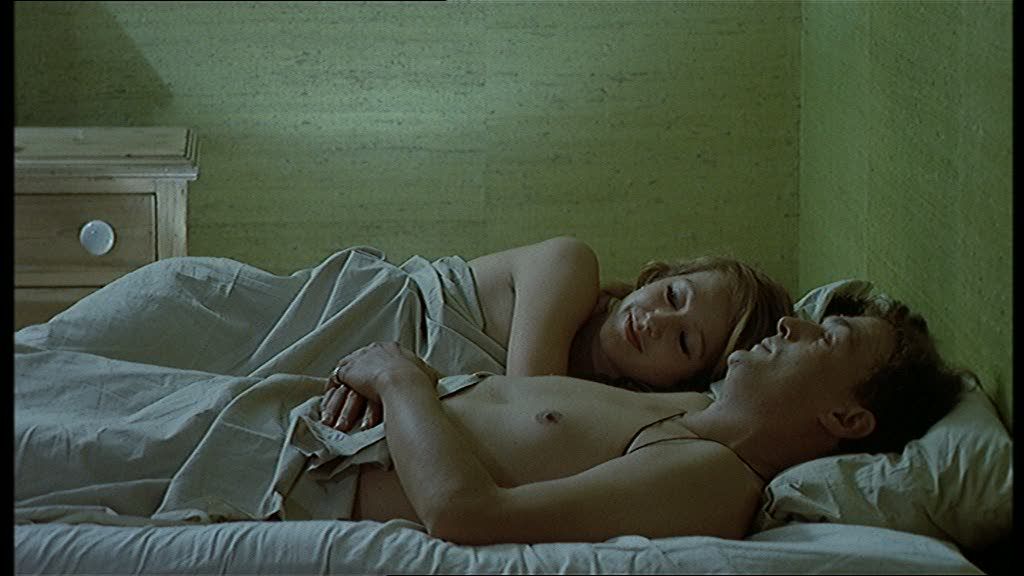
In this film, death and sex are intimately woven together. Pialat alternates scenes in the hospital where Monique is wasting away — confrontations with mortality — with more sexual and sensual scenes. After visiting his mother in the hospital, Philippe returns home to find Nathalie in bed; he joins her and talks about his mother's illness and her impending death while his wife lies next to him, naked, not saying a word, sprawled out with the sheets draped casually across her breasts. She is quietly sensual and sexy, comfortable in her skin, and her presence is an unspoken counterpoint to Philippe's words. Later, a scene at the hospital cuts directly to Philippe passionately making out with a young woman named Corinne (Corinne Derel), stripping off her clothes to reveal an over-ripe body, fleshy and curvy, her buttocks distorted beneath his grasping hands, the imprints of her bra and panties still embedded in her skin. Her flesh, her body, the way her bra constrains and reshapes her proportions, recalls the opening scene in which Monique, stripped to her bra and a skirt, lies down for X-rays, the machine optically overlaying measurements and grid markings across her body. The decaying, dying body of Monique is continually contrasted against the young, supple flesh of the girls Philippe and Roger meet and seduce, and the continuity between these scenes emphasizes that both extremes are endpoints in a cycle, youth and beauty eventually aging into devastation and death.


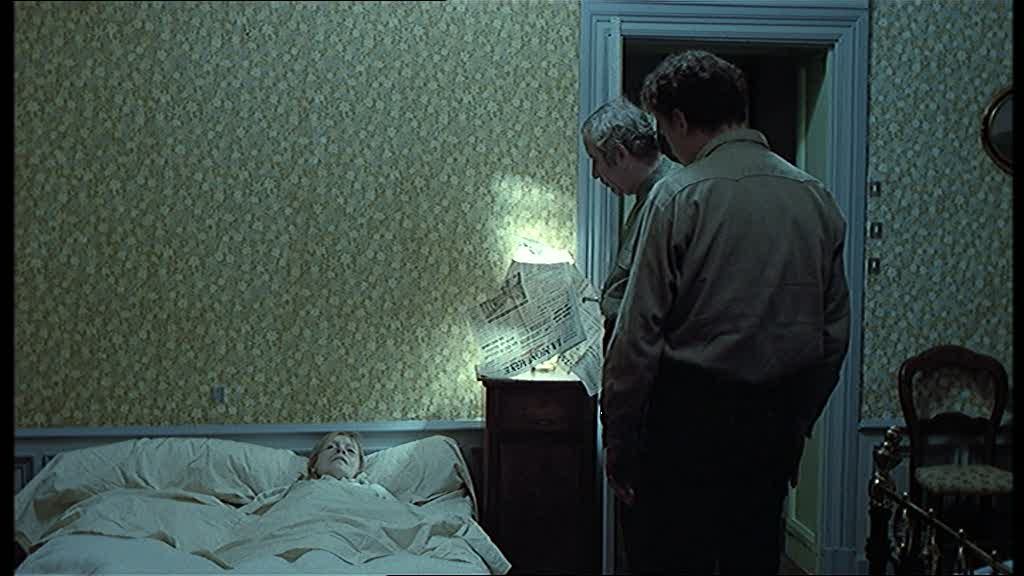
Mélinand gives an extraordinary and stripped-down performance here, speaking less and less as the film goes on, progressing toward a pale, zombified state, wrapped up in her sheets like a mummy, unable to move, her mouth convulsively opening and closing as the harsh gasp of her breath rattles and wheezes on the soundtrack. Pialat increasingly places her at the extreme lower boundaries of the frame, her prone form parallel to the frame and hovering just above its bottom edge, only her head visible above the sheets enfolding her, as though she were a drowning woman just barely managing to keep her head above the water.

The formal purity of Pialat's framings accentuates her increasing isolation, wrapped in a cocoon, her disembodied head gasping for air. A vast stretch of yellow patterned wallpaper fills up the majority of the frame above her. The camera often holds steady for long stretches of time, simply staring with discomfiting directness at the truths of mortality and disease. The camera occasionally quivers, subtly shifting and reframing — the hand of the cameraman weakening, his own human frailty and the limits of his body intruding into the picture — but it never looks away, never flinches from the realities of feeding, injections, the total failure of Monique's body.

This is a harrowing, deeply affecting film, with great patience for allowing the full complexity of these characters to reveal itself over time. Pialat understands that you can love someone, care for them, and still hurt them badly. He knows that the tenderness these characters show for each other in one scene is not necessarily inconsistent with the craven behavior they display in another. He also knows that these complexities, these complicated relationships and the characters' experience of sensuality, are ultimately trumped by the finality of death. In the film's last twenty minutes, the focus subtly shifts back towards Monique, the narrative paring away the various threads surrounding her until the camera is back to staring relentlessly at her wasted body as she gasps her last few breaths. Pialat does not look away, not from the prepping of her body after her death; not from the emotional catharsis of placing her in her coffin; not from the funeral itself, which he creeps up on from around a corner, his camera slowly arcing until the grieving family comes into view. The penultimate shot is a long view from the back of Philippe and Nathalie's car as they leave after the funeral, speeding away from death, even as the camera looks steadily backwards, like Orpheus leaving the underworld, unable to resist looking back on the scene of death once more.

Friday, May 1, 2009

The Conversations #4: Star Trek


Jason Bellamy and I have now posted the fourth installment of our regular monthly series of conversations at The House Next Door. This month, with the release of the new J.J. Abrams-directed Star Trek origin movie only a week away, we have gone back to the first six Star Trek films, the ones featuring the original cast from the late 60s television show that started it all. It's a fun and wide-ranging discussion that we hope will be interesting for Trekkies and non-Trekkies alike. Below I've posted Jason's introduction to the piece; click through to the House to read the rest.


JASON BELLAMY: America's relationship with Star Trek began before man ever set foot on the moon. Gene Roddenberry's creation was born in 1966 and lasted three seasons on TV before dying of low ratings in 1969. Forty years, endless reruns, four live-action TV series and 10 feature films later, Star Trek is alive and well in the pop culture. In just a few days, on May 8, the crew of the starship Enterprise—Kirk, Spock, Bones, Scotty, Uhura, Sulu and Chekov—will hit the big screen yet again in an origin story directed by J.J. Abrams. Star Trek, as the film is simply called, is perhaps the most anticipated movie of the spring. And though its arrival is hardly a surprise in this era of remakes and retreads, the brand's longevity is nonetheless impressive.

From 1987-2005, there was some form of modern Star Trek on TV. The Next Generation (1987-94) begat Deep Space Nine (1993-99), which begat Voyager (1995-2001), which begat Enterprise (2001-05). All of these series can be traced back to the 1966 pilot that started it all, but it's safe to say that none of these series would have been possible without the varied yet undeniable success of Star Trek at the cinema. From 1979-91, six Star Trek films were released featuring the recognizable cast and characters of the original TV series. Almost two decades later, these films are cherished by some ("Trekkies" or "Trekkers"), mocked by others and seemingly ignored by everyone else.

Ed, I have invited you to join me in boldly going where so many have gone before, to those first six Star Trek films. Over the course of our discussion, I'd like to explore the factors that make Star Trek beloved and belittled. I'd like to figure out whether Star Trek gets too much respect or not enough. I'd like to debate the series' impact on cinema. And I'd like to forecast what a successful Abrams adaptation might look like. But let's begin at the beginning. Tell me: Prior to rewatching the first six Star Trek films, what was your relationship to those films and to the overall brand? Which of these films had you seen, and how long had it been since you'd seen them? What was your stored impression of Star Trek cinema up until a few weeks ago, and what is it now?

Continue reading at The House Next Door