Friday, July 24, 2009

Hollow Man


Hollow Man was the last of Paul Verhoeven's run of Hollywood genre films, made following the lackluster reception of his previous two pictures, Showgirls and Starship Troopers. Both of those box office flops were later reappraised by various audiences as trashy cult/camp successes or genuine masterpieces, but that doesn't seem likely to happen for Hollow Man, which similarly flopped upon release but seems to reveal the director reaching the limits of his interest in making this kind of film within Hollywood. That's a shame, because the film's concept is certainly the kind of thing one would expect Verhoeven to eagerly embrace, to transform into the kind of morally ambiguous, pulpy genre deconstruction/celebration that he does best. Instead, while the film is good — even bracingly potent — in isolated stretches, it's sabotaged at every turn by indifferent scripting, disconnected acting, and one of the most absurd action denouements in Verhoeven's career. The film introduces some interesting concepts, some tantalizing hints of the film Verhoeven at his best could make of this material, and then destroys everything in a raging inferno.

The film is the story of government research scientist Sebastian Caine (Kevin Bacon), who's leading a project to discover a way to make people invisible. Naturally, once he's perfected the process, or believes he has, he wants to switch from testing the procedure on apes to, in the grand tradition of movie mad scientists, volunteering himself as the first human test subject. It's a heady concept, and Verhoeven hints right from the beginning that the film's going to be about Sebastian exploring his darkest impulses without moral accountability. Even before he turns invisible, Sebastian is kind of a jerk, a brilliant guy who treats his co-workers with barely disguised contempt, particularly the women, with the one exception of his ex-girlfriend Linda (Elisabeth Shue), who he treats just slightly better because he'd like to sleep with her again. He's also a voyeur, habitually spying on a woman who lives across the street from his apartment; she generously feeds his voyeurism by stripping down to her lingerie every night, tantalizing him, before closing the shades to finish undressing. It's obvious, then, what kinds of things Sebastian will want to do once he's invisible. This is a classic pulp premise, the invisible man who primarily uses his gift so he'll get to see lots of naked women.

To some extent, Verhoeven delivers on this premise, having Sebastian immediately abuse his power for sexual thrills. Tellingly, it's not being invisible per se that gets him off, but the ability to do what he wants without being held accountable. His first sexual assault, walking up to a sleeping girl and unbuttoning her blouse, doesn't necessarily require him to be invisible in order to do it. The invisibility comes in handy only when she wakes up, so he can escape literally unseen. Being invisible doesn't so much open up new things for him to do, it merely allows him to do what he already could've done, except now he can do it assured that he won't get caught. The moral dilemma at the story's core, then, is the question of whether morality disappears with the possibility of punishment and accountability: if a man can do what he wants without anyone ever seeing him do it, what will he do? Unfortunately, Verhoeven seems largely uninterested in these questions, or at least uninterested in the possibility of exploring them in this particular movie. Instead, the film rapidly degenerates into a rather typical, if particularly lousy, horror film.

The second half of the film does have some inventive, tense horror sequences, in which Sebastian stalks his fellow scientists after trapping them in the underground bunker where they work. These sequences revolve around the clever back-and-forth as Sebastian tries to maintain his edge of invisibility, while the other scientists attempt to find ways to track him, from spraying him with various substances to using heat and motion sensors. These scenes have the claustrophobic intensity of something like Howard Hawks' The Thing From Another World, one obvious touchstone among many similar films where a group of potential victims are trapped in an enclosed, inescapable space with a killer. But as good as these scenes sometimes are as slasher/victim duels, it can't help but be disappointing that Verhoeven abandons his premise's moral concepts for such generic fare. Moreover, the final twenty minutes are an absolutely torturous attempt at a big action finale, in which Sebastian seems miraculously unkillable as explosions fill the underground complex. This ridiculous final battle all takes place in an elevator shaft where the last surviving protagonists, Linda and her scientist boyfriend Matt (Josh Brolin) struggle to escape and fight off the half-materialized Sebastian while an elevator literally bounces up and down the shaft, rocketing around crazily amidst the flames. It's a mess, a halfheartedly assembled compendium of action movie clichés that definitively erases any possibility that the film could have redeemed itself with its conclusion.


The film has other problems, too. One of these is that Sebastian is such a jerk to begin with that his gradual transformation into an even bigger jerk isn't really that interesting or morally complex. This should be a Jeckyll and Hyde story, a story about the dark impulses contained in all men, but in this case it's not exactly shocking when we learn that this sexist asshole is capable of rape, sexual assault and murder once he's invisible. The film's subtexts about male sexual voracity are poorly developed to begin with, limited to a handful of throwaway scenes, like the one where Sebastian's fellow scientist Carter (Greg Grunberg) is caught reading a porn magazine and talking dirty to the pictures. If the script, by Air Force One scribe Andrew W. Marlowe, intends this stuff to be a clever way of showing that all men are pigs, let's just say it doesn't work.

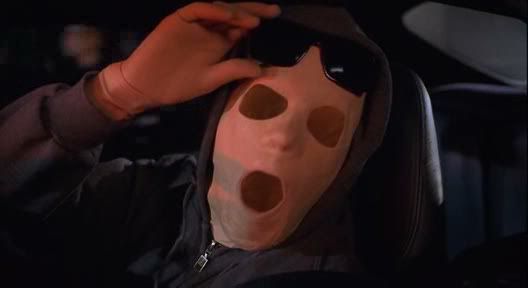
In fact, the script is arguably responsible for much of the film's failure, in that it takes a striking premise and then slowly, methodically, wears away anything that might be interesting about it, replacing it with clichés. The dialogue is almost unrelentingly generic, riddled with awkward phrasing and lines of almost astonishing mundanity. It's the kind of script that sabotages any possibility of meaningful acting, and the cast mostly responds by not really bothering to act. Bacon is a sneering cipher, and then he disappears altogether, spending most of the film unseen, acting from behind a rubber mask or various CGI effects. But even then he's not nearly as bad as Shue's sniveling, characterless Linda, who keeps giving in to steamy moments with her former lover Sebastian and then pulling back at the last moment to show she's a good girl after all. She's cheery and empty, while Brolin's Matt is stoic and empty, and most of the rest of the cast are just warm bodies, biding their time in waiting for the slasher finale. Only Kim Dickens, as the veterinarian Sarah, turns in a decent performance, emanating the low-key bitchy resentment that Verhoeven has always seemed to cherish in his female characters.

On the positive side, the film does make interesting use of its special effects. The CGI used here hasn't dated well, as tends to be the case with CGI, and the effects have a blatant unreality that makes them look cartoony. Even so, there's a real sense of wonder to scenes like the one in which an invisible gorilla rematerializes one layer at a time: first its veins become visible, its neural pathways, its muscles and organs, its skeleton, the layers of skin piling on before finally reaching its hairy exterior. Even with effects that today look substandard, the scene amply captures the sense of magic and awe in this scene. Later, when the effect is reversed for the scene where Sebastian disappears, it's equally powerful and unsettling, an image of the human body peeled away layer by layer, revealing what's inside, making us tick, and then obscuring all of those innards as well.

The film comes alive in moments like this. It comes alive, too, in a scene preceding Sebastian's disappearing act, when, in the hallway leading to the lab, Sebastian tells an astonishingly dirty joke. It involves Superman, a nude sunbathing Wonder Woman, and an invisible man, and it neatly encapsulates the film's anxiety about what men will do when granted power and true freedom from responsibility. It's a joke about what happens when someone can do something without anyone ever knowing, and its twist relies on the fact that while Sebastian is telling the joke, the audience suspects that he's implicitly comparing himself to Superman; after all, he's always joking that he's playing God. But it turns out that he doesn't aspire to be Superman, and despite his patter he doesn't really think he's God either. He just wants to be the invisible man. He aspires to be a man shorn of the moral responsibility that comes with having a face, a tangible presence in the world. This lewd, tasteless joke is one of the film's best, most revelatory moments. It's very tempting to attribute it to Verhoeven; it seems impossible that it could be a product of the same script that is everywhere else so lifeless, humorless, and blind to the ideas and possibilities embedded in this material.

The film is undoubtedly a failure, and it's probably no coincidence that after this Verhoeven finally departed from Hollywood, returning to the Netherlands to make his next feature, the creatively rejuvenating Black Book. Hollow Man, though interesting at times, reveals the limits of Verhoeven's ability to play around within Hollywood genre tropes. He seems constrained by his material, prevented from really taking this story to its naturally lurid, morally inquisitive excesses. And a reined-in, neutered Verhoeven is a director who has had his best tools and resources stripped away from him.

Thursday, July 23, 2009

Total Recall


Total Recall was Paul Verhoeven's second movie in Hollywood, following up on the blunt, ultraviolent satire of RoboCop with an even loonier, more abrasive vision of totalitarian control. The film, loosely drawing its inspiration from a Philip K. Dick short story, imagines a future in which Mars has been colonized as a mining colony, producing a metal that is much in demand on Earth. The whole operation is presided over by the power-hungry Cohaagen (Ronny Cox), who maintains an iron grip on Mars by tightly controlling the air supply doled out to the inhabitants of the red planet, who live in specially controlled domes. If they want to live, they'll breath the air Cohaagen supplies — at a price, of course. It's a perfect situation for a would-be tyrant: complete control over people's very lives. His subjects need to bow to him just to survive, and there's no bargaining when it comes to a necessity like air, especially when Cohaagen's the only supplier.

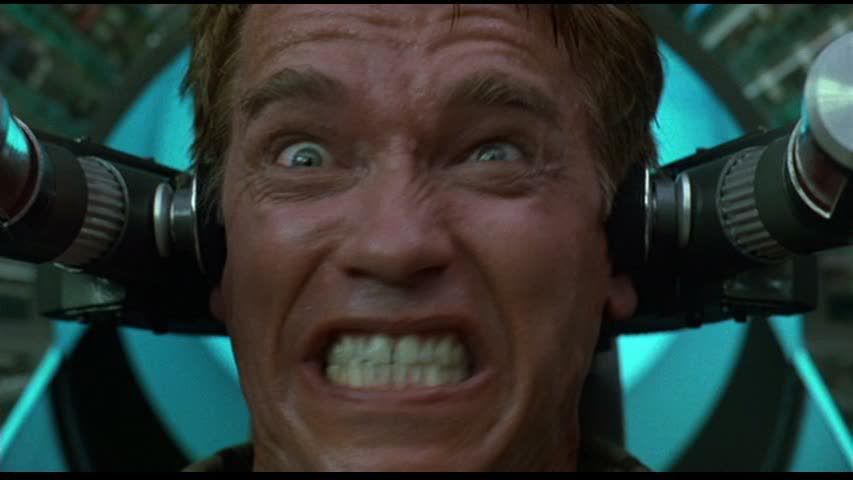
As in RoboCop, Verhoeven is depicting a model for how a future authoritarian state might emerge — seizing control of natural resources, monopolizing the things people need, controlling the media to disperse only the information they want to get out, in this case propaganda about the "terrorist" rebels who resist. Not much information about Mars reaches the outside world, but one man becomes interested in the red planet when he begins obsessively dreaming the same dream over and over again, in which he is walking across the planet in a spacesuit with a mysterious woman. This man is Douglas Quaid (Arnold Schwarzenegger), and he seems to be perfectly ordinary: he's a construction worker, he's got a pretty wife, Lori (Sharon Stone), and he's never been off Earth. But his dreams persist, and he begins to want a solution to this mystery. He suspects maybe something is up. Of course, the audience knows long before he does that something's up. One of the film's most brilliant maneuvers is casting Schwarzenegger as a secret agent whose mind has been erased and his identity changed to that of an ordinary working man. This is Arnold we're talking about here, with his Bavarian lisp and his bulging, elephantine muscles. He looks absurd as a normal guy. He looks out of place in normal clothes, without a gun in his hand. He looks vaguely ridiculous kissing his wife goodbye as he leaves for work, as though he was a sitcom husband going through his daily routine. Today, he looks absurd too as a politician, but that's another story. The point is, it's obvious from the moment we see him that Douglas is not just some ordinary guy. He looks like a secret agent in disguise, a brawler, and it's no surprise when he's attacked and fluidly demolishes his assailants with a barrage of countermoves.

It turns out that someone's been messing with his mind, and his former self was a government agent working on Mars, an agent who had apparently switched sides to the rebels at some point. This is when the fun really begins. As a satire of totalitarianism, the film has its moments, but Verhoeven doesn't go nearly as far with the ideas as he did in RoboCop. But as a totally crazy, goofy sci-fi action movie, Total Recall is pretty hard to top. The explosive violence and gore of RoboCop is carried over here, and each fight scene is basically a collage of inventive ways of dispatching people, with Arnold in typical action hero mode, racing around, pounding bad guys, and tossing off his usual ludicrous one-liners. (His best, because it's simultaneously the cheesiest and the nastiest, is directed at his faux-wife Lori: "consider this a divorce.") The action scenes are occasionally clumsy, and there are several scenes where it's obvious that stunt actors are simply throwing themselves around to give the impression of a frenetic fight that just isn't actually happening, while in another scene everybody vibrates spastically to make it seem like the ground is shaking. Verhoeven's occasionally awkward with stuff like this, the big epic fight scenes so central to the film, though he also stages much of the violence with panache.

A bigger hurdle to enjoyment (except of the campy variety) is the lame dialogue and inconsistent acting. No one expects a real performance out of Schwarzenegger — the guy's most famous for playing a robot, with good reason — but the rest of the cast mostly seems to be acting down to his level. Cox especially hams it up as the villain Cohaagen, though his theatrical mustache-twirling fits the film's over-the-top B-movie tone well enough. Out of everyone in the cast, only Sharon Stone turns in an actual performance, in the small but crucial part of Lori. Her sexy-bitchy mannerisms and stop-on-a-dime transitions from seductive to icy seem now like a rehearsal for Basic Instinct's Catherine Tramell, and it's obvious why Verhoeven cast her in the part for his next film. As for Total Recall, despite its generic, pulpy dialogue and weak performances, for the most part the film is a visceral action showcase, and that's really all it tries to be. Verhoeven's political subtexts are increasingly overwhelmed by the wildly entertaining surface, which makes it a rare Verhoeven film where, in the battle between surface and subtext that always takes place in his work, the surface wins.


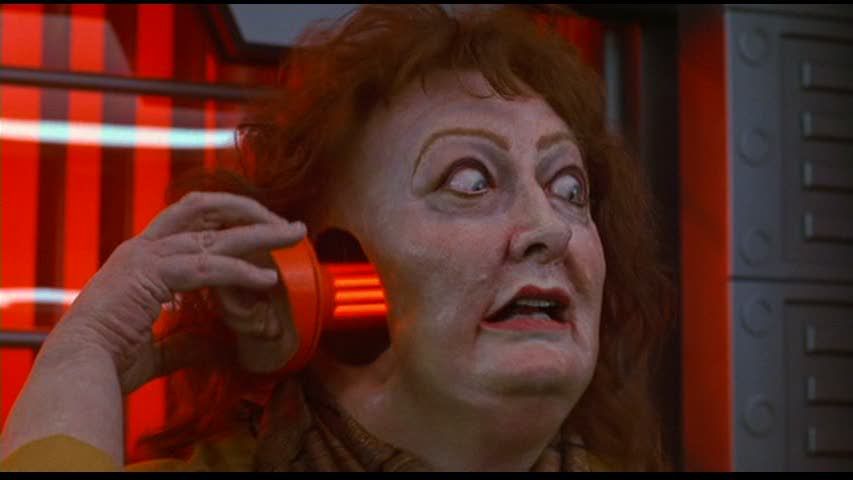
Still, it's a pretty entertaining surface. A lot of the credit has to go to the special effects work of Rob Bottin, who crams the film with inventive plastic and rubber effects. Most of the film's most memorable images are a result of this effects work: the bulging, cartoony eyes of Douglas as he flails about on the surface of Mars, gasping for air; the special robot suit that allows Douglas to disguise himself as a woman; the infamous three-breasted prostitute; the various deformed "freaks" who inhabit Mars' Venustown. These images have a sense of wonder, not because they seem futuristic, because they really don't, but because they're so tangible. They're not realistic by any means — in fact they're grotesque and deliberately exaggerated — but they nevertheless feel real. In that respect, the effects are reminiscent of the equally potent gore and viscera in David Cronenberg's 80s horror films, which seem like an important touchstone here. As in Cronenberg's work, the use of plastic effects rather than CGI grounds the film in a real, lived reality, even if in this case it's an absurd alternate future where three-breasted women and freakish mutants coexist, and where a mask of a woman's face can unfold itself like a flower opening to reveal Schwarzenegger inside.

These images provide much of the film's energy and vitality, particularly when Douglas finally comes face to... uh, faces with the rebel leader Kuato (Marshall Bell), a seemingly ordinary man who's hiding a baby-like tumor under his shirt, growing from his chest. This creature, which has psychic powers and leads the rebel army, is a stunningly grotesque puppet, slimy and very organic-looking. Such striking and memorably horrific images are a big part of the film's enduring appeal. Certainly, the creature and makeup effects have dated a lot better than the crude work done to create the surface of Mars itself; the red planet sometimes looks like an Earth desert tinted red, and sometimes looks like a blatant studio set with a painted backdrop. In a way, though, this artificiality only enhances the film's sense of unreality, as its protagonist tries to untangle his fractured mind. The plot races through multiple reversals and false detours, suggesting at various times that Douglas is delusional, that he's really a secret agent, that he's stuck in a virtual memory simulation gone wrong, that he just needs to swallow a red pill in order to wake up — presumably into The Matrix, which would eventually run with that particular idea. At the very end of the film, Douglas' last line even casually, jokingly suggests that maybe all of this was simply a dream, and he's about to wake up, at which point the sun flares in the distance, whiting out everything.

It's a telling little joke, because ultimately it doesn't really matter what's going on here. All of the material about multiple identities and the mind and memory are essentially red herrings, distracting from the real point. The film could be a paranoid delusion, it could all be happening in Douglas' head, but even if it isn't, it's always clear that the film is a fantasy in somebody's head, that it's unreal and ridiculous from the very beginning. It's Verhoeven's fantasy, basically, in which a capitalist nightmare — a monopoly run amok — is defeated through the efforts of freaks, outcasts and deviants. Verhoeven's touch shows through most clearly in the portrayal of these outcasts, who are both ogled as freaks — including a real dwarf mixed in amongst the makeup-enhanced mutants — and simultaneously treated as the only decent people in the film besides Douglas and his rebel girlfriend Melina (Rachel Ticotin). It's surely no coincidence that the film's rebels dwell in a section of Mars given over to sex clubs and exotic pleasures of all kinds. Even here, in probably Verhoeven's most impersonal film, the evidence of his overblown sensibility is everywhere. The film might be just a silly action movie at heart, but its anything-goes aesthetic propels the action along and gives the film its verve; Verhoeven is never content to simply show an image when he can rub it in the audience's face.

Wednesday, July 22, 2009

Flesh + Blood


Ugly, brutish and relentlessly bleak, Paul Verhoeven's Flesh + Blood is perhaps the director's idea of doing a realistic period picture, though of course with Verhoeven any concept of "realism" is entirely relative. The film is roughly made, with little concern for period detail or verisimilitude — in one shot, a soldier stabbed with a sword falls to the ground, the blade sticking out of his chest, and in the next shot he's clutching his bloodless chest, the sword gone altogether. The film is riddled with moments like this, evidence of a loose, casual approach to filmmaking. Verhoeven's realism is different: he's interested in including the details you don't normally see in period costume dramas. He wants to include all the grit, the ugliness, the grime and filth and rot. His actors are caked in dirt, and they perform with crass broadness; the performances are as messy and grandiose as everything else in this over-the-top film.

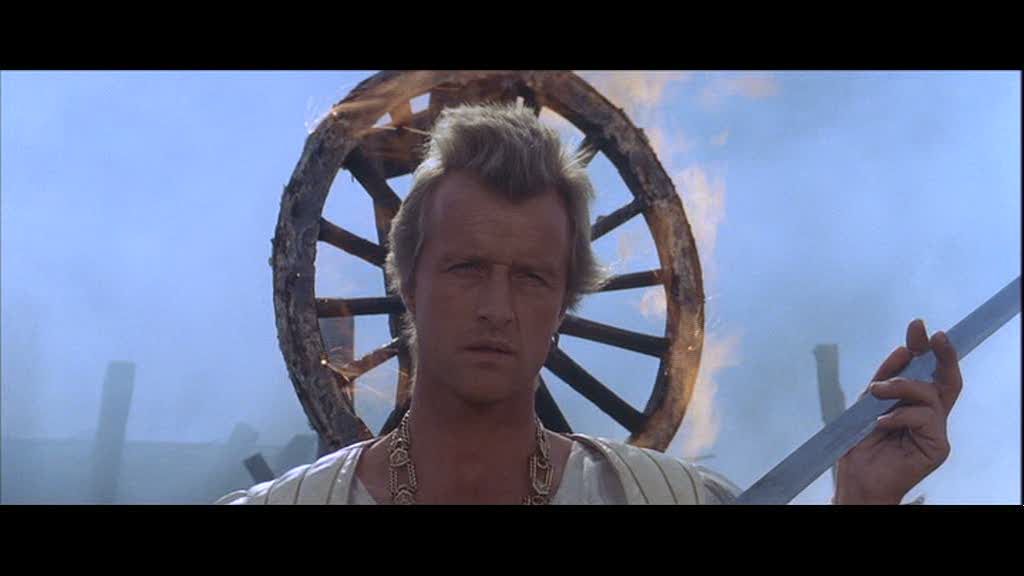
The film follows a group of 16th Century mercenary warriors led by Martin (Rutger Hauer). The mercenaries help the deposed lord Arnolfini (Fernando Hilbeck) regain control of his walled city, but once the job is done, Arnolfini has no more use for the looting, raucous mercenaries, and he has his warrior captain Hawkwood (Jack Thompson) drive the mercenaries away, disarmed and without pay. Martin won't tolerate this, so he leads his men back against Arnolfini, slaughtering the lord's guards and stealing his wagons, as well as kidnapping the virginal princess Agnes (Jennifer Jason Leigh), who was betrothed to marry Arnolfini's scientist son Steven (Tom Burlinson). Agnes is initially terrified, but in order to stay alive and relatively safe, she cozies up to Martin, seducing him and expressing her love for him, refusing to allow any of the other men in the mercenary gang near her.

The film is epic and nearly operatic in its melodramatic intensity, as Martin and his men careen across the medieval countryside, finally finding a castle which they clear of its inhabitants and take over. They settle in like lords of the manor, guided by the "signs" dictated to them by the half-mad priest Cardinal (Ronald Lacey), who believes they are being led by a statue of St. Martin, and that Martin is himself acting as an earthly incarnation of the saint. Of course, Martin helps nudge the statue into place to deliver the signs he wants the others to see, establishing himself as unequivocal leader and making sure he keeps Agnes for himself. The barbarians are on a parody of a holy quest, and once they take up residence in the castle, they also parody the manners of the elite they're displacing, spurred on by Agnes, who attempts to control Martin by showing him how to eat with a knife and a fork. There ensues a mad orgy in which the mercenaries attempt, clumsily and roughly, to mimic her courtly manners, shoveling massive pieces of meat into their mouths with their forks, chopping awkwardly at the food with dull knives.

The film makes every effort to separate these 16th Century barbarians from the present, to establish that this is a different time, a cruder and meaner time, a time guided by a different morality. None of these characters are likable, neither the mercenaries nor the soldiers, led by Steven and Hawkwood, who pursue them in order to rescue Agnes. If the mercenaries are brutish and violent and crude, Arnolfini's soldiers aren't much better. In fact, the film's opening attempts to align the audience's sympathies with the mercenaries, as they are betrayed by Arnolfini after loyally doing his bidding. Of course, the mercenaries are hardly sympathetic protagonists themselves, raping and pillaging their way through every city they come across. Even when Martin decides to surreptitiously help Agnes avoid the attentions of the other mercenaries, he does it not so much because he feels sorry for her, but because he seems to want to keep her for himself. He was won over into something like love when his attempt to rape her was met with feigned pleasure, the girl pumping her hips against him and urging him on the way she'd seen her maid do it in the bushes.


Throughout the film, Agnes remains an ambiguous figure. It's not at all clear if she's simply faking her devotion to Martin to keep herself safe, or if she's hedging her bets on which man will win out in the inevitable confrontation. She manages to secretly slip signs of her love to Steven to show him how she feels, but at the same time she aggressively pursues Martin, and it seems that at some point her charade slips into genuine feeling for the mercenary leader. She's an interesting character, seemingly another of the film's many sly critiques of religion. She was educated in a convent where, with access to the nuns' many books, she ironically learned more about the ways of the world than most other young, virginal girls could. She has, as Martin says at one point, an innocent face — he calls her an "angel" — but the rest of her is not so chaste. Even when she first meets Steven, she overcomes his initial reluctance to marry a girl he doesn't know with her bold, straightforward seduction. She wins his heart beneath the dangling corpses of two bloated, rotting hanged men, and at the climax of the scene Verhoeven switches to a wide shot of the kissing couple framed between the dangling bodies of the dead men. Ultimately, Agnes is only as innocent as she can be in an era like this, surrounded by death and brutality — she is unflappable and tough despite her exterior appearance, and she is willing to do what she must to survive and get what she wants.

The film is a typically excessive, sensually overwrought piece from Verhoeven, who has always brought his uniquely skewed sensibility to all manner of genre films. Here, he's made a lurid, bloody, outrageously sexual period piece, a film in which the barbarism and cruelty of these people is paraded around relentlessly. Verhoeven isn't concerned with making his characters likable, and he cheerfully revels in their amorality. Even Steven, the closest thing the film has to a genuine hero, becomes hard and cold after Agnes is kidnapped, viciously threatening Hawkwood in order to force him to help, and later purposefully infecting the mercenaries with the bubonic plague. The film's ending is thus a parody of the conventional "happy ending." The hero has rescued his bride-to-be and vanquished the villains, but it somehow doesn't seem like such a positive outcome. Steven's soldiers, taking over where the dead mercenaries left off, grab the mercenaries' surviving women to rape and sleep with them, while Hawkwood rides back to the half-mad former nun he keeps as his woman after nearly killing her in an earlier battle. The film isn't so much about a battle between heroes and villains, but a struggle between opposing sides of nearly equal amorality and ugliness; one can't root for any of them to win, and the film is unceasingly unpleasant and grim. This makes Flesh + Blood staggeringly ambiguous in its effect; all of this bloodshed and misery and hatred seems to have been over nothing, despite each side's conviction that God or justice were in their corner.

Tuesday, July 21, 2009

Showgirls


Paul Verhoeven's Showgirls must surely be among the most absurd movies ever made, a gaudy, nasty, hysterical tribute to excess and bad taste. Made from a script by the notoriously exploitative Joe Eszterhas, Verhoeven's collaborator on Basic Instinct and a seasoned peddler of sleaze, the film is a glorious mess, a neon overload of sexploitation. It's the inspirational story of an ambitious young girl who fights and claws her way to the top of her profession, struggling to be the best she can be, fighting to make her way on sheer talent and drive alone. Uh, yeah. That's what it's supposed to be, anyway. That's the kind of movie that Showgirls models itself on, the movie where the small-town girl makes it in the big city because she's just so talented, so tough, so pretty — she gets the gig, gets the guy, wins the hearts of all America in the process. These kinds of films are capitalist fantasies, melodramatically romantic visualizations of the idea that anyone in America can pull herself up by the metaphorical boot straps. There's a reason these kinds of films are so popular, why they're an enduring mainstay of the American cinema, virtually a genre unto themselves: everyone likes to feel like this success is possible, that anyone can make it with enough hard work and dedication. Everyone likes to think America is a meritocracy where those with talent rise to the top.

Showgirls is, defiantly, outrageously, not this type of movie, though it pretends to be right down to the very end. It is a remarkably straight-faced parody of the genre it supposedly represents, probably because its lead actress, Elizabeth Berkley, seems to think that's the kind of movie she's in. Berkley pours herself into her character, the aspiring dancer Nomi Malone. She stomps around, she pouts and cries and squeals (actually squeals!) with delight, she eats junk food with the ferocity of a true carnivore. She dances so vigorously she looks like she's in the midst of a particularly tough fight, flailing her arms around as though throwing punches. She pumps her hips and flashes her body for anyone who'll look. She intones Eszterhas' frankly ridiculous dialogue with earnest intensity. She completely sells every moment, and it's obvious: Nomi thinks that her arc in this film is one of self-discovery and self-realization, because that's exactly what Berkley thinks. By the end of the film, as she's unleashing vicious roundhouse kicks (Nomi, kung fu master!) at the head of a brutal rapist, or dramatically heading out of town in her six-inch stripper heels, she seems triumphant, redeemed, a new woman born from the shell of the old, a beautiful butterfly emerging from her cocoon. Or some crap like that, anyway.

In her own way, Berkley delivers an astonishing performance, though certainly not a "good" one. Then again, what would be a good performance in this context? The character of Nomi demands a certain badness, a wide-eyed enthusiasm and intensity. She's larger than life, and Berkley is the perfect actress to play Nomi because she's just so raw and sloppy, so awkward, so completely without barriers. She never seems to catch on to the fact that she's in a farce, which is probably a good thing, because that would kind of ruin the fun. And oh what fun there is. The film is delirious and pretty much batshit crazy, a neon-tinted orgy of American enterprise run amok. It's a delicious satire, because on its surface it doesn't seem satirical at all. It's a fairly accurate portrayal, one suspects, of exactly what goes on in this kind of milieu: the bitchiness, the catfighting, the trading of sexual favors, the ugly, seedy underside to all the glitz and glamour. Nomi arrives in Las Vegas, running away from her past, hoping to become a dancer. She starts working in a strip club, not exactly her dream, but this film would be a tragedy if Nomi wanted to be a ballerina and wound up just shaking her tits and ass instead. No, it's a comedy because the peak of her ambition, the one thing she absolutely wants to do, the dream job that would drag her out of this hellish strip club, is to be a showgirl in a flashy topless revue at one of the Vegas nightclubs. Yes, she's a stripper who dreams big: she wants to show off her tits and ass in a "classy" setting. (The quotation marks are necessary because this is Vegas' idea of "class," class as conspicuous consumption; the brighter everything shines, the classier it is.)

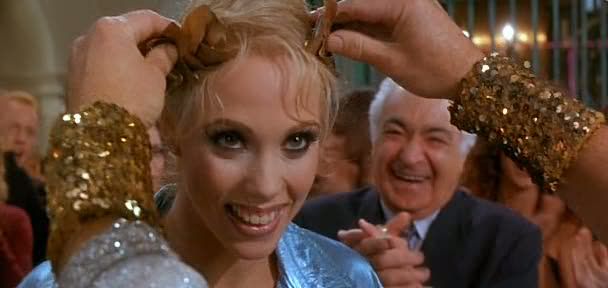
There's a hilarious scene when Nomi first sees the revue, which is called simply "Goddess." It's a faux-arty melange of leaping half-naked dancers, explosions and lots and lots of glitter, and at its center is the sexy, bitchy superstar Cristal Connors (Gina Gershon). The show looks like the Cirque du Soleil with bare boobs, gloriously tacky and gaudy. And Nomi is transfixed, raptly watching from the crowd as though confronted with a heavenly vision, her hands unconsciously mimicking the poses of the dancers on stage. Her eyes shine: she knows what she wants. Clearly, Verhoeven is having fun here, offering up all these kitschy surfaces without comment, as though to say, here it is, here's the American dream in all its glory, this is the pinnacle, this is something to aspire to. It's virtually the same attitude as the director took in his equally opaque satire Starship Troopers; both films offer up exactly what Verhoeven assumes that audiences want. It's a gesture of contempt, in a way, giving them what they want in the crudest, most overblown fashion. You asked for it, you got it. Want lots of mindless violence, things blowing up, blood and gore and video game special effects? Here's Starship Troopers. Want sex and glitz and conspicuous consumption, want excess and naked bodies? Here's Showgirls. One suspects that these two films together represent what Verhoeven sees when he looks at the American film industry, and it's apparent that he doesn't like what he sees.


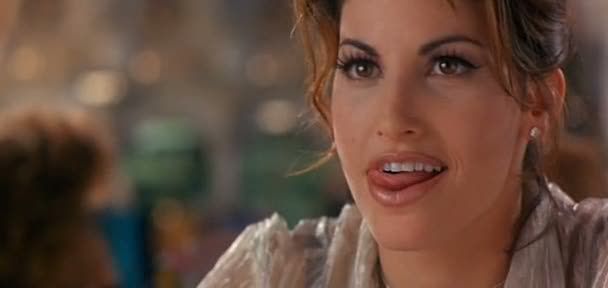
This perspective gives the film a wicked edge, a biting undercurrent that elevates it to the level of a camp classic, albeit a deliberately campy one. It's all in the details, like the richly funny performance of Gina Gershon, who plays the whole film with a predatory, crooked smile, permanently baring her teeth as though ready to bite into her prey. If Berkley probably isn't in on the joke, Gershon definitely is, and she feeds into the campiness of the project, relishing the overblown dialogue, rolling her tongue around her lips, looking at Berkley's Nomi with naked lust in her eyes, pouting her lips out until they look like shelves. She's lively and funny and bitchily endearing. Berkley, on the other hand, plays every scene with a deer-in-the-headlights stare; her Nomi is half lost little girl and half vicious tough dame, with a switchblade and a temper.

This is fitting, of course, because one of the film's unspoken (but nonetheless central) jokes is that Nomi just isn't that talented: she looks at home in a strip club, and even seems to be a talented stripper, as far as that goes, but once she's elevated to the moderately more demanding burlesque show, with its complex routines and choreography, she seems out of her element, awkward and ungainly. She goes far because she generates "heat," which seems to be code for everyone wanting to fuck her, both the men and the women. And indeed, one of the film's recurring lines is that she dances like she fucks, which is especially funny in light of an early scene at a club where she's spastically dancing, flailing her limbs around, obviously thinking she's cool and sexy when in fact she looks like a malfunctioning machine; one expects to see sparks flying from her joints. Sure enough, later on, when she gets a comically overwrought sex scene with entertainment manager Zack Carey (Kyle MacLachlan) in Zack's pool, she fucks him by straddling him and then flailing wildly, flopping around in the water like a fish that's just been hooked. At the moment they orgasm, she throws her head back into the spray of foamy water pouring from a dolphin statue's mouth, another of Verhoeven's typically unsubtle jokes. The film is all about details like this. See also: the way, immediately before this jaw-droppingly unsexy sex scene, Zack switches on the green neon palm trees by his poolside, doing it with a suave flick of his hand, as though it's meant to seduce her. The even funnier second punchline is that it does seduce her; of course Nomi gets off on neon.

The film is bathed in neon, too, simply saturated in it. It must be one of the most garish, brightly colored films ever made, and its visual sensibility matches its over-the-top acting and soapish storyline. It's a brilliant, deadpan satire, hilarious and tacky and relentlessly overblown, nearly operatic in its frenzied excess. It's a film about the American dream, but not quite in the way it pretends to be: it's about people who scratch, claw, betray and sleep their way to the top, about crass commercialism and the marketing of sexuality (this last of course a great irony since the film itself was marketed on the strength of its sexual excesses). It's a film in love with its own melodrama, in love with the neon overload of Las Vegas even as it satirizes and mocks it.