Wednesday, October 6, 2010

The Social Network


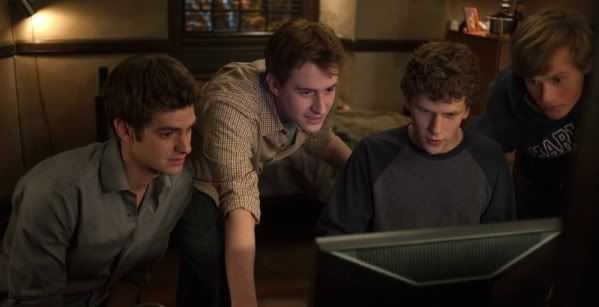
The Social Network details the development of social networking hub Facebook, as the site developed from the drunken game of Harvard computer whiz Mark Zuckerberg (Jesse Eisenberg) into a worldwide phenomenon. Facebook has arguably had a tremendous impact on Internet communication, but this film, directed by David Fincher from a script by Aaron Sorkin, doesn't have much to say about the ways in which the site has or has not changed the Internet. Instead, it's more of a psychological and legal drama about the desire for acceptance, the bizarre anti-logic of business in the dot-com era, and of course the American passion for betrayals and lawsuits. The film is, among other things, a scathing portrait of Facebook founder Zuckerberg, who is here portrayed as a disconnected, selfish jerk who betrayed his friends and built his ideas upon the foundation laid by others. The film is a profile of Zuckerberg, but more than that it's a profile of a time (the early-to-mid 2000s) and a place (mostly the inner workings of Harvard University) from a director whose best work has often made geography and time central concerns.

Like Fincher's Zodiac before it, The Social Network is a historical film, but a historical film that is set a mere seven years in the past. It is, nevertheless, history, and Fincher is as deliberate and detail-oriented in recreating the feel of an early 2000s college campus as he was in capturing the feel of 70s San Francisco. The campus at night, bathed in eerie yellow lights and accompanied by the moody music of Trent Reznor (whose effective score, in collaboration with Atticus Ross, alternates between low-key background buzz and bursts of dancey pop-industrial), becomes as powerful a presence in the film as the dangerous nighttime vistas of Zodiac. And the film's detours into college parties — from the glitzy, privately catered affairs of the elite frats to cheesy theme nights and rowdy, drug-fueled house parties — resonate with telling details. The era that Fincher is evoking so concretely here is precisely the era before Facebook changed youth culture by, as Zuckerberg says, putting college social life online. To some extent, in this era where a few years can bring and have brought massive changes in technology, nostalgia cycles have shortened to the point where this film can be nostalgic for the pre-Facebook technology and web culture of a few years ago, when blogs still seemed somewhat novel and websites like MySpace and LiveJournal were at the cutting edge.

Fincher loves dealing with process, methodically following the steps, treating every story like a case to be solved; one suspects that he identified very strongly with Jake Gyllenhaal's Robert Graysmith in Zodiac. Sorkin's script for The Social Network allows Fincher to indulge that fascination with process, as the narrative carefully traces the development of Facebook from the coding right up to the business dealings to the inevitable lawsuits that followed. It's a multi-leveled examination of this story that recalls Zodiac in many ways: of all Fincher's films, there is clearly the strongest connection between his serial killer process piece and his dissection of a website's birth. Both films are backward-looking, and The Social Network makes its retrospective nature explicit by continually cutting back and forth from the dual lawsuits against Zuckerberg to the events that led up to that point. Where the earlier film delved into the gathering of evidence and the obsessive analysis of clues, The Social Network revels in the minutiae of coding and algorithms and innovations.

Although The Social Network is never quite as affecting or as evocative as Zodiac, which is still Fincher's best film, this is a sharp, witty film, packed with great characters and scenes that reveal the mix of careful research and keen observation that Sorkin and Fincher bring to this film. Sorkin famously got tips from Harvard alum Natalie Portman on the secrets of the school's exclusive "final clubs," and this knowledge shows through in the periodic inserts of fraternity hazing and private parties where these privileged elites unwind. The idea of privilege is a key subtext here, as the original germ of an idea for Facebook was to create a social networking site that sets itself apart through exclusivity — specifically, the exclusivity of Harvard prestige. Twin rowing champions Cameron and Tyler Winklevoss (Armie Hammer), who eventually wind up suing Zuckerberg for stealing their ideas, embody that privilege, the inherited elitism of being born into money and feeling entitled to the benefits of that lineage. At one point, outraged by what they see as Zuckerberg's thievery, they use their connections to wrangle a meeting with the president of Harvard, but they're non-plussed when he responds to their complaints with contemptuous jokes and berates them for expecting special treatment because of who their father is. It's a great scene, and a scene that one suspects Zuckerberg himself would appreciate, as it deflates those who just naturally have all the money, charisma, success and athleticism that Zuckerberg seems so desperately to want.

Zuckerberg's complicated attitudes about privilege and elitism — resentment and contempt mingled with his own air of entitlement — also wind through the film. Eisenberg perfectly captures the snobby, snotty, clipped tone of an insecure young geek who's convinced that he should get whatever he believes he deserves — who's convinced, simultaneously, both that he's better than everyone around him, and that everyone else thinks he's insignificant. It's that mix of profound insecurity and outrageous self-confidence, projected in every twitch and mutter of Eisenberg's pitch-perfect performance, that really sells this character, and to some extent the film as a whole. It's a totally satisfying performance of an absolutely aggravating and unlikeable character. Fincher earns equally great performances from everyone in this film, and Justin Timberlake, as Napster co-founder Sean Parker, is especially potent, projecting the hyperactive enthusiasm and radical pose of a new generation of Internet entrepeneurs who ride waves of grassroots guerilla programming to international prominence. But despite Timberlake's flashy and fun performance — witness the obvious pleasure he gets from telling a recent conquest that he's a kind of Internet celebrity — it's the quieter, more restrained Eisenberg who remains at the film's core.

As good as Eisenberg is in this role, the script occasionally does him a disservice, most notably with the conceit of hinging so much of Zuckerberg's motivation and psychology on his rejection by girlfriend Erica (Rooney Mara), who he insults on his blog after their nasty breakup at the start of the film. It's a simplistic thread of pop psychology that even provides the predictable emotional punchline before the end text describes the outcomes of the lawsuits, another all-too-typical legal drama touch. These kinds of pat movie devices don't serve the film well: the all-too-easy intimation that Zuckerberg started Facebook to get revenge on a girl, that his obsession with her continued to drive him for years afterward, conflicts against the subtlety and complexity evinced by the film elsewhere. The film is at its best when it's patiently setting the scene, building up the atmosphere of a college campus and establishing the character of Zuckerberg as an impatient genius whose lack of social niceties make him an unlikely choice for the founder of the world's most successful social website. Sorkin's eloquent, frequently funny script makes the film a lot of fun, whether its gently mocking the pretensions of the Harvard elite (although the Winklevii, as Zuckerberg memorably dubs them, do ironically emerge not as stock villains but as more sympathetic characters than their rival in some respects) or nailing the strange twists of college life (like a great subplot involving a chicken and "forced cannibalism"). This is a smart, entertaining, and often incisive film that merges the in some ways quite distinct aesthetics of Fincher and Sorkin to create a very compelling hybrid.

Monday, October 4, 2010

Burial Path/The Process/The Machine of Eden


Stan Brakhage's Burial Path, as its title implies, seems to be concerned with the burying of the dead, with mortality. If it can be said to have a narrative, it's a simple story: finding a dead bird in one's garden and burying it. But Brakhage takes this simple moment, this prosaic story, and expands upon it, free-associating around the ideas and images conjured up by this dead bird. The film opens with an image of a bird, a drawing like those found in science textbooks or bird-watching guides, and then an image of the dead bird itself, lying in the dirt. Then the associations start. The film's structure is like a moment interrupted by a diagrammatic layout of the thought process of the observer. Someone sees a dead bird in a garden, and towards the end of the film the bird is laid to rest, carefully buried beneath a thin layer of soil in the garden by gentle hands. In between, the observer thinks about birds, about death, the mind wandering at will, its musings and meanderings captured by the collage of Brakhage's images.

Frequently, these images seem to be just on the verge of focusing, wavering in this hazy state where it's almost possible to tell what's being depicted, but often the focusing stops there, or regresses into blurriness, not quite revealing the subject of the image. It's as though a memory has hovered on the edge of awareness only to slip away unheeded, the mind moving on to other things. For Brakhage, seeing and thinking are intimately linked. His cinema is all about sensation, about the process of seeing and the ways in which vision is linked to memory, intellect, decision-making, spirituality and mysticism. The film's rapid flood of images is entirely subjective and ephemeral, a loose stream of associations linking the dead bird to a flurry of birds in flight against a green-tinted sky, or a bird carefully pecking at the ground on a bright, summery day. The variety of the images suggests a span of memories, pulled from disparate situations, different emotional tones, different nostalgic moments.

Pale, faded greens, grays and blues are juxtaposed against bursts of bright, fiery red — stop light red, blood red. The film's dominant tone is muted and faded, as though worn away by the distance of the past. The sporadic moments, mostly inserts that last for barely seconds at a time, where brighter colors enter the film are thus shocking and bracing. Branches of trees are blurred into fractal shapes, hinting at clear lines and patterns in the indistinct haze, suggesting that there is a meaning, a way to make sense of the chaos, if only everything were clearer, if only the images would coalesce into some readily identifiable form. Instead, the rush of images continues, sometimes suggesting narrative moments and precise memories, sometimes evoking the concrete shape of the bird that triggered this journey, sometimes simply presenting a fog in which nothing is solid or tangible. At one point, fading out of the fog of distortion, kids in red jackets sit on a low wall, laughing — and, for just a fraction of a second, almost too quickly to be perceived consciously, Brakhage cuts in a very brief glimpse of the same shot unfiltered, unprocessed, the jackets as bright as a fire engine, the colors undiluted by Brakhage's careful process of wearing and muting. It's that longed-for moment of clarity, there and then gone again in the haze of memory, lost in the rapid pace of thought.

In the last minutes of the film, the real fire hinted at earlier makes its appearance, its flames dancing much as Brakhage had made the jittery red and gold blurs of light dance earlier in the film. It is a fire that represents, perhaps, the mortality hinted at by the dead bird, a cleansing flame that seems to be licking up towards the frame, threatening to engulf and erase everything in its fiery climax.


Stan Brakhage's The Process is a flicker film using blocks of solid color flashed up on the screen, sometimes with images lurking within the saturated color, suggesting that if only it were desaturated, a concrete image would reveal itself, the form would be visible. Brakhage is separating form and color into their pure states, abstracting color from tangible referents, treating pure red, pure blue, pure green, as things in themselves, each with its own space, its own frame. These bursts of color are alternated with prosaic images of people walking, talking, driving, their actions unclear, often shrouded in shadows or portrayed in negative, in that ghostly blue-and-black netherworld that further abstracts color from reality.

This flicker creates a feeling of impermanence. Like most flicker films, The Process is meant to be felt, to be experienced, more than actually watched. The solid colored frames create rhythms that are broken up by the actual images, like the appearance of two kids in cowboy outfits drinking sodas, or a pair of candles with their flames gently flickering in the gloom, matching the shimmery pace of the alternating colors. At one point, a figure seems to be emerging from a kind of tunnel, a hallway made to seem vast and deep by the gulf of purple light surrounding it. These images have no meaning, tell no story, present only glimpses of domesticity, play, perhaps ritual. The actual images and the colors are treated equally, as elements in Brakhage's patterns and rhythms, a pure primary color and an image of a child given the same mental and visual weight by the film's structure. Both flicker by, barely glimpsed, an afterimage on the viewer's eyelids.

This ephemeral feel translates to the film as a whole, which seems like a minor experiment from Brakhage, who is as always concerned with sensation and vision. He is playing with the formal contrast between solid colors and the messy, shadowy documenting of reality.


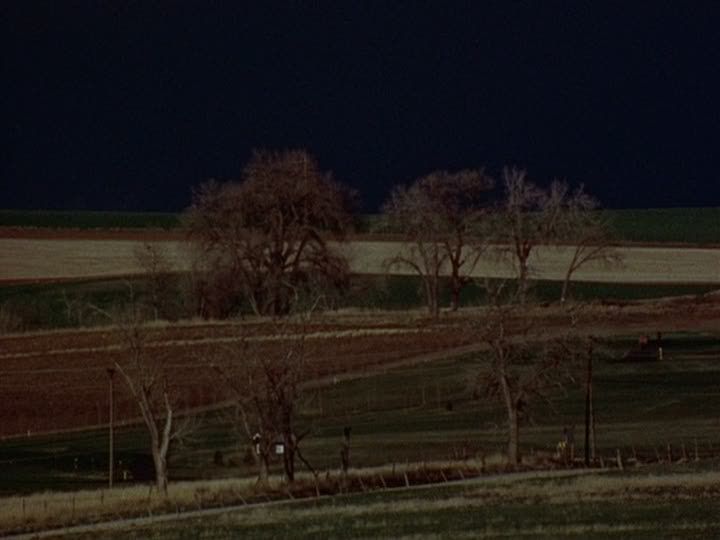
The Machine of Eden is about lighting and about scope, about distance. The film consists largely of landscape shots and skies, with comparatively judicious use of the interior domestic scenes that so often ground Stan Brakhage's films in his daily lived reality. The bulk of the film examines a few locations over and over again: snowy mountain peaks, a stretch of green farmland, a few scraggly-looking autumn trees by the side of a highway. Brakhage's camerawork is by turns graceful and jittery, sometimes resorting to whip zooms that emphasize a detail only to leap back out to the larger image, or incrementally increase the camera's distance from a particular landmark. He films mostly still skies, pregnant with heavy rainclouds or, less often, pale blue and cloudless, though at one point the image abruptly leaps into motion, the clouds spiraling and swirling together the way the paint would flow from frame to frame in Brakhage's later hand-painted works. There's a sense of distance here, of overlooking the beauty of the natural world from an abstracted viewpoint somewhere above, as though the creator implied by the title was observing his craftsmanship, eyeing the tiny details as well as the sweeping grandeur of these mostly unpopulated landscapes.

At times, Brakhage's abstraction transforms the sky into an empty color field, devoid of reference points until, during a pan across the stretch of dark blue, the tips of some even darker hills appear towards the bottom of the frame, finally introducing a hint of context to the image. The same aesthetic defines the domestic scenes, which are focused on the arm of a chair or the suggestion of a person breathing beneath the covers in bed, the only intimation of human presence the steady rise and fall of the fabric in response to the unseen person's respiration. When full human figures appear — a woman and children walking through trees — they're shot from behind, their faces unseen. It's as though Eden, that lost garden of natural beauty, is found wherever people are not, glimpsed when humanity's back is turned. Maybe that's why so many of the images in the film are dark and dim, shot with clouds running overhead, their shadows playing across the white snow of the mountains or bathing the entire landscape in a dark curtain.

Brakhage only sporadically allows the light in, in the form of a blinding orange sun that darts across the blackness of the frame, a sun that refuses to stand still. Elsewhere, a dim landscape is momentarily illuminated as the sun breaks through the clouds, casting its pure white glow over the land, melting through the gloomy and apocalyptic aura suggested by all those stormy vistas. Brakhage also mitigates against the film's deadening, harrowing visual aesthetic with a goofy insert of a goat trotting after its master, its ears flapping in slow motion like miniature wings, as though it's about to take off in pursuit of the flocks of birds that occasionally glide across the film's deep blue skies.

Monday, September 27, 2010

Haut bas fragile


The films of Jacques Rivette often revolve around mysteries and secrets, around conspiracies and secret societies, the past hovering with foreboding over the present, his characters involved in labyrinthine plots that lead to places beyond understanding. Haut bas fragile is no exception, centered as it is on three young women whose lives are seemingly haunted by the past, by the secrets that linger all around them. Louise (Marianne Denicourt) has just awoken from a 5-year coma, and is determined to start a new life while pushing aside everything (boyfriend, family) that occupied her before her prolonged and involuntary absence from the world. Ida (Laurence Côte) was adopted as a child and is obsessed with finding out the identities of her biological parents, hoping that this knowledge will tell her something about her own identity. And Ninon (Nathalie Richard) is fleeing a life of violence that's shown in the opening scenes of the film, when a jealous ex stabs a man who she's dancing with at a club. These women, whose paths cross in ways both major and incidental over the course of the film, are all struggling to determine the courses of their own lives against the inertia of the past, simultaneously seeking the truth about the past and trying to break free of its influence.

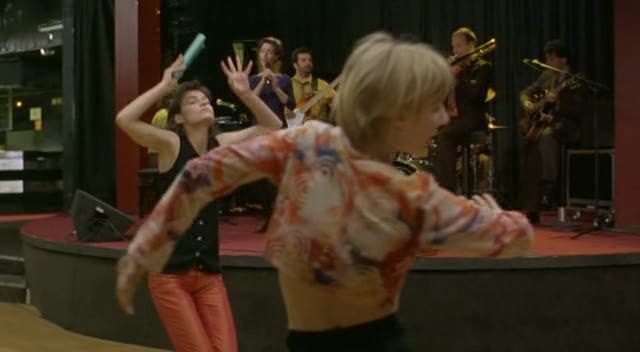
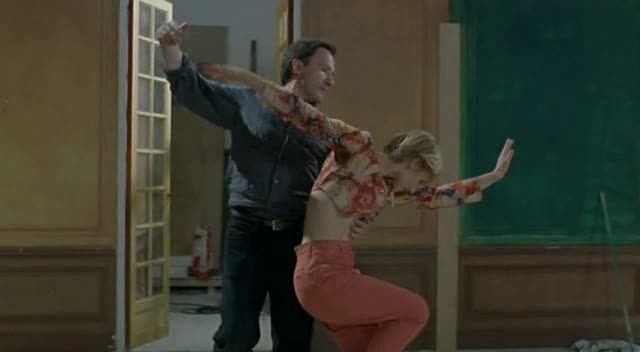
This is a common theme in the cinema of Rivette, this concern for the past, a theme that echoes through works like Secret Défense and The History of Marie and Julien, both films where history is a trap, a pattern that dooms the protagonists to cycles of repetition. In Haut bas fragile, however, this trap is continually sidestepped and defused, most notably through music and dance. The film is a musical — or at least, it increasingly becomes one, as the scenes of muscial interruption and performance become more and more frequent over the course of the narrative, transforming what had at times threatened to become a portentous drama into a playful subversion of this drama. Whenever the characters fight or argue, as they often do, their movements become formalized and graceful, striking poses in the midst of the fight, extending their limbs and becoming cat-like in their motion, until the music suddenly erupts and the argument has become a dance, often a dance of flirtation and seduction. It's through the dance, through music and movement, that the characters in the film fall in love and forge friendships, dancing around each other even as Rivette's camera, a playful third partner in these dances, dances around the actors.

This is a charming, exciting film, one in which Rivette lightly prods at some of his typical concerns. He introduces, as he often does, a secret society of sorts, a club that meets in an underground lair to play a sinister game of cards, presided over by the suave and mysterious Alfredo (Wilfred Benaïche). The game is a game of life and death, where one card dictates the killer and another card decides the victim in a real-life game of stalking and murder, a game that recalls Robert Altman's bizarre sci-fi film Quintet. But when Louise — who has infiltrated this mysterious circle through the help of the ubiquitous Roland (André Marcon) — draws the card of the killer, the game turns out to be a farce, a ruse designed to help her overcome her vertigo. The conspiracy dissipates like so much smoke, whereas in so many of Rivette's other films, the conspiracy — and the doubt over whether it exists or not — dominates the action and becomes an obsession for the protagonists. Louise's affliction is probably no coincidence, either, given Rivette's admiration for Hitchcock: whereas Scotty in Vertigo must undergo repeated traumas and psychological torture because of his vertigo, Louise overcomes hers in a few moments through a game. It's a conscious subversion of the thriller's psychosexual dimensions. Again and again, the playfulness of dancing and loving and verbal sparring — like the rhymes of Louise and Ninon's song as they celebrate their newly forming friendship — frees the characters from the constraints of generic drama.


Rather than becoming trapped in cycles of distrust and betrayal, these characters open up new possibilities through the seductiveness and goofiness of dance. The result is a series of happy reversals that send the film careening wildly away from the tragic course that it occasionally seems to be on. Ninon's thievery has short-term bad consequences for one ancillary character, but when she reappears later in the film, she's in a better situation than ever, happier than ever. It's as though Rivette is suggesting that tragedy need not be a permanent condition, and that the story of a life is exactly what we make of it. Thus, though much of the film's narrative is built around a sheaf of papers that provide incriminating evidence about Louise's father, these ultimately turn out to be something of a red herring. The papers threaten to shatter Louise's relationship with her earnest young suitor Lucien (Bruno Todeschini), but instead she doesn't allow the papers' revelations to disturb her; they're part of the past, part of a history that she's moving away from. The real purpose of the papers, in the end, is to provide an excuse for Ninon and Louise to meet, to go off in secret momentarily, and then to emerge, dancing and playful, Ninon twirling around her friend as Louise sways to the music and strikes silly poses as though caught in the flash of a camera. And Rivette's camera, for its part, spins slowly around the women as well, adding its own spiraling inertia to their graceful dance.

This film is a typically slippery and ambiguous delight from Rivette, a mystery whose solution lies, not in the revelation of secrets, but their submersion within an alternate narrative of love, flirtation, and affectionate friendship. It is, as with so many of Rivette's films, a celebration of femininity, where the attempts of the men to control and protect the women, to dictate the direction of the story, prove utterly inconsequential. Ninon and Louise, bonding over a shared distrust of Roland — whose intersections with all three women drive much of the narrative — joke about cooking and eating him, a reversal of the traditional conception of predator and prey. Roland and Lucien attempt to follow, to stalk, to track down these women, but in the process the women turn the tables, rejecting the conspiracies and lies of the men in favor of openness and seduction and the vitality of the dance. These are the positive, exuberant forces at the center of Haut bas fragile, which is packed with Rivette's sly wit and playfully experimental spirit.

Tuesday, September 21, 2010

Blow-Up


Michelangelo Antonioni's Blow-Up is an unsettling, mysterious film that seems to be hiding multiple secrets beneath its glossy, impenetrable surface: the grainy, Rorschach blot photographs blown up by fashion photographer Thomas (David Hemmings) in his search for clues to a murder provide a blueprint for the film as a whole. Strange encounters, clues and red herrings, inexplicable happenings: the film is disconnected and radiates a zombie-like vibe right from its opening sequence, in which a troupe of mimes, faces caked with pasty white makeup, are contrasted against the deadened faces of factory workers clocking out for the day. Blow-Up is often summarized as being about a photographer who comes to believe that some photographs he took hold the evidence of a murder, but in fact more than half the film passes by before the pivotal moment when Thomas becomes obsessed with uncovering the clues in these photos. Before that point, he takes fashion photos, berating and verbally abusing the confused models, and has a nearly silent scene with Patricia (Sarah Miles), the wife of his painter friend, in which body language and exchanges of looks suggest some kind of longing between the two, and goes shopping for antiques, impulsively buying a giant wooden propeller. Antonioni prepares for Thomas' obsession with the details of a seemingly innocent photograph by patiently building a portrait of a man dissatisfied and adrift in his own life. Several times there are intimations of hidden homosexuality, as when Thomas seems disturbed by the "queers and poodles" infiltrating his neighborhood, or when his complaints about women are answered with the retort, "it would be the same with men."

Thomas, it seems, doesn't know what he wants. He's a vile and abrasive man, and midway through the film his encounter with two giggly would-be models (Jane Birkin and Gillian Hills) keeps teetering on the brink between playful flirtation and stormy violence. It's a disturbing sequence, since at times it seems like Thomas is on the verge of raping the girls, while at other moments they're playing along, flirting and joining his game. A similar dynamic is at work in the crucial scene between Thomas and Jane (Vanessa Redgrave), the woman in the pictures that drive the narrative in the film's second half. Thomas stumbled across Jane with an older man in a small park, and was moved to take photos, hiding in the bushes as the man and the woman walk along, talking, kissing, embracing. But when Jane sees the photographer, she confronts him, and later somehow tracks him down to his studio, where she alternates between cajoling and seducing him to give her the photos he took. It's such an interesting scene because, while Thomas initially seems fully in control, holding back against the tearful and increasingly desperate pleas of this woman, as they interact further she subtly gets the upper-hand, climaxing with the moment when she offers herself to him by removing her top, shaming him into at least pretending to give in.

There are a lot of subtle threads running through this film in scenes like this, notably the dynamic of male/female relationships and the balance of control and domination. Thomas is used to ordering women around, posing them how he wants, getting just the image of them that he wants, manipulating them into presenting a surface that's compelling to his camera — and beneath that surface, he doesn't care what lurks. But Jane is different, a woman who obviously has a story, and secrets, that never escape from beneath the surface she presents to Thomas. She disappears from the film after this scene, and her secrets disappear with her. The second half of the film has a fascinating arc. First, Thomas decodes the photographs he's taken, printing them out and using magnification and selective viewing to locate key points within the photos, following Jane's gaze in one photo and extrapolating in another to the point where she might be looking. His wall is eventually covered in photographic enlargements, blow-ups that reveal previously hidden details. At the end of this process, Antonioni inserts a montage of the photographs in an order that tells a story: the two lovers walking, eventually reaching a spot where another man, previously unseen, lurks in the bushes with a gun, waiting to kill Jane's companion, and then a shot of what may be the corpse lying in the bushes once the deed is done.


This montage is a kind of model for the cinematic art, the construction of a story through the arrangement of still images in sequence. The order in which the images appear, and the details highlighted in each image, determine what story is told. And the process also establishes the complicity of the artist in what he documents, in that Thomas' mirror image is surely the man with the gun: two men lurking, hidden, in the bushes, pointing something at the couple walking out in the open air of the park. Snapping a picture, or firing a bullet. The remainder of the film represents the reversal of this cinematic process of narrative construction, calling into question everything that had been created through this montage. The pictures disappear, stolen from Thomas' studio. The body in the park disappears as well, although not before Thomas sees, or imagines he sees, it with his own eyes one night. Jane disappears, the phone number she left behind a fake, her identity still a total mystery by the end of the film. Thomas' narrative of murder is ultimately ephemeral, removed as it is from concrete reality. When Thomas shows Patricia the only remaining photo he has, a grainy blow-up of what might be a corpse lying on the ground, she compares it to her husband's abstract paintings, inscrutable and open to interpretation. Earlier, the painter had explained what he liked about one of his own paintings by pointing to a single rectangular segment and praising it as a good leg, implying that this abstracted geometric tangle is actually a figure drawing.

There's a similar interplay between abstraction and representation in Thomas' photographs, a concept that overturns the simplistic understanding of photography as a documentary art, as the simple art of capturing the reality in front of the lens. Blow-Up suggests that even photographic art can lie and distort and hide the reality, that even a photograph can be abstract and dissembling. In the end, Thomas, like the film itself, winds up questioning what's real at all. In the final scene, the mimes from the beginning of the film return, playing a pretend game of tennis, and at one point silently instruct Thomas to "retrieve" a "ball" that has supposedly gone flying into the grass off the court. Thomas complies, pretending to throw a ball back to the players, but as they resume their pantomime, the shot remains trained on Thomas as he watches. The sound of a tennis ball bouncing back and forth on the soundtrack suggests that we create our own reality, that sometimes the mind is more powerful than the vision, that sometimes what we see or think we see is not to be trusted.

This is a compelling, mysterious film that uses such symbolic images — heavy-handed, perhaps, but nonetheless effective — to probe the ideas of photographic deceit, narrative, voyeurism and masculine exploitation that lie at the film's center. The sequence of Thomas desperately trying to piece together a narrative in still images is the film's core, and contains by far its most powerful material. But if the rest of the film is more scattershot, more unfocused, that's because it's documenting and critiquing a lifestyle that's similarly unfocused and empty. This becomes most clear in the weird scene where Thomas, looking for his manager, goes to a concert by British blues-rock band the Yardbirds. As the band plays their poppy, rollicking song, the audience looks disinterested and joyless, standing utterly still, their faces bored and bland, until one of the band members smashing his instrument provokes a frenzied riot. It's as though the music isn't enough, the crowd needs the visceral thrill of the violence, and they go wild trying to get the shattered guitar neck that's thrown into the mob — a souvenir that Thomas escapes with seemingly without realizing it, and discards as soon as he's out of the crush of the crowd. The guitar fragment serves the same purpose as the photographs, for a moment at least: a material object in which to invest great meaning, a thing to provide structure and forward momentum to an otherwise aimless existence.