Tuesday, February 7, 2012

Indiana Jones and the Temple of Doom


With Raiders of the Lost Ark, Steven Spielberg established a new movie icon, a new larger-than-life hero in the tradition of the pulp adventure. The second movie in this new series, Indiana Jones and the Temple of Doom, immediately announces itself as a very different kind of movie, a very different take on the pulp hero. The film opens with, of all things, a musical number, staged like a Busby Berkeley set piece, with glamorous showgirls in glittery costumes arranging themselves in colorful, shiny patterns within the frame. The song, of course, is "Anything Goes," an appropriate anthem for a film that deliberately erases the line between good taste and bad, casting Indy (Harrison Ford) in an even more absurd, crazy adventure than his first cinematic outing. Within the first twenty minutes of the film, Indy has battled gangsters while surrounded by balloons in a club ballroom, leaped from a window with club singer Willie Scott (Kate Capshaw) in tow, then jumped from a plane with nothing but an inflatable boat to break his fall, before careening off a massive cliff into the river rapids below.

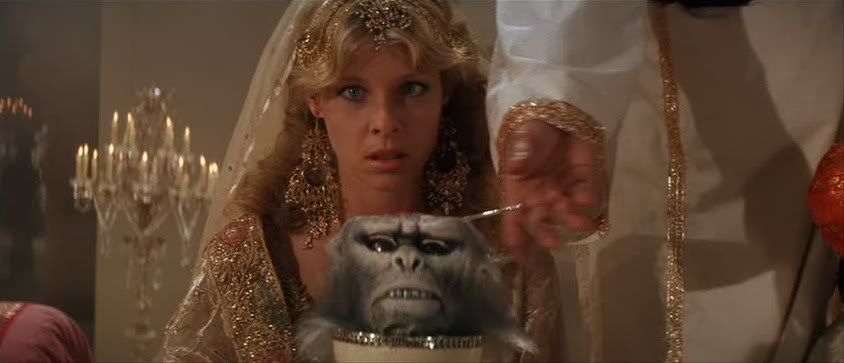
Temple of Doom is also more exaggerated than its predecessor in terms of the supporting characters who accompany Indy on this adventure. While Raiders of the Lost Ark featured cartoonish Nazis as the villains, Indy's allies were the loyal and noble Egyptian guide Sallah and Karen Allen's tough, witty portrayal of Marion Ravenwood. The shrill, helpless Willie Scott is no Marion, though, and Kate Capshaw is no Karen Allen; her character here is basically the butt of jokes about feminine incompetence and greed. When Indy drags her to an Indian palace, investigating the disappearances of many children from a rural village, the first thing she thinks when she sees the wealth and splendor of the palace is to wonder if the maharajah is married. Even worse is the infamous Short Round (Jonathan Ke Quan), a Chinese orphan boy who accompanies Indy on his adventures, and who basically serves as a source of caricatured comic relief with his heavy accent and squeaky catchphrases. The infamous dinner scene — where Willie and Short Round are horrified as their hosts serve giant bugs, eyeball soup, a snake that spills out smaller living serpents when sliced open, and, most memorably, chilled monkey brains, served out of a monkey head with removable scalp — is another example of the film's wallowing in grotesque orientalism.

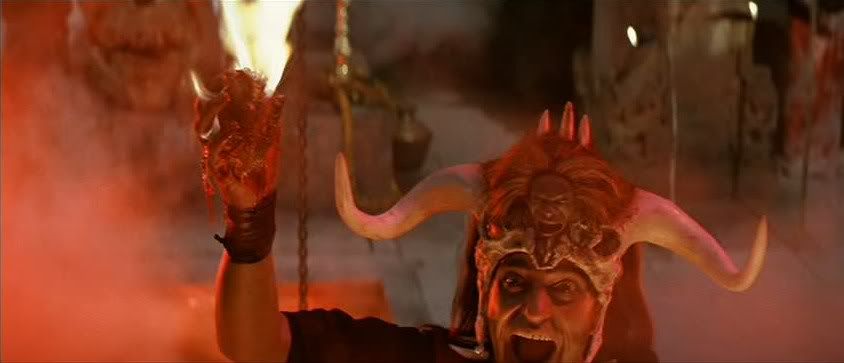
At its best, though, the film's melodramatic outrageousness can be strangely compelling. This is true even of the problematic aspects: the seduction scene between Indy and Willie is hilarious, since it consists of two profound egotists posing and sparring, culminating with Willie throwing her head back, closing her eyes and murmuring that she'll be the best he's ever had. Later, Spielberg indulges in a very different form of excess when the three heroes witness an ancient ritual in which a priest pulls the heart from a man's chest before thrusting the (somehow still living) man into a whirlpool of fire. This scene is all about operatic excess, taking the fiery spiritual climax of Raiders of the Lost Ark as a starting point and simply expanding its red-hued lunacy to even greater lengths.

That exaggeration extends as well to the vision of the slave labor mine that lurks within the temple, where dirty, chained-up children hack at rocks with hammers while being whipped by bare-chested overseers. At one point, Spielberg even conflates voodoo with Indian culture, because basically the evil cult depicted in the film doesn't emerge from any one culture or anything real whatsoever. The cult is instead a vision of every foreign culture, as viewed through the xenophobic eyes of the West, all blended together into a soup of strange customs, blood sacrifices, horrible food, and a pagan obsession with death and destruction. It'd be easy to say that Spielberg is parodying that particular lineage within the pulp fiction genres that he's drawing on, but that doesn't really seem to be the case: he's just delivering a potent and especially ugly vision of the stereotypical foreign bad guy, the villain whose very obvious distance from Western culture is the only source of his evil.
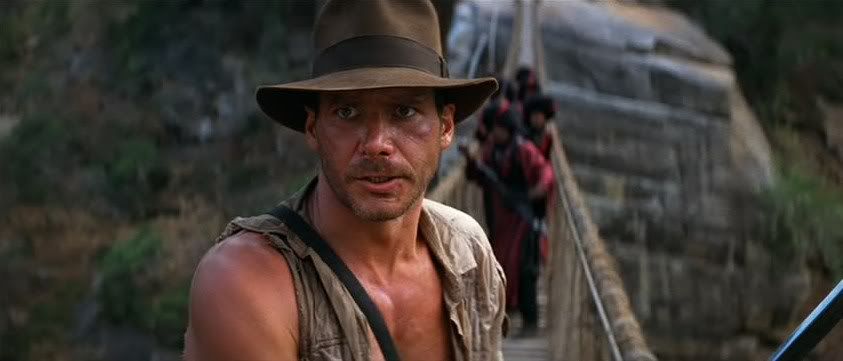

The best part of the film comes at the very end, when Spielberg drops all the campy strangeness and simply embraces the spirited action set pieces that made Raiders so boyishly exciting. The mine car chase sequence is punchy and thrilling, crisply edited and visceral, and Spielberg follows it with an equally tense and well-realized sequence with Indy trapped in the center of a rope bridge, sword-wielding villains advancing on him from either end of the bridge. Spielberg, whose action scenes always have a keen sense of place and spatial relationships, inserts long shots in which the bridge runs across the whole frame, showing Indy as a dot in the middle with the slowly approaching enemies, purple blots in their long robes, closing in on him. The action scenes stacked up towards the end of the film have all the tightly wound intensity of the best Spielberg action sequences, and this consistently exciting final act goes some ways towards redeeming the sometimes slack narrative, annoying characters and orientalist oddities of the rest of the film.

Temple of Doom is well-known as the oddball entry in the Indiana Jones series, at least before the fourth film, The Kingdom of the Crystal Skull. It's a deeply strange and flawed film that, to its credit, doesn't simply repeat the very successful formula of its predecessor but tries to do something different within the pulp lineage. It doesn't always work — an understatement, perhaps — but there's still something hypnotizing about the film's embrace of its own knowing excesses. It's a very inconsistent movie, of course, both in terms of quality and tone: sometimes harrowing and horrific, sometimes barreling forward with no-consequences action, and sometimes goofy and cheery, as when Spielberg nods to the elephant hijinks of Howard Hawks' Hatari!, a film that (as Adam Zanzie first tipped me off to) seems to be very important to his career and his approach to cinema. The film's final shot embraces all these contradictions, as Indy grabs Willie for a kiss (after pulling her to him with his signature whip; kinky!) while Short Round urges an elephant to spray them with water and repeatedly squeals, "very funny!" It's cheesy and ridiculous, especially when Spielberg then pulls back to show a crowd of laughing Indian kids running to embrace the couple. Spielberg's dealing with big, bold images and events here, and the film is packed with clichés and absurdities. That it sometimes overcomes its own ridiculousness to deliver a satisfying action set piece or some other fun bit of business is a tribute to Spielberg's keen instincts showing through.

Monday, February 6, 2012

Raiders of the Lost Ark


Raiders of the Lost Ark was the movie that introduced the world to the legend of Indiana Jones, the archeologist/adventurer whose exploits — invading ancient ruins in search of treasure, trying to beat the Nazis to the mythic Ark of the Covenant — are director Steven Spielberg's tribute to pulp fiction serials and boys' adventures. Indy (Harrison Ford) is a romantic daredevil who, in the film's famous opening sequence, enters a South American ruin looking for a gold idol, dodging clever traps of darts, bottomless pits, and a boulder that rolls out of an alcove to pursue the hero through this treacherous cave. The opening sequence is so legendary for a reason, as it economically introduces the hero, his exploits of derring-do, and his ability to escape from even the most seemingly hopeless odds.

The film is packed with such iconic moments, the scenes that fascinated me as a kid watching this movie over and over again, and which can still evoke a silly grin of pleasure. There's Indy abruptly cutting short an Arab enemy's elaborate swordplay by simply shooting the guy. There's Indy chasing a Nazi convoy on a horse while the exhilarating and unforgettable John Williams theme plays. There's Indy and his one-time lover Marion (Karen Allen) in a shootout with Nazi troops led by the sinister, perpetually smirking Toht (Ronald Lacey), a cartoon Nazi villain who wants the Ark as a magic weapon to deliver to Hitler himself. Spielberg deliberately makes Indy's adventures over-the-top and outrageous, culminating in the religious fury of the climax, in which the Nazis win, getting to the Ark and opening it before Indy can — for which they're rewarded only with God's fury, an extinguishing fire that erases any trace of the villains from the world. That ending is pretty interesting, because Indy has nothing to do with the bad guys' defeat: he has the opportunity to destroy the Ark, foiling the Nazis' plans, but as Indy's opposite number, the French archeologist Belloq (Paul Freeman) recognizes, Indy can't do it, he can't simply destroy the relic he's been pursuing. He's obsessed, just like Belloq and Toht are, and he wants to see what's inside the Ark as badly as they do. So he and Marion end up tied to a wooden post, watching as the villains open the Ark, which should be the bad guys' moment of victory but instead turns into their death because they hadn't considered what it means to use a relic of such holy significance for evil ends. Indy wins because he lost.


Elsewhere, Spielberg has a lot of fun just playing with the genre conventions of the adventure. A perfect example is the spatial playfulness of the scene where Marion is being kidnapped, carried around in a large woven basket by a pair of turbaned bad guys. As Indy chases after the thugs carrying her, the geometry of the scene has a cartoon absurdity to it, as he winds down one alleyway after another, only to have the men he's pursuing show up behind him or down a distant alley when just moments before they'd turned the same corner that Indy has just rounded. It's Bugs Bunny logic, turning these back alleys into a surreally warped maze where space and time don't behave as they're supposed to. Spielberg frequently mixes the comic with the tragic in this way; the goofy illogic of the chase sequence doesn't diminish the danger that Marion is in, and indeed the sequence ends with her seemingly dead, blown up in the explosion of a truck that Indy tips over, unaware that it's full of explosives. Earlier in the film, Toht, always a locus of darkly comic violence, reaches for an amulet that he needs to locate the Ark, but the metal has been surrounded in flames and burns the Nazi's hand, so he runs screaming outside to stick his hand in the snow. Even at the climax, the open-mouthed screams of Toht and the other Nazis, before their faces begin to melt and decay, are almost funny in their exaggerated expressions of terror. Spielberg, who would later approach Nazis much more seriously, here makes them comic foils, dangerous and despicable but also ridiculous, worthy of derision as much as contempt.

That's a big part of the film's crazy charm, its enduring importance as an action/adventure classic. It's a film that doesn't really take itself seriously, right from the goofy opening moments when one of Indy's South American guides runs screaming in exaggerated horror from a stone statue. When Indy, early on, famously shouts that he hates snakes, you just know that by the end of the film he'll have to get through a tomb full of the slithery reptiles. This kind of movie logic is everywhere in the film, like in the subsequent scenes where Indy returns to his day job as an archeology professor, teaching classes that seem to be populated almost entirely with young girls who adore the dashing, handsome prof. (One of them, memorably, writes "love you" on her eyelids so that the message appears whenever she blinks.)


Another big part of the film's charm is Karen Allen's vivacious performance as Marion, who in a way is even more of a bigger-than-life figure than Indy himself. Indy is legendary primarily because of what happens to him, and because he reacts to everything with the same everyman casualness, betraying maybe a little smile or a flicker of satisfaction at most when he evades death yet again. Marion's a much more intense personality: she's introduced into the film during a drinking game in which she drinks a much bigger man into passing out, while she simply flashes a crooked grin and collects her money. Marion is a more complex and much more real character than the iconic Indy. She's had an active life — she owns a bar in a remote Asian city — and is obviously still nursing some heartache from the older Indy's cavalier treatment of her the last time he saw her. Her introductory drinking game is echoed in the later scene where she seduces Belloq, playing up her own exaggerated drunkenness and lulling him into drunken complacency before pulling a knife on him. She's a great character, a great woman, and if she sometimes falls into the damsel-in-distress role, waiting for Indy to rescue her, just as often she's scheming and fighting for herself, running around in the background of action scenes clobbering thugs in the head with metal pans. She's easily as much a part of this film's appeal as Indy himself.

What's great about Raiders of the Lost Ark is how cleverly Spielberg mines the pulpy adventure tropes that he's drawing on here, making a film that revels in its own artifice, its obviously fictional nature, and is all the more enjoyable because of it. It's a film that deals in legends and icons before the film itself even became legendary or iconic. Indy is a prefabricated icon, and even early on in the film, he's portrayed as just a distinctive silhouette, hat and all, on the wall of Marion's bar, identifiable just from his shadow. He was made to be a cinematic icon, and he fulfills the role admirably.

Friday, February 3, 2012

Limite


The Brazilian writer and poet Mario Peixoto directed his only film, Limite, when he was very young, and he never made another film. Limite thus remains as a romantic one-off artifact, an often forgotten and neglected avant-garde work. The film has a simple and iconic scenario, in which two women (Olga Breno and Tatiana Ray) and a man (Raul Schnoor) drift on a boat, their clothes worn and torn, their food supply nearly exhausted, their expressions downtrodden and miserable. As they sit in the boat, aimlessly floating on the tranquil water, they remember their pasts and tell their stories to one another. One of the women is an escapee from prison, and the man was involved in a tragic love triangle that ended with the loss of his lover, but their stories aren't the real focus of the film. The flashbacks are elliptical and abstracted, with very little true narrative content. The only intertitles appear, jarringly, in a brief stretch late in the film, during a conversation between the man and a rival suitor (Brutus Pedreira), both of them mourning their lost love. During this conversation, the film unexpectedly veers into the territory of the traditional silent melodrama, with Peixoto filming the charged glances that pass between the men while the titles relate the few lines of tense, angry dialogue that constitute almost the entirety of the film's verbal content, though there is also some onscreen text from a newspaper that relates the story of the woman's jailbreak.

These snippets of text are Peixoto's only concessions to narrative momentum. The rest of the film teeters on the edge of abstraction, and the narratives, such as they are, are vague and simple. Peixoto seems less concerned with conveying tangible details or telling particular stories so much as exploring iconic situations. He's interested in emotional content in its raw form, so the stories related through the flashbacks sketch out only the outlines of these characters' lives, emphasizing the pain and anguish they feel rather than the particular events that brought them to this state. Peixoto relies on the viewer to connect the dots, to be swept up in the emotional poetry of these often-empty natural landscapes, melancholy small town streets, overcast skies and ocean waves.

Unfortunately, it can be a challenge to do the work required by Peixoto. The film often feels as empty and uneventful as its landscapes. The film is relentlessly slow-moving, and often dull, especially in the first half when Peixoto holds many seemingly endless long shots of people simply walking, shot from multiple angles and sustained for several minutes at a time. The abstracted narratives and stark, patiently paced imagery can be trying, as there is often very little context for any given shot, and thus very little cause for the emotional investment that Peixoto demands. He's reaching for visual poetry rather than narrative, but too often I just didn't feel the poetry of his images, I couldn't access the emotions he's expressing. The imagery is generally too plain, too static and repetitive, to hold up the film in the absence of any other content.


Which is not to say that the film is entirely disappointing. Its best sequences are poetic and moving in mysterious ways that are difficult to articulate, and for every aimless shot of someone walking along a country road, there's an image of startling emotional immediacy. At one point, one of the women, upset about something, goes out to a cliff overlooking the sea and the curving shore below. The camera, looking over her shoulder, begins to sway and shake in sympathy with her mental turmoil, turning in graceful arcs from the shore out into the water, and then beginning to spin rapidly, the whole scene turning upside-down and tracing 360-degree circles. This disorientation perfectly reflects the mental state of the woman, who is wracked by a mysterious despair that drove her to this desolate outcrop.

In another sequence, the man recalls his love affair in a methodical progression of shots, most memorably a closeup of hands clasped together as he walks along a jetty with a woman, surrounded on both sides by water. The man and woman go bathing together in a lake, and afterwards he carries her out of the water like a groom carrying his bride across the threshold — is this a romantic image, or did she die? it's not quite clear — and then Peixoto inserts a montage of natural images. The whole sequence is then repeated with the man and the woman fully removed: their footprints are visible in the sand on the jetty, and then Peixoto shoots the rest of their walk with the figures absent, ending with a shot of the footprints being washed away by the waves washing up on the shore. It's a beautiful and simply powerful evocation of lost love, an affair ending, all traces of its romance being erased as it fades into memory. At moments like this, Peixoto's imagery is direct and evocative, economically stating a strong and familiar emotion with a few elegantly montaged images.

At other times, Peixoto's less direct visual poetry can be equally affecting, as when the film climaxes with a few minutes of waves crashing against rocks, frenetically collaged together with rapid editing far more jagged and fast-paced than anything else in the film. There's a literal dimension to this sequence, as a representation of the stormy seas that ultimately wreck the boat at the end of the film, but more importantly it's an entirely abstract emotional climax, a peak of frenzied feelings and desperation, the turmoil of the water standing in for the turmoil in the minds of the protagonists. The film has some excellent sequences like this (a meta scene in which a laughing audience watches a silent movie is another) but they're spaced out by long dead stretches, patience-trying sustained shots and slack pacing. Limite is not quite the lost classic of avant-garde cinema that it's often held up as, but it's definitely an interesting experiment, and in its best moments it achieves a stark emotional purity and simplicity that is very appealing indeed.

Wednesday, February 1, 2012

Stavisky...


With Stavisky..., Alain Resnais has made a film that seems to be all about appearances and surfaces, but uses its glossy, charming — but ultimately tragic — gangster story as a way of exploring questions of identity and politics. The story of the conman Stavisky (Jean-Paul Belmondo), who reinvents himself as the sophisticated financier and businessman Serge Alexandre, takes place in the crucial years of 1933-1934, a period of slowly increasing tension in the lead-up to the Spanish Civil War and World War II. The film is based on real events that inspired right-wing riots on February 6, 1934, leading indirectly to the gradual loss of power by leftists and socialists within the French government. The film was written by Jorge Semprún, who had also written Resnais' La guerre est finie in 1966; like that film, Stavisky... engages with European fascism and leftism through questions of identity and personality. Stavisky/Alexandre is a man of many names, many identities, a small-time crook who has put his past behind him and become a well-respected member of society, dealing with high-ranking politicians and businessmen, coming up with grand plans that would impact the entire world economy. Stavisky is hiding from his past, at times acting as though the man he was is someone else entirely, with no connection to his present self at all.

Resnais connects this denial of self with the question of Jewish identity during a time of steadily increasing anti-Semitism in the years before the Holocaust would begin in earnest. Stavisky is a Jew, and a self-denying Jew, just like his father, who had entirely repudiated his faith. But he's self-denying in an entirely different way from his father, who had always advised him to be "average," to let people ignore him; Stavisky doesn't believe in this advice. As one of his employees says about him, "He wanted the world to talk about him. He should have wanted it to forget him." Stavisky's grand plans only draw attention to him, make him a target, impossible to ignore or to forget. In this, he is compared to a refugee German actress (Silvia Badescu) who he sees giving an audition in his theater: she stands up on stage and announces that she is a Jew, that she has fled from Germany. She is announcing her identity up front, hiding nothing, very unlike Stavisky, whose Jewish roots are deeply buried beneath layers of alternate identities and invented names. Perhaps that's why he's so moved by her, although their stories only intersect briefly. He sees in her a pride and a strength of character that, despite all his bravado and his smiling confidence, is utterly missing in him because he can never truly be himself. And yet Stavisky, in his own way, also refuses to be "average," refuses to hide or to congenially assimilate into society. Instead, he places himself out in the open, using the connections he builds to ingratiate himself into polite society, politics and the inner workings of the world economy.

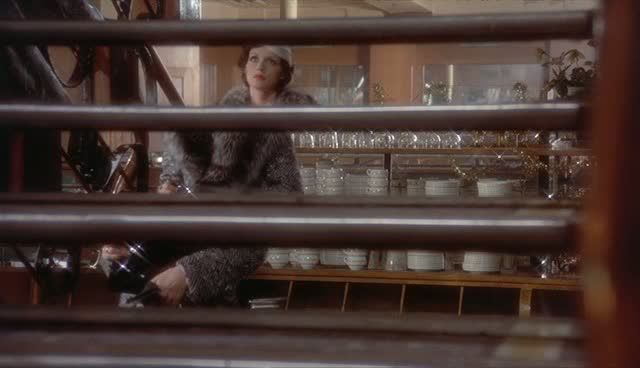
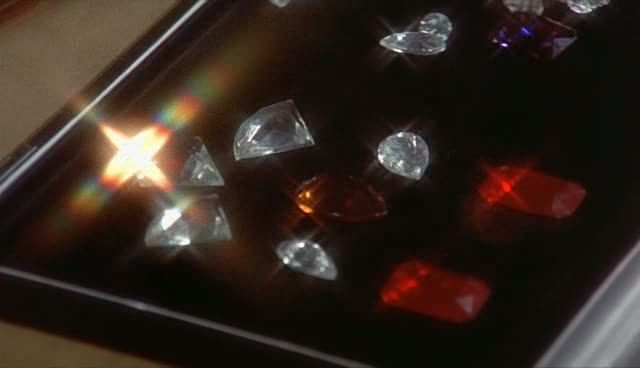
It's this domain of privilege and power that serves as the film's milieu. The film is set almost entirely in fancy hotels, glitzy seaside casinos, resorts for the idle wealthy. The camerawork of Sacha Vierny accentuates the shiny, colorful veneer of these surroundings. The camera drifts lovingly over the facades of these pleasure palaces — although Stavisky, who says that happiness is momentary and pleasure permanent, would likely not call them that — and revels in the excess and grandiosity of this lifestyle. Jewels glitter brightly, sparkling with stars of white light. The women, like Stavisky's beloved wife Arlette (Anny Duperey), are dressed in fine furs and sleek dresses, their made-up faces surrounded with shimmering jewels. Everything is glamorous and draped in riches, even in the midst of the Great Depression, which hardly seems to have touched the social circles that Stavisky operates in. The lively Stephen Sondheim music makes the film seem like a musical with no real musical numbers, just the sprightly accompaniment of Sondheim's jaunty melodies and romantic string themes. Alexandre puts on theater productions, giving the public garish spectacles to distract from the real conditions of the world for ordinary people. As his employees tell him, no one wants frugality in their entertainment, they want to be entertained and delighted by everything they don't have in their own lives. The film is dripping in ostentatious displays of wealth and privilege, set in a fantasy world that seems entirely disconnected from both the poverty of most people and the brewing political turmoil that would throw the entire world into chaos and horror by the end of the decade.


That turmoil rarely intrudes in obvious ways into the world that Stavisky has built for himself, and yet he's surrounded by signs of what's to come. He has associates and friends on both sides of the political spectrum, especially among rightists like the charming, cheerful fascist Baron Jean Raoul (Charles Boyer), who wants to replace France's parliamentary government with a National Union comprised of wealthy, influential society people. Stavisky also nurtures his connections with Juan Montalvo (Roberto Bisacco), a Spanish exile who's gathering funds and weapons to trigger a civil war back in his native country. Stavisky involves himself in wild schemes, financed with fake bond issues, to rejuvenate the world economy and end unemployment, but the real future is to be found in the plans of his friends, who plot against the left with the help of this disguised Jew, who barely thinks about the political consequences of his associations. He says that he remains neutral, that he'll support whoever is in power and forge connections on both sides to cover himself in any eventuality, but he never seems to grasp the deeper implications of the platforms that these polite fascists are really pushing for.

The film's political subtext also involves the parallels and connections between Stavisky and the exiled Leon Trotsky (Yves Peneau), who arrives in France in the opening scenes of the film. Resnais then cuts from Trotsky's motorcade to an image of Stavisky/Alexandre descending in an elevator in one of his posh hotels. Just to underscore the point, Resnais cuts back and forth a few times, stuttering the image between Trotsky's car and Stavisky in his elevator; the hotel scene is accompanied by lushly romantic strings, while no music plays over the images of Trotsky. This montage at first seems like a simple joke, juxtaposing the arrival of this important political figure with the lavish lifestyle of the conniving gangster, but the parallels between the two men go deeper than that. Both are Russian Jews in exile, and by the end of the film, the failure of Stavisky's criminal schemes will have catapulted the rightists to power and endangered Trotsky's position in France. Throughout the film, Stavisky's showy existence and denial of his roots is contrasted against Trotsky's quiet maintenance of his beliefs and his low-key engagement with the radical politics of the era.

Although the film's surface period evocation is flawless — the art direction is sumptuous and detailed — Stavisky... is far from a typical period epic. Resnais, as he often does, uses non-chronological editing to fragment the narrative, weaving together flashbacks and flash-forwards that foreshadow and then outright depict Stavisky's downfall and death while he's still at the height of his power. In one key sequence, Stavisky goes walking in the woods, visiting the house where his father, embarrassed of his son's criminal record, committed suicide. As Stavisky prepares to leave the site, Resnais cuts in for a surreal closeup of a dead mouse that Stavisky steps past without seeing it, a symbol of the doom that he can't see coming. (Later, a white ermine frolicking in the snow serves as a prelude to Stavisky's actual death; Resnais loves playfully using animals as mysterious symbols like this.) The film's interpretation of the real-life Stavisky Affair suggests that the title character was unwittingly responsible for many of the failures of French leftism in the pre-WW2 era, haplessly paving the way for the Vichy regime and the victories of French fascism.