Monday, September 27, 2010

Haut bas fragile


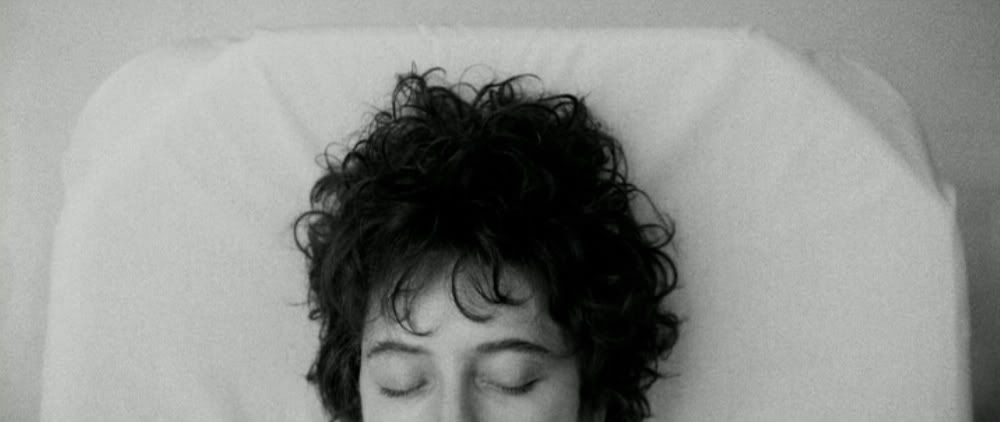
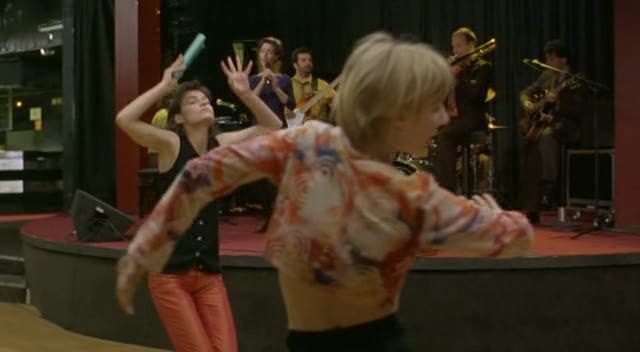
The films of Jacques Rivette often revolve around mysteries and secrets, around conspiracies and secret societies, the past hovering with foreboding over the present, his characters involved in labyrinthine plots that lead to places beyond understanding. Haut bas fragile is no exception, centered as it is on three young women whose lives are seemingly haunted by the past, by the secrets that linger all around them. Louise (Marianne Denicourt) has just awoken from a 5-year coma, and is determined to start a new life while pushing aside everything (boyfriend, family) that occupied her before her prolonged and involuntary absence from the world. Ida (Laurence Côte) was adopted as a child and is obsessed with finding out the identities of her biological parents, hoping that this knowledge will tell her something about her own identity. And Ninon (Nathalie Richard) is fleeing a life of violence that's shown in the opening scenes of the film, when a jealous ex stabs a man who she's dancing with at a club. These women, whose paths cross in ways both major and incidental over the course of the film, are all struggling to determine the courses of their own lives against the inertia of the past, simultaneously seeking the truth about the past and trying to break free of its influence.

This is a common theme in the cinema of Rivette, this concern for the past, a theme that echoes through works like Secret Défense and The History of Marie and Julien, both films where history is a trap, a pattern that dooms the protagonists to cycles of repetition. In Haut bas fragile, however, this trap is continually sidestepped and defused, most notably through music and dance. The film is a musical — or at least, it increasingly becomes one, as the scenes of muscial interruption and performance become more and more frequent over the course of the narrative, transforming what had at times threatened to become a portentous drama into a playful subversion of this drama. Whenever the characters fight or argue, as they often do, their movements become formalized and graceful, striking poses in the midst of the fight, extending their limbs and becoming cat-like in their motion, until the music suddenly erupts and the argument has become a dance, often a dance of flirtation and seduction. It's through the dance, through music and movement, that the characters in the film fall in love and forge friendships, dancing around each other even as Rivette's camera, a playful third partner in these dances, dances around the actors.

This is a charming, exciting film, one in which Rivette lightly prods at some of his typical concerns. He introduces, as he often does, a secret society of sorts, a club that meets in an underground lair to play a sinister game of cards, presided over by the suave and mysterious Alfredo (Wilfred Benaïche). The game is a game of life and death, where one card dictates the killer and another card decides the victim in a real-life game of stalking and murder, a game that recalls Robert Altman's bizarre sci-fi film Quintet. But when Louise — who has infiltrated this mysterious circle through the help of the ubiquitous Roland (André Marcon) — draws the card of the killer, the game turns out to be a farce, a ruse designed to help her overcome her vertigo. The conspiracy dissipates like so much smoke, whereas in so many of Rivette's other films, the conspiracy — and the doubt over whether it exists or not — dominates the action and becomes an obsession for the protagonists. Louise's affliction is probably no coincidence, either, given Rivette's admiration for Hitchcock: whereas Scotty in Vertigo must undergo repeated traumas and psychological torture because of his vertigo, Louise overcomes hers in a few moments through a game. It's a conscious subversion of the thriller's psychosexual dimensions. Again and again, the playfulness of dancing and loving and verbal sparring — like the rhymes of Louise and Ninon's song as they celebrate their newly forming friendship — frees the characters from the constraints of generic drama.
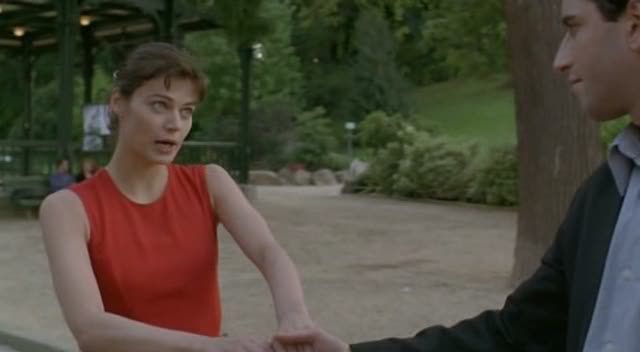
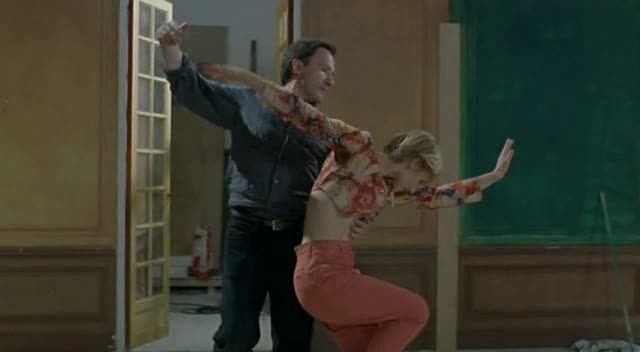
Rather than becoming trapped in cycles of distrust and betrayal, these characters open up new possibilities through the seductiveness and goofiness of dance. The result is a series of happy reversals that send the film careening wildly away from the tragic course that it occasionally seems to be on. Ninon's thievery has short-term bad consequences for one ancillary character, but when she reappears later in the film, she's in a better situation than ever, happier than ever. It's as though Rivette is suggesting that tragedy need not be a permanent condition, and that the story of a life is exactly what we make of it. Thus, though much of the film's narrative is built around a sheaf of papers that provide incriminating evidence about Louise's father, these ultimately turn out to be something of a red herring. The papers threaten to shatter Louise's relationship with her earnest young suitor Lucien (Bruno Todeschini), but instead she doesn't allow the papers' revelations to disturb her; they're part of the past, part of a history that she's moving away from. The real purpose of the papers, in the end, is to provide an excuse for Ninon and Louise to meet, to go off in secret momentarily, and then to emerge, dancing and playful, Ninon twirling around her friend as Louise sways to the music and strikes silly poses as though caught in the flash of a camera. And Rivette's camera, for its part, spins slowly around the women as well, adding its own spiraling inertia to their graceful dance.

This film is a typically slippery and ambiguous delight from Rivette, a mystery whose solution lies, not in the revelation of secrets, but their submersion within an alternate narrative of love, flirtation, and affectionate friendship. It is, as with so many of Rivette's films, a celebration of femininity, where the attempts of the men to control and protect the women, to dictate the direction of the story, prove utterly inconsequential. Ninon and Louise, bonding over a shared distrust of Roland — whose intersections with all three women drive much of the narrative — joke about cooking and eating him, a reversal of the traditional conception of predator and prey. Roland and Lucien attempt to follow, to stalk, to track down these women, but in the process the women turn the tables, rejecting the conspiracies and lies of the men in favor of openness and seduction and the vitality of the dance. These are the positive, exuberant forces at the center of Haut bas fragile, which is packed with Rivette's sly wit and playfully experimental spirit.

Tuesday, September 21, 2010

Blow-Up


Michelangelo Antonioni's Blow-Up is an unsettling, mysterious film that seems to be hiding multiple secrets beneath its glossy, impenetrable surface: the grainy, Rorschach blot photographs blown up by fashion photographer Thomas (David Hemmings) in his search for clues to a murder provide a blueprint for the film as a whole. Strange encounters, clues and red herrings, inexplicable happenings: the film is disconnected and radiates a zombie-like vibe right from its opening sequence, in which a troupe of mimes, faces caked with pasty white makeup, are contrasted against the deadened faces of factory workers clocking out for the day. Blow-Up is often summarized as being about a photographer who comes to believe that some photographs he took hold the evidence of a murder, but in fact more than half the film passes by before the pivotal moment when Thomas becomes obsessed with uncovering the clues in these photos. Before that point, he takes fashion photos, berating and verbally abusing the confused models, and has a nearly silent scene with Patricia (Sarah Miles), the wife of his painter friend, in which body language and exchanges of looks suggest some kind of longing between the two, and goes shopping for antiques, impulsively buying a giant wooden propeller. Antonioni prepares for Thomas' obsession with the details of a seemingly innocent photograph by patiently building a portrait of a man dissatisfied and adrift in his own life. Several times there are intimations of hidden homosexuality, as when Thomas seems disturbed by the "queers and poodles" infiltrating his neighborhood, or when his complaints about women are answered with the retort, "it would be the same with men."

Thomas, it seems, doesn't know what he wants. He's a vile and abrasive man, and midway through the film his encounter with two giggly would-be models (Jane Birkin and Gillian Hills) keeps teetering on the brink between playful flirtation and stormy violence. It's a disturbing sequence, since at times it seems like Thomas is on the verge of raping the girls, while at other moments they're playing along, flirting and joining his game. A similar dynamic is at work in the crucial scene between Thomas and Jane (Vanessa Redgrave), the woman in the pictures that drive the narrative in the film's second half. Thomas stumbled across Jane with an older man in a small park, and was moved to take photos, hiding in the bushes as the man and the woman walk along, talking, kissing, embracing. But when Jane sees the photographer, she confronts him, and later somehow tracks him down to his studio, where she alternates between cajoling and seducing him to give her the photos he took. It's such an interesting scene because, while Thomas initially seems fully in control, holding back against the tearful and increasingly desperate pleas of this woman, as they interact further she subtly gets the upper-hand, climaxing with the moment when she offers herself to him by removing her top, shaming him into at least pretending to give in.

There are a lot of subtle threads running through this film in scenes like this, notably the dynamic of male/female relationships and the balance of control and domination. Thomas is used to ordering women around, posing them how he wants, getting just the image of them that he wants, manipulating them into presenting a surface that's compelling to his camera — and beneath that surface, he doesn't care what lurks. But Jane is different, a woman who obviously has a story, and secrets, that never escape from beneath the surface she presents to Thomas. She disappears from the film after this scene, and her secrets disappear with her. The second half of the film has a fascinating arc. First, Thomas decodes the photographs he's taken, printing them out and using magnification and selective viewing to locate key points within the photos, following Jane's gaze in one photo and extrapolating in another to the point where she might be looking. His wall is eventually covered in photographic enlargements, blow-ups that reveal previously hidden details. At the end of this process, Antonioni inserts a montage of the photographs in an order that tells a story: the two lovers walking, eventually reaching a spot where another man, previously unseen, lurks in the bushes with a gun, waiting to kill Jane's companion, and then a shot of what may be the corpse lying in the bushes once the deed is done.


This montage is a kind of model for the cinematic art, the construction of a story through the arrangement of still images in sequence. The order in which the images appear, and the details highlighted in each image, determine what story is told. And the process also establishes the complicity of the artist in what he documents, in that Thomas' mirror image is surely the man with the gun: two men lurking, hidden, in the bushes, pointing something at the couple walking out in the open air of the park. Snapping a picture, or firing a bullet. The remainder of the film represents the reversal of this cinematic process of narrative construction, calling into question everything that had been created through this montage. The pictures disappear, stolen from Thomas' studio. The body in the park disappears as well, although not before Thomas sees, or imagines he sees, it with his own eyes one night. Jane disappears, the phone number she left behind a fake, her identity still a total mystery by the end of the film. Thomas' narrative of murder is ultimately ephemeral, removed as it is from concrete reality. When Thomas shows Patricia the only remaining photo he has, a grainy blow-up of what might be a corpse lying on the ground, she compares it to her husband's abstract paintings, inscrutable and open to interpretation. Earlier, the painter had explained what he liked about one of his own paintings by pointing to a single rectangular segment and praising it as a good leg, implying that this abstracted geometric tangle is actually a figure drawing.

There's a similar interplay between abstraction and representation in Thomas' photographs, a concept that overturns the simplistic understanding of photography as a documentary art, as the simple art of capturing the reality in front of the lens. Blow-Up suggests that even photographic art can lie and distort and hide the reality, that even a photograph can be abstract and dissembling. In the end, Thomas, like the film itself, winds up questioning what's real at all. In the final scene, the mimes from the beginning of the film return, playing a pretend game of tennis, and at one point silently instruct Thomas to "retrieve" a "ball" that has supposedly gone flying into the grass off the court. Thomas complies, pretending to throw a ball back to the players, but as they resume their pantomime, the shot remains trained on Thomas as he watches. The sound of a tennis ball bouncing back and forth on the soundtrack suggests that we create our own reality, that sometimes the mind is more powerful than the vision, that sometimes what we see or think we see is not to be trusted.

This is a compelling, mysterious film that uses such symbolic images — heavy-handed, perhaps, but nonetheless effective — to probe the ideas of photographic deceit, narrative, voyeurism and masculine exploitation that lie at the film's center. The sequence of Thomas desperately trying to piece together a narrative in still images is the film's core, and contains by far its most powerful material. But if the rest of the film is more scattershot, more unfocused, that's because it's documenting and critiquing a lifestyle that's similarly unfocused and empty. This becomes most clear in the weird scene where Thomas, looking for his manager, goes to a concert by British blues-rock band the Yardbirds. As the band plays their poppy, rollicking song, the audience looks disinterested and joyless, standing utterly still, their faces bored and bland, until one of the band members smashing his instrument provokes a frenzied riot. It's as though the music isn't enough, the crowd needs the visceral thrill of the violence, and they go wild trying to get the shattered guitar neck that's thrown into the mob — a souvenir that Thomas escapes with seemingly without realizing it, and discards as soon as he's out of the crush of the crowd. The guitar fragment serves the same purpose as the photographs, for a moment at least: a material object in which to invest great meaning, a thing to provide structure and forward momentum to an otherwise aimless existence.

Monday, August 16, 2010

The Conversations #19: Todd Haynes


Another installment of The Conversations has been posted at The House Next Door. For the first time in a while, Jason Bellamy and I have turned our attention to a comprehensive director overview, the first one we've done since our two-part discussion of Quentin Tarantino a year ago. I'm very excited about this new conversation on director Todd Haynes, which covers his film work starting with his hard-to-see underground short Superstar: The Karen Carpenter Story, up until his latest feature, I'm Not There. It's a long and wide-ranging conversation, one I'm especially proud of and happy with. Check it out, and as always be sure to comment; Jason and I had a lot to say on this subject, and we hope you do too!

Continue reading at The House Next Door

Monday, August 9, 2010

Dawn of the Dead


Dawn of the Dead is the second of George Romero's "Dead" movies, made ten years after his powerful debut Night of the Living Dead, which established a world in which the dead were mysteriously and suddenly coming back to life as lumbering, flesh-eating monsters. Dawn picks up in the immediate aftermath of those events, as this horrible state of affairs continues to spread, terrorizing people everywhere. From the start, Romero signals that this is going to be a very different kind of movie from the slow-burning tension and suspense that characterized the dark, claustrophobic Night. The film opens abruptly, in mid-scene almost, as, while the credits slowly roll, a TV news broadcast degenerates into chaos and shouting. Two on-air announcers bicker over different interpretations of the zombie menace, while off-screen everyone's equally divided over what to do, what to think, where they can go next. Everything's falling apart, the usual institutions can offer little solace or help, and the familiar trappings of modern society, like TV itself, become absurd and even dangerous, leading viewers astray. This is the theme Romero is exploring here, in which the collapse of society reveals something of the absurdity of that society's conventions and ideas. It's an idea that will continue to resonate throughout this wild and frenetic film once the credits end and the real action kicks in.

The initial minutes of the film are a whirlwind of activity and fractured plotlines, as police storm a tenement — many of them spouting racist invective the whole time, since Romero's concept of satire is anything but subtle — and an employee at the news station, Francine (Gaylen Ross) plans to run away with her pilot boyfriend Stephen (David Emge). Eventually, after a tour of the chaotic countryside, where the army mingles with redneck posses to take potshots at hordes of zombies who look suspiciously like hippies, the film narrows its focus to a quartet of survivors fleeing in Stephen's helicopter; the couple is joined by SWAT team members Peter (Ken Foree) and Roger (Scott Reiniger). This quartet eventually takes refuge in a mall that's swarmed with zombies, gradually clearing the place of the infestation and settling into a life of isolation and relative safety.

Over the course of the film, the zombies begin to seem less and less important, except as a symbol of mass conformity and mindless consumerism: the setting of a mall is not accidental, and the dialogue continually repeats the idea that the zombies are congregating at the mall because some impulse left over from their human days is telling them that this is a special place. The zombies are American consumers, shambling through the mall's bland corridors, rambling from shop to shop, staring wildly into the windows with uncomprehending hunger for what's inside. There's something eerily familiar about all the long, distancing shots of figures lumbering aimlessly through this antiseptic space, staggering about with blank expressions, going through the motions of a shopping expedition by rote, repeating mindlessly some faint echo of their old lives. When Romero archly stages a balletic sequence of lines of zombies parading across a skating ring, the satirical intent of the setting is solidified: middle America envisioned as a place of such deadening conformity that all these unthinking consumers might as well be dead, or undead.


Romero contrasts this mindless repetition against the uneasy new community formed by the four survivors. These four suggest a microcosm of society, and the issues they face with each other are as important to the film as their actual confrontations with the zombies. Francine's character provides a feminist archetype, as she fights to be considered equal with the three men, included in their decisions and debates, allowed to contribute to the group's efforts. Early on, she listens in as the three men try to decide, not only what to do about the zombies, but whether they should abort her three-month pregnancy in these terrible circumstances. Francine is forced to fight against a situation where she's assumed to have no input on anything, even as related to her own body, where she's treated as a helpless damsel in distress even though she shows every sign of being capable of handling herself. In contrast, Peter, as a black man, does not face these same pressures; in fact, in this small community he's accepted and respected on the basis of his intelligence and strength, without any of the prejudice that he presumably encountered as a police officer. At one point, after the zombies have been cleared out of the mall, Peter serves a romantic dinner for Francine and Stephen, acting as a waiter in a way that suggests servitude. But the important distinction is that here he's acting as a friend, doing something nice for these people who have fought and worked side by side with him. These are relationships forged in mutual respect, where anyone can be accepted if they work hard enough — including Stephen, who's initially weak and somewhat cowardly, but who soon becomes a valuable contributor to the group, earning the respect of the more experienced and stronger Peter and Roger.

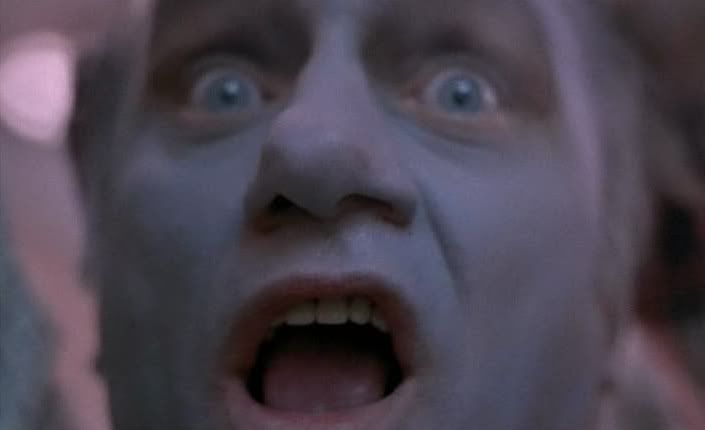
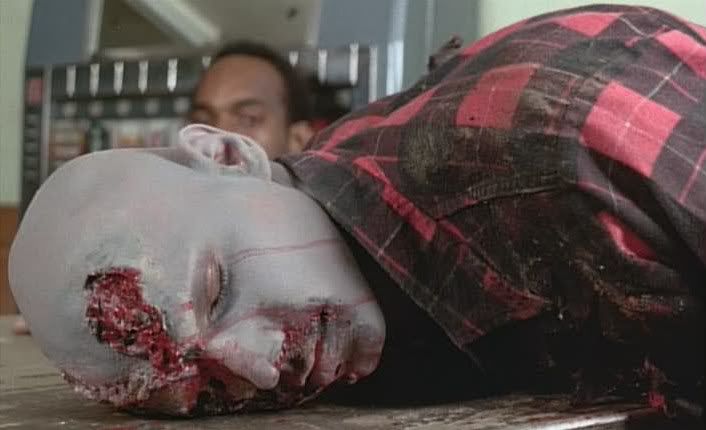
Romero is exploring the possibilities for a society of equals, suggesting that under tremendous pressure the best qualities of people might come out — and also the worst qualities, as evidenced by the group's later apathy and restlessness, as well as the caricatured avarice and nastiness of a biker gang who storm the mall late in the film. The film is in a constant state of tension between chaos and order, human kindness and baseness, destruction and rebuilding, society and anarchy, thought and mindlessness. Romero sees human nature in terms of the opposition of these conflicting values, with individuals vacillating between the two poles at various times. And the zombies are far from the only representatives in this film of the baser values. By the end, as everything falls apart, the film has degenerated into a free-for-all of slapstick violence and dark comedy. The bikers assault the zombies with pies and spray-bottles, hit them with giant hammers, drop-kick them with movie karate moves, all while generic mall muzak plays its bouncy themes in the background. There's a dark absurdity to it all, the violence becoming comic and silly, an effect exacerbated by the profoundly unconvincing makeup effects on most of the zombies. Indeed, an occasional zombie here and there is slightly scary and creepy-looking, but most of them just look like humans with blue paint on their faces, which might be written off as sloppy effects work if Romero wasn't constantly emphasizing the connection between the zombies and the average unthinking consumer. In this respect, the lame makeup effects even become a virtue, making the zombies seem anything but inhuman except for their weird lunging walk.

In fact, the dominant characteristic of Dawn of the Dead is its unsettling mish-mash of tones and themes. Romero's debut, Night of the Living Dead, was a crisp, economical horror film, unerringly creepy and minimalist, presenting its ideas about society and humanity in stark black and white while exploring the tense horror of the zombie attacks. Dawn, in comparison, is loose and even messy, meandering about from one moment to the next with all the aimlessness of a zombie shopper. Its bold, colorful aesthetic and cheesy gore effects drain much of the horror from the premise, replacing it with bloody comedy, broad social satire and, at times, a surprisingly nuanced exploration of the relationships that arise between four very different people in a situation of great stress. In forsaking the simplicity and grittiness of Night of the Living Dead, Romero found enough compensating virtues to make his second zombie flick a fascinating, wild, not always coherent but multi-layered satire.