Friday, August 31, 2012

Jungle Fever


Considering Spike Lee's career-long examination of various American attitudes about race and culture, it's not surprising that at some point he should take a look at the concept of inter-racial relationships. Many of Lee's films have thesis-like ideas at their core, from Bamboozled's satirical dissection of the history of blackface and the issue of race in the entertainment industry, to School Daze's inquiry into divisions within the black community, to the consideration of black/white romance in Jungle Fever. Like so many of Lee's films, Jungle Fever fearlessly looks at race head-on, and like so many of his films, it's messy, provocative, awkward, contradictory, uneven — and unevenly acted — stylistically eclectic, and (over)loaded with ideas. It's never a smooth viewing experience, but then it's clearly not meant to be; its barbs are there to get caught on, to provoke viewers of any race into thinking about ingrained prejudices and the ways in which the history of race in America continues to dominate current-day interactions and relationships between races.

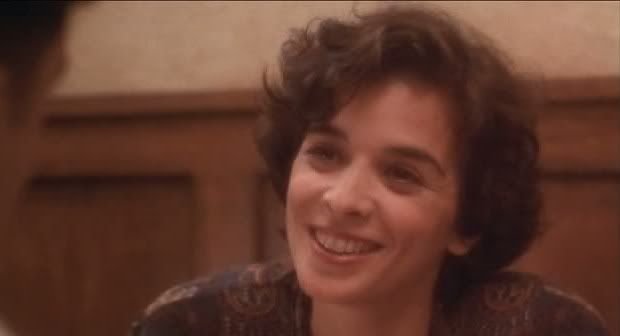
The narrative of Jungle Fever skips all over the place a bit sloppily, but basically it's about the relationship between the black architect Flip (Wesley Snipes) and his white Italian secretary Angie (Anabella Sciorra). Flip is initially antagonistic — he'd wanted his white bosses to hire a black secretary for him — but one night, working late in the moodily lit office, the pair suddenly develop a romantic rapport that leads to a night of passionate sex, even though Flip is in fact married, and seemingly very happily, to Drew (Lonette McKee). There's no explaining attraction or lust, and Flip and Angie simply give in, with predictably problematic results.

Lee places the emphasis on the reactions to this affair more than the affair itself, and at times the film seems to keep forgetting about Flip and Angie for long periods of time. Instead, he detours into scenes with Angie's former boyfriend Paulie (John Turturro) and his crude Italian buddies hanging around a convenience store, expressing racist attitudes while simultaneously lusting after the pretty, educated black woman who visits the store every morning and is friendly with Paulie. Much of the film turns around these kinds of nakedly polemical scenes, shoving character and narrative into the background for scenes like the one where Drew and her friends discuss men and skin color, Lee's camera circling relentlessly around the room while the dialogue, though apparently improvised by the actresses themselves, hamfistedly delivers these ideas.
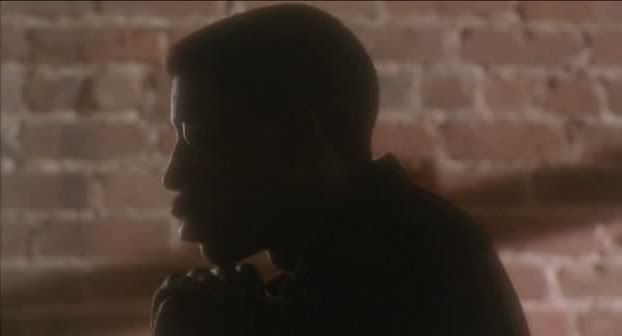

All of Lee's films have this dichotomy, this tendency to interrupt the narrative for scenes of straightforward political and racial preaching, but Jungle Fever is probably one of his most unbalanced films in that respect: it's not as straightforwardly satirical and polemical as a film like Bamboozled, so its preaching sits uncomfortably with the moments that are more about character or narrative. A prime example is the scene where Flip and Angie visit his parents (Ruby Dee and Ossie Davis), only to have his reverend father deliver a long, to-the-camera address on the history of slavery, miscegenation, and the rape of female slaves by white masters. What could and maybe should be a character scene, about the discomfort of the couple with the reverend's distaste for their relationship, instead becomes just another of Lee's immersion-breaking history lessons, and the central relationship gets shifted more and more to the fringes of the film.

There's still some interesting material here, especially in the way Lee shows the couple receiving prejudice and judgment from all quarters, in both Flip's black Harlem community and Angie's Italian Bensonhurst community. One of Lee's recurring themes is the way that blacks and whites are trapped by race and by the racist history of this country, fated by culture and history to play certain roles, to repeat certain mistakes over and over again. There's some uncertainty here about just how real Angie and Flip's relationship is, regardless of race, but race ensures that they don't stand a chance; it's just too big a barrier to get around. Flip's sudden voicing, late in the film, of prejudiced attitudes about mixed-race children is hard to justify narratively or in terms of his character up to that point, but thematically it makes perfect sense: these ideas, ingrained as they are, are exceptionally difficult to escape, passed down from generation to generation and running through entire cultures, both white and black.

The specter of race makes it impossible to judge this relationship like any other relationship, impossible even to think of Flip's adultery as just adultery rather than a betrayal of his entire race. In that sense, the way the film keeps getting bogged down in polemics and theoretical discussions of race and history is part of the point: these issues are so tangled and complex that this story can't just be a story.

Wednesday, August 29, 2012

Steamboat Bill, Jr.


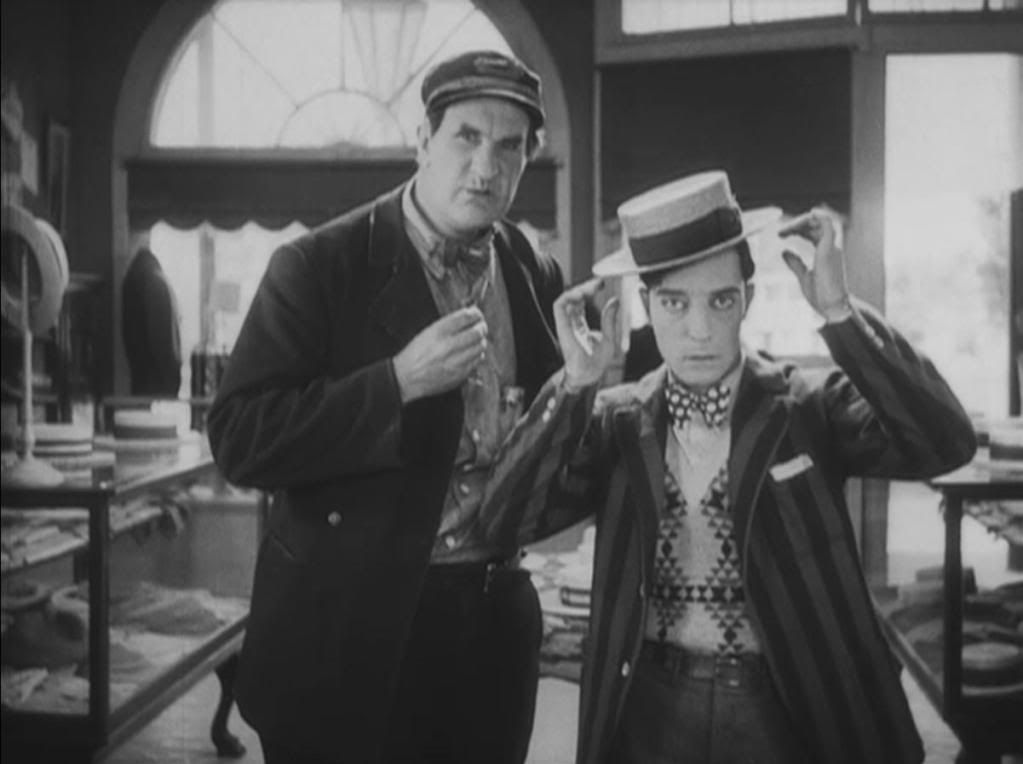
Steamboat Bill, Jr. is another of Buster Keaton's absolute best films, a brilliant masterpiece of physical comedy with a premise perfectly tailored to Keaton's penchant for death-defying stunts, blending humor and action to such a degree that those two aspects of his work become inextricable. Keaton's physical feats of daring at the climax of this film represent some of his best stuntwork, both irresistibly funny and shocking in the very real sense of danger that's continually present in these obviously carefully timed and designed stunts, where just a second or an inch off could've meant disaster for the actor. It's obviously Keaton's very precise, utterly logical genius driving these stunts and gags, which is why it makes no difference that he's not the credited director; it's Keaton's unmistakeable intelligence at work here, not that of credited director Charles Reisner.

The film has a quite poignant thematic emphasis on fathers and sons, as Keaton plays an effete, intellectual college kid who tries to impress his tough, masculine riverboat captain father Steamboat Bill (Ernest Torrence), who he is meeting for the first time. When Bill first realizes that Keaton is his son, Keaton is prancing around with a violin in a manner that's obviously meant to be a parody of homosexuality — he's trying to quiet a crying baby with his antics, but his father doesn't realize this and simply looks at this spectacle as the first manifestation of his son's unmanly ways. In his beret and fancy clothes, with a wispy mustache that earns the withering contempt of his father, Keaton recalls the inept snobs of some of his earlier films, though here he's not a son of privilege. The subtext is Bill's desire that his son — even a son that he hasn't seen since he was a baby — should be an echo and a mirror of the father, hence the comedy of the scene in which the captain walks around the train station trying to figure out which man is his son. At one point, he mistakenly walks up to a black man in a gag that recalls Keaton's mistaken proposal to a black woman in Seven Chances, both jokes essentially reflecting some skittishness and subtextual discomfort with the prospect of inter-racial romances.

The heart of the film is this troubled father/son dynamic, with the father disappointed in the son he'd hoped would be a rugged tough guy like his dad, and the son who just wants to impress his dad without having to discard his entire persona. Keaton fits in better, it seems, with his father's rival, J.J. King (Tom McGuire), who runs a much more modern and fancy steamboat operation, and whose daughter Kitty (Marion Byron) is Keaton's girlfriend, much to the chagrin of both the rival fathers. This Romeo and Juliet tale of forbidden romance provides the impetus for some of the best jokes, as Keaton keeps trying to sneak away to see Kitty under the watchful and disapproving eyes of both fathers. There are countless inventive and funny sequences here, particularly an extended bit of Keaton keeping various clothes hidden under his bedrobe so he can sneak out. Byron's also a dynamic, adorable presence here, one of Keaton's best leading ladies, her cutesy energy and almost Chaplin-esque shuffling walk a nice contrast to Keaton's infamous stoicism and restraint.


Keaton has a way of enlivening even minor scenes with subtle little gestural touches, like the way he discreetly leans in to smell Kitty's hair while she's talking to him, or the way, after he's knocked out by the sheriff and thrown into the back of a car, with only his legs sticking up, he casually crosses his legs as the car takes his supposedly unconscious body to the hospital. Also hilarious is the scene where he tries to bust his father out of prison with some tools baked into a massive loaf of bread, a scene in which Keaton's whimsically pantomimes various hand signals for escape to his father while the sheriff's back is turned.

The peak of the film, though, is unquestionably the lengthy climax, one of the best of Keaton's typically frenzied final act extravaganzas, as a storm sweeps through the town, with Keaton wandering dazed and baffled through one dangerous situation after another. This whole sequence is a marvel of split-second timing and perfectly realized stunts, with whole buildings and houses falling down or blowing away with Keaton right next to them, the town being torn apart all around him, with him as the mostly untouched center of the storm, always just in the right spot to avoid otherwise certain death. Most famously, at one point the whole front wall of a house falls down and Keaton survives because he's standing precisely in the spot where the window lands. There are countless more similarly startling moments, like a house that lands on top of him and then collapses as soon as he steps out of its door, or a wall that falls as he steps through its door. At one point, he wanders onto a theatrical stage, where he pulls a chain that causes him to disappear into a trapdoor. He then tries to dive into a lake that turns out to be a painted backdrop, a realist echo of the magical dream at the center of Sherlock Jr.; the theater isn't as permeable to magical intrusions as the cinema's screen.

As these incidents pile up and the wind blows, Keaton's unceasing physical artistry becomes absolutely hypnotic, especially during the daring chain of rescues that caps off the film, with Keaton athletically leaping from one level to another on the steamboat and rigging a series of mechanical contrivances of the kind he's always loved. His bravado wins over everyone — his father, Kitty's father, and Kitty herself — so that his character wins the admiration he so intensely desires even as Keaton himself wins the admiration of any audience witnessing the very real stunts and gags he executes so flawlessly here.

Monday, August 27, 2012

I Know Where I'm Going!


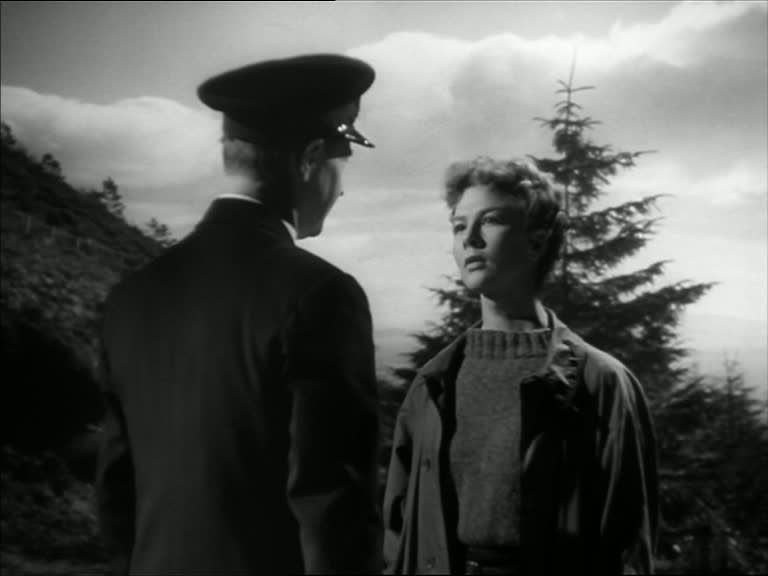
Moving, romantic, and utterly magical, I Know Where I'm Going! is one of the great collaborations of the Archers, writer-directors Michael Powell and Emeric Pressburger. This is a delightful romance of the Scottish isles, totally charming and sweet, shot with an eye for the natural poetry of the land, the beauty of sea and sky even in their darkest, most threatening moments. This charming love story concerns the determined, materialistic Joan (Wendy Hiller), who knows precisely where she's going in life. As the opening credits whimsically show, she's wanted things ever since she was a baby, and she's always gotten them eventually, thirsting for silk stockings and fine dinners. She has plans for her life, and she's about to fulfill them by marrying the wealthy industrial magnate Bellinger. She's traveling to the Scottish island of Killoran for her wedding, but when a bad storm strands her for several days on the nearby island of Mull, she begins falling in love with Torquil (Roger Livesey), a local lord who's rich in titles but poor in cash, something that is decidedly not in her plans.

There are signs even before this that Joan isn't necessarily as happy as she pretends to be with her well-planned life and her cunningly ambitious impending marriage. On a train journey, as she sleeps, Powell and Pressburger project her dreams onto the plastic wrapping of her wedding dress, hanging nearby, with the crinkly plastic overlaying her dream images, as though she's surrounded in it, trapped by it, about to be preserved or suffocated in plastic. Voices chattering about her wedding and the plans surrounding it are synced up with the chugga-chugga rhythm of the train's wheels, a manic clatter of voices that seem to be mocking her with their talk of schedules planned down to the minute. She's haunted by the rigidly planned life she has ahead of her, everything planned out, everything safe and scheduled, a life seemingly dedicated only to getting the wealth and prestige she'd always thought she'd wanted. Later, when she's getting off the train, Powell and Pressburger mock the stuffed-shirt assistants who greet her by segueing from one man's top hat to a shot of a train's smokestack, so that the smoke briefly seems to be erupting from the top of the man's head. Even before the storm delays her, Joan seems to be having second thoughts, she's just too stubborn to ever admit it.

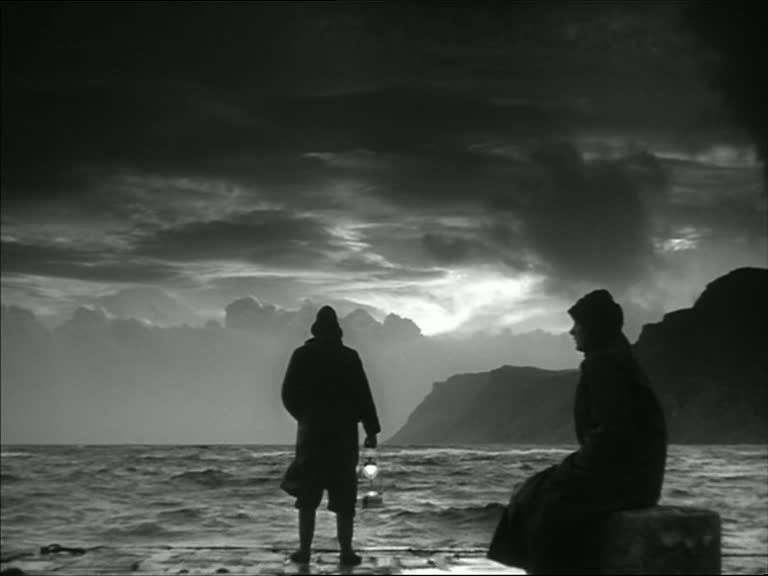
When Joan arrives at the island of Mull, a gorgeous, moody atmosphere settles over the film, with voices calling through the fog, and men silhouetted on the rocky shore, set off against the tumultuous waves of the sea. None of Joan's stubbornness and determination can overcome the weather, and though she insists on standing by the water waiting for a boat that, it's obvious, is not coming, she can't will the wind to stop blowing or the sea to calm. She might know where she's going, but she's finally confronted something she can't control; the winds and waves are as stubborn as she is. And then she meets Torquil, with whom she immediately forms a warm and obvious bond, even though her standoffish instincts keep trying to reassert themselves. Even if Joan herself thinks she knows where she's going, the audience knows she'll be going somewhere else altogether. The pleasure lies in the grace and beauty with which Powell and Pressburger document this blossoming love, juxtaposing it with the majestic rural expanses of the Scottish islands and the foreboding splendor of the overcast weather.


The film powerfully captures the feel of Scottish culture, steeped in the Gaelic language, with its mysterious sounds and cadences, so like music. One of the film's loveliest scenes is the anniversary celebration that Torquil and Joan attend, leaving behind the stuffy society bridge game of Bellinger's friends to listen to music and watch the dancing of the servants. The floor shakes, and the bagpipers play, and the dancers couple off and swap partners, laughing and drinking and have a great time, such a far cry from the lame tea party upstairs, where one woman kept interrupting any potentially interesting conversation with questions about when they were going to play bridge. The film continually contrasts the folksy ways of the island dwellers against the high society manners of the crowd that Joan is soon going to be marrying into. The people of the island, Torquil says, are "not poor, they just haven't got any money," which he insists isn't the same thing, though Joan doesn't see it — what Torquil means, of course, is that they just don't need any money.

When Joan first arrives on the island, her buttoned-up manners and assiduous politeness are contrasted against the local woman Catriona (Pamela Brown), who makes a grand entrance preceded by her wet, shaggy, exuberant dogs — contrasted later against the sedate true-breeds of the rich folk — with the woman herself bounding into the room with the same enthusiasm, her hair wet, her eyes fiery and a broad grin on her face as she embraces her old friend Torquil and exclaims her welcome in Gaelic. Catriona is so different from the prim and proper Joan; when Joan says that she and Torquil should eat lunch at separate tables, he says that she's the most proper girl he ever met, which she decides to take as a compliment even though there's more than a note of irony in his tone.

The film deals broadly with the theme of rural decency versus elite sophistication, with Joan's stubbornness set off against the locals' familiarity with nature and connection to the earth and the sea, and against the local legends that add mystery and myth and a sense of history to their lives. In contrast, Joan's prospective husband tells her over a radio that only one family in the area is worth knowing: a family of elitist snobs just like him, of course. He's not interested in communing with nature or learning about local history, and Joan is ultimately seduced as much by the land, the people, the culture, as she is by Torquil himself.

Friday, August 24, 2012

The Story of Adèle H.


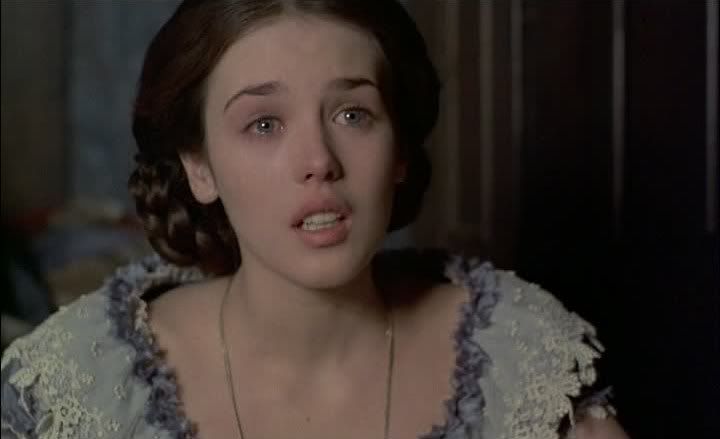
François Truffaut's The Story of Adèle H. is a study of romantic obsession and madness, an intensely focused character study about the disintegration of a young woman's mind in the wake of a failed romance. Based on the diary of Adèle Hugo (Isabelle Adjani), the daughter of French writer Victor Hugo, the film concerns Adèle's desperate and unrequited love for the British lieutenant Albert Pinson (Bruce Robinson). Adèle follows Pinson to Halifax in Canada, where he deploys with the army during the American Civil War. She begins stalking and pursuing the chilly, disinterested lieutenant, who's earned a reputation as a womanizer and a spendthrift, amassing gambling debts and bedding many women while Adèle pines hopelessly for him.

Truffaut relates the story of Adèle's descent into madness with a simple, direct style, chronicling without ornament or sentiment the increasing desperation and sorrow of this young girl who suffers for her love, chasing a man who clearly has no interest in her anymore, who has already gotten all he ever wanted from her. The film's style is bleak and dry, and Néstor Almendros' images are restrained to a flat color palette of grays and browns, capturing the increasingly constricted and miserable world that Adèle, so focused on her love, barely even notices around her. The film is overly literary, tied, like many of Truffaut's films, to its script, and to the excerpts from Adèle's letters and journals, which she often reads in voiceover. The film often feels bogged down by words, by letters passing back and forth, and if not for the remarkable performance that Truffaut gets from his lead actress, there would be little to hold onto here.

The film is driven by Adjani's exceptional performance as the miserable Adèle. Adjani possesses a fragile, crystalline beauty that, as the film progresses, becomes increasingly pale and wispy, her skin the shade of paper, her eyes strained by her constant tears. She carries the film's full emotional weight, perfectly capturing the intense suffering of this lovesick woman. Adèle's misery could seem simply pathetic if Adjani's performance were not so raw and sensitive, so totally committed to conveying this young woman's passion and her pain. As she becomes more and more unhinged, she begins to look like a ghost, dressed in rags, unable any longer to disguise her madness behind the appearances of a respected young lady.

Adjani is a powerful central presence, gradually revealing more and more of her tormented inner life as the script slowly peels back the layers of her insanity. There are indications that Adèle's mind isn't especially stable even before her fruitless pursuit of Pinson definitively shatters her mental well-being. When someone tells Adèle that she must have been unhappy when her older sister died, she replies, "everyone in the family adored her," a non-answer that suggests her ambivalent feelings about the sister who looked so much like her but seemingly had her life much more in order than the obsessive, lonely Adèle. Adèle is haunted by dreams in which she's drowning, as though she identifies with her sister, who died so dramatically with her loving husband, unable to save her, drowning along with her. It seems as though Adèle almost envies this romantic tragedy, haunted by the knowledge that her dead sister not only was favored by the family, but possessed the true, intense, passionate love that Adèle herself so desperately desires.


Adèle's infatuation with Lieutenant Pinson causes her to profoundly disconnect from reality, concocting such an elaborate series of lies and distortions that it's soon not clear what she actually believes. While she fruitlessly pursues the lieutenant, she sends dispatches back to her concerned family in which she makes it seems as though she and Pinson are in love and preparing to be married. Adèle is so immersed in her love that she's detached from reality, at once knowing that Pinson will never marry her and yet clinging to an impossible, unrealistic hope that he will change his mind. Her love drives her to some rather pathetic behavior: she tells Pinson that if he marries her, she will allow him to continue seeing other women, and at one point she even hires a prostitute and sends her to Pinson for the night, though Truffaut discreetly cuts to black before revealing if Pinson accepted this outrageous gift or not. Adèle even considers hiring a hypnotist to hypnotize Pinson into marrying her, though she abandons this possibility when the hypnotist is revealed as a fraud.

Truffaut occasionally shifts the film's focus off of Adèle to clumsily discourse on her father. At one point, a doctor discovers Adèle's identity and explains, mostly to the audience, just who Victor Hugo is and why he's so important, delivering an exposition-laden speech about the great man's literary talent and political beliefs, as well as a condensed version of his biography. It's obvious that Truffaut wanted to present this miniature essay on Hugo, to express his admiration for the author who had been exiled for his convictions, but this material has been shoehorned in here, its tone forced and unconvincing. The same goes for the voiceover at the end of the film, in which a narrator abruptly steps in to describe what happens to Adèle after the film ends, as well as to discuss the death of Victor Hugo and the mourning for the great man across all of France. Most of the film is so resolutely focused on internality and emotion that these diversions into historical context, these odes to Hugo, feel very out of place.

The film as a whole is often interesting, thanks mainly to Adjani's strong performance, but it's also a curiously flat affair, anchored by that searing central performance and not much else. It's never clear why Truffaut thinks this story is so important, though the great import placed on Adèle's parentage raises the disturbing possibility that Truffaut is telling the story mainly because of his admiration for Victor Hugo, rather than because he finds Adèle herself so compelling. It's a study of emotional breakdown, but though Adjani commits completely to this role and powerfully conveys her character's fragmentation, it never feels like the film as a whole is as committed to these intense emotions as the actress is. Truffaut retains his distance, resting the film so completely on the actress that in the end, it's only her performance that makes an impact rather than the character or the story, let alone any ideas or themes that might arise from this tale.