Showing posts with label 1975. Show all posts

Monday, February 4, 2013

Xala


Ousmane Sembene's Xala is a sharp, bitter satire of Senegalese independence, lampooning the corruption and incompetence of the sham self-government of Sembene's home country, comparing the new black leaders' shameful failings to sexual impotence. One of these new leaders is El Hadji (Thierno Leye), a wealthy and well-respected businessman who is about to marry his third wife. On his wedding night, however, he is unable to consummate his marriage to his beautiful young wife; he has been cursed with a "xala" that renders him impotent. This impotence in the bedroom mirrors the impotence of Hadji and the other corrupt black businessmen and politicians of the new supposedly independent government, because while triumphantly claiming to have taken Senegal away from white European colonialists, this new government is deeply in the pocket of the colonialists, who still wield their power in fact if not in title.

In the opening scenes, the French are kicked out of the Chamber of Commerce, their statues and other paraphernalia left outside on the steps of the chamber as a symbol of the change in government. But the change is not as dramatic as it initially seems: by the time the new black council has met for the first time, they've shed their African garb for Western tuxedos, and the former white rulers are still in the room, now handing out suitcases full of money to the new black ministers. The changes are purely cosmetic. The French art has been replaced with a photograph of the new black president, and black men now sit around the conference table, but they are puppets of the old white rulers, who now adopt a subservient pose while still controlling everything from behind the scenes. Sembene stages this all methodically: the changeover from the whites to the blacks is orderly, as is the smooth process by which the white bankers and politicians sneak back into the governing room. It's like a revolving door by which the whites are kicked out, without fanfare, and re-enter the chambers of power just as easily.

Sembene is relentlessly parodying this state of affairs, and the humiliation of Hadji is a kind of symbolic revenge against all the leaders of his type, who claim to represent the people but only work to enrich themselves. Throughout the film, more and more ugly revelations about Hadji slowly come out, as his life crumbles around him under the curse of the xala. He's involved in numerous corrupt, under-the-table deals, accepting cash to sell off reserves of badly needed food intended for poor regions afflicted with droughts. Hadji and his friends are remote from those struggles. While the mass of his country's people starves to death, Hadji buys TVs and cars for his third wife, using the money from European bribes and his own corrupt deals to pay for the luxuries of his wives.


Some of the film's most powerful scenes focus not on Hadji but on the vast lower classes of the country who he ignores in his own quest for personal enrichment. El Hadji's sexual plight is juxtaposed against the genuine suffering of the crippled beggars and poverty-stricken villagers who Hadji and his fellow ministers refer to as "human rubbish." The ministers supposedly represent the people, but it's obvious that they only represent themselves, that they're out of touch with the way real people live their lives in this poor, drought-plagued country. One man comes to the city hoping to buy food for his poor village with the scant money the villagers have scraped together, but his funds are stolen and he's left to live with the other beggars. Another man sells a political newspaper that he brags is the only Wolof-language journal in the country, a sign of how marginalized African culture has become in a country where the ruling classes, black or white, speak French. Hadji's politicized daughter Rama (Myriam Niang) refuses to speak French, infuriating her father by answering him in Wolof even though he speaks to her in French, and she also refuses to drink the bottled Evian water that's such a prominent status symbol for the black ministers and upper class.

The black ministers try to separate themselves from African culture, decrying the superstitions of tradition and religion in their efforts to assimilate with the Europeans. (Of course, virtually the only tradition the male ministers don't reject is the traditional ability to marry more than one woman.) Thus the "xala" that afflicts Hadji is an expression of the Africanness that he rejects, and his increasingly desperate efforts to overturn the curse bring him into contact with precisely the superstitions and traditional beliefs that his Eurocentric attitudes oppose. Sembene is symbolically forcing the black ruling class with their European pretensions to "lower" themselves back to the level of the rest of the people: one village witch doctor tells Hadji that he has to crawl towards his wife on hands and knees, a charm clenched between his teeth.

The film is at times savagely funny in its mockery of Hadji and his friends, and there's a great deal of anger in Sembene's outrage at the ways in which these business and governmental leaders have simply acted as puppets for a de facto French regime. In one scene, Sembene even gives Hadji himself a speech decrying the hypocrisy of his fellow ministers, who eventually turn their backs on Hadji, essentially for getting caught committing the same crimes that they've all committed. The ending, especially, is seething with rage, as Sembene makes Hadji an effigy for the entire corrupt ruling establishment. Xala balances this righteous anger with its humanist, realist depictions of the poor and the maimed, the people suffering from poverty and hunger while men like Hadji exploit the country and the people, only pretending to represent black revolution and black self-government.

Monday, October 22, 2012

Lips of Blood

[This piece was previously posted as a guest review at Jeremy Richey's blog Fascination: The Jean Rollin Experience, one of the Internet's very best resources on Rollin.]

Jean Rollin's best films use B-movie horror plots and low-budget production values as portholes into an eerie, unsettling dream world that ultimately has little to do with typical blood-and-gore horror movies. This is especially true of Lips of Blood, one of the director's finest works, and one of his most dreamlike and abstract. The film is a slow, sensuous study of the power of memory and the lure of childhood fantasies, a feverish dream of a film that chronicles a quest that's as much mental as physical.

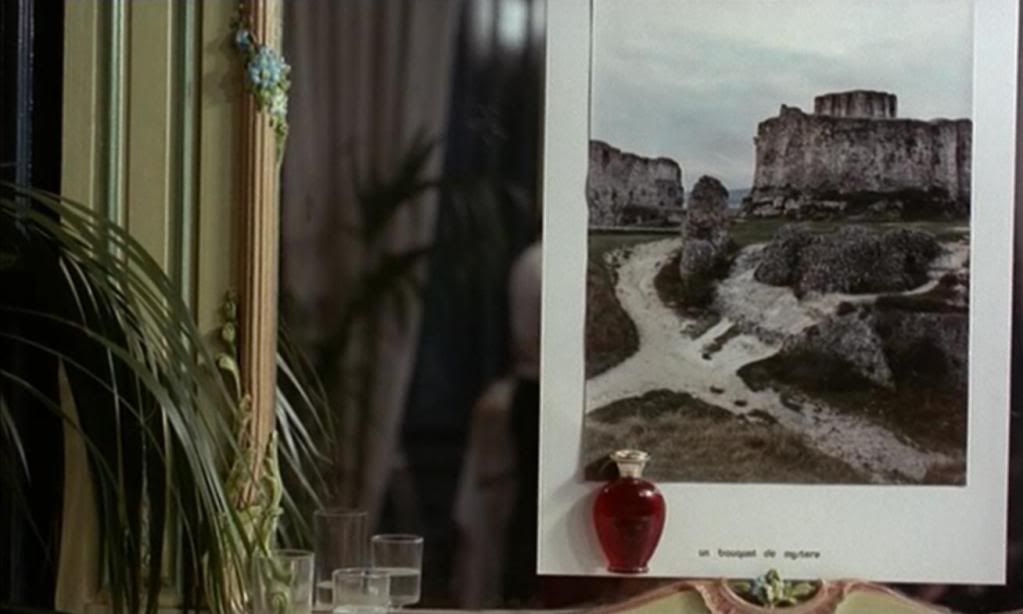
Frederic (Jean-Loup Philippe) is at a party when he sees a photograph of a ruined castle that triggers a previously suppressed childhood memory or dream. He comes to believe that he's been to this castle as a boy, and that he's forgotten it for some reason; his childhood is a blur to him, and he's long felt disconnected from the stories that his mother (Natalie Perrey) has told him about his forgotten boyhood. The photograph instantly opens a path into his memories, stirring up images of a dreamlike night that he spent in the castle, watched over by a beautiful young girl (Annie Belle) dressed in white. He'd repressed the memories of the castle and the girl, but now that they've entered his mind again, he becomes obsessed, fixated on discovering the castle's whereabouts and trying to locate the girl.


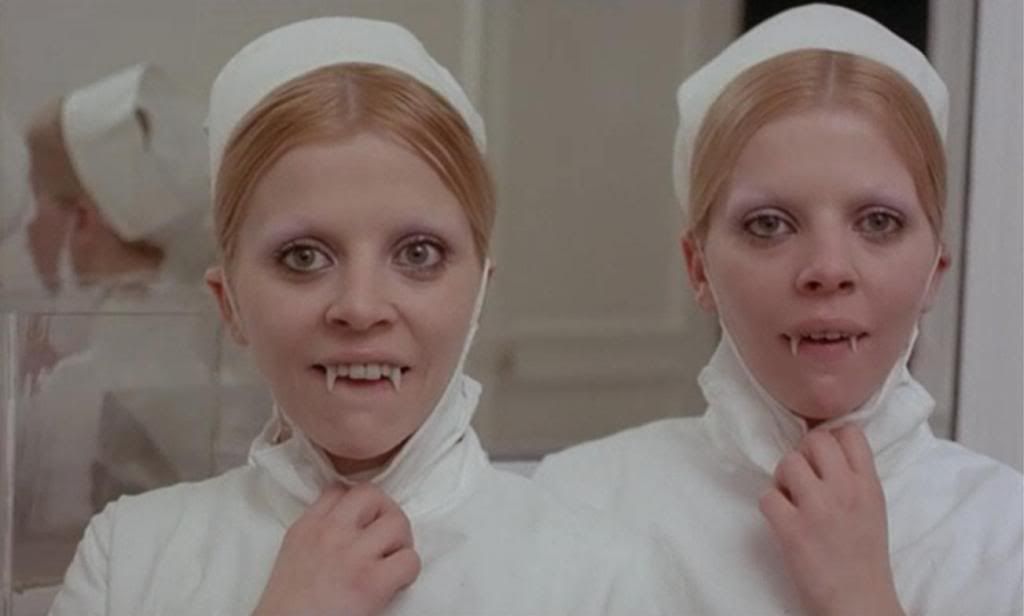
Frederic is haunted by this dreamlike memory, and the film is all about the power that this fixation has over him. At the party at the beginning of the film, he compliments a girl on her perfume, prompting her to pointedly respond, "scents are like memories; the person evaporates but the memory remains." In Frederic's case, the memory too had evaporated for twenty years, but now it's wafted back up into his senses, and he begins seeing the mysterious girl from the castle everywhere. He goes to see a movie — the poster outside is for Rollin's The Nude Vampire, but the theater's actually showing The Shiver of the Vampires, suggesting how intimately connected all these gothic vampire fantasies are — and the girl appears in the theater, beckoning him to follow her. She leads him to a crypt, where Frederic unwittingly releases a quartet of creepy vampire girls (Catherine and Marie-Pierre Castel, Anita Berglund, and Hélène Maguin) who shadow him throughout the rest of the film, continually intervening to rescue him from the mysterious forces that seem intent on stopping him from locating the castle or the girl who dwelled within it.

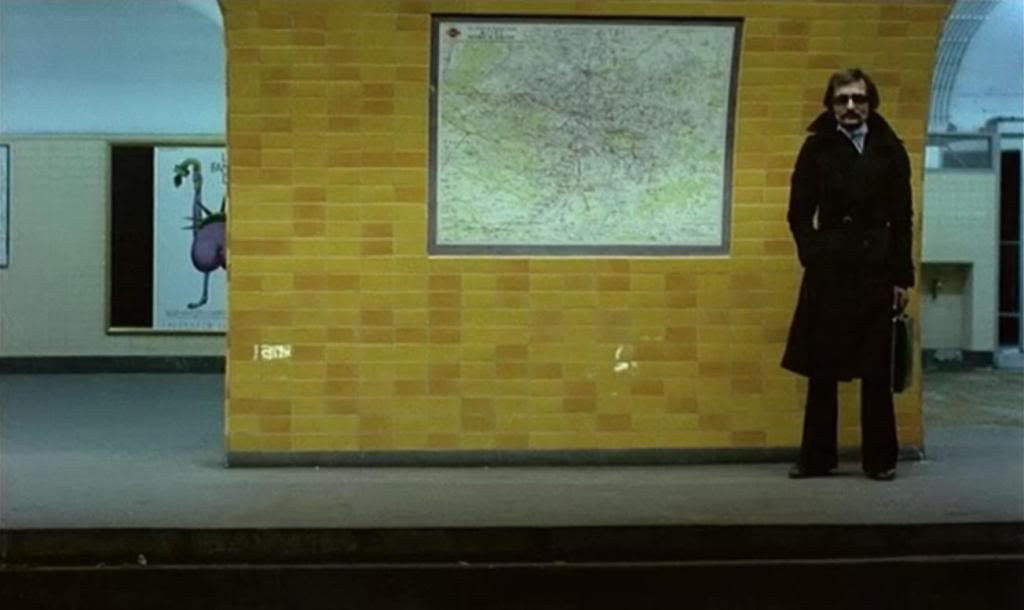
The film moves at a typically lethargic, dreamlike pace, blending gothic horror imagery — bats and graveyards and vampire girls clad in gauzy robes — with a weird conspiracy thriller vibe. A photographer (Martine Grimaud) who tries to tell Frederic about the castle winds up dead, another woman poses, unconvincingly, as the girl from the castle, and a mysterious assassin tracks Frederic through the night, while the vampires stalk around the fringes of the plot, fading out of the shadows. Rollin's films have often been comparable to the surreal quest narratives of his contemporary Jacques Rivette, with worse acting and more nudity, and nowhere is that comparison more relevant than here. Rollin renders the city as a quiet, nearly unpopulated stage, pools of colored light highlighted in the darkness, shadows cast large and threatening on stone walls as Frederic wanders around the city, searching for answers and chasing phantoms through the streets.

The film feels like a loosely connected series of set pieces, with Frederic's frazzled state of mind creating the sense of disorientation and confusion that dominates his increasingly desperate journey. He begins to doubt his own sanity: the girl from his memory, or his dream, pops into being and blinks out of existence just as suddenly, leading him through the night, eventually guiding him directly to the answer he seeks, the location of the castle from the photo. Meanwhile, the vampires attack and kill random people, baring their uncomfortable-looking fangs and bloodying their mouths on the necks of their victims. At one point, the Castel sisters disguise themselves as nurses in order to rescue Frederic from the mental hospital where he's been locked up by his mother, who seems to know something about all these secrets and mysteries.


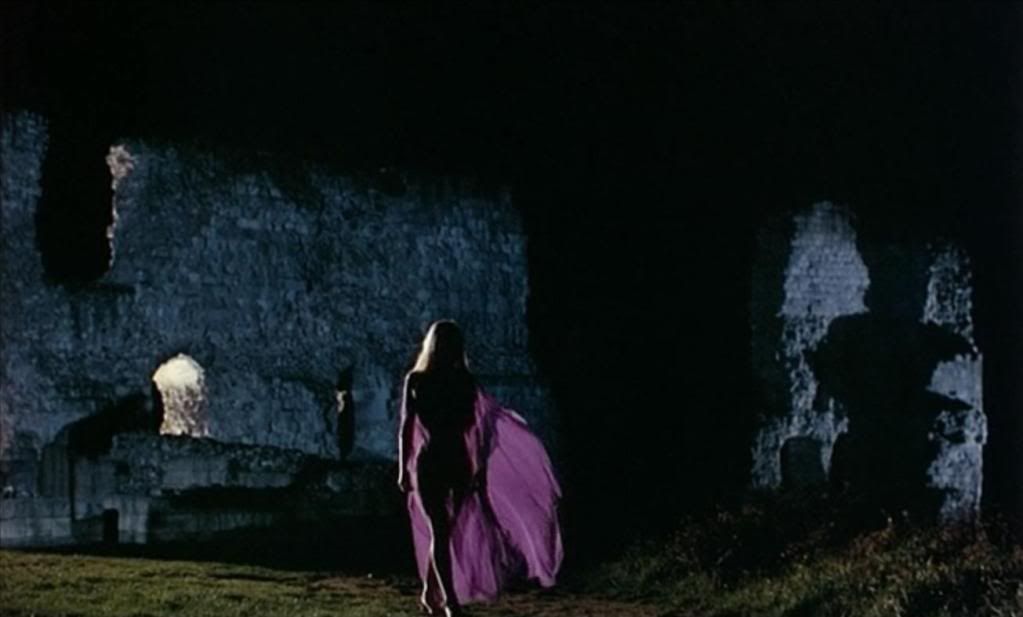
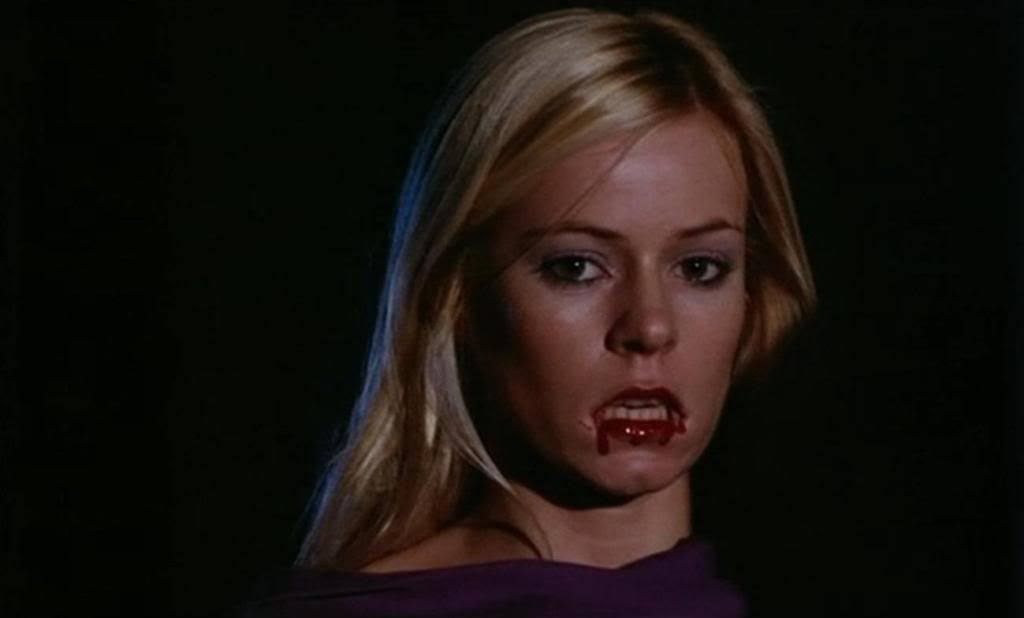
Indeed, Frederic's mother provides the obligatory burst of exposition that suddenly explains the story towards the end of the film, setting up the fantastic final act in which Frederic confronts the true nature of his reawakened memories. He's found what he's been searching for, and in the final ten minutes of the film Rollin adopts a tone of lunatic celebration, reveling in the embrace of the supernatural and the bloody. The supernatural is rarely to be feared in Rollin's work. The supernatural is, instead, erotic, alluring, haunting, beautiful, a fixation for Rollin just as the castle becomes for Frederic. There is thus an air of real melancholy in the final act's confrontations between vampires and vampire hunters; Rollin's sympathies are obviously not with the men with their stakes, menacing these girls, but with the vampires themselves, so young and lovely and sensual, retreating in fear before the men. The vampires are the real victims, not to be feared or hated but desired, respected, adored, just as Frederic desires the girl from his memory, who is, of course, also a vampiress, using her power to lure him back to her, to get him to set her free.

Rollin makes the embrace of the supernatural a cause for celebration here, particularly in the ecstatic coda, in which the long-imprisoned vampire relishes her newfound freedom, taking pleasure in the sensuality of nature. Together, Frederic and his vampire love run along the striking, apocalyptic, by now very familiar beach that so often symbolizes the pathway between worlds in Rollin's work. It's here that Frederic embraces his fate and is reborn, and in the finale — at once gloriously silly and wonderfully romantic — the lovers sail off together in a coffin, heading off into a new undead existence together.

Monday, October 1, 2012

Deep Red


Dario Argento's Deep Red is the predecessor of the director's unsettling Suspiria, sharing with that film a bright, colorful aesthetic, here with a particular emphasis on the red of the title. At times meandering and oddly paced — after a riveting opening, the film wanders aimlessly for quite a bit of its length — Deep Red is nevertheless dotted with enough striking, brilliantly composed images and chilling set pieces to make it compelling and often creepy.

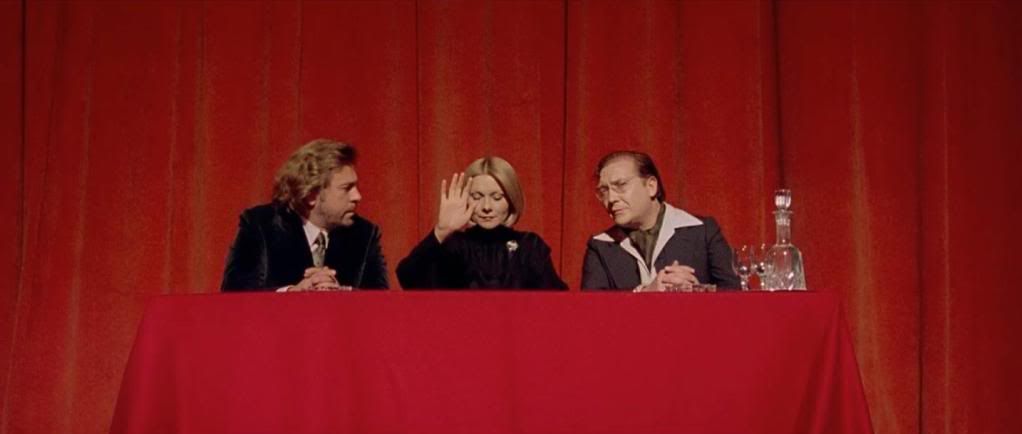
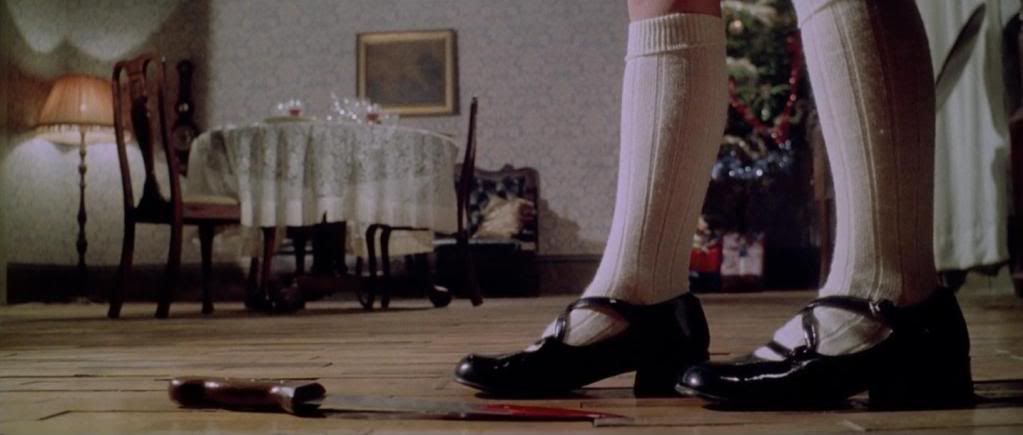
Certainly, the film starts incredibly strong, doling out a few mysterious images — like a child's stockinged feet approaching a bloody knife on Christmas morning — during the credits, establishing the primal scene of violence that will drive the rest of the film. The film's best sequence is the extended opening featuring the psychic Helga (Macha Meril), who, during a demonstration of her powers, is suddenly assaulted by violent thoughts from someone in the audience. Argento stages this stunning sequence on a dramatic stage decorated with red-on-red: the dais at which the psychic sits is draped in a red cloth, and the curtains behind her are also red, so that she's surrounded by bright, bloody red as she writhes and cries out, overcome by the darkness and malevolence she unexpectedly finds drifting into her mind from somebody in the audience.

Argento's camera, taking on the point-of-view of this mysterious evil presence, shakes and jitters as the killer retreats from the theater. Throughout the film, Argento several times indicates the killer's perspective with this kind of handheld camera, most unsettlingly in the subsequent scene where Helga leaves the now-empty theater, still sensing the presence of those horrible thoughts, as the camera peeks out at her from behind a nearby pillar. The camera seems to be shaking with the killer's excited heavy breathing, with the thrill of the chase, establishing a voyeuristic perspective that aligns the camera, and the watching audience, with the hidden killer's vantage point. Soon, Helga is a victim, her gruesome murder witnessed by her neighbor Marc (David Hemmings), who begins investigating the killer while the body count, predictably, keeps getting higher and higher.


Argento's visual inventiveness is at its peak during the film's gory murder sequences, each of them a taut and unsettling set piece that's perfectly designed. In one scene, the killer's presence in a dark closet is indicated by a single eye suddenly opening in the darkness, at which point Argento's camera zooms in to capture that one eye staring out of the surrounding blackness. In another scene, for some reason the killer's appearance is preceded by an utterly creepy doll that jauntily jogs towards the terrified victim, cackling and waving its motorized arms in front of it. The doll's appearance is made even more unsettling by the casual way that Argento frames it, initially in a long shot in which the doll's unnatural movement is very disturbing, before cutting in for the obligatory closeup of its grinning plastic face.

These eerie scenes are spaced out through the film, providing periodic bursts of insane imagery and bright red blood that looks like paint. Much of the film is dedicated to Marc's slow, hesitant investigation, assisted by the reporter Gianna (Daria Nicolodi), and there's something of a disconnect between the baroque scenes of violence and the surrounding ordinariness of the rest of the movie. The film sometimes feels a little slack whenever the killer's not around, though the oddball humor and quirky fringe characters help to liven things up whenever the tension dissipates. There's a subtext of sexual insecurity in Marc, who's beaten at arm-wrestling by Gianna, and feels cramped and claustrophobic in her car, sitting significantly lower than her in the broken passenger seat, making him look very foolish next to her. Later, he visits his friend Carlo (Gabriele Lavia) and discovers that Carlo is gay, staying with a feminine man who might pass for a woman if not for his peach-fuzz mustache.

Much of the film's comic relief, especially the bizarre scenes featuring Carlo's mother (Clara Calamai), winds up tying into the film's twisty ending, but before this, the comic tone and alternation of suspense with the meandering investigative scenes gives the film a strange, disjointed feeling. The jangly, chiming prog rock soundtrack by Goblin (who'd go on to top themselves with their even better score for Suspiria) adds to the film's strangeness, the music resonating with the childlike melody that serves as the killer's trademark and connects these crimes to some sort of traumatic childhood incident. Deep Red is ultimately a very strange movie, its rambling pace spiked with scenes of violence that are made almost beautiful through the filter of Argento's aesthetic.

Friday, August 24, 2012

The Story of Adèle H.


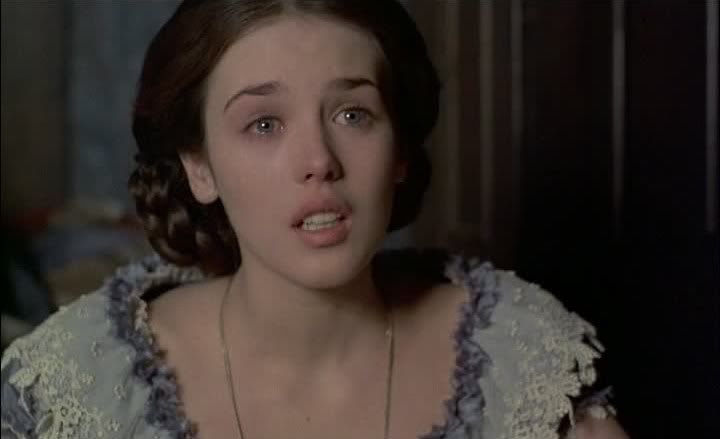
François Truffaut's The Story of Adèle H. is a study of romantic obsession and madness, an intensely focused character study about the disintegration of a young woman's mind in the wake of a failed romance. Based on the diary of Adèle Hugo (Isabelle Adjani), the daughter of French writer Victor Hugo, the film concerns Adèle's desperate and unrequited love for the British lieutenant Albert Pinson (Bruce Robinson). Adèle follows Pinson to Halifax in Canada, where he deploys with the army during the American Civil War. She begins stalking and pursuing the chilly, disinterested lieutenant, who's earned a reputation as a womanizer and a spendthrift, amassing gambling debts and bedding many women while Adèle pines hopelessly for him.

Truffaut relates the story of Adèle's descent into madness with a simple, direct style, chronicling without ornament or sentiment the increasing desperation and sorrow of this young girl who suffers for her love, chasing a man who clearly has no interest in her anymore, who has already gotten all he ever wanted from her. The film's style is bleak and dry, and Néstor Almendros' images are restrained to a flat color palette of grays and browns, capturing the increasingly constricted and miserable world that Adèle, so focused on her love, barely even notices around her. The film is overly literary, tied, like many of Truffaut's films, to its script, and to the excerpts from Adèle's letters and journals, which she often reads in voiceover. The film often feels bogged down by words, by letters passing back and forth, and if not for the remarkable performance that Truffaut gets from his lead actress, there would be little to hold onto here.

The film is driven by Adjani's exceptional performance as the miserable Adèle. Adjani possesses a fragile, crystalline beauty that, as the film progresses, becomes increasingly pale and wispy, her skin the shade of paper, her eyes strained by her constant tears. She carries the film's full emotional weight, perfectly capturing the intense suffering of this lovesick woman. Adèle's misery could seem simply pathetic if Adjani's performance were not so raw and sensitive, so totally committed to conveying this young woman's passion and her pain. As she becomes more and more unhinged, she begins to look like a ghost, dressed in rags, unable any longer to disguise her madness behind the appearances of a respected young lady.

Adjani is a powerful central presence, gradually revealing more and more of her tormented inner life as the script slowly peels back the layers of her insanity. There are indications that Adèle's mind isn't especially stable even before her fruitless pursuit of Pinson definitively shatters her mental well-being. When someone tells Adèle that she must have been unhappy when her older sister died, she replies, "everyone in the family adored her," a non-answer that suggests her ambivalent feelings about the sister who looked so much like her but seemingly had her life much more in order than the obsessive, lonely Adèle. Adèle is haunted by dreams in which she's drowning, as though she identifies with her sister, who died so dramatically with her loving husband, unable to save her, drowning along with her. It seems as though Adèle almost envies this romantic tragedy, haunted by the knowledge that her dead sister not only was favored by the family, but possessed the true, intense, passionate love that Adèle herself so desperately desires.


Adèle's infatuation with Lieutenant Pinson causes her to profoundly disconnect from reality, concocting such an elaborate series of lies and distortions that it's soon not clear what she actually believes. While she fruitlessly pursues the lieutenant, she sends dispatches back to her concerned family in which she makes it seems as though she and Pinson are in love and preparing to be married. Adèle is so immersed in her love that she's detached from reality, at once knowing that Pinson will never marry her and yet clinging to an impossible, unrealistic hope that he will change his mind. Her love drives her to some rather pathetic behavior: she tells Pinson that if he marries her, she will allow him to continue seeing other women, and at one point she even hires a prostitute and sends her to Pinson for the night, though Truffaut discreetly cuts to black before revealing if Pinson accepted this outrageous gift or not. Adèle even considers hiring a hypnotist to hypnotize Pinson into marrying her, though she abandons this possibility when the hypnotist is revealed as a fraud.

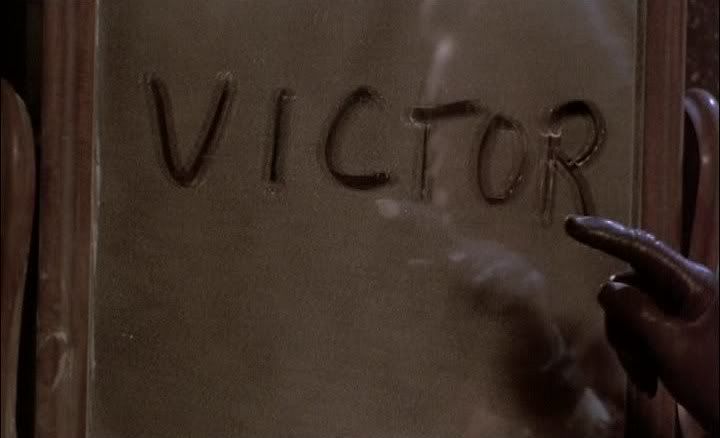
Truffaut occasionally shifts the film's focus off of Adèle to clumsily discourse on her father. At one point, a doctor discovers Adèle's identity and explains, mostly to the audience, just who Victor Hugo is and why he's so important, delivering an exposition-laden speech about the great man's literary talent and political beliefs, as well as a condensed version of his biography. It's obvious that Truffaut wanted to present this miniature essay on Hugo, to express his admiration for the author who had been exiled for his convictions, but this material has been shoehorned in here, its tone forced and unconvincing. The same goes for the voiceover at the end of the film, in which a narrator abruptly steps in to describe what happens to Adèle after the film ends, as well as to discuss the death of Victor Hugo and the mourning for the great man across all of France. Most of the film is so resolutely focused on internality and emotion that these diversions into historical context, these odes to Hugo, feel very out of place.

The film as a whole is often interesting, thanks mainly to Adjani's strong performance, but it's also a curiously flat affair, anchored by that searing central performance and not much else. It's never clear why Truffaut thinks this story is so important, though the great import placed on Adèle's parentage raises the disturbing possibility that Truffaut is telling the story mainly because of his admiration for Victor Hugo, rather than because he finds Adèle herself so compelling. It's a study of emotional breakdown, but though Adjani commits completely to this role and powerfully conveys her character's fragmentation, it never feels like the film as a whole is as committed to these intense emotions as the actress is. Truffaut retains his distance, resting the film so completely on the actress that in the end, it's only her performance that makes an impact rather than the character or the story, let alone any ideas or themes that might arise from this tale.

Friday, October 21, 2011

The Conversations #28: Barry Lyndon


The latest installment of The Conversations has now been posted at The House Next Door. For this latest discussion, Jason Bellamy and I have tackled Barry Lyndon, arguably the most overlooked film of Stanley Kubrick's mature career. We talk about the film's unforgettable visual style and its (purposefully) forgettable protagonist, as well as the themes of class, love and ambition that run through this great movie. As usual, we invite comments that expand upon our discussion, so please read the piece and add your own thoughts in the comment section.

Continue reading at The House Next Door

Friday, August 19, 2011

The Conversations #27: Jaws


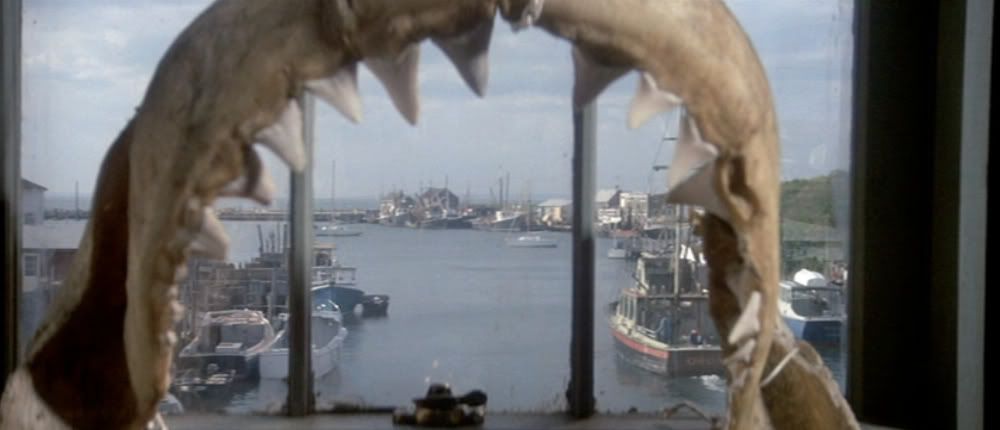
Jason Bellamy and I have posted our latest conversation, this time turning our attention, at the heart of summer blockbuster season, to one of the first summer blockbusters, Steven Spielberg's classic Jaws. We talk about the film's reception at the time, its legendary status, and how it holds up now. We also talk about the music, the shark, the performances, the influence of Hitchcock and Hawks, and the surprising amounts of meta humor built into this often harrowing film.

Come join us with your own Jaws thoughts. As always, we welcome your contributions to the comment section.

Continue reading at The House Next Door

Thursday, March 17, 2011

Eadweard Muybridge, Zoopraxographer


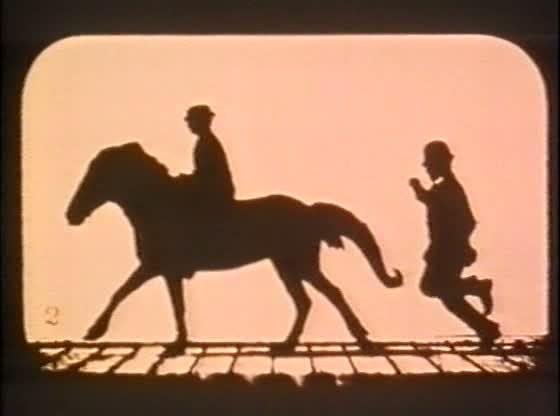
The photographer Eadweard Muybridge can be considered an early pioneer of the development of motion pictures, even though his work preceded the official birth of the cinema. Muybridge is most famous for his sequences of still images that captured animals and humans in various stages of motion: these images, strung together as stills or projected with Muybridge's zoopraxiscope (a primitive motion picture prototype), not only represented steps towards the development of the cinema, but in the realm of science, completely changed the nature of accepted thinking about animal locomotion. Eadweard Muybridge, Zoopraxographer is a film essay by Thom Andersen that explores Muybridge's life and work, first in the form of a conventional documentary biography, and then, more provocatively, as a coherently argued work of criticism that examines the ideas and associations evoked by viewing Muybridge's pre-cinematic oeuvre at a remove of almost a hundred years.

Roughly the first half of Andersen's film is devoted to a biography of Muybridge, accompanied by images from the photographer's work. The material is informative and interesting, if not necessarily exciting, and it establishes the context of Muybridge's times and his photographic background. The narration, by the actor Dean Stockwell, is deadpan and purposefully dry, straightforwardly recounting Muybridge's early photographic and journalistic endeavors. But Andersen's perceptive, incisive perspective on this material is revealed in key ways, as when the narrator says that it was "manifest destiny" that gave Muybridge passage — on a commercial ship — to Central America, where the photographer documented the laborers on sugar plantations. The voiceover's wry reference to Muybridge reworking his name as a Spanish sobriquet has a subtle hint of mockery in it, subverting the objective tone of the words themselves.

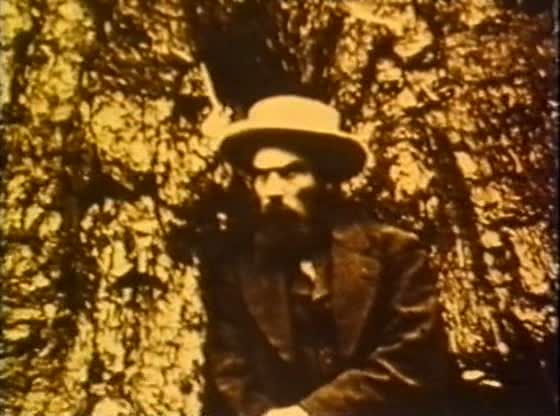
Andersen's perspective is even more pointedly revealed in the sequence where he recounts Muybridge's marriage, his subsequent discovery that his wife was cheating on him, and then his very public murder of her lover. The narration retains its dry, serious tone, but Andersen slowly zooms in on an image of Muybridge, his eyes hooded, a bushy beard covering the lower half of his face, fixing the camera with a sinister glare. Then the story takes a really unexpected turn when Andersen reveals that Muybridge, at his murder trial, initially pleaded insanity but was in fact acquitted entirely, on the grounds of "justifiable homicide." The subtext is obvious: if the slow zoom on Muybridge's impenetrable face encouraged consideration of what kind of man this was, the trial's outcome suggests just how different this era was from our own. This will be a theme that Andersen will pick up, in a very different way, in the analytical second half of his film, but here it's already an undercurrent, pointing to the unbridgeable gap between the pre-cinematic 1800s and our own time.


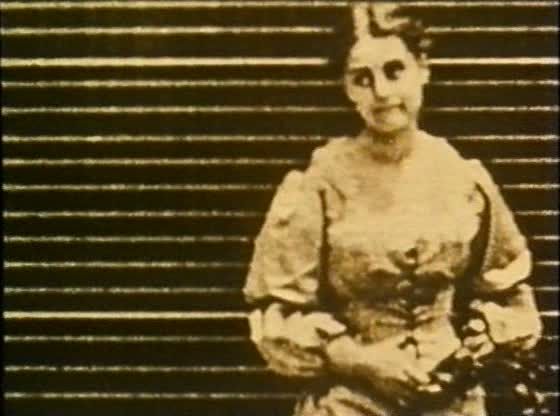
Once Andersen establishes the basic details of his subject's life and the nature of his work, the filmmaker delves into analysis with a section explicitly titled "Analysis" (the previous sections, mirroring Muybridge's scientific terminology, were titled "Prospectus" and "Catalogue"). Andersen then immediately leaps into the substance of Muybridge's work, particularly the series of photographic sequences, mostly of people, that he made at the University of Pennsylvania from 1883 to 1886. Muybridge meticulously documented and quantified his work, balancing between scientific rigor and an aesthetic, emotional component that prefigures the artistic/industrial divide that would be worked out in the subsequent early cinema of Edison, Lumière, and other pioneers. What's fascinating about Muybridge's work, to Andersen, is that tension between the functional/scientific and the social/artistic/emotional. Many of Muybridge's subjects were naked men and women, and Andersen juxtaposes these images against the photographer's similar documents of people in the clothing of the era: restrictive, long, formal, conservative.

Muybridge's work is presented as a radical statement in an era in which sexuality and nudity were considered beyond the pale. What's especially provocative about his images to Andersen, however, is how ordinary the presentation of nudity is, how casual. Muybridge's images depict men and women performing athletic feats, but also ordinary chores or activities as prosaic as drinking tea or getting out of bed. Andersen is probing the tension inherent in these images, even now: the scientific setting, with its abstract grid backdrop, contrasts against the casual nudity of the subjects, so that each image attempts to capture natural activity, but does so in an utterly artificial way. This means that Muybridge's photographs, balanced as they are between scientific inquiry, artistic portraiture, documentary representation, and even social commentary, are especially rich sources for the consideration of what a photographic or cinematic image represents and what can be represented by the image.

Andersen also makes the (debatable) point that the nudity in Muybridge's work was especially subversive because it did not resort to the pictorial conventions — lyricism, romanticism, idealization — that were and are used to aesthetically represent nudity in much popular art. In fact, it's likely that Muybridge's photos were as accepted as they were precisely because of their aura of scientific importance, because the nudity could be justified, not as prurient, but as observational and clinical. Andersen is right, though, that Muybridge's images are especially fascinating as early examples of the verité impulse in image-making, whether in photography or the nascent cinema. In talking about Muybridge's pre-zoopraxiscope work, Andersen points out that Muybridge's on-location photography and naturalistic depictions of unstaged, unposed scenes were breaks from the norms of the time, when most photography was made in studios, with rigid poses and very formal conditions. Muybridge, almost from the beginning of his career, had the impulse to photograph the world as it was, to take pictures even of innocuous clouds and trees, and he carried this documentary impulse over into his scientific work. This is just one respect in which Muybridge presaged the "actualities" of the early cinema, with its depictions of trains pulling into stations and athletes performing feats.


One of Andersen's first deconstructions of Muybridge's images in his "Analysis" is to translate Muybridge's tabulations of times recorded and not recorded into a cinematic reconstruction that restores the element of time to these individual still photos. Andersen represents the times between images with black spaces, so that the images seem to flicker across the screen, pulsating, as the voiceover poetically describes the relationship between the images, which freeze a fraction of second forever, and all the unrecorded time that exists in between photographs but has not been immortalized. That the images, once animated in this fashion, still create the illusion of movement simultaneously exalts the magic of the cinema and laments the non-recorded images that linger, like unseen ghosts, in between each frame of the film.

Andersen is making the very interesting argument that, while Muybridge's system, with its multiple cameras, was an oddity that had little to do, from a technological standpoint, with the eventual invention of the cinema as we know it, from a philosophical and physiological standpoint Muybridge was laying the groundwork for the innovations of Edison and Lumière. What Muybridge's work proved was that a finite series of images, projected together and interrupted by black frames, could, through the phenomenon of the persistence of vision, create the illusion of movement. Muybridge, like all later filmmakers, was taking still images — frozen snapshots of particular moments in time — and reanimating them into the forward motion and flow of moving time. He was reintroducing time to the static image, and towards the end of this film Andersen illustrates the point by recreating one of Muybridge's most provocative and evocative images, the slow progress of two naked women gradually moving closer together until they lightly kiss. Andersen's flickering recreation returns Muybridge's influence to the cinema, using modern means to duplicate the strobing but sensuous quality of Muybridge's primitive proto-cinema. As Andersen presents it, there's something poignant about the dead-end status of Muybridge's invention; he was held back by the lack of technical advances that would come too late for his work, but he was already thinking in ways that would be developed to fruition in the more direct precursors to the modern cinema.

In Eadweard Muybridge, Zoopraxographer, Andersen has created a work of criticism in film form, not only providing a biography of Muybridge and a chronicle of his influential work, but examining the implications of that work in sociology, art, the science of perception, and sexual mores. Andersen's commentary, as drolly recited by Stockwell, is at times dryly ironic (Muybridge "was the first and only zoopraxographer") and at times seems bemused and peeved by the sexual repression of Muybridge's era — and the enduring puritanical spirit that has stretched into the present as well. Muybridge thus becomes an unlikely icon for the sexual revolution, a precursor not only of the cinema but of a sensibility of clear-eyed examination that doesn't flinch away from nakedness, that's concerned with discovering the truth of human existence in all its unglamorous ordinariness. Andersen is a sharp, perceptive critic whose consideration of Muybridge opens up into social criticism, film theory, sexuality, aesthetics and technology. He is doing the work of all the best critics: looking closely and intently at these flickering images and finding a wealth of ideas to be drawn out and connections to be made.

Wednesday, February 17, 2010

The Conversations #15: Nashville


Jason Bellamy and I have now completed the latest installment of our ongoing Conversations series, in which we discuss various films and filmmakers in back-and-forth debates and discussions. This time around, we tackle Robert Altman's Nashville, discussing its politics, its music, and the intricacies of Altman's distinctive aesthetic. There's plenty of disagreement between us this time around, so don't expect a straightforward tribute to an acclaimed masterpiece. As you'll see, we've approached the film from very different perspectives. I think the clash is interesting and perhaps revealing about the nature of Altman's dense, challenging film. This is the first of our conversations to be posted at the new home of the House Next Door as the blog for Slant Magazine, so check out the new site. As usual, Jason and I hope that our piece will be only the start of the larger conversation; we welcome reader comments and hope there will be some lively discussion revolving around this one.

Continue reading at The House Next Door

Monday, June 29, 2009

Pleasure Party


[This is a contribution to the Claude Chabrol Blog-a-Thon currently running at Flickhead from June 21 to June 30. For ten days, Flickhead will be dedicated to the works of the French New Wave master, and I'll be following along with many reviews of my own.]

If Claude Chabrol's Nada could be thought of as a kind of sequel to Godard's La Chinoise, Chabrol's next film, Pleasure Party, might be an examination of another older film by another of Chabrol's French New Wave contemporaries. Pleasure Party opens with an idyllic image of familial happiness, as the cheerful Philippe carries his daughter Elise on his shoulders through a field of sunflowers, then kisses his lover Esther as the happy trio lounges on the beach, fishing and playing and enjoying a relaxing day together. Philippe is played by the writer Paul Gégauff, a frequent Chabrol collaborator, and his wife and child are played by his real-life ex-wife Danièle and real daughter Clemence. It is probably no accident then that this opening, with its cheery family outing, fields of sunflowers and classical music, evokes the opening minutes of Agnès Varda's similarly themed Le Bonheur, which also featured a real-life couple and their real children (the actor Jean-Claude Drouot and his family).

As in Varda's film, Chabrol is interested in examining the tensions that can develop within this happy family cliché, the ugliness that can result from pushing too far, shaking up the comfortable status quo. As in Varda's film, the central character is an egotist, and it is his selfishness and obliviousness that brings tragedy upon him and his family. In fact, Philippe is probably one of the most unpleasant characters in all of cinema, a despicable creep who relentlessly controls his lover. He takes pride in his superiority to her, and views himself as her teacher, imparting lessons to her. When she displays her weakness, meekly acquiescing to his desires, he loves her, swelling with happiness. During their fishing expedition, she is squeamish to bait her hooks or to remove the fish from the line after catching it, and Philippe responds with condescending affection. It's obvious he appreciates that she needs him; it feeds his hungry ego to know that she is weak, that she cannot do things without his help. He is teaching her, he says at one point, "how to live."

This smarmy self-satisfaction is nigh-unbearable, and soon even the cringing, servile Esther begins to grow tired of this attitude. When Philippe casually tells her one morning that he has cheated on her several times, and intimates that he wouldn't mind if she did the same, she takes him at his word, sleeping with their acquaintance Habib (Giancarlo Sisti) after a dinner party. Philippe, of course, is not as open-minded as he had thought. While he expected his own infidelities to be received with understanding — and for the most part the ever-accommodating Esther made no fuss — he cannot be so tranquil about her straying. He begins to berate her and mock her, growing even crueler than ever, while on the surface maintaining that he doesn't care what she does. He mocks her friends, particularly the philosophy of Habib, and pretends that his objection to her new lover is intellectual. It's probably at least partly true: Philippe is an upper-class snob and believes that the spiritualist ideas of Habib and his circle are beneath him. Philippe makes much of the fact that Esther is of a lower class, and says that he tried to raise her up to his level, and that by hanging around with Habib she is lowering herself. It's also probably true that race plays some role in Philippe's anger, along with class; he believes that his own class, his own race, is the pinnacle, and looks down on anyone else, his own lover included.


More than anything, though, it's simply a matter of ego. Philippe liked having a woman who he could shape and mold to his own liking, who he could fill up with his own ideas, who could serve him and love him and him alone. He sees that he is starting to lose this — Esther is becoming independent, going out on her own, making new friends of her own, listening to their ideas. This is what he objects to more even than her making love to another man. He cannot bear the thought of his woman thinking for herself. After Esther finally leaves him, sick of the humiliations and brutality he subjects her to, Philippe marries a woman he barely knows, the pretty young triple-divorcée Sylvia (Paula Moore). But he finds that she is much too independent for him, much too content with her own ways, her own life. She is wealthy without his help, and has had many lovers already (including even Habib, her second husband!). When they go on a fishing trip, mirroring the opening scenes, Sylvia can bait her own hooks, catch her own fish and take them off afterwards, without Philippe's help or instruction — when he sees this, he actually breaks down and cries, missing the helpless woman who had to turn to him for everything. It is the pathetic breakdown of a man whose fragile ego requires him to prey on those weaker than him.

In short, Philippe is a thoroughly monstrous creation, a self-centered and abusive man who cannot live without inflicting pain and suffering on someone else. He is a parasite, and Chabrol does not flinch from a precise limning of this monster's personality and behavior. One of the film's most horrifying scenes comes just before Esther finally deserts Philippe for good. After an evening in which he has forced her to apologize for everything, to express her desire to return everything to the way it was, Philippe is still not satisfied; he suddenly grows enraged, slapping Esther around and forcing her to lick his feet. Chabrol captures this humiliating moment in closeup, then slowly pulls back to frame the kneeling Esther, her tongue against Philippe's foot, in a door, a small rectangle of light surrounded on either side by darkness. As a portrait of the unhealthy, parasitic relationship between abuser and abused, this image is the film's most potent and horrible.

But this is the low point: Chabrol cuts from this immediately, without fanfare, to some time later, after Esther has already left Philippe. Her abasement is captured onscreen, but once she frees herself she nearly disappears. This is because the film never wavers from Philippe's point of view, as though sucked in by his outsized ego. This is a film about the monster, not his victim. It's also in many ways a film about class warfare, Chabrol's perennial subject. There is an implicit class difference between the lovers, which makes their relationship something like servant and master rather than a bond between equals. This is the way Philippe wants it, anyway. Like the self-satisfied upper class he represents, he is unhappy when confronted with an equal; he wants only a slave.

Saturday, May 23, 2009

Wrong Move


Wim Wenders' Wrong Move is a film as aimless and blank as its protagonist, the chilly, antisocial Wilhelm (Rüdiger Vogler), a young man who finds himself in the position of wanting to be a writer while fostering a hatred and distrust of his fellow people. This makes his desire to express himself a weird kind of paradox: he wants to connect and communicate with people he doesn't even like. This unlikable, introspective central character nevertheless soon gathers an improbable cast of fellow outcasts around him: the lonely theater actress Therese (Hanna Schygulla), a mute juggler (Nastassja Kinksi), an old street singer (Hans Christian Blech), and a sensitive but rather lousy poet (Peter Kern). These unlikely characters exist as abstracted symbols only. They're people who seem to have no inner lives, nothing happening beneath the surface. They speak in abstractions, too, spitting out lengthy soliloquies about politics, creativity, alienation, history and sexuality. They are mere puppets to be maneuvered by Wenders in an allegorical examination of German culture at a precise moment in time. He's exploring, very self-consciously, the difficulty of creating art that engages with politics without losing sight of human specificity — ironic for a film entirely devoid of such specificity.

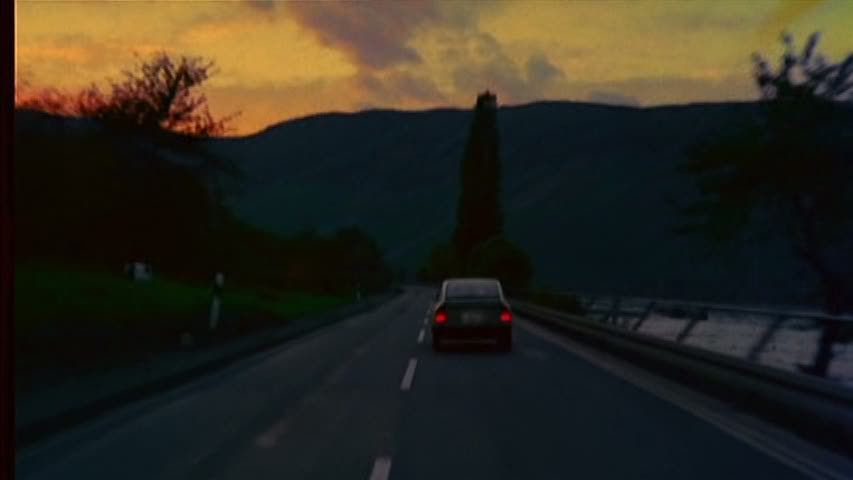
Indeed, Wenders seems to be just drifting along with his characters, who come together for no earthly reason and part the same way. In between, they drive or walk around the German countryside, stopping for one night at the home of a suicidal industrialist (Ivan Desny) who regales them with stiff monologues about loneliness and isolation. It's all so artificial, so contrived, and the dialogue is torturously overwritten (by the novelist and director Peter Handke, adapting Goethe). Nobody in the film ever seems to be having a conversation, only waiting for the other person to stop speaking. Maybe that's the point, as the film itself hints in Therese's ruminations about the artificiality of acting, how difficult it is to express herself naturally using someone else's words. But Wenders theatrical stylization never rises above the level of a drama exercise, a theoretical game rather than a fully developed work.

In scene after scene, his characters simply lounge around or walk around, spouting non sequiturs, with Wenders' cutting pointedly ignoring the nonsensical nature of all this chatter: his rhythmic variations of shot and counter-shot flow as though following a perfectly normal, natural conversation. It's exhausting, as is the studied blandness of Vogler as the disaffected writer Wilhelm. His sporadic voiceover, taken from his journals, basically consists of writing about how he has nothing to write about — the ultimate form of solipsism. Today, Wilhelm might be on Twitter all day; in the 70s he becomes a wanderer and scribbles crushingly mundane entries in his notebooks. He's no more interesting or worth spending time with than any other solipsist, and Wenders never gives him, or any of the other actors, any depth to flesh out this one-note characterization.


This means that a wonderful actress like Schygulla is more or less wasted here, left to stare blankly and recite stilted prose, though Kinski and Blech bring a certain low-key charm to their more playful roles. The old man with his mournful harmonica tunes and the young mute girl with her low-hanging bangs and big green eyes are compelling characters, even if they're never able to step outside of the allegorical boxes Wenders places around them. Kinski, at least, is saved from having to deliver any of the pat dialogue, and she says more with her hesitant smile and thin, childish face than most of the other characters are able to get across in pages of dialogue.

That said, there is a subtle absurdity and surrealism in the film's pacing, a mysterious quality that comes through especially in the many meditative, quiet night scenes. The film's cinematography is gorgeous, with an eye for slightly contrasting colors, creating visual disjunctions in the ways the colors clash against one another. The night scenes are coolly sumptuous, infused with pale blues and subdued pink lights, the icy color palette giving these moments an antiseptic quality despite their visual splendor. The lights, the colors, are pristine and clean like a hospital corridor, smoothing over the messiness of urban spaces and natural settings alike. There's a distanced, distracted beauty to Wenders' aesthetics, though his overtly stagey character blocking can be distracting in its precision and formality.

In this way, Wrong Move is a puzzling and rather dry experience, a road movie where the road is far more interesting than any of the people traveling along it. Wenders' aesthetics are consistently off-kilter and strange, though one senses this is intentional; he pulls the viewer in with his self-conscious visuals and theatrical set design, but pushes the audience away with his abstraction and refusal to delve into his characters beyond the thinnest outer layers. Even the soundtrack, alternating uneasy silence with the tense, droney music of Jürgen Knieper, subverts expectations and creates a mood of unmotivated discomfort. The music's harsh dissonances and plinking, isolated piano notes suggest a climactic explosion that never comes. Instead, the film just fizzles away into nothing, its characters not so much resolving anything as simply disappearing, one by one, from the film, often literally walking or running offscreen, never to return. It's an odd and unsatisfying ending to an odd, unsatisfying movie.

Wednesday, May 6, 2009

Films I Love #30: Asyl (Kurt Kren, 1975)


The structural films of the Austrian avant-garde filmmaker Kurt Kren are each based around a single technical conceit to which the film rigidly coheres, and around which it is structured. For Kren and the structuralists he inspired, the technical craft of cinema is in fact the whole of the cinema, and the themes and ideas in his films arise directly and solely from the methods of their contruction. Asyl is one of Kren's most formally ambitious works, an experiment in time lapse photography, multiple exposures, and segmented images. When he moved to a home in the country, Kren set up a static camera nearby, and over the course of 21 non-consecutive days, he fed the same strip of film stock through the camera once per day. In front of the lens, Kren also placed a masking board with holes in it, the placement of which was varied daily so that each time the film stock went through the camera, different areas of the image were exposed. The result is a film in which, within a single frame, time and space are made to overlap and coexist in unusual ways, creating impossible landscapes composed from footage shot on different days throughout the year. Sometimes, most of the film is exposed and the image becomes a collaged landscape, in which a snowbank runs directly into a grassy springtime meadow, or in which rain falls through the top half of the frame only to disappear when in reaches the bright sunshine of the lower half. At other times, the image is more pointillist, with distinct areas floating in the black frame like pieces of a puzzle that needs to be assembled.

The seasons run seamlessly into each other in this way, and time becomes hazy. Occasionally, a person will walk along the road in one part of the image, disappearing at an invisible border where the image fades into a different day, a different time. Kren is here reconfiguring film as a medium in which time and space cease to be linear in any sense. The film is instead about totalities; it invites the viewer to think about the progress of time and the way it generally works in cinematic images, and by contrast to process the multiple layered times implicit in each frame of Asyl. This short is Kren's finest work, with a conceptual purity and inventiveness that are unmatched even in his consistently intriguing oeuvre.

Thursday, April 23, 2009

Keetje Tippel


Keetje Tippel, based on the life of the prostitute, artists' model and socialist author Neel Doff, is a typically bracing, emotionally complex melodrama from director Paul Verhoeven. As is often the case with Verhoeven, he's working within the confines of a familiar genre, the period drama in this case, and even within the structure of a familiar story: the commoner who aspires to a higher level and gets transformed into a member of high society. It's a Cinderella story, in other words, and one of the film's characters even refers to the titular heroine Keetje (Monique van de Ven) as Cinderella. She's one daughter in a large and miserably poor family who have moved to Amsterdam in the hopes of finding better opportunities. But once there, the family continues to struggle, living in a horrible, rat-infested house that floods when it rains, with each of them trying without much luck to find and hold a steady job. Keetje's father (Jan Blasser) is a cheery, expansive guy, obviously a decent sort, but he's unable to keep a job for very long, and deeply feels the guilt of being unable to provide for his family. Keetje's bratty, lascivious sister Mina (Hannah de Leeuwe) helps provide for the family by working in a brothel — at least until she gets kicked out for drinking too much — but Keetje is too proud to sell her body, and tries to get more honest work.

This proves not to be easy. One of Verhoeven's most consistent themes is the humiliation and degradation that society heaps on the innocent and pure-hearted, and Keetje cannot escape this fate. She is a beautiful girl, but this only makes it harder for her: everywhere she goes, men want her, lust after her, and look at her poverty as a vulnerability they can exploit. She tries to work in a factory, washing clothes in poison chemicals that burn her hands and throat, but the horrible conditions there, coupled with the antagonism of the other women, quickly drive her away. A stint in a hat shop lasts a little longer, but she's not much happier. Her attempts to show some pride in her handiwork, to engage with her work as something more than a dumb drone, are stifled by her bosses, who don't want creativity. This is textbook Marxist commentary. Keetje is alienated from the results of her labor, forbidden from taking credit for what she's made with her own two hands, treated as simply an inhuman cog in an assembly line. Worse, the shop's owner has her stay late one night and, predictably, rapes her, a scene staged with a typically lurid Verhoeven touch: Keetje, always playful and whimsical, is making shadow puppets on the wall when her play is interrupted by a phallic shadow as the boss, naked and lustful, enters the room.

Keetje's humiliations only begin here, but throughout her often miserable adventures, she retains an unquenchable thirst for dignity and pleasure, and an indomitable spirit that never gives in. A great deal of the credit for this wonderful heroine must rest with van de Ven, an actress who Verhoeven had previously discovered for his film Turkish Delight. She has an impish smile and bright eyes, a waif's face that gives her a girlish, innocent appeal. It is obvious from the first moment she appears on screen that she does not belong in rags, filthy and laboring in a factory; she's too bright and charming, too kind-hearted. She wants the best for her family, and tries to protect them from predators, though it turns out that they mostly do not want protection and respond with spite. But when her family pushes her into prostitution, with her mother hovering outside during her visits with johns, waiting to snap up the money afterward, Keetje does not hesitate to finally abandon them when she gets a chance. She falls in with a crowd of painters and socialists and intellectuals, among them the banker Hugo (Rutger Hauer) and the socialist agitator Andre (Eddie Brugman). These men are able to raise Keetje out of her poverty, giving her fine clothes and, in Hugo's case, moving her into his house.


But Hugo, as it turns out, is actually only a few rungs up the social ladder from Keetje, and the strain of supporting her in a grand lifestyle proves to wear on him — he eventually abandons her for the promise of marrying his boss' daughter, moving up in status and wealth through this match. The film is continually driving home the ways in which poverty and class insecurity affect people even at the level of their one-on-one relationships. In this film, and in these people's lives, class is not an abstract concept, not the proletariat rhetoric of the Communists, but a concrete factor in everyday reality. Class and status are what they must escape, what they must struggle against in order to eat, in order to sustain their families. Life at the bottom is brutal and harsh, as Keetje knows well. She is beaten by the police for stealing bread for her hungry little brother. She is sexually exploited whenever she simply tries to find decent work for herself. Her family seems to grow every time she sees them, inexplicably gathering more children, which suggests that either Verhoeven is elliptically passing over long periods of time, or he's employing a subtle surrealist touch to emphasize the hopelessness of Keetje's family. Every day their family seems to be larger and harder to feed. So Keetje knows all about class, and knows about it from firsthand experience rather than conceptual reading. When Andre and his friends are admiring a painting, praising the pride and nobility of the way the workers are depicted, she corrects them, saying that the workers aren't proud but hungry.

And Keetje is hungry, too, and determined to get what she wants. In one of the film's best scenes, Andre and Hugo take her out to dinner at a fancy French restaurant, where she is oblivious about such niceties as how to order and how to use her utensils. This is a typical scene for this type of movie, a cliché even, but van de Ven plays it with such exuberant energy that it becomes fresh and exciting all over again. With her toothy smiles, her awkward way of shoving her spoon all the way into her broad, rubbery mouth, her easygoing adaptation to any circumstances, she's charming and fun even when she's being somewhat oafish and silly. She manages to make even her greed charming: she's been denied everything for so long that she feels no shame about taking what she can get, when she can get it. Verhoeven has great sympathy and affection for this woman, great respect for her refusal to be cowed or broken. She takes everything that the world can throw at her and simply shakes it off, smiles, moves on.

This is a quality that Verhoeven prizes in his protagonist, a kind of paradoxical joie de vivre in spite of the harsh conditions she faces. The film itself reflects this appreciation for the finer things in its hazy, brightly colored imagery, with many of the exterior scenes seemingly shot at the "magic hour," the many-hued glory of the sky hovering just between day and night. This is a vibrant, powerful film, frequently difficult to watch in its exacting portrait of lower class degradation. But the purity and grace of its heroine, and the fluid visual style of Verhoeven, make it a bittersweet delight as well.

Tuesday, November 4, 2008

Here and Elsewhere


[This post is a contribution to the Politics & Movies Blog-a-thon, running from November 4-9 at The Cooler.]

As with so many of Jean-Luc Godard's films, Here and Elsewhere is an intensely mediated, indirect examination of reality (or, as Godard would probably prefer, realities). It is not so much a political film as it is about political films, about the ways in which images, sounds, and their combinations can contribute to or impede understanding. It is also a study in contrasts, with the title's dual concepts the central dichotomy at work: "here" for the familiar, the domestic; "elsewhere" for the unfamiliar, the foreign. This dichotomy arises, naturally for Godard, in the very process of making his film. Here and Elsewhere began in 1970 as a project for Godard and Jean-Pierre Gorin's Dziga Vertov Group; the duo visited Israel to make a film about Palestinian guerrillas, only to have the film fall apart unmade once they returned to France with their footage. Five years later, Godard completed the film with his new partner Anne-Marie Miéville, and the result is as much a commentary on the unfinished film and its failures as it is a film about the Israeli/Palestinian conflict.

In its finished form, the film opposes the original material, the footage from Israel, against new footage shot "here," in France, of a typical working class family, who are mostly depicted watching TV. The suggestion is of a French family receiving images and sounds from a foreign place, from "elsewhere," a mysterious locale removed both in distance and time. The elapsed time creates profound discontinuities between the images of the Palestinians and those of the French family, and Godard continually points out this disjunction by reminding us, in voiceover, that most of the people in the images from "elsewhere" are now, just five years later, dead. The film thus contains the proof of its own irrelevance as a piece of propaganda: the battles it attempts to represent and to awaken understanding of are long since fought and lost, presumably replaced in the present by new conflicts and new fighters. There is a sense of sadness in these images, which are now in a sense out of date, disconnected by half a decade from the place and time they captured.


Godard goes beyond the specificity of this particular instance, however, to suggest that images are always disconnected in this way from the reality they represent. The Dziga Vertov Group films evinced a distrust of images for this very reason, preferring to trust in sound. Here and Elsewhere is arguably a more sophisticated take on this philosophy of images and sounds: both are distrusted, and at the same time the film invests both components of the cinema with the potential for revolutionary education. Towards the end of the film, Miéville utters what might be the film's defining line, "learn to see here in order to understand elsewhere." The process of learning described involves both critiquing the conventional use of images and developing new ways of treating them. The film's critique of cinematic images is most cogently stated in a series of scenes where Godard demonstrates the ways in which cinema's method of showing images, one after another, is limited. In one scene, a group of five people parade in front of a camera, holding up images from Israel one by one, speaking a slogan as their image gets its time in the frame.

This is an undoubtedly limited way of exploring complicated realities, and throughout the film Godard posits several alternative ways of presenting images to facilitate greater understanding. One of the most common is the chain of images presented simultaneously on the screen, so that each link in the chain can be seen at every moment. A series of three small monitors hold photo cells, which Godard switches in and out in one scene to demonstrate various chains of causality, violence, and oppression: a photo of Nixon, a photo of a bomber plane, a photo of a group of revolutionaries. Godard views these strips of images as an improvement of cinema, a way of demonstrating the relationships between images in a more permanent way, without trusting the "memory" of the cinema that requires relationships to exist between frames that flicker only briefly on the screen. Another of his characteristic techniques of handling images, familiar from his 70s video work, is the overlapping and juxtaposition of multiple images in relation to one another. Here and Elsewhere contains some of his most radical usage of the technique prior to his much later Histoire(s) du cinema project, which could be said to revolve almost entirely around juxtapositions of this type. In one scene, Godard displays an image of an old Socialist with "Lenine" written on his upturned palm, then washes a second image across the screen, fading the old man into a crowd of 1930s Popular Front radicals, then to the image of Hitler. The images suggest the connections between socialism "then and now," a counterpoint to the film's title, while also interpolating the fascist enemies of socialism. The juxtaposition also serves as a reminder of how easily populist movements can be co-opted for fascism; Godard flashes the word "populaire" on screen across the images of both Hitler and the socialists, rapidly cutting between the opposing forces to link them in unexpected ways.


To some extent, this tendency towards equivalence is betrayed by Godard and Miéville's differential treatment of the Israelis and Palestinians in the footage from 1970. An image juxtaposing Hitler with Israeli Prime Minister Golda Meir, while the letters of "Israel" slowly morph into "Palestine," is controversial, to say the least: there's obviously a huge distance between the two political leaders that Godard's image purposefully elides. Similarly, the film condemns Israeli-committed atrocities but fails to do the same for those brutalities inflicted upon Israelis. At one point, Miéville's voiceover appears to support the 1972 abduction and murders of the Israeli Olympic team at the Munich games. She faults the abductors for their mistaken agenda and tactics — she says that, instead of demanding that Palestinian prisoners be released, they should have used their leverage to get images of their people's plight broadcast on international TV — but she does not condemn or even question the necessity of the killings. There is something academic and distanced in this revolutionary zeal, a perverse willingness to advocate violence and bloodshed from an armchair position outside the action. It is also by no means a foregone conclusion that the film's wholesale application of revolutionary socialist rhetoric to Palestinian guerrilla fighters is a comfortable fit. It is interesting to consider the Palestinians' lost homeland and conflict with Western capitalist powers in the context of Marxist class struggle, but class is hardly the only pertinent consideration. Certainly, this must be the only film to discuss the Israeli/Palestinian conflict in such depth without even once mentioning religion.

These limitations and paradoxes are of course familiar components of Godard's political perspective, which incorporates self-questioning dialectics with polemical rhetoric, often allowing contradictory elements to bump right up against one another. That's certainly the case here, where the entire film is founded on a system of oppositions: between 1975 France and 1970 Palestine, foreign and domestic, seeing and hearing, film and still images, politics and everyday life. In bringing together all these opposing forces and interrogating them, Godard and Miéville are attempting to posit a new form of political discourse, one which finds common ground and points of resonance without regard to national borders, instead emphasizing class unity. The film attempts to forge connections between the oppressed and their counterparts "elsewhere," while simultaneously drawing the connections between their oppressors: Nixon, Brezhnev, Golda Meir, Hitler. The film is predicated on the French family depicted as "here" realizing that the Palestinians they see on TV are in fact their mirror image. Godard holds up images of the distant oppressed to the oppressed at home, hoping to create a new consciousness. If the film doesn't quite succeed at that, it is nevertheless a flawed but fascinating document of Godard's emergent video-editing techniques and his vision of their political potential.

Friday, August 8, 2008

Numéro Deux


Numéro Deux was one of many returns and fresh starts for Jean-Luc Godard, in a career that has been filled with continual reinventions and attempts to "return to zero." By the early 70s, Godard had ended his radicalized period with the Dziga Vertov Group by retreating into isolation with his new partner Anne-Marie Miéville and amassing a collection of video equipment with which he began rethinking his relationship to the cinema and to the image. After a three-year absence from public view, Godard returned with Numéro Deux, a project whose origins are obliquely alluded to in the anecdote about "George" that Godard himself delivers on-camera in the film's opening scenes. "George" is Georges de Beauregard, the producer who financed Godard's first film Breathless and many other initial offerings of the French New Wave. Beauregard came to Godard in 1975 proposing that he remake this first film with his new equipment, and Godard (somewhat disingenuously) agreed. This being Godard, it's highly unlikely he ever intended to remake his first film — as he told a journalist at one point, the film was not going to be called Breathless Numéro Deux, but Numéro Deux (Breathless), and by the time it came out any reference to the film it was ostensibly revisiting had been dropped altogether.

The result is one of Godard's starkest, most uncompromising films, an aesthetically minimalist essay on sex, work, children, mortality, love, and ideology; it is a rigorous attempt to document and develop a politics of the everyday. To these ends, the film consists almost entirely of shots where television sets and video monitors contain all the action. With the exception of some framing shots that pull back to show Godard at work in his studio, the bulk of the film takes place in a black limbo in which images float within smaller frames, sometimes multiple images on separate TV sets, sometimes only one image. Despite the disorienting distancing that occurs as a result of this filming method, the choice is an apposite one for a film that aims to document prosaic reality. The images take on a cold, bland reality that they would not have possessed had Godard chosen to film them in more traditional or "cinematic" ways. This was his return to the cinema after a three-year gap (and a longer absence before that, when his radical Dziga Vertov Group films were barely seen or distributed) but in many other ways it is also his critique of the cinema (and for Godard, who has always so closely identified with his chosen medium, a critique of the cinema must be a self-critique as well). "That's history, it's not the movies," says an old man, by way of delineating the difference between reality and history. Godard isn't so sure. Even before the old man is done speaking, Godard flashes a title up on the screen, where the letters of the word "history" are changed one by one to read "cinema" instead. Even at this point, over a decade before commencing work on the Histoire(s) du cinema, he was beginning to conflate and intermingle the two concepts.

Even so, the film limns the limitations of cinema by stripping away everything cinema ordinarily does: narrative is simplified into a series of banal details, psychological characterization is limited, pictorial beauty is eliminated, and even the linearity of cinema is subverted by the film's cyclical, overlapping, and repetitive structure. What's seen in a tiny corner of the screen at one point, on a small TV set, may later be repeated on a larger set positioned more prominently. In this way, images are repeated throughout the film, and scenes play out multiple times, with different accompanying soundtracks and different images to play off of and interact with. The soundtrack is a typically disjunctive and layered cacophony, with Godard's use of repetitions and choppy sound editing even more pronounced than ever before — and yet he also allows many of his characters the dignity of telling their own stories in long, uninterrupted monologues that privilege anecdote and detail. Television is a fitting vehicle for this project because TV is a medium of the mundane. But where TV transmits only mundane fantasies, Godard is interested in showing something of mundane reality.

To this end, his film focuses on an "average" family — father, mother, two kids, grandparents — as they perform their daily tasks. The father goes off to work, the mother sits at home mostly bored, the kids ask questions, the grandparents meditate on dying. The film starts from the stereotypical in order to dig deeper, into the kinds of things that such stereotypes, and the inevitable truths within them, have to say about the culture that produces them. One of the ways in which Godard digs deeper is to explore the sexual and scatological impulses that drive the familial unit. In one scene, the father (Pierre Oudrey) and mother (Sandrine Battistella) are in bed together engaging in a remarkably passive and sterile sexual rite: they take turns looking at one another's private parts while delivering monologues on what they see. The father's, delivered while both he and the audience look at his wife's ass, describes the woman's body as a river and the man's as a shore; he says that the river does violence to the shore, washing over it and destroying it, but no one ever talks about the way in which the shore also does violence to the river by confining and stifling its flow. This poetic rumination draws a more nuanced conception of women's rights into an idea that might be described as the primal theme of Godard's 60s work: the mutual destruction that exists between men and women, especially in love. This theme crops up also in the gangster story that the couple's children tell each other, in which a criminal and his girl take turns betraying and attacking one another. It's the film's only reference to its origins in Breathless, and an indirect one at that, but it draws attention to the continuity with Godard's earlier films, as well as the crucial distinctions to be made.

The woman's responding monologue is more quotidian, more practical; she doesn't employ metaphors but speaks in plain, vulgar language about her experiences of marriage and sexuality. For her, life with her husband is a continuum between his ass, seen on the way out the door in the morning on his way to work, and his penis, which greets her when he returns home at the end of the day. She delivers this dispassionate accounting while half sitting up, naked, holding his penis in her hand and stroking it. The film's presentation of sexuality is joyless, disconnected, and chilly, distanced by the un-inflected acting, the static images, and the artificiality of the framing device by which all the film's images are presented on TV screens. If ordinary cinematic presentation already exists at several removes from reality, Numéro Deux broadens the distance. This is quite in line with Godard's adoption of Brechtian theatrical techniques in his earlier films; the blatant artificiality makes the viewer more aware of the artifice as such, and conversely forces them to think more carefully about the film's content rather than responding intuitively or emotionally. This technique is more pronounced in Numéro Deux than in perhaps any of Godard's other films. Here, Godard leaves no possible choice but to approach this material from a distance, in the abstract; there are no characters as such, no beautiful images to appreciate. It's cold, boring, ugly, and utterly rigorous in its examination of the conditions of life; the result is a film that's chilling and often difficult to watch, and yet invigorating to think about, both while it's on and afterward.


The film also finds Godard dealing in crude, blunt metaphors that capture the everyday reality he's after. The film mentions shit and other bodily processes so often that one wonders if "number two" has the same slangy meaning in French as it has in English, a possibility that gives the title a new resonance. The film uses intertitles in the familiar way that Godard has turned into a peculiar artform all its own, creating punning resonances between words and phrases with slippery, shifting meanings. All the titles within the film are continually morphing, as letters are replaced one by one to create new words, often with intermediary words in between. In one of his more unsubtle moments, Godard transforms "travail" into "merde," work into shit, a reflection of the emptiness of work in a consumerist, capitalist society in which work is only a way to fill the hours between equally interminable stretches at home. There is no passion in this dark, clinical film, in which the characters all feel the same numb nothingness for work, sex, love, and politics. At one point, the mother is handed a pamphlet about the treatment of female political prisoners in Chile; she's told it concerns all women, but her flat response is "No, not me."

This disconnection from political realities is extended to nearly every facet of life for these characters, who exist in self-contained bubbles where only the TV has any real meaning. In one scene, all the characters, usually off by themselves in their own individual spaces (marked off by the borders of Godard's monitors) come together to watch TV themselves, a striking meta moment if ever there was one. Godard, as usual ahead of his time, saw both the potential and the problems of TV. Bypassing its widespread use as a tool for cultural indoctrination and passivity, he activates the medium's aesthetic power to comment upon a culture numbed to any possibility of genuine communication or interaction. In one of the film's more disturbing scenes, the parents bring their children into the bedroom for an impromptu lesson on sexual intercourse. They describe their genitals as types of mouths, and sex as a kind of kiss or conversation. In sex, they say, they are silent and yet communicating, a paradox that the duality-obsessed Godard could never resist. In a way, it's a wonderful and emotionally genuine description of what sex should be and can be, and yet there's nothing else within the film to suggest that these people actually experience sex as this ideal of communication and connection. More likely, they're simply passing on the myth to the next generation, parroting back the concept of the ideal while certainly not living it.

Moreover, the scene is disturbing in its casual juxtaposition of children and explicit sexuality, a theme that Godard plays with in somewhat ambiguous and discomfiting ways throughout the film. When, in an earlier scene, he uses his then-nascent video editing techniques to splice a closeup of a young girl over a scene of a man and woman having anal sex, it provokes another queasy moment of unease that is heightened in several more scenes that exploit this combination of youth and sexuality. This destabilization, the removal of norms, is doubtless one aim at work within this film, though it's arguable that Godard never develops the purpose or context of these scenes enough to avoid their more uncomfortable undertones. Godard's cinema has always been enthusiastically engaged with the boundary between the real and the filmed, between filmed reality and the reality that is being filmed. But here — as in the scenes of genuine animal slaughter that were so jarring and disturbing, for all the wrong reasons, in Weekend — the real intrudes on Godard's cinema in ways he cannot fully control or channel. Just as those were real animals spilling real blood in Weekend, these are real children, really witnessing sexual acts and displaying themselves for the camera. Moments like this cut through all of Godard's Brechtian distancing techniques and disrupt the flow of thoughts triggered by the film itself. Instead of thinking about the ideas that Godard is raising, the audience is reminded of the conditions of filming and production, the real people involved rather than the abstracted generic family they are playing. Godard has often intentionally brought these behind-the-scenes details into his films — he does so even in this film, with the nod to Beauregard and voiceover credits that name the actors — but here, I'd argue, the methods of production are brought into the film unwittingly.

Despite these caveats, Numéro Deux is an important film for Godard, and it started him on the path towards the formal and thematic territory he would explore for the next several decades of his career. The film itself is as challenging and confrontational as anything he has ever made, even if its approach to its material and themes is less obtuse than usual. It is, like the "return to zero" Le gai savoir, which marked the beginning of Godard's radical era, a re-imagining of cinematic language that establishes the ground to be explored further in the filmmaker's next phase.
Thursday, June 12, 2008

Innocents With Dirty Hands


A wife's plot to kill her husband, inherit his money, and run off with her young lover goes wrong in incredibly complicated ways (and for very interesting reasons) in Claude Chabrol's Innocents With Dirty Hands. The story is appropriately convoluted, packed with twists, betrayals (and seeming betrayals), and enough reversals to fill up years of a daytime soap opera. In fact, towards the end, a few of these sudden reversals are so dramatically implausible that they seem to be ripped right from a soap plot themselves. What saves the film from being just another needlessly twisty thriller — indeed, what elevates it to the level of a truly great film — is Chabrol's wry, ironic, even bleakly comic eye, which sees in this morbid material the elements of a fantastic farce, as well as a dark commentary on issues of justice and gender.

This ironical slant should be evident from the very opening moments of the film, in which the young writer Jeff (Paolo Giusti) first encounters the lovely Julie (Romy Schneider, in a hypnotizing performance of equal parts iciness and passion). Julie is unhappily married to the much older Louis (Rod Steiger), who was once kind to her but since a heart attack a year earlier has been sinking ever deeper into alcoholism, depression, and unpredictable aggression. In the first few shots of the film, Chabrol shows a closeup of Julie's face, her icy green eyes covered by sunglasses, the sky mirrored in their reflective surfaces. The camera abruptly pulls back, disrupting this contemplative moment and revealing her naked body lounging in the sun, as an orange kite suddenly falls from the sky and lands on her exposed butt. "Do you want your kite back?" she asks Jeff when she sees him standing by, looking embarrassed, and Chabrol is clearly relishing the awkward humor of the situation. Once Jeff has gingerly retrieved his kite, Julie casually turns over, exposing her breasts as she murmers, "And is there anything else you'd like?" This playful seductiveness, coupled with the everyday absurdity of the situation — it's like something out of a teen boy's hyperbolic daydream — infuses the opening with a sultry energy that is soon channeled into much darker emotions as the story progresses.

Nevertheless, Chabrol never completely abandons this ironical tone, carrying his sense of humor and playfulness through the film even when the plot becomes much more serious. This is especially true of Chabrol's treatment of the pair of police inspectors (Pierre Santini and François Maistre) who investigate the mysterious disappearance of Louis. These detectives are introduced as they wait outside Julie's door for her to answer, and when one of them makes an offhand comment about the salt air making his underwear itch, it's hard to miss exactly how seriously Chabrol takes these officers of the law. Indeed, the law and the justice system are not favored with a great deal of respect in this film; Chabrol takes a very dim view of such institutions and their ability to fairly dispense justice. These two detectives, with their smirking inquiries, sexual insinuations, and tendency to latch onto pet theories with very little evidence, are constantly hectoring Julie, at times it seems more out of their own perverted curiosity than for any professional reasons. In one scene, Chabrol frames the two officers on either side of her blank countenance, smiling with barely controlled prurience as they question her about her husband's impotence and ask about the "sexual relations" she had with him.

These officers also have the distinction of lagging just behind the plot in figuring things out. As new revelations are made, the officers, in completely separate scenes from the main action, without actually knowing what's going on, somehow come to conclusions that gibe with what was just shown. Their logic is infallible, their evidence-gathering abilities somewhat less so, but this never stops them from seizing onto each new theory and running with it. The problem is, though the detectives appear to be correct each time they make these assumptions and deductions, the film is filled with so many twists that their theories are soon contradicted by new facts, unbeknownst to these perpetually clueless cops, but revealed to the audience. The film's process of advancing and then deflating such deductive theories mocks the conventional police procedural conventions in which the master detective simply thinks his way through the crime until he finds a solution. The solutions here are almost totally divorced from evidence or even observation, based as they are entirely on preconceptions and clichés. The cops see a pretty young wife, a missing husband, and an also-missing young neighbor, and they don't need to see any more; they're practically blinded from seeing any more by the amassed weight of stereotyping that connects the dots of the little narrative they imagine. Not that the other side of the justice system is depicted as being any better. Julie's lawyer similarly assumes her guilt and begins spewing out, unprompted, an outrageous series of lies that's he concocted for her "defense" without even consulting her.

There's also a real element of sexual politics in Chabrol's critique of the justice system. Perhaps the single thread running throughout the whole film is the rampant misogyny that is expressed, sometimes explicitly, by virtually every male character who encounters Julie. The detectives sneer to each other that Julie is a "slut," again without any evidence for the accusation, while she can hardly meet even one man, even in very official and serious capacities, who fails to remark on her great beauty. Her lawyer's first words to her are that she's a "superb woman," while her husband's financial adviser remarks, as a complete non-sequitur, that she's very pretty. Such comments carry with them all sorts of insinuations — not only of the unconsummated desire these men jealously feel for her, but of the certainty that she must have cheated on her husband and killed him. Her very beauty itself becomes an accusation, evidence of her guilt, and even the judge who hears her case can't help remarking on her looks as though they weighed against her.

It's also interesting that although Julie begins the movie as a plotter, a rather stereotypical manipulative, scheming wife, as the film progresses she becomes more and more the victim, betrayed and used even when she tries to atone for her crimes. Her greatest crime, being a woman, cannot be corrected, and some characters — like the financial adviser whose advances she spurned, and who tells her outright that he hates and distrusts women — can never forgive her for it. She started as a would-be murderess, but she winds up a prostitute for her own husband, humiliated and paid for sex. In a startling sequence of perverse sensuality, he forces her to reenact her love scenes with Jeff, taking the illicit lover's place himself, and later this dynamic is reversed yet again when, in a horrifying scene, Jeff rapes and attacks her for rejecting him. Although the film begins as a rather standard murder thriller, it soon becomes clear that Chabrol is just as interested in teasing out the dense psychological undercurrents of the characters and their relationships as he is in following the curvy road traversed by the narrative. Julie sets out to free herself from an increasingly miserable marriage, but instead she finds herself trapped anew at every turn. She is acted upon but never allowed to really act. And even when it seems that she might find some measure of contentment anyway, various masculine forces will not allow her to, claiming her femininity as their own privilege. This is a film about powerful men, outraged at the idea that this woman does not obey them or give in to their desire. It's no coincidence that a scene towards the end of the film closes with Julie, her clothes torn and her body partially exposed after a brutal rape, lies in a car surrounded by police, all of them gaping in at her, their faces seen above her, leering down. They are in the position of power, observing her defilement with detached irony.

To some extent, this critique of masculine privilege is aided, ironically, by Schneider's own beauty. Her stern, hard-edged classical beauty makes the desire of these men for her not only believable, but palpable. And Chabrol surely does not forget that his own film essentially opens with an invitation to leer at the actress' naked body, a moment of sexual exploitation that takes on new significance by the end of the film, as Chabrol systematically shows the devastating effects of such attempts at sexual control. At the end of the film, Schneider's body is again exposed, but this time the audience is placed at one remove, watching the police watch her instead of directly ogling her form. Innocents With Dirty Hands is a masterfully executed film from Chabrol, who dedicates equal effort to his thriller's complex plot mechanics and to the dense layers of satire embedded within the narrative. The result is a film that works on multiple levels, completely satisfying its generic obligations even as it interrogates the gender assumptions so often at the heart of the thriller genre.