Showing posts with label 1951. Show all posts

Friday, November 16, 2012

The Tales of Hoffmann


Michael Powell and Emeric Pressburger's version of Jacques Offenbach's opera The Tales of Hoffmann is a brightly colored, theatrically decorative celebration of lavish imagery and ecstatic dancing. This was the next logical step for Powell and Pressburger after The Red Shoes, their classic tragic romance about a ballerina torn between her love of the dance and her love of a man. The gorgeous, elaborate dance sequences in that film are here extended into a full staging of an opera/ballet, with everything sung, and all the drama embodied in graceful dances. As in that earlier dance film, despite the theatrical aesthetic of the sets, this is a dazzlingly cinematic adaptation, taking place in a sumptuous world of unreality, its time-spanning love stories leaping without warning down to the scale of dancing puppets or blurring the boundaries of reality with supernatural interventions.

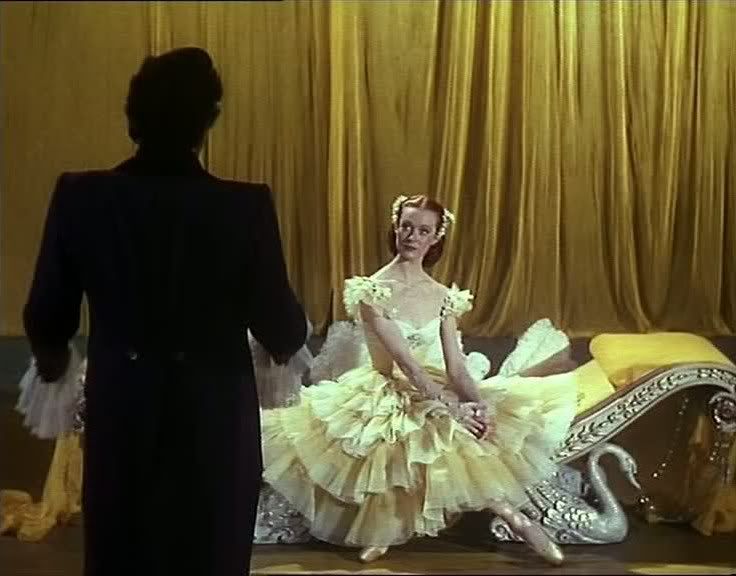
It's the story of the poet Hoffmann (Robert Rounseville), who in the framing story begins relating a trio of tales from his past, each of them concerning a woman he loved and lost. Each of these segments is a self-contained story in itself, providing further opportunity for Powell and Pressburger to vary the aesthetics and tone of the film. Throughout each of these stories, continuity is provided by the recurrence of actors playing multiple roles, particularly Robert Helpmann, who in each of the film's segments, including the framing story, plays Hoffmann's diabolical nemesis. In the first segment, the young Hoffmann falls in love with Olympia (Moira Shearer), a doll constructed by Spalanzani (Léonide Massine) and the mad inventor Coppelius (Helpmann). They present her as Spalanzani's daughter, and Hoffmann, still an innocent youth, untutored in worldly things, falls completely for the ruse, bowled over by the beauty and elegance of the doll — a rather elegant metaphor for youth's tendency to seek perfection in love, to elevate the loved one to the pristine, passive perfection of a porcelain doll. This section's aesthetic is sugary and bright, a fluffy confection with frilly yellow drapes circling the room where Hoffmann falls for the fake girl while watched over by an audience of other puppets.

The songs are often spiked with an edge of naughty wit, as when Hoffmann's friend Nicklaus (Pamela Brown) comments that Olympia is preparing "to show off her technical pieces," a double entendre that earns a collective shocked glance from the assembled puppet audience, and prompts Nicklaus to smile at the camera, as though acknowledging the naughty pun about the mechanical girl. A perverse undercurrent runs through this whole sequence as the besotted Hoffman obliviously pursues the doll, delighting in her clockwork dancing and gestures of love, all of it playing out with the kind of kinky strangeness that motivated Ernst Lubitsch's rather similar silent comedy Die Puppe. The perversity of this set-up reaches its climax in the surprisingly chilling final scenes, where Coppelius and Spalanzani fight over Olympia and wind up tearing her to pieces limb by limb, knocking her head off, tearing off her arms and legs, leaving behind just a single leg dancing gracefully in the void, and her head on the floor, blinking with mechanical clicks, as the final image of this sequence.

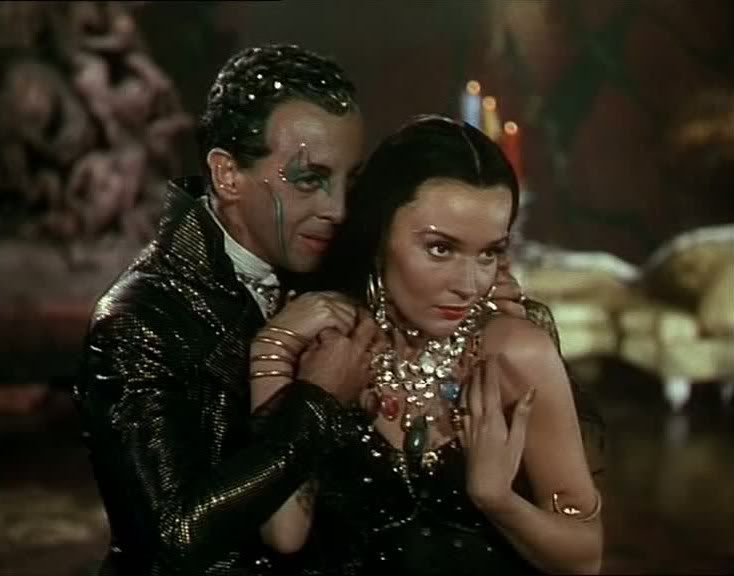
In the film's second segment, Hoffmann is seduced by the alluring Giulietta (Ludmilla Tchérina), who steals the unsuspecting man's soul by getting him to glance into an enchanted mirror. In contrast to the bright primary colors of the previous segment, this story is draped in lush shadowy textures, its colors dark greens and purples. There are mirrors everywhere here, reflecting the dishonesty and trickery of this false love, culminating with Giulietta's sensuous, snake-like dance of triumph, in a mirror where she is reflected but Hoffmann, his reflection stolen along with his soul, does not appear. It's a masterful sequence, the woman's moves making it seem as though she's weaving her body around the man, dancing triumphantly around him, even though he does not appear in the shot, his absence structuring her dance anyway.

Later, Hoffmann descends a gloomily lit staircase and takes a ferry ride into the underworld, pursuing his missing reflection. This whole segment is steeped in gothic imagery, culminating in a duel in the underworld, overlaid with an image of Giulietta's beautiful but deadly face superimposed over the river of the dead with its black-robed ferryman. Tchérina's performance as Giulietta exudes a raw sexuality that infuses the entire segment, giving it the stormy, passionate, dangerous quality of a doomed romance.
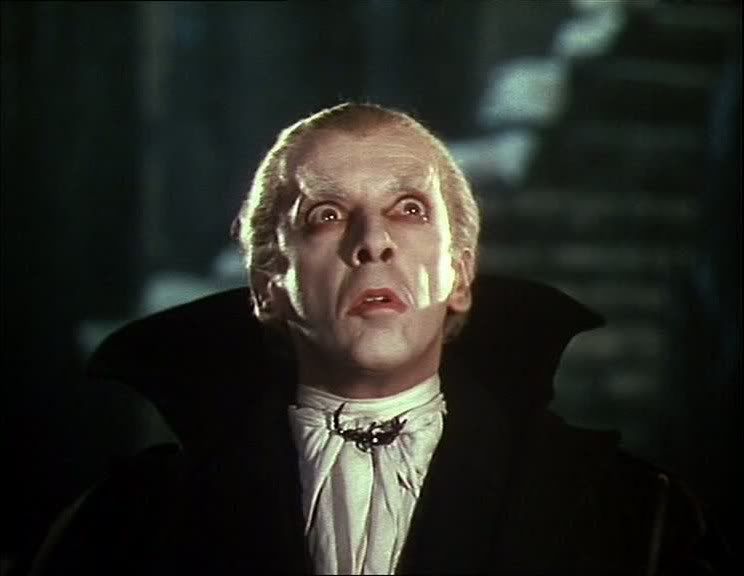

In Hoffmann's final story, he loves the sickly opera singer Antonia (Ann Ayars), who's subjected to the dubious medical care of the sinister Dr. Miracle (Helpmann). In a dazzlingly surrealistic sequence, Miracle, looking like the vampire of F.W. Murnau's Nosferatu, stalks after the girl through a surreal, distorted dreamscape, as she fruitlessly flees the menacing figure with his pale white face, black-rimmed features, and black robes. She runs through a maze-like set, running into one door and suddenly appearing out of another, always returning to the room in which Miracle looms threateningly over her bed, with Antonia unable to escape.

This sequence reaches a fever pitch with an even more spectacular sequence in which Miracle tries to seduce Antonia into breaking her vow to Hoffmann: she's been forced to choose between her love of music and her love of Hoffmann, and Miracle offers her a career as a famous opera singer to make her forget her lover. As Miracle tries to win the girl's soul, he enlists the spirit of her mother, a famous singer herself, and the music becomes ecstatic and frenzied, with multiple overlapping voices, as the setting shifts into a hazy, unstable dreamworld with Antonia dancing amidst the chaos, finally being almost swallowed by flames as the music reaches its wild, intense peak.

As Antonia's tragic tale reaches its conclusion, it fades seamlessly back into the framing story through a series of images in which Helpmann appears in his various guises as the film's multi-named villain, embracing each of the film's women in turn, before a brief coda in which he enacts his final revenge on his enemy Hoffmann, by stealing away the last of the film's women, the dancer Stella (played again by Shearer). Throughout all these parallel romances, the emphasis remains squarely on the colorful, at times downright avant-garde visuals that Powell and Pressburger apply to this material. The film's aesthetic vibrancy allows even those who might not connect to the operatic music — like me, admittedly — to get swept up in the emotional intensity and garish beauty of the film anyway.

Tuesday, May 8, 2012

The Big Night


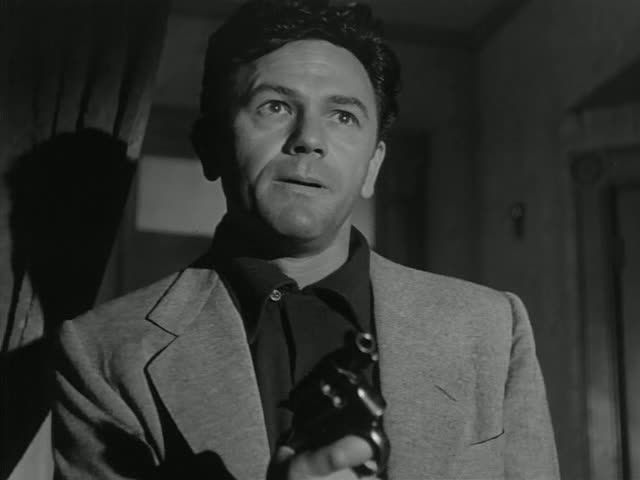
Joseph Losey's The Big Night is a coming of age tale in the guise of a noir, a thiller that's ostensibly about revenge but is actually about a teen's desperate struggle for sexual and emotional maturity. George (John Drew Barrymore) is a weak young guy, a loser who's always getting kicked around, who seems so much younger and more innocent than his age. In the film's opening scene, he's beaten up by a group of guys who taunt him, pushing him towards a girl they're hanging around with, telling her to kiss him, but she just pushes him away, dismissing him as too immature. All of this happens, much to George's humiliation, beneath the watchful eye of his stern, tough father (Preston Foster), who looks on but doesn't intervene or say a word. It's obvious that the weakling George feels overshadowed by his father, which has helped to keep him immature. The boyish George soon shakes off this beating and bounds into his father's bar, fresh from a haircut, rubbing his smooth cheeks and enthusing that the barber said he needed a shave.

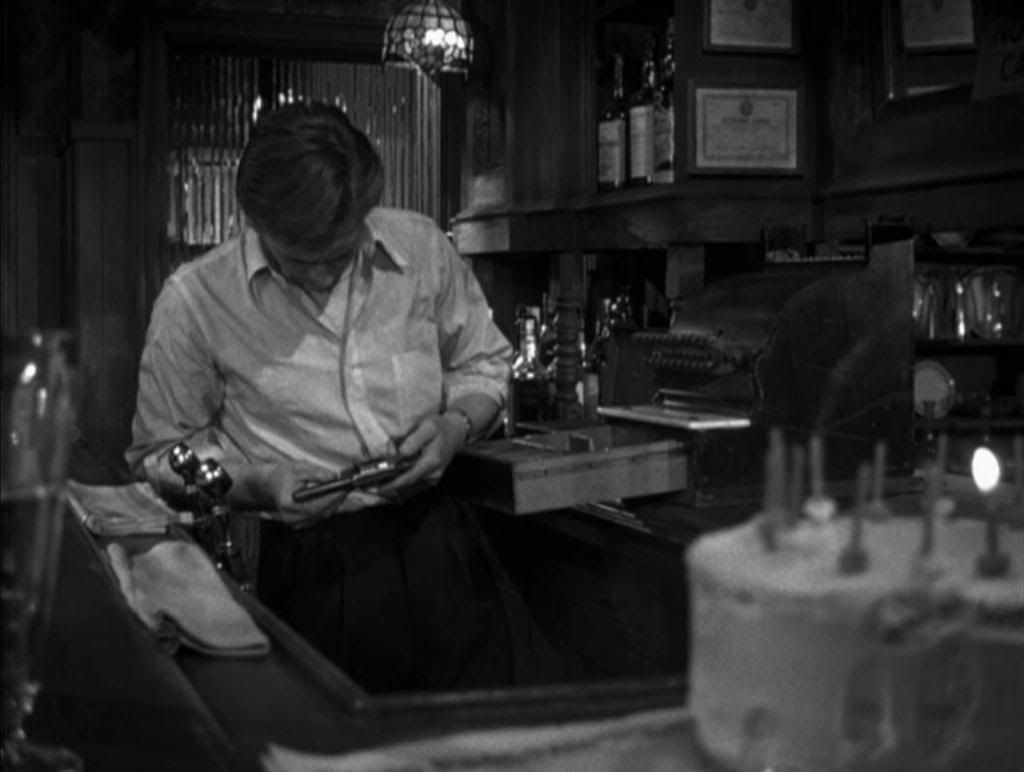
He's eager to be a man, but he still acts like a boy and he's still treated like one by everyone. His father throws him a birthday party, bringing out a cake and singing to him. But George can't avoid the look of disapproval in his father's eyes when he fails to blow out all the candles on his birthday cake, as though that one candle left flickering was a sign of his unmasculine weakness. Losey then makes sure that, throughout the subsequent scenes, the cake is often highlighted in the corner of the frame, that candle still burning in the foreground, a reminder of that small failure. George's journey into manhood will commence when he sees his father get beaten up by the sportswriter Al Judge (Howard St. John); George's father obediently kneels down for a caning, which Judge delivers with savagery while George and the other bar patrons watch. George is horrified to see his father, his icon of masculinity, lowered like this, and when his father seems willing to simply shrug the incident off and forget it, George grabs a pistol and runs off into the night, determined to track down Judge and get his revenge.

Despite this strong premise, the film is surprisingly aimless, with George stumbling into the dysfunctional family drama of the alcoholic journalism professor Lloyd Cooper (Philip Bourneuf), Cooper's girlfriend Julie (Dorothy Comingore), and her younger sister Marion (Joan Lorring). This trio provides a sounding board for George's tortured musings about his immaturity and his confusion about his father, who'd he always looked up to but who had disappointed him so profoundly. Barrymore delivers a sweaty, histrionic performance that's over-the-top but appropriate to this whiny teenager. Still, his endless agonizing quickly becomes tiresome, and the middle section of the film gets bogged down with an abortive quasi-romance between George and the personality-free Marion.


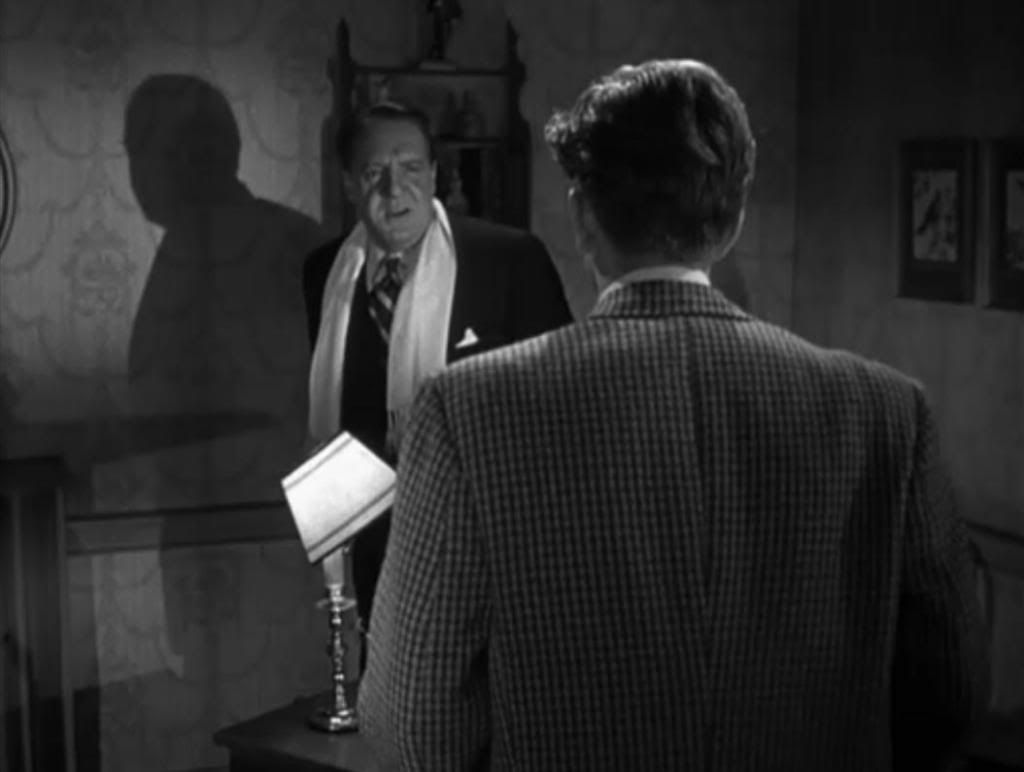
The film's momentum recovers during George's long-delayed confrontation with Judge, in which the sportswriter reveals that things are much more complicated than George had guessed. It's a tense and powerful meeting, and Losey enhances the suspense with striking compositions in which the two men seem to be stalking around one another, their shadows elongated on the walls. The film's noirish atmosphere, courtesy of cinematographer Hal Mohr, is effective in general, rendering the spartan sets with a shadowy, low-budget minimalism that often makes it seem that George is wandering through a wasteland whenever he ventures outside. The interiors are appropriately dingy, too, as George passes through the city's seedy dive bars, nightclubs and fighting rings in his quest for revenge.

One curious moment stands out as a great scene with little to do with George's quest. At a nightclub, he hears a black singer who really impresses him, and after the show he approaches her at the curb outside the club, telling her how much he loved her singing and how beautiful he thinks she is. But then he adds, "even if you're...," trailing off before he makes the unspoken reference to her race. But she gets it anyway, of course, and it's heartbreaking the way Losey highlights her face in closeup, transitioning from her warm smile of pleasure at being complimented, to a wounded expression that's also a look of recognition. It's obvious that she's heard this before, maybe many times before, but she's still hurt to be hearing it again, and from such a seemingly earnest kid no less. It's a moment of sociopolitical engagement that has Losey's fingerprints all over it: it's entirely unnecessary to the narrative, except perhaps as more evidence of George's immaturity, but it stands out as one of the film's best scenes.

Its uneven performances and sometimes slack narrative aside, The Big Night is a raw and interesting noir that's notable for its emphasis on adolescent angst and sexual undertones. It was one three thrillers Losey made in 1951, his last year in Hollywood before his exile, and though it's a flawed film, not as interesting as The Prowler or his remake of Fritz Lang's M, there's enough substance here to make it worth seeing anyway.

Thursday, April 12, 2012

M (1951)


Fritz Lang's M is such an enduring classic that it's hard to imagine a Hollywood remake of it, but that's exactly what director Joseph Losey did, twenty years after Lang's original film about the hunt for a child killer. Losey's remake of M, made under the aegis of the original film's producer Seymour Nebenzal, is extremely faithful to its source, following more or less the same script and at times even recreating scenes virtually shot for shot. It would be easy to dismiss the film as an inferior copy of a classic, and many have: the remake was a flop at release and doesn't have much of a reputation even now. But, though it unquestionably does not match the power of the Lang film, it's still a compelling noir in its own right, transplanting Lang's richly ambiguous social parable to 1950s Hollywood at the height of Red hysteria, which is clearly a prominent subtext here.

For Lang, the film was an anti-death-penalty treatise, a somber and timely warning of the dangers of widespread fear and paranoia, and, of course, a plea to watch out for one's children. For Losey, it's a psychosexual thriller and a parable for the McCarthyite anti-Communism that would soon drive the director out of the United States for the remainder of his career. At one point, in a scene that also appears in Lang's film, two witnesses are arguing over whether a kid's dress was red or blue. Losey adds a key detail: the witness who insists the dress was blue angrily asks the other, "what are you, a Communist?" That loaded question, which was already being casually tossed around at the least pretext in the US of this era, hangs over the film, with Losey subtly reinterpreting Lang's persecution parable, replacing 1930s Germany with 1950s Hollywood to suggest a link between the rise of the Nazi party and the rise of McCarthy. The change in context resonates throughout the early scenes, as random innocent people are persecuted in the streets by a public worked up into hysteria by the child killings.

Losey also subtly changes the film's meaning by making the motive for the child murders implicitly sexual; the film is loaded with sexually charged symbols in a way that Lang's original wasn't. The opening credits show the killer (David Wayne), seen only from behind, approaching little girls, luring one with a string toy that he suggestively pulls and teases with his hands, the framing often hiding the toy altogether so that it's not clear what he's doing, just that he's walking up to a little girl with his hands pumping around at his hips. Another shot shows him turning on a water fountain for a girl, who bends over to drink, her head obscured by the mysterious stranger standing in front of her. Already, Losey, dodging the censors, is suggesting a transgressive sexual component to the murders, a creepy subtext that distances Wayne's killer from the more famous portrayal by Peter Lorre.


Indeed, Wayne plays killer Martin Harrow with a bland-faced intensity and mommy-fixated sexual dysfunction that prefigures Anthony Perkins' Norman Bates in Hitchcock's Psycho more than it looks back to Lorre. Most chilling of all is the scene of the killer sitting in the dark, his face shrouded in shadow, tightly grasping the dangling cord of the lamp hanging above him, wrapping it around his fist, breathing heavily and pulling his hand further and further up the cord. It's such an obviously sexual scene that one wonders how Losey got away with it, especially when the killer "climaxes" by finally pulling the cord and putting out the light. (That the cord is later revealed to be a shoelace taken from the shoes he collects as fetish objects from his victims only confirms the sexual metaphor.) This is immediately followed by a scene where he goes over to his desk, still panting breathlessly, and begins molding a clay sculpture of a child, wrapping a cord around its neck and squeezing to pop its head off, while Losey prominently highlights the photograph of a matronly older women behind the sculpture, a mise en scène detail that suggests the killer is a sexually frustrated mama's boy.

Such scenes proliferate throughout Losey's remake, suggesting that the killer instinctively makes a connection between masturbation and strangulation; at one point, he finds a wounded bird and picks it up between his fists, its head popping out between his fingers as he squeezes it, before letting it go and sobbing with guilt. His final confessional speech is significantly different from Lorre's version of the scene, too, as he talks about a childhood dominated by his mother's tyrannical insistence that all men are evil and need to be punished — a speech comically punctuated by his aside that she's "a good woman."

In this way, Losey makes the material his own even while largely sticking to the template of the original film. He can't match the overwhelming formal beauty of Lang's film, but he has his own minimalist, low-budget aesthetic that gives his take on this material a rough, shot-on-the-streets realism very different from the shadowy expressionism of Lang's M. Losey shot a lot of footage on the streets of Los Angeles, and staged the climactic search for the killer in the instantly recognizable Bradbury Building, an iconic location for many movies, its angular staircases and multiple levels used well in the scenes of the city's criminal underworld tracking Harrow. Losey's austere aesthetic — only occasionally broken by diversions like the Hitchcockian cut from a mother worrying at home to a screaming, cackling clown — puts the emphasis on Wayne's increasingly unhinged performance and the slightly comic efforts of the police and criminals to catch him. Losey dared to remake a classic, and though the remake is not on the same level as Lang's masterpiece, it should be remembered as a noir classic in its own right, with its substantial differences from its source marking it as a worthy extension of Lang's themes.

Wednesday, July 27, 2011

The Prowler


Joseph Losey's noir The Prowler opens with a shot that immediately tweaks the audience by placing the viewer in the voyeuristic position of a creeping pervert. The first shot of the film gazes through a woman's bathroom window as, inside, she dries herself off after a bath, putting on a robe. Her body remains teasingly just out of view beneath the window's frame, which functions like a cinematic frame within the frame, and Losey's camera, tracking slowly in to get a closer look, heightens the voyeuristic sensation of leering in. Then, the woman seems to notice the camera, looking out the window with concern and horror as she realizes that someone is watching her, and she quickly pulls the blinds shut, cutting off the view. It's not the camera she actually sees, of course, but a peeping tom whose perspective the camera had been taking. The titles roll then, and in less than a minute Losey has effectively signaled that, like all films about voyeurism, this too will be about the cinema, about those people out in the audience, watching eagerly from their hidden spots in the dark. The black humor of this set-up is made even more apparent when, after the credits, a pair of cops visit the frightened woman, and one insinuates that maybe she shouldn't have tempted the prowler by offering herself up for view like that, framing herself in the movie screen of the open window. After all, for a culture growing increasingly acclimated to the cinematic experience, peeping in on such living movies is second nature (and the woman herself is a failed actress, used to being watched).

But the real voyeur of the film turns out to be not the unseen prowler outside the window but one of the cops, Webb Garwood (Van Heflin), who is immediately attracted to the prowler's victim Susan (Evelyn Keyes) and begins aggressively courting her at night, after his shift is over. When Webb and his partner Bud (John Maxwell) first come to investigate the incident, Budd questions Susan while Webb remains outside, prowling through the bushes, looking into the house. The compositions suggest that he too is a voyeur, peeking through the windows, watching Susan from afar, and when he appears at the bathroom window, he startles Susan every bit as much as the original prowler had. Webb represents law and order in his crisp police uniform, but really he's an outsider, discontented with his life, feeling like he's watching other people's happiness and success while he's had nothing but "bad breaks."

Susan, it turns out, is from his hometown in Indiana, but while that fact draws the pair closer together, it also awakens a reserve of bad memories for Webb. He'd been a star athlete in high school, but his college scholarship had ended early after a quarrel with a coach, and his youthful dreams evaporated at that time. Unlike Bud, a model of contentment who loves being a cop, loves his wife, and loves his mind-numbingly dull rock-collecting hobby, Webb wants something more and can only dwell on all the missed opportunities and bad luck he's had in his life. Above all, he had the bad luck to be born poor and to grow up poor; while Susan grew up rich and married an even richer man, Webb was from the wrong side of the tracks and had to watch his poor father squander countless opportunities for improvement, settling for stable middle class mediocrity instead. Webb is an outsider in the spacious mansion Susan shares with her radio announcer husband; he looks in and sees the life he wants, the comfort and security he wants, maybe even the woman he wants.


The film's script, by Hugo Butler and an uncredited Dalton Trumbo, isn't exactly a model of sedate realism: it winds through multiple twists and turns and dramatic shifts in mood. The story is melodramatic and blustery, and its central romance goes through so many unconvincing reversals that it's hard to know what to think of the weepy, malleable Susan. A late revelation suggests that maybe this tonal confusion, too, is purposeful, since even Webb doesn't seem to know what he wants. Heflin, with his big, expressive eyes and perpetual hangdog look, is perfectly suited to Webb's chronic dissatisfaction and the sinister undercurrents that occasionally come bubbling up from deep within him, but Keyes delivers a much less satisfying performance that leaps wildly from one emotion to another. The film's shifts in locale and tone, however, are handled adroitly by Losey, whose direction of this lurid, intense material locates the proper balance of absurdity and tension.

Losey has an especially keen grasp of background diegetic sound, which he uses to comment on the images and foreground events of a scene. Susan spends her nights listening to her radio announcer husband, who ends every broadcast with the cheery sign-off, "I'll be seeing you, Susan." This turns out to be very convenient once Webb starts spending his nights with Susan while her husband is at work, since as Webb says, they always know where he is. The two budding lovers canoodle on the couch, lounging around together, laughing and kissing, and all the while the husband's voice murmurs away in the background, his words offering sly commentary on what goes on at his own house while he's at work, unaware. He describes the pleasure he feels when relaxing on an evening at home, being served a snack by his wife, and as he sets the scene, Susan lays out a tray of sandwiches for Webb, who leans back and lights a cigarette, the first tendrils of smoke wafting up into the foreground of the frame just as the announcer describes smoking his own first cigarette of the evening. Webb seems spooked, joking that he feels like the guy is watching them.

The announcer likes to babble on about his wife on the air, describing her cooking and their domestic contentment, and his happy words overlay the images of Susan and Webb having their fun in the time before that final sign-off indicates that the husband is on his way home. Later, the announcer's voice, played back on a record, has an even more sinister meaning, his affectionate sign-off now interrupted with the violent scratch of the turntable's needle being yanked out of the grooves.


It's obvious enough where all this is heading, but the inevitable homicide merely marks the film's halfway point, and the script has plenty of surprises left. Though the shadowy noir cinematography (by Arthur C. Miller) is effective and eerie in the Los Angeles scenes, the film really becomes interesting when the action shifts away from these typical noir locales. At one point, Losey signals the couple's decision to retreat into the desert with a fade to black, which is immediately followed with a gorgeous, haunting image of a car, isolated in the middle of a blank wasteland, kicking up dust in its trail as it cuts through the sand. The rocky western ghost town where the couple holes up is far from the usual noir haunt, and instead of shadows and grimy interiors (like Webb's cheap apartment from earlier in the film, with a silhouette target forebodingly hung on the wall) there's a grim, barren wasteland where nobody visits, "not even the coyotes" that are nevertheless heard howling plaintively at the film's climax. The way that Losey frames scenes of domestic idyll and hopefulness against this rocky and desolate setting suggests just how short-lived the film's cheerier moments are destined to be.

The Prowler is a rich and idiosyncratic noir that explores the archetypal noir themes — greed, violence, ambition — in some unusual ways. The actual prowler of the opening, it turns out, is incidental to the story, a plot device and a red herring. The real prowler, the real creep, is the outsider who so desperately wants what he can only look at from afar, the guy who waits in the darkness, watching and desiring but separated from what he sees by seemingly insurmountable barriers. Webb's voyeurism is a matter of class, primarily; he looks at the wealth and success of others and he wants what they have. Perhaps Losey is suggesting that the cinema works similarly by presenting visions of glamor and beauty to dazzle audiences, who watch from the darkness, voyeurs who desire the purity and wonder of what's up on the screen, the window through which they peer.

Wednesday, June 22, 2011

He Ran All the Way


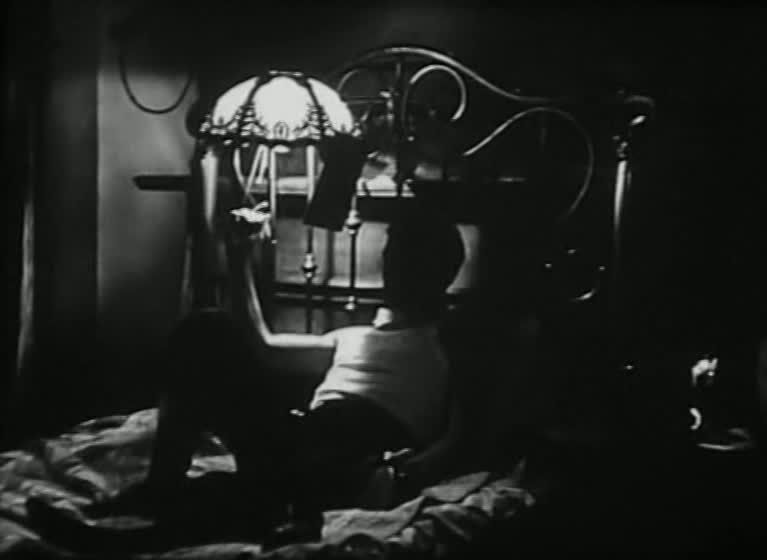
He Ran All the Way is an emotionally and narratively incoherent film that is, nevertheless, compelling in its raw examination of a family under pressure and a man without a family falling to pieces as he realizes just how unloved he really is. Nick Robey (John Garfield) is a loser with no real connections in the world, and no real hopes. The opening shot is a pan across Nick's messy, cramped apartment, finally resting on the bed where Nick thrashes around, yelling in his sleep, haunted by nightmares of endlessly running. He's woken by his mother (Gladys George), who obviously has not the least bit of affection for her son. She berates him for being so lazy, sleeping until nearly noon when he should be out looking for a job, and they get into a nasty argument that climaxes with her slapping him. This is a portrait of a totally unloving mother/son relationship; every time Nick calls her "mom," he spits the word out with such contempt that he makes it sound like a slur, a hateful curse. From the beginning, it's apparent that this is a man who has nothing.

Nick soon tries to pull off a payroll robbery with his weaselly friend Al (Norman Lloyd), but the plot of course goes wrong, Al is wounded and captured, and Nick shoots a police officer while escaping. There follows one of the film's most visually potent sequences, as Nick wanders through a series of desolate urban landscapes, living up to the film's title and fulfilling the prophecy of his nightmare about killing a man and being forced to run constantly. Director John Berry and cinematographer James Wong Howe perfectly capture that sensation of being alone in a dismal world, a never-ending flight from unseen pursuers who might be lurking around any corner. The images isolate Nick in his surroundings, until finally he manages to lose himself in the crowds at a pool. That early sequence of Nick on the run is important, because after Nick meets the innocent Peggy (Shelley Winters) and gets her to bring him home with her, the film settles down into a claustrophobic cabin fever drama with the paranoid Nick imprisoning Peggy and her family in their own apartment.

Howe's shadowy noir imagery is so eerily beautiful in the exterior shots that it's almost a shame that the bulk of the film is spent cooped up in an apartment from that point on, but Howe and Berry are equally adept at conveying the tight spaces of the few rooms where Nick imprisons Peggy, her parents, and her little brother. Unfortunately, though Garfield delivers a relentless, grim performance as the cornered, pathetic Nick, the film's narrative and characterization leap haphazardly around, making a hash of what could have been a thematically resonant study of family and love. Nick's initial come-ons to the sheltered Peggy are so schizophrenic that one wonders why she spends a minute with him; he's at best distracted and at worst seems sociopathic and nasty, and yet despite some initial resistance she invites him back to her family's apartment and awkwardly flirts with him.


Peggy is a pathetic character, weak-willed and malleable, a caricature of the good girl who doesn't know anything of the world or sex. It's kind of laughable when, late in the film, she makes an attempt to dress sexy and seduce Nick, who is also something of an idiot (or else just desperate for love) and seems wowed by her gussied-up look even though, it must be said, she basically looks exactly the same as she always had. There's an interesting idea here, no doubt about it. Nick is a guy with no connections: his only friend sells him out and gives up his name to the police, making his situation even worse, and when he tries to contact his mother she wants nothing to do with him. Nick doesn't care about anyone or anything, but his confrontations with Peggy's father Fred (Wallace Ford) are interesting as the collision of two totally different archetypes. Fred is a family man and a religious man, and all he wants out of life is to be left alone, to work, to spend time with his family. When Fred asks what Nick wants out of life, all Nick can do is wave a handful of money in the other man's face, as though this grubby handful of stolen bills is a substitute for the happy family life that Fred has.

The film's development of this theme is haphazard at best, and the long middle section of the film quickly enters a holding pattern in which nothing much happens. The tension merely remains static, neither building nor receding, and the family tries to go about their lives as best they can while Nick endlessly dithers. The script sometimes becomes almost comical in the heavy-handed lengths it goes to reinforce the family theme. In one scene, Nick buys the family dinner, but the mother cooks a stew for her family, and they all eat that while ignoring the comparatively lavish feast that Nick has set out for them. He then tries to force them to eat at gunpoint, and a very unlikely standoff occurs, with the father delivering a forced speech that feels much more like the script setting out its principles than like anything a man in this situation would actually say.

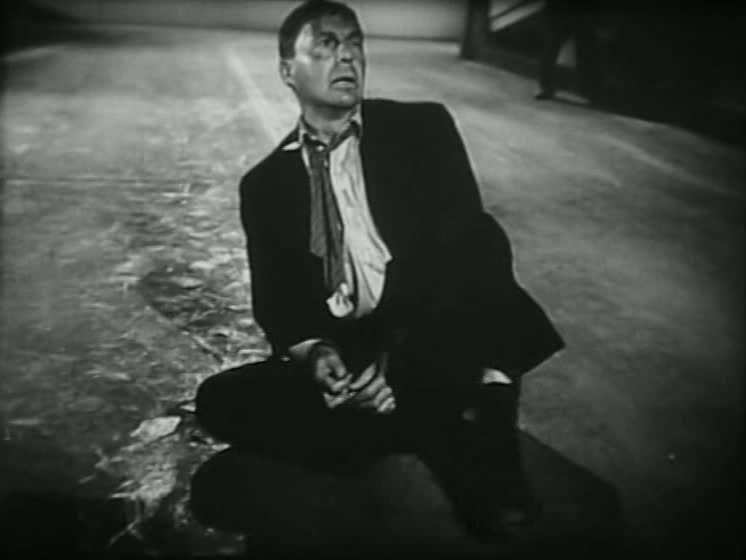
The ending is especially incoherent, as Peggy sometimes seems to be tricking Nick into thinking she loves him, and sometimes seems to be actually feeling something for him. There's a moment when Nick, thinking he's been betrayed, pulls his gun on Peggy and nearly shoots her, and the script treats this as though it's a revelation — "you were going to shoot me," Peggy sputters, unbelieving, as though Nick hadn't been consistently nutty and violent throughout the film. Either the girl is truly dense or the script is simply inconsistent in its portrayal of this unlikely quasi-romance. Nick, for his part, really is just dense, or really so desperate for someone to care about him that he'll accept even the most unconvincing declarations of love. In spite of all the film's narrative holes and half-realized characterization, though, the ending really is potent and emotionally raw. Nick is forced to confront, on a rain-slick, nighttime noir street, the reality of his complete worthlessness and disconnection. He ends the film literally staring into the light, having gained a measure of self-awareness about his own role in pushing away anyone who might care for him with his distrust and anger and brutality. It is, of course, a realization that comes far too late for him.

Wednesday, February 9, 2011

Diary of a Country Priest


Robert Bresson's aesthetic is famously stark and austere, with a stripped-down approach to narrative and performance. In Diary of a Country Priest, his third feature, Bresson examines the daily life of a tormented young priest (Claude Laydu), the head of a country parish, who suffers both from a stomach ailment and from the doubt and insecurity that plague his ministry. Laydu's performance, like most performances in Bresson's ouevre, is drained of expressiveness. The priest, though often captured in closeup, only rarely betrays more than a hint of the turmoil afflicting him inside. His face is a blank mask, his mouth slightly downturned, his eyes often closed or looking down, hidden from the camera's gaze. This restraint is a hallmark of Bresson's cinema, and it is a big part of what makes his work so challenging: he resists conventional expressiveness, instead turning inward, and encouraging his actors to do the same. Curiously, the effect Bresson achieves through this restraint is often not blankness, not exactly, but more like sadness and disconnection. His characters, with their empty expressions, seem to be suffering quietly and internally, isolated from others, out of touch with their emotions. The general restraint also enhances the impact of those moments when the priest's quotidian suffering becomes too much to bear without expression, as when he's overwhelmed by a sudden attack of nausea and rolls his eyes in pain, his face contorting as he nearly faints from the pain. The film becomes locked into cycles of repression followed by momentary lapses in which the priest's carefully controlled emotions boil over; it is as close as Bresson ever gets to emotional catharsis, and a very modest and unshowy catharsis at that.

The priest's story is told through a series of diary entries that serve as divisions within the film: each incident or moment is separated from the subsequent one by an image of a journal page, with the pen scratching across the paper, writing the words that are then read aloud in voiceover. The diary provides an elliptical structure to the film, building the priest's story through what he himself chooses to recount, creating a sense of the daily rhythms of an isolated life. The priest is young and has been placed in charge of a small country parish, which proves to be a difficult task for him since the town's people are mostly hard peasants and farmers with little use for religion. Masses are sparsely attended; in fact, only one person in the film is ever seen attending a mass said by the priest. The priest finds his faith continually challenged by the people he's supposed to be serving. The children are uninterested in his lectures, and the one student who he at first thinks is attentive and spiritual turns out to be nearly as unreceptive as the others.


The core of the film's story concerns the priest's fraught relationship with the family of a local dignitary, a Count (Jean Riveyre). The count's wife (Rachel Bérendt) is deep in mourning for the couple's dead son, to the point where she's cut herself off from the world, including her still-living daughter Chantal (Nicole Ladmiral). Chantal, for her part, is miserable growing up in this troubled home, especially since her father is rather openly carrying on with Chantal's governess (Nicole Maurey). The film revolves, in a subtle way, around a conversation between the priest and the Countess, as the priest tries to pull her out of her self-imposed isolation, to convince her that she should re-engage with God and with the world despite the devastating loss of her son. This extended back-and-forth is, in its quiet way, the film's dramatic climax, a moment of profound significance for both participants.

When the priest gets home afterward, he writes in his journal that the conversation was a "struggle," and that's precisely what it was. The priest and the old woman were fighting over her soul, engaged in an invisible tug-of-war over her fate in the afterlife. Their words, harsh and direct, are like weapons aimed at one another, each one seeking to open a wound deep enough that the battle will end. The film makes spiritual struggle a kind of war, as violent and emotionally exhausting as any physical struggle, if not more so. The priest's mentor makes the same comparison, saying that they are at war, that they must face their enemy, though he never says who that enemy is. The Devil? Sinners? Hell itself? It hardly matters: it's the sense of never-ending struggle that defines these men of God, even if the struggle itself is vague and metaphysical, occurring on an invisible plane, its effects on Earth ambiguous and uncertain. The priest believes that he has triumphed with the Countess, that he has left her in peace and lifted a tremendous burden from her through the power of his words. But any effect of this transformation must by necessity be displaced from the material world. The priest goes to the woman's deathbed hoping to see some sign of his good work in her dead body, but there is no smile on her lips, no hint of the serenity that he believed she met death with, no evidence of his effect on her. She died like any other human, and her essence departed from her body.

Towards the end of the film, Bresson makes the war metaphor even more explicit by introducing the character of Olivier (Jean Danet), a soldier in the Foreign Legion and a cousin of Chantal. He arrives on a motorcycle, first heard but not seen, a buzz in the distance, until he picks up the priest one afternoon and gives him a ride. The scene where the priest rides on the motorcycle is remarkable, as the priest vacillates between moments of carefree joy and serious introspection. Bresson watches the priest's face in closeup, as he smiles, feeling the wind on his face, enjoying the sensual rush of this ride, and then the smile melts away and his expression again grows distant and blank, as his voiceover returns on the soundtrack, delivering a running interior monologue of his thoughts about God and death and faith. It's a wonderful portrait of a man who thinks too much, allowing his constant internal monitor to overshadow the immediacy of a present-tense experience. He feels the rush of the motorcycle ride only briefly, in flashes of an unworried, spontaneous smile, which is then erased by the return of his self-consciousness. Because this is Bresson, there is also a note of homoerotic tension between the priest and the young soldier, particularly when the soldier drops off the priest at his destination and speaks to him with a knowing leer as he tells him that they could be great friends. It's more than just a hint of illicit sexuality, though; the soldier sees in the priest a kindred spirit, someone made for battle. He tells the priest that he could easily trade in his priest's robes for a uniform of a very different kind, the uniform of the soldier, waging physical rather than spiritual battle.


In its simple, graceful way, Diary of a Country Priest deals candidly with the mysteries of faith and the nearly uncrossable divide between the material and spiritual worlds. As if to prove the point, the film itself is inextricably rooted in the material world: the details of the priest's limited diet, the lower-class mess and clutter of a former priest's urban apartment, the inky darkness of the night, as the priest sits inside staring at the sheets of rain streaming down his window. When the priest, walking home late one night, falls to the ground, the mud beneath him has a moonlight sheen as his fingers sink into the wet soil. The grounds of the Count's manor are mostly filmed in long shots that emphasize the scope and sprawl of the flat lawns, often with a crooked branch hanging down in the foreground, zigzagging across the frame. The film is about wrestling with the spiritual, with what happens after death, but physicality and materiality are its real métier.

Wednesday, March 11, 2009

The Thing From Another World


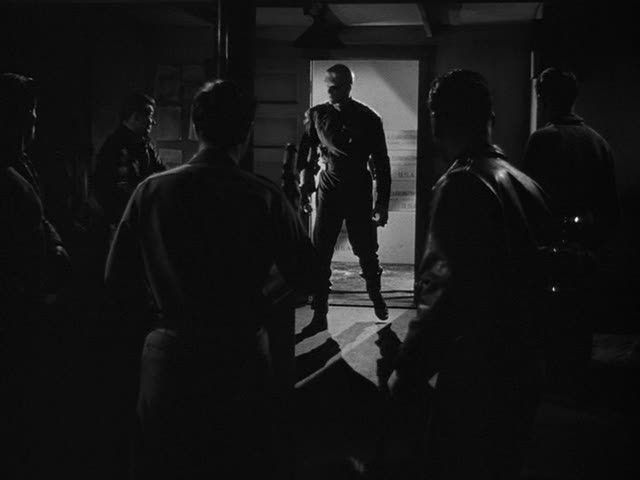
The Thing From Another World is one of the great classics of sci-fi horror, a taut minimalist study of a group of military men and scientists under pressure, hemmed in by an extraterrestrial monstrosity that crash-landed at a remote research station near the north pole. The film was produced by Howard Hawks, and though ostensibly the first directorial feature of editor Christian Nyby, it's well-known that Hawks was on the set giving, at the very least, comprehensive advice, and most likely taking over the directing chair for himself. Certainly, though the science fiction premise is unlike anything else in Hawks' filmography, the film bears the director's aesthetic signature and deals with some of his typical concerns. Indeed, the alien monster appears only sporadically, in brief flashes, mostly obscured by darkness. The film's emphasis is not on its horror elements but on the dynamics within the tight-knit professional groups doing hard, dangerous work in the midst of this snowbound wasteland.

Among these men is Air Force Captain Patrick Hendry (Kenneth Tobey), who fulfills the role of the romantic hero even though, like Hawks' Air Force before it, this is a film where individual characters matter far less than the group as a whole. The research station is populated mostly with minor, little-known actors (Dewey Martin, James R. Young, Robert Nichols, etc.), including several recurring Hawks bit players, which only enhances the impression that the individual personalities of these men are not meant to stand out. They exist only as a part of the group and, symbolically, as members of the human race. Hendry and his crew of military men are summoned to a research station near the north pole after a mysterious aircraft crashes with a tremendous impact some fifty miles away from the station. The crash immediately begins triggering strange phenomena: communications are disrupted and measuring instruments go haywire, while Geiger counters pick up traces of radiation from the vicinity of the crash. Hendry's men are summoned by the brilliant scientist Dr. Carrington (Robert Cornthwaite) to help investigate the crash site and determine what happened. Of course, the crashed aircraft is no ordinary plane but a flying saucer, and though the military accidentally destroy it while trying to free it from the ice that hardened around it, they do recover the frozen body of one of the craft's inhabitants, a massive alien trapped in a block of ice.

Of course, soon enough the alien escapes and begins stalking around the base, largely unseen, feeding on the blood of the base's human and canine inhabitants. But the film's focus is not so much on the horror of the alien's violence but on the effect his mere existence has on the people at the base. Carrington sees the creature as a specimen, an unprecedented opportunity for scientific discovery and new knowledge. Hendry sees the alien as a threat to be contained and possibly eliminated. And the eager reporter Scotty (Douglas Spencer) sees only a phenomenal story, one that unfortunately he isn't able to tell thanks to military stalling and spotty communications. The alien itself is rarely shown, even after it emerges from its icy prison. The first time it attacks one of the base's soldiers, it's just a hint of a shadow falling across the man, who turns and fires his gun at the offscreen monster. Later, the alien, played through bizarre makeup by James Arness, is only seen from a distance or bathed in shadows, its hulking menace enhanced by this indirectness.


Hawks and Nyby spend much more time with the gathered inhabitants of the base, who huddle together in tight circular compositions, clustered around tables where papers and scientific demonstrations and endless cups of coffee hold their interest as they discuss what to do about the alien. These tight, cluttered compositions are purely Hawksian and perhaps the most obvious indication of Hawks' influence on the film. Despite the looming threat, the dialogue is crisp and light, with the actors delivering their lines at Hawks' characteristic brisk pace. The camaraderie between the men, especially the military men, is established through their continual exchanges of jokes and banter, particularly at the expense of Hendry, who the men rib for his interest in the scientists' assistant Nikki (Margaret Sullivan). Nikki is a typically Hawksian woman, strong and assertive and capable of verbally sparring with Hendry and even pulling jokes on him just like one of the boys. She even gets the drop on him, tying his hands behind his back for some playful S&M foreplay, feeding him drinks and then giving him a kiss once he's passive and restrained.

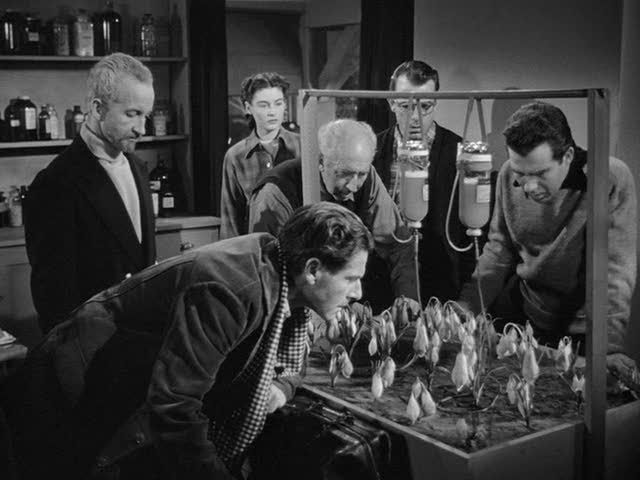
In the film's second half, Hawks and Nyby slowly build the tension, compressing the station's staff into tighter and tighter spaces, keeping the monster mostly out of sight but allowing his unseen presence to spread terror throughout the compound. There's also the queasy fascination of such unforgettable images as the severed hand that slowly comes back to life and begins flexing its fingers, or the bed of alien plant buds, fed on human plasma, that throb as though breathing and cry like hungry babies. The special effects are crude and simple, but these roughly crafted images contribute to the film's minimalist intensity. Considering that this was Hawks' sole contribution to the sci-fi or horror genres, he proves startlingly adept at it. An assault on the creature with kerosene and a flare launcher in a small, dark room is awash with frenzied terror (as well as being a very early experiment in setting stuntmen on fire), with the flaming alien careening around the confined space, flailing its arms around and unleashing an inhuman howl.

Towards the beginning of the film, there are several stark exterior sequences in windy, barren white landscapes with snow blowing past in flurries. As the film progresses it becomes increasingly claustrophobic and enclosed, culminating in the final sequence where the group backs into a corner within the isolated, cut-off station, waiting for the alien to come for them, their cold breath letting out trails of steam in the chilly air. The Thing From Another World is a fascinating, quietly intense masterpiece, with Hawks bringing his unique perspective to the sci-fi horror genre and truly making it his own.

Sunday, November 23, 2008

The Day the Earth Stood Still


Filmed and released at the height of the Cold War, The Day the Earth Stood Still presented a bold call to look beyond national borders and quest for peace and unity rather than war. In particular, the film was an anti-nuclear parable, a grave warning that the consequences of nuclear warfare could be global or even cosmic, a far cry from even the greatest devastation resulting from conventional war. This message is delivered to the people of Earth by the very human-like alien Klaatu (Michael Rennie), who arrives in a spaceship accompanied by a tremendous, indestructible robot named Gort (played by real-life giant Lock Martin beneath a clumsy costume). The film's anti-war and anti-nuclear agenda was controversial in its day, just as its special effects were state of the art. Seen today, the message is utopian and obvious, while the effects look rudimentary, but the film stands up surprisingly well as a classic of its genre.

Partly, the film's enduring status as a sci-fi masterpiece, rather than a historical curiosity, can be attributed to the great use that is made of relatively modest effects. Director Robert Wise, coming to the film from a background in noir and horror, knows how to get the most from a minimalist aesthetic, and he slathers these sets in artfully applied shadows that give a realistic feel to the cardboard-like backdrops. Klaatu's ship, draped in shadows, has an unearthly ambiance as the alien walks around its circular inner chamber, turning on lights one at a time by waving his hand over rows of strange buttons. The lighting often keeps the alien himself shrouded from view, keeping him mysterious and aloof. Though he looks human and, for most of the film, attempts to blend in with humans, he is often kept at a remove, his thoughts and goals hidden from understanding.

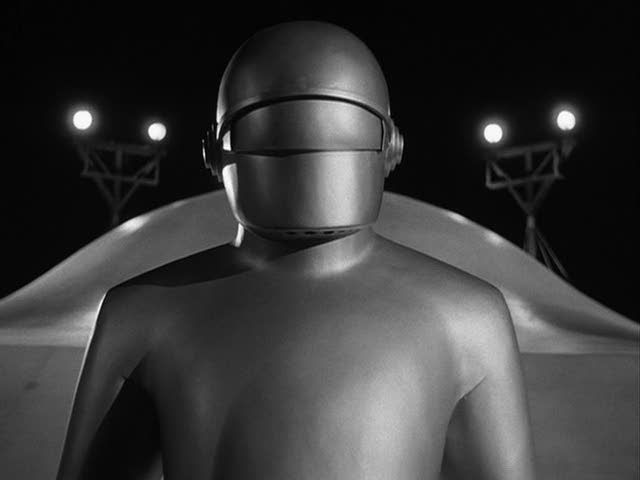
Even Gort, who in the broad light of day risks looking kind of silly rather than threatening, is mostly filmed in ways that enhance his intimidating aura rather than exposing the awkward artifice of his costuming. The robot's cold, silent acts of destruction, mostly presented in inscrutable closeups on his blank face, are terrifying in their slow, deliberate inevitability. Wise manages to make this robot seem all-powerful and unstoppable with only a few unconvincing laser bursts and amorphous glowing effects. The film also achieves a great deal with its score, a minimal drone mostly played with a pair of theremins, and composed by the great Bernard Hermann. This score functions much like the sets, creating tension and suspense from a surprisingly ascetic foundation. From the very opening strains, over the credits sequence's static painted images of outer space, the music's whining pulsations create an uneasy mood, a sense of impending doom. The score, the sets, the lighting, the effects: all are unified in creating believable sci-fi from the most minimal starting point. The individual elements might be cheesy and makeshift, but the total effect is brilliant.


More importantly, the film succeeds because its emphasis is not on the whiz-bang bravura of its technical effects, but on the dramas triggered by the alien's arrival. The bulk of the film takes place on a very human scale, with Gort and the spaceship offscreen as Klaatu attempts to blend in with the people of Earth so that he can learn about them and understand their capacity for violence. When he arrives on the planet, bringing his message of peace, he is shot in the arm immediately by a skittish soldier who mistakes the gift he offers for a weapon. He soon escapes the military's custody and takes a room at a small boarding house, where he befriends the young widow Helen Benson (Patricia Neal) and her son Bobby (Billy Gray). Klaatu seeks to understand this race of people who react so instinctively with violence and fear, and if the film's overall message of peace is overly pat — giving up violence is hard to argue with and harder still to achieve — its insight into the global politics of fear is more acute. The film portrays a planet wracked with fear, suspicious and all too ready to believe the worst about others. It takes an alien outsider to question why this planet is so consumed by "us versus them" politics rather than taking a global view to preserve the integrity and survival of the planet as a whole.

Klaatu's interactions with Helen and Bobby provide him with a positive counterpoint to his experiences elsewhere on Earth, though Helen's boyfriend Tom (Hugh Marlowe) is just another suspicious jerk who's certainly not thinking globally: he's only out for himself. The film implicitly draws the connection between Tom's personal selfishness and the larger selfishness of nationalism. Whether it's one person putting personal gain above all else, or entire countries and governments valuing their own aims over the possibility of international cooperation, Klaatu simply doesn't understand this kind of short-sightedness. His tour of Washington with Bobby — taking in both the rows of graves at Arlington and the words of Abraham Lincoln at the Lincoln Memorial — encompasses both horror and hope for the potential of this planet's societies. For its subtle atmosphere and its overriding humanistic touch, The Day the Earth Stood Still remains one of the great achievements of the science fiction genre.