Friday, May 8, 2009

Invincible


When Werner Herzog made Invincible in 2001, he had not made a fiction feature in a full decade, since 1991's Scream of Stone; the director once best known for his features starring Klaus Kinski had, while making little distinction between fiction and documentary, increasingly dedicated himself wholly to the latter. As Herzog's return to the form of the fiction feature, Invincible is certainly a strange and awkward movie, a would-be epic in which nothing much actually happens even with a bloated running time of over two hours. It's a curiously inert and stilted film, with a rather graceless script, written by Herzog himself but without many traces of the grand, eccentric poetry that Herzog, a gifted writer, so often inscribes into his best work. Or maybe it's just that his lines, delivered by a cast consisting mostly of inept non-actors, are smothered by the hesitancy of the performers. In any event, this was an inauspicious return to the feature for a director whose work has remained powerful and relevant into his late career, even as his interest in and talent for the fiction feature seem to have abandoned him.

Nevertheless, the film's central character, Zishe Breitbart (real-life bodybuilder Jouko Ahola), is an archetypal Herzogian protagonist. He is a strongman, a powerful young man who is discovered as a blacksmith in a small, tight-knit Jewish town in Poland, where he lives with his family. He is enticed to leave this life behind and move to Berlin, where he gets a job as a stage performer at the occult theater of Erik Jan Hanussen (Tim Roth), performing feats of strength before appreciative audiences. The story is based on a real strongman, but Herzog has shifted the timeline so that Zishe is in Berlin as the Nazis are just gathering power: the streets and theaters are filled with men in Nazi uniforms and armbands, heckling Jews and expectantly awaiting Hitler's rise to power. Hanussen is another historical character, a hypnotist and clairvoyant who was closely associated with the leaders of the Nazi party in the years preceding Hitler's election. He is a fascinating figure, a Jew who posed as a Dutch aristocrat and entertained the Nazi elites, and the film's most compelling segments are the ones dealing with this strange and slightly sinister man. Roth plays him with a quiet intensity, nearly whispering much of the time, his voice rising and falling in a hypnotic wave-like cadence.

The rest of the cast are, unlike Roth, mostly amateur actors, and unfortunately it shows. Ahola's earnest awkwardness is sometimes appropriate to Zishe's character, his small-town shyness and unfamiliarity with the big city, but at other times it's all too apparent that the professional bodybuilder (who was declared "World's Strongest Man" in 1997 and 1999) is just stiff and uncomfortable on screen. The same is true of Anna Gourari, who plays the pianist at Hanussen's occult theater. Her scenes with Zishe are especially painful and labored, and it's hard to believe that Herzog, who once guided brilliant and precisely controlled performances from the notoriously difficult Klaus Kinski, was happy with these scenes. There's a strange indifference to many of the dialogue scenes, an odd clipped quality, and the pacing seems subtly off. Scenes end abruptly without reaching any obvious point or climax. This contributes to the weird stretching of time here: the elliptical editing gives the impression that quite a long time is passing by, but when Zishe returns to his family at the end it becomes apparent that he hasn't actually been gone very long.


Because of the inconsistent quality of the performances, some of the film's best scenes are the actual performances at Hanussen's club. Hanussen's demonstrations of his supposed hypnotic powers are staged as long closeups on the mystical guru's face as he speaks softly to his subjects, lulling them into a trance, Roth staring intently into the camera as though he was hypnotizing the audience as well (as Herzog once toyed with doing as an introduction to Heart of Glass). Herzog seems to love the vaudeville aspect of Hanussen's stage shows, and he indulges in some elaborately choreographed Busby Berkeley fantasias in which costumed showgirls dance themselves into complex patterns on the stage.

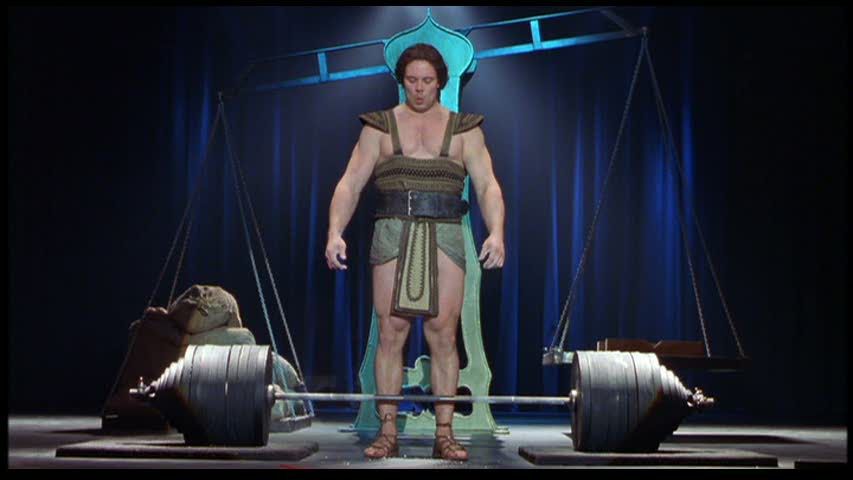
Zishe's own stage show is fascinating as an examination of issues of Jewish and Aryan ethnic identities and the developing tensions within Germany during the immediate pre-Nazi era. Hanussen, who hides his own Jewish heritage behind virulent pro-Nazi rhetoric, has Zishe appear in a blonde wig and ridiculous Viking armor as the Aryan hero Siegried. As he performs his feats of strength, he is applauded by the uniformed Nazis in the crowd, who embrace him as one of their own, cheering him as though his actions reflect well on the entire Aryan race. The irony is obvious, and Zishe soon enough reveals the truth, which outrages his former supporters but makes him a hero to the Jewish people. These tensions are interesting and potentially explosive, but Herzog never does enough with them, never pushes things far enough. The normally apolitical Herzog isn't really interested in doing a direct historical drama about the rise of Nazism in his home country, but nor does he find enough depth in the character studies of Zishe or Hanussen (the latter, one suspects, would have been a far more interesting protagonist for a film like this). The resulting film is uneven and rather aimless, with some of its best ideas and moments buried by the meandering plot and leaden acting.

Wednesday, May 6, 2009

Films I Love #30: Asyl (Kurt Kren, 1975)


The structural films of the Austrian avant-garde filmmaker Kurt Kren are each based around a single technical conceit to which the film rigidly coheres, and around which it is structured. For Kren and the structuralists he inspired, the technical craft of cinema is in fact the whole of the cinema, and the themes and ideas in his films arise directly and solely from the methods of their contruction. Asyl is one of Kren's most formally ambitious works, an experiment in time lapse photography, multiple exposures, and segmented images. When he moved to a home in the country, Kren set up a static camera nearby, and over the course of 21 non-consecutive days, he fed the same strip of film stock through the camera once per day. In front of the lens, Kren also placed a masking board with holes in it, the placement of which was varied daily so that each time the film stock went through the camera, different areas of the image were exposed. The result is a film in which, within a single frame, time and space are made to overlap and coexist in unusual ways, creating impossible landscapes composed from footage shot on different days throughout the year. Sometimes, most of the film is exposed and the image becomes a collaged landscape, in which a snowbank runs directly into a grassy springtime meadow, or in which rain falls through the top half of the frame only to disappear when in reaches the bright sunshine of the lower half. At other times, the image is more pointillist, with distinct areas floating in the black frame like pieces of a puzzle that needs to be assembled.

The seasons run seamlessly into each other in this way, and time becomes hazy. Occasionally, a person will walk along the road in one part of the image, disappearing at an invisible border where the image fades into a different day, a different time. Kren is here reconfiguring film as a medium in which time and space cease to be linear in any sense. The film is instead about totalities; it invites the viewer to think about the progress of time and the way it generally works in cinematic images, and by contrast to process the multiple layered times implicit in each frame of Asyl. This short is Kren's finest work, with a conceptual purity and inventiveness that are unmatched even in his consistently intriguing oeuvre.

Tuesday, May 5, 2009

Bedlam


Bedlam was the last of producer Val Lewton's RKO horror films, and it's a rather stunning conclusion to the vaunted series of B-movies the producer oversaw at the studio throughout the 40s. As with all of Lewton's work, this film strays far from its ostensible genre, and its horror is strictly human and realistic; it is the horror of cruelty and indifference towards one's fellow beings. Just a year after the end of World War II and the revelation of the horrors of the Holocaust, Lewton made a film about society's continuing tendency to classify people as either human or subhuman, declaring certain specimens to be animals, brutes, mindless, not worthy of respect or dignity or even the ordinary essentials of living. The film is set comfortably in the past, in the 18th Century, and it ends with an optimistic message of progress, but one can't help but think that there are darker, uglier truths at its core.

The film concerns itself with the plight of the insane, institutionalized at a famous London asylum derisively called "Bedlam," where the overseer George Sims (Boris Karloff) charges admission for high society visitors to come and watch the lunatics and be entertained. It is an appalling state of affairs, but no one seems to mind other than Nell Bowen (Anna Lee), an entertainer herself and the protege of the wealthy Lord Mortimer (Billy House). She is a former actress and a cultivated wit, and she is kept as something like a court jester for the corpulent lord. She herself is far from amused by the conditions in Bedlam, but she tries to resist the pangs of her conscience, trying to maintain the air of upper-crust indifference that her friends and companions wear so comfortably. She finds, however, that she cannot stifle her feelings, and the Quaker Hannay (Richard Fraser) encourages her to do something about what she's seen. When Sims parades a troupe of lunatics in theatrical costumes before one of Mortimer's parties — even making a cruel joke out of the death of one of the performers — she is horrified as much by the laughter at the table as by Sims' own actions. She tries to use her influence with Mortimer to change conditions at Bedlam, but the threat of raised taxes proves much more persuasive to the lord than his companion's desires; he tells her to consider his problems rather than those of the poor in the asylum.

Eventually, Nell's insistence on stirring up trouble and trying to improve conditions at Bedlam gets her committed herself, with Sims manipulating a sanity hearing against her and getting her under his care. Sims is a true villain, and Karloff delivers one of his best, creepiest performances as the sadistic asylum-keeper. He is a toady to the upper class, cherishing his stable position, in which he is at least tolerated in society by virtue of his usefulness, but he is never really accepted. All he wants is this acceptance, and he tries to present himself as a poet, an educated man of letters, though as the introduction makes clear, he can only really attain this status by imprisoning and murdering his more sensitive and intelligent rivals. He is a monster masquerading as a sophisticate, and his ingratiating smiles fade over time into sinister leers. He looks uncomfortable, too, in the neat dark wig that covers up his shock of white, ragged hair, another society pretense, a thin veneer barely covering up his evil nature.


This is one of Lewton's most pointed and forceful social commentaries. One of the film's greatest scenes is the climactic moment when, after Nell has finally engineered her escape from Bedlam, the inmates take Sims as their prisoner while one of them, a former judge (Ian Wolfe), decides to put the prison supervisor on trial. The inmates hold a trial in which Sims stutters out his excuses and justifications, saying that he didn't want to hurt anyone, that he was merely following the dictates of society, trying to fit in with those around him — a defense that essentially amounts to, "I was just following orders." It rings as false here as it did at the contemporaneous Nuremberg Trials, but the inmates nevertheless declare Sims to be "sane" and therefore release him. It's a fascinating moment, not least because the inmates' verdict of sanity can also be understood as an acknowledgment of his culpability for his actions. The inmates act as though Sims' sanity frees him, but in actuality it confirms that he knew exactly what he was doing, that his cruelty and viciousness were conscious.

Lewton and director Mark Robson sculpt this film's images with their usual care and delicacy. The images from the early part of the film, in Mortimer's lavishly appointed home, are bright and pristine, seeming to glow with light. The brightness and good cheer of Mortimer's parties and the laughter constantly echoing throughout his house create a powerful contrast against the squalor of Bedlam. The film purposefully delays the moment when the inmates' quarters, hidden behind a heavy wooden door, are finally revealed. When Nell goes to visit the asylum for the first time, as she steps through the doors the camera remains on her face, in a closeup as her eyes go wide and her mouth opens slightly, unable to suppress a gasp of horror. Lewton and Robson hold the moment, taking in Sims' self-satisfied smirk behind her, convinced that he has another satisfied customer. And then the camera slowly tracks backward into the room, revealing the filth and misery and darkness in which Bedlam's inhabitants must live. They are sprawled out all over the floor, most of them dressed in rags and covered in dirt, sleeping on straw, living like animals. As Sims leads Nell around the room, he even describes what kinds of animals certain inmates are: some are pigs, wallowing in their own filth, while others are dogs and need to be kicked every so often. He's a cartoonish villain, but his villainy feels all too real anyway.

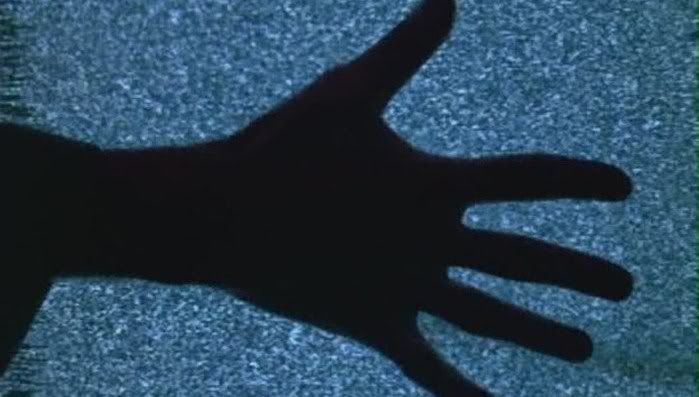
The same can't always be said of the other characters. Despite the film's many virtues, it often suffers from mannered, stilted dialogue — it's the kind of writing that tries to approximate older forms of speech by eliminating contractions and making the conversational rhythms stiff and slow. Karloff's sheer intensity gets across even the clunkiest of the dialogue, but some of the other actors occasionally stumble. This is especially a problem for Fraser, whose stubborn Quaker comes across as self-righteous and sermonizing. Lee, however, is a worthy foil for Karloff's scenery-chewing evil. She's free-spirited and quick-witted, even if the rather staid dialogue never really establishes her as quite as funny as she's supposed to be. But as usual with Lewton's productions, the emphasis is on the film's atmosphere, particularly the eerie, darkly lit interior of the asylum, with its shadowy back corridor where grasping hands reach out from between the bars of cages. This is a horror story about the inhumanity with which people treat one another, and the societal structures that prop up and encourage this inhumanity.

Monday, May 4, 2009

Libeled Lady


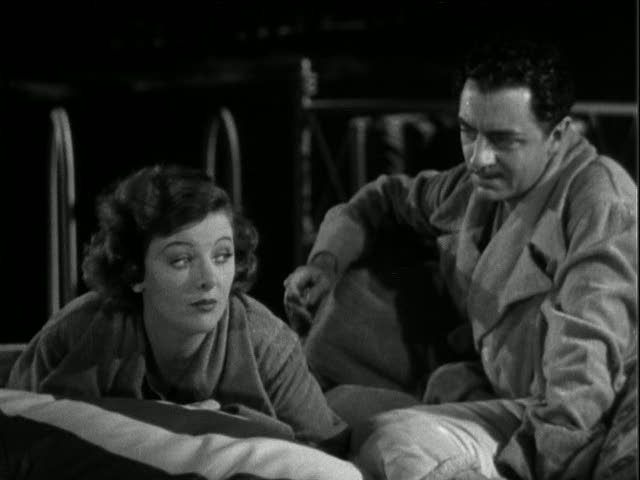
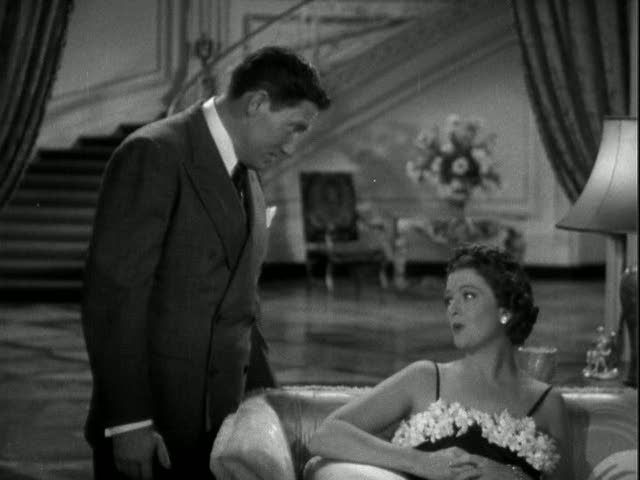
Libeled Lady provides an opportunity to see the unparalleled screen chemistry between William Powell and Myrna Loy outside of their six-film collaboration on the Thin Man films. This film, released two years after The Thin Man and just shortly before its first sequel After the Thin Man, offers a change from the comfort and wedded familiarity of Powell and Loy's Nick and Nora Charles. Here, the relationship between their characters is still in flux, still developing, and the film's greatest pleasure comes in watching them slowly work towards that easy interplay. When the film starts, there's a distance between them, a gap to be bridged by sheer charm and verbal seduction. Loy is Connie Allenbury, the globe-trotting daughter of a wealthy businessman and political hopeful (Walter Connolly). Allenbury had long been a rival of the newspaper the New York Evening Star, which accidentally prints a libelous and utterly untrue story about Connie, thus opening themselves up to a tremendous lawsuit. As a result, the paper's manic editor, Haggerty (Spencer Tracy), sends their best libel man to do anything he can to stop this lawsuit in its tracks, including compromising Connie so that her reputation really is ruined and the suit falls apart. This is, of course, Powell, as the compulsive and irresistible ladies' man Bill Chandler.

So the relationship between Connie and Chandler starts out as antagonistic. Connie suspects from the moment she meets him that Chandler is up to something — though her father adores this supposedly ace fisherman — and she maintains an icy remoteness that Chandler cannot crack. It's something to see the usually suave Powell utterly flummoxed, startled into silence by the mere fact that this woman will have nothing to do with him. She outsmarts him and steps neatly around his traps at every turn. From this hesitant beginning, though, the pair slowly begins developing towards their signature quick-witted repartee, with Powell's one-liners gliding effortlessly off of the ramp of Loy's pert, faux-wounded manners, her rolling eyes and puckered mouth. It's like watching the moment when Nick and Nora Charles first met and fell in love, when Nick's ragged charm and wit finally melted away the society ice queen's outer layers to find the playful girl inside.


Director Jack Conway doesn't have to do much with this pair besides get out of the way, and for the most part he does. The comic and romantic patter between Loy and Powell isn't particularly sharp or incisive — the script doesn't have the bounce or verve of the best Thin Man films — but the actors' warmth and obvious comfort with one another brings the characters to life. The film occasionally falters whenever it doesn't rely on the interplay of its leads, as in a lengthy and intermittently tedious sequence of fly fishing, with Chandler posing as a pro fisherman for the benefit of Connie and her father. To the extent that the scene relies on Powell's slapstick talents, it's a flop, because there's something deadening about seeing the dapper, self-possessed Powell trying to take a pratfall. He's not a physical comic, and it doesn't help that Conway's staging of Chandler's hapless attempts to catch a fish is flat and lifeless.

Thankfully, Powell and Loy do get admirable support from Tracy, and especially from Jean Harlow, as Haggerty's fiancée Gladys, who is used as a pawn in the plot to trip up Connie. Haggerty marries off Gladys to Chandler, keeping her hidden so that once Chandler compromises Connie, Gladys could appear to make it seem as though Connie were running around with a married man. Gladys provides comic relief throughout the film, a kind of crass, side-of-the-mouth counterpoint to Connie's prim sophistication. But in the final scene, she comes into her own, taking charge of the narrative by force. Her big moment is practically metafictional, a very self-conscious denial of the "happy ending" that seems to be developing in the final moments in the film; she sees the way this thing is heading, and she wants to make sure that she doesn't get left out of the Hollywood ending. As a result, the film seems to end twice: the narrative begins winding down and tying up loose ends only to be thrown into confusion again by Gladys at the last minute. The effect is sort of like those old Looney Tunes cartoons where the characters, conscious of their status in a fictional artifice, try desperately to exert some control over the direction of the story. Like Daffy in Duck Amuck, the cartoonish Gladys won't allow herself to be pushed around by some writer without putting up a fight, and her big speech winds up questioning not only the dictates of the story but the assumptions of the audience, who were probably only too willing to accept a "happy ending" for the charming, witty, upper-class characters while the vulgar, urban dame gets a raw deal. It's a great moment, subtly undercutting the assumptions about class underlying so many Hollywood romances and comedies. If the rest of the film is rarely so sophisticated or complex, though, it's still often funny and light and enjoyable, making this a fluffy entertainment that at the last moment hints at something more.