Monday, October 8, 2012

Mother


Joon-ho Bong's Mother is an extraordinary character study of a woman who will do anything for her son, a film that's full of surprises, narratively and tonally, and yet always remains rooted in its intense study of the titular mother (Hye-ja Kim) and her mentally handicapped son Do-joon (Bin Won). As with Bong's previous film, The Host, Mother skillfully balances multiple tones, shifting seamlessly from oddball comedy to melodrama to mystery to a rather strange kind of psychological thriller. The shifting tones and the instability of the narrative — much of which is built around Do-joon's unreliable memory — contribute to the sense that anything can happen at any moment, that the film is constantly in a state of flux, even as it revolves unceasingly around the warped mother/son relationship at its center.

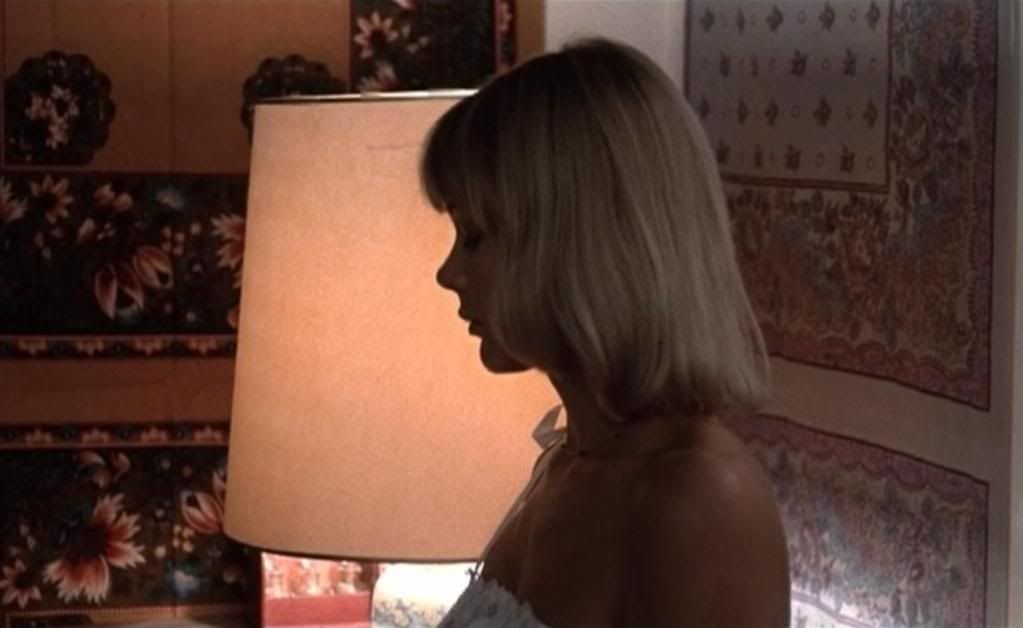
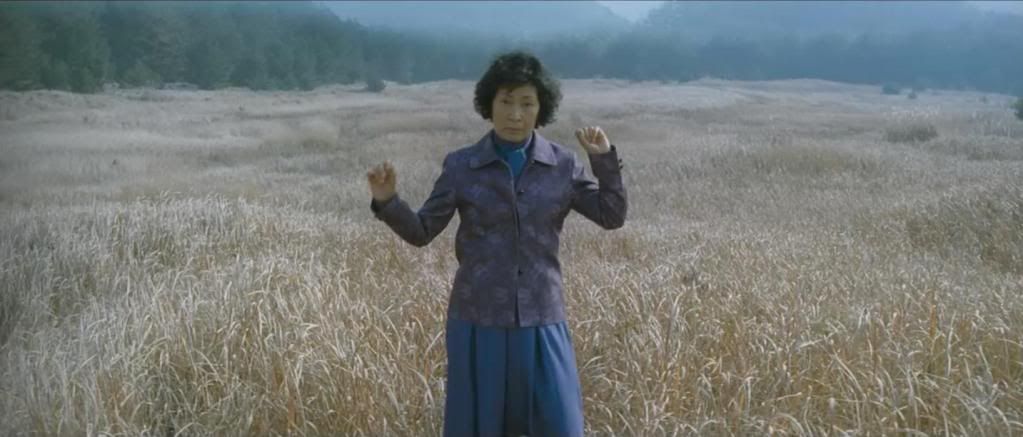
The film's brilliant opening credit sequence establishes this sense of disorientation almost immediately. The film's first image is the mother walking slowly across a large field of wheat, looking downtrodden until she climbs up a hill to approach the camera, at which point she begins swaying rhythmically and dancing, languidly and deliberately, theatrically smiling and then covering her grin with her hand. This remarkable sequence, already jarring and oddly funny, is followed by a dramatic, foreboding image of this woman bathed in shadow, staring down the camera as the film's title appears onscreen. Already, Bong seems to be announcing that this will be an unconventional film, as unattached to any single genre as Bong's ostensible monster movie The Host was.

The film's drama emerges when the amiable, slow-witted Do-joon is accused of the murder of a schoolgirl after a drunken night when he followed the girl to an abandoned house, where she was found dead the next morning. Do-joon is a somewhat goofy, innocent soul who's constantly led into trouble by his friend Jin-tae (Ku Jin). At the beginning of the film, these two chase down a group of rich professors driving a Mercedes Benz that nearly hits Do-joon and his dog. Do-joon and Jin-tae chase the car to a golf course, where they hilariously get their revenge, with Jin-tae kicking off one of the car's rearview mirrors and Do-joon flying through the air in a failed martial arts move, crashing into the pavement without connecting with the car at all. The confrontation then degenerates into a comical, absurd wrestling match in a sand trap.

The film's tone shifts once Do-joon is arrested, as he signs a confession under pressure from the police, seemingly not even fully understanding what he's signing. His mother hires a high-priced lawyer who probably costs more than she can really afford, but the lawyer, who says he's so busy that he never sits down, never seems to have much interest in Do-joon or his mother. In one hilarious sequence, he summons the mother for a conference and delivers his recommendation at a bar, surrounded by his two passed-out friends and the giggling prostitutes they've hired, who clap politely as the lawyer delivers his advice to his client. Bong continually offers up these tonally destabilizing moments that undercut the drama of the situation with bizarre comedic asides.

He also ventures at times into an eerie murder mystery as Do-joon's mother investigates the crime, since the police have closed the case after arresting her son. To aid in her investigative efforts, she enlists Jin-tae, who at times comes across as a creepy suspect himself, particularly in a tense sequence where the mother hides in Jin-tae's closet, believing that she's found evidence that he was the killer, having to sneak out of his house while he's asleep. Bong enhances the tension by emphasizing the obstacle course of trash that the mother has to gingerly step around as she sneaks out, finally knocking over a bottle of water. Bong then cuts to a taut closeup of Jin-tae's fingers dangling close to the floor, the puddle of water slowly spreading towards his hand. Even after he's seemingly exonerated as the killer, Jin-tae maintains a creepy edge, as he becomes a bad cop to the mother's good cop, tracking down kids who knew the murdered girl and beating evidence out of them, culminating in a grisly sequence in which he traps one kid in a disused ferris wheel and kicks his teeth out.
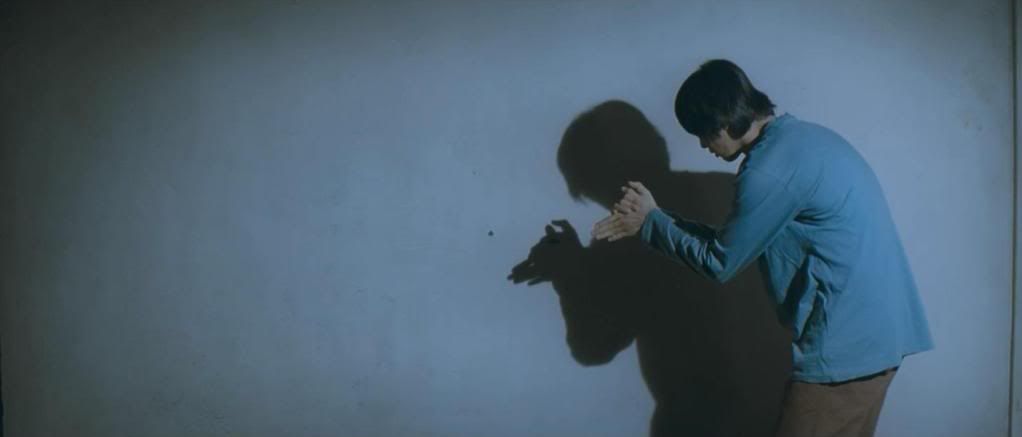

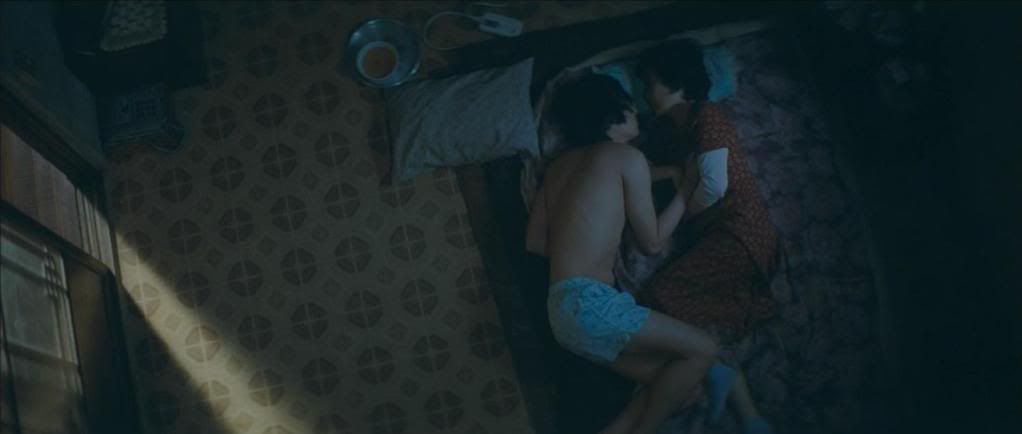
The film's uneasy tonal balance is further disrupted by the fact that, the more the mother investigates and prods at Do-joon's memory, the more unsettling facts come to life, particularly about the relationship between mother and son. Even before Do-joon's arrest, there were intimations of a strange codependency between them; they slept together in the same bed every night, and when Do-joon stumbles in drunk late one night, he collapses onto the bed and instinctively, casually cups his hand on his mother's breast as he stretches out next to her wearing only his boxers. Eventually, even more troubling revelations come to light about their past, revealing just how twisted this woman is, revealing that there's something deeply warped in her affection and protectiveness for her son.

The film's harrowing, powerful final act goes even further, taking a mother's willingness to do anything for her son to its extreme. The film's unsettlingly cheery conclusion, in which the mother takes a "thank you mothers" bus ride given to her as a gift by Do-joon, builds on the film's theme of memory. The mother, who practices acupuncture illegally, says that she knows of a special pressure point on the thigh that eases the pain of memories, allowing one to forget about the past and move on. Much of the movie rests on her trying to get Do-joon to remember, to recall details about the night of the murder that might help prove his innocence, but in the end she decides that she doesn't want all these memories stirred to the surface after all, that it's better to forget, to ease the pain with a needle and then carry on as though nothing has happened. In the film's final image, she performs this procedure and, putting her pain behind her, she stands up with the other loving mothers on the bus and begins dancing, echoing the opening credits sequence, in an image that is at once ecstatic — with the sun shining through the bus' dirty windows, flaring at the camera — and bittersweet, since it represents the triumph of repression, denial, violence and lies.

Friday, October 5, 2012

The Man Who Loved Women


François Truffaut's The Man Who Loved Women is a retrospective look at the life and many affairs of an unrepetant womanizer, a man who can't resist chasing after one woman after another, never settling for any one woman for very long. But Truffaut's film, unfortunately, is nearly as shallow as its protagonist, Bertrand Morane (Charles Denner), who flits around after all these women, waxing poetic about their charms, the beauty of their bodies, and making his pursuit of them seem like an art, an expression of his philosophy about the world. Bertrand pours that philosophy out into the pages of the book he's writing, and it's around that book that Truffaut structures the film, relating anecdotes from Bertrand's past through the stories he writes in his lightly fictionalized novel.

This is, despite its potentially lurid subject matter, a curiously flat and dry affair, simply relating one interchangeable affair after another, as Bertrand serially seduces women he meets at random and women who he goes through elaborate machinations to encounter. As a comedy, it's not especially humorous, and as a character portrait it skates along the surface except for a few moments when the script (by Truffaut, Michel Fermaud and Suzanne Schiffman) delves into Bertrand's psychology only to come up with some trite rationalizations for his behavior. It's hard to know what's more disappointing, the fact that the film spends most of its time observing this man's surface presentation of himself, or the fact that when it does dig deeper, it comes up with only clichéd mommy issues and a failed romance that seemingly set him upon his current path.

Truffaut spends much of the film on the surface of Bertrand's life, but these glimpses into his formative experiences suggest a very simplistic psychology at the core of the film. Bertrand is copying the behaviors of his mother (Marie-Jeanne Montfajon), who was a promiscuous lover who didn't want a child to change her life, so she simply ignored her son as much as she possibly could. So Bertrand's desire to "collect" women is both an imitation of his mother and a kneejerk response to her neglect, causing him to be desperate for women's affection and attention. Or else Bertrand was deeply wounded by Véra (Leslie Caron), who appears late in the film, when it had seemed like Bertrand was incapable of a truly substantial relationship with a woman, to describe a time when he did have what could have been a real, significant love if he hadn't screwed it up. Both of these possibilities are floated as possible psychological explanations for Bertrand's attitude towards women, which reduces this character to little more than a collection of well-worn clichés.


At one point, Truffaut seems to anticipate the potential criticisms of his film and tries to duck around them with a scene where Bertrand sends his manuscript to some publishers. At a meeting regarding the manuscript at one of these publishing houses, none of the readers like the book except for Geneviève (Brigitte Fossey), who defends Bertrand's book against the criticisms of the others. Most of the critics' complaints about the book could just as easily apply to Truffaut's film — that its protagonist is too self-aggrandizing, that the psychology of it is uninteresting — but Geneviève deftly overturns their objections, thus defending the film as well, making these seem like both a preemptive defense and a self-congratulatory assertion of the film's success. She claims that Bertrand's story is simply full of "the contradictions of life," that the writer is actually self-aware about his own womanizing, which he is to some extent, but the implication that Truffaut's film is so dramatically unsatisfying because it's about reality is hard to take. This isn't reality but a flat, overly literary bundle of character types and shallow characterization.

There are, nevertheless, some nice moments here, scenes and performances that hint at a potentially more satisfying movie that Truffaut could have made. Denner's performance as the titular womanizer is mostly fine, projecting some of the charm and elegance that make this otherwise unremarkable-looking man so irresistible to so many women. But it's the women who really shine, and it's to Truffaut's credit that he populates the film with so many lively, winning performances from women, so that Bertrand's conquests become as much a tribute to the loveliness and appeal of all these actresses as they are a more general poem to the lure of women. Especially compelling is Nathalie Baye as a woman who Bertrand goes to great lengths to meet, only to find out that she's not the woman he thought she was. Baye's appearance, towards the beginning of the film, provides a tantalizing glimpse of a path not taken for Bertrand. Once he finds out that she's not actually the woman he'd glimpsed on the street one day and tracked down so relentlessly, he leaves, but Baye's shy smiles and straightforward manner make her a compelling presence, lingering past Bertrand's loss of interest, implicitly condemning his shallow fixations.

Many of the film's other women are equally compelling — Nelly Borgeaud as an unhappy housewife who gets off on danger, Valérie Bonnier as a girlfriend who eventually decides she needs more from a relationship than the cool Bertrand can offer — but by necessity none of these characters stick around very long or are developed beyond a few scenes. Truffaut's film ultimately just provides a mirror for Bertrand's life: shallow, self-absorbed, displaying a stereotypical masculinity and flitting from one moment to the next without ever spending too long with any one person or thinking too hard about the meaning of it all.

Wednesday, October 3, 2012

Betty


Claude Chabrol's Betty is a devastating, moving, extraordinarily acted portrait of a lost soul whose drinking and sexual promiscuity isolate her from the bourgeois family she's married into, and from which she's eventually ejected entirely. Based on a novel by Georges Simenon, the film is a deeply affecting study of addiction and disconnection. Marie Trintignant delivers an astonishing performance as the title character, exploring the confusion, depression, and fragility of this aimless young woman — as well as the undercurrent of emotional coldness and cruelty that perhaps lies beneath her surface frailty.

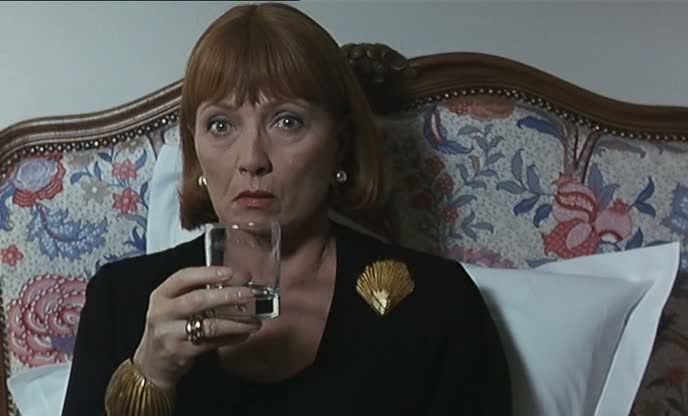
The film opens with a sequence that suggests a familiar Chabrol thriller in the offing. Betty is picked up by a twitchy, increasingly creepy man who claims he's a doctor, and goes with him to a club called Le Trou, a reference perhaps to the Jacques Becker classic as well as an indication that the people inhabiting this bar have reached the bottom, that they've sunk so low they're underground and desperately trying to tunnel out. As Betty swigs glass after glass of whiskey, the doctor begins exhibiting increasingly disturbing signs that he's no more stable than the woman he picked up. His patter becomes chilling, even vaguely threatening, as he talks about dead animals and gets noticeably sweaty, not that Betty, immersed in her drinks, seems to care about her companion's unhinged demeanor. The scene seems to be building to an apex of sinister violence, particularly when the doctor, his sweaty visage framed in profile against the cool blue of a fish tank in the background, tells Betty that she has worms underneath her skin, and that he'll dig them out for her with a needle he keeps handy.

Chabrol is offering up a red herring here, setting up what seems to be a thriller of predation and violence, when in fact this is a very different kind of movie, and the encounter with the doctor is soon defused by the arrival of the kindly bar owner Mario (Jean-François Garreaud) and his lover, Laure (Stéphane Audran), who explains that the doctor is a drug addict. Far from being a violent thriller, this is a quietly intense character study, an intimate portrait of a woman who, like everyone else in Le Trou, has sunk to her seeming low point, fallen as far as she can.


Betty is taken in by Laure, a woman of the upper-class who's rejected society after the death of her husband, retreating to a nice but isolated hotel and making nightly visits to Le Trou. As Laure helps Betty to recover from her desolation, Betty's story is doled out in fits and starts via flashbacks. She'd been married to Guy (Yves Lambrecht), the youngest son of a wealthy and prestigious bourgeois family, until Guy and his domineering mother (Christiane Minazzoli) had walked in on Betty having sex with one of the many lovers she'd taken to distract herself from a numbing, alienating existence. Betty was sleepwalking through life, and Chabrol, of course, is excellent at portraying the deadening effect of bourgeois home life. Betty felt detached even from her two daughters, who were so well-cared-for by a hired nurse that Betty was superfluous, a stranger to her own children, basically only interacting with them to give them a good-night kiss. She had a seemingly ideal life, on paper at least, but it never truly felt like her life, which is why she secretly drinks and arranges her constant affairs. When she gets caught, it seems like she wants to get caught, that she's secretly setting herself up for a confrontation, for something to shake her out of this dreadful nothingness.

Trintignant is exceptional here, plumbing the depths of this woman's misery and seemingly irresistible urge towards self-destruction. One of her lovers, a medical student (Thomas Chabrol) who loves to psychoanalyze her, asks her, "you know your problem?" Betty abruptly becomes serious, intent, flatly answering, "no, tell me," her desperate need to understand herself showing through what had otherwise been a somewhat casual conversation. The way she says it, it's obvious that she really wants to understand herself and her "problem," to pick apart why she is the way she is, even if this pretentious young man with his rote recitations of Freudian subtext doesn't actually have any of the answers. It's a small moment, the nuances of Trintignant's performance embodied in every little line like this, always communicating the submerged intensity of this sad woman.

Audran, in her last role in a Chabrol film, is equally remarkable, as a woman who is in her way every bit as damaged as Betty is, but has managed to recover, to carve out a small and comfortable life for herself as a balm for her loss and sadness. She is a glimpse of a possible future for Betty, and perhaps Betty herself also sees it, because in the film's devastating and unexpected finale, Betty, selfishly rejecting the possibility of growth or true healing, simply grasps for what her friend has and takes it. Betty, beneath her hurt and her victimhood, has a cold and calculating side to her as well, a darkness that prevents her from seeing a less destructive route out of her rut. The coda, which chronicles the minimal effect of all this emotion and self-destructiveness on the chilly, perpetually polite world of the bourgeois — the world that both Laure and Betty had fled for different reasons — adds a final ironic twist to the film's bleak picture. It's a powerful and intense film that is unsparing in its depiction of the central character's weaknesses, as well as her surprising and cruel strengths.

Monday, October 1, 2012

Deep Red


Dario Argento's Deep Red is the predecessor of the director's unsettling Suspiria, sharing with that film a bright, colorful aesthetic, here with a particular emphasis on the red of the title. At times meandering and oddly paced — after a riveting opening, the film wanders aimlessly for quite a bit of its length — Deep Red is nevertheless dotted with enough striking, brilliantly composed images and chilling set pieces to make it compelling and often creepy.

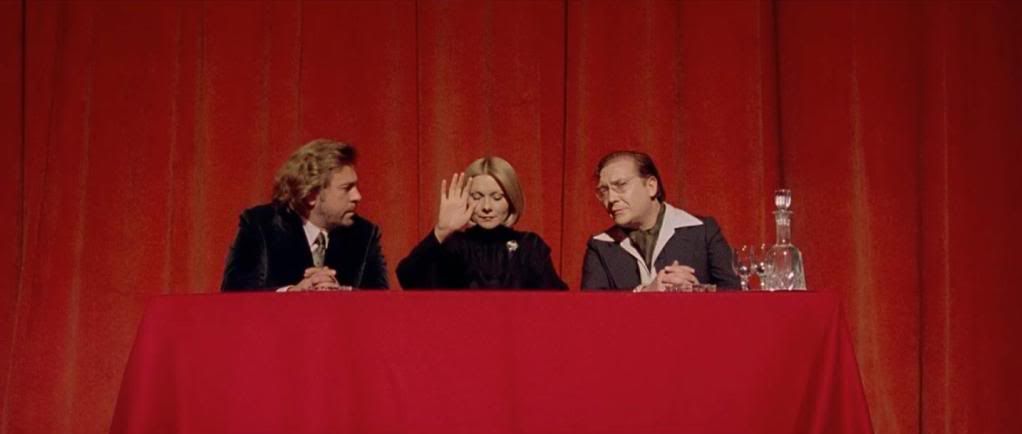
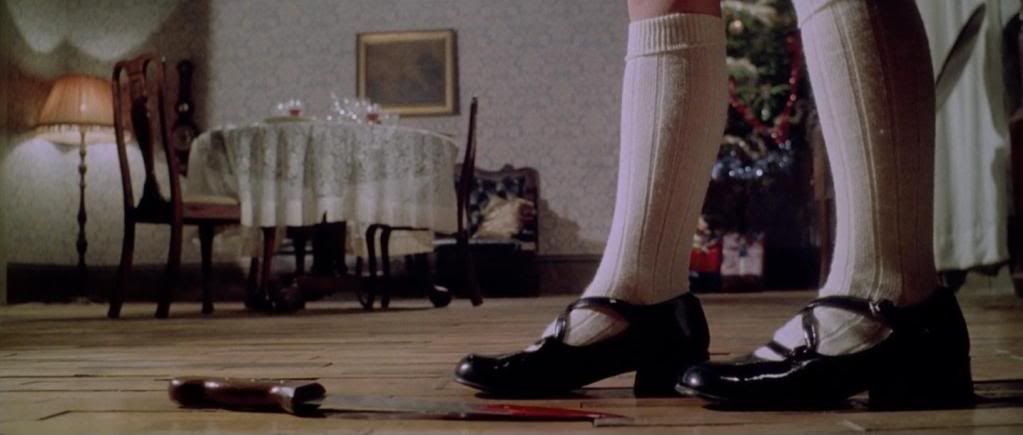
Certainly, the film starts incredibly strong, doling out a few mysterious images — like a child's stockinged feet approaching a bloody knife on Christmas morning — during the credits, establishing the primal scene of violence that will drive the rest of the film. The film's best sequence is the extended opening featuring the psychic Helga (Macha Meril), who, during a demonstration of her powers, is suddenly assaulted by violent thoughts from someone in the audience. Argento stages this stunning sequence on a dramatic stage decorated with red-on-red: the dais at which the psychic sits is draped in a red cloth, and the curtains behind her are also red, so that she's surrounded by bright, bloody red as she writhes and cries out, overcome by the darkness and malevolence she unexpectedly finds drifting into her mind from somebody in the audience.

Argento's camera, taking on the point-of-view of this mysterious evil presence, shakes and jitters as the killer retreats from the theater. Throughout the film, Argento several times indicates the killer's perspective with this kind of handheld camera, most unsettlingly in the subsequent scene where Helga leaves the now-empty theater, still sensing the presence of those horrible thoughts, as the camera peeks out at her from behind a nearby pillar. The camera seems to be shaking with the killer's excited heavy breathing, with the thrill of the chase, establishing a voyeuristic perspective that aligns the camera, and the watching audience, with the hidden killer's vantage point. Soon, Helga is a victim, her gruesome murder witnessed by her neighbor Marc (David Hemmings), who begins investigating the killer while the body count, predictably, keeps getting higher and higher.


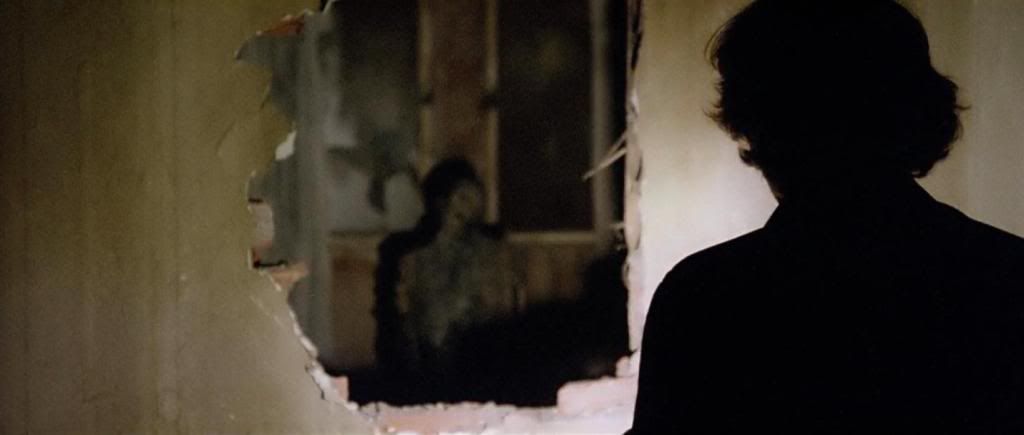
Argento's visual inventiveness is at its peak during the film's gory murder sequences, each of them a taut and unsettling set piece that's perfectly designed. In one scene, the killer's presence in a dark closet is indicated by a single eye suddenly opening in the darkness, at which point Argento's camera zooms in to capture that one eye staring out of the surrounding blackness. In another scene, for some reason the killer's appearance is preceded by an utterly creepy doll that jauntily jogs towards the terrified victim, cackling and waving its motorized arms in front of it. The doll's appearance is made even more unsettling by the casual way that Argento frames it, initially in a long shot in which the doll's unnatural movement is very disturbing, before cutting in for the obligatory closeup of its grinning plastic face.

These eerie scenes are spaced out through the film, providing periodic bursts of insane imagery and bright red blood that looks like paint. Much of the film is dedicated to Marc's slow, hesitant investigation, assisted by the reporter Gianna (Daria Nicolodi), and there's something of a disconnect between the baroque scenes of violence and the surrounding ordinariness of the rest of the movie. The film sometimes feels a little slack whenever the killer's not around, though the oddball humor and quirky fringe characters help to liven things up whenever the tension dissipates. There's a subtext of sexual insecurity in Marc, who's beaten at arm-wrestling by Gianna, and feels cramped and claustrophobic in her car, sitting significantly lower than her in the broken passenger seat, making him look very foolish next to her. Later, he visits his friend Carlo (Gabriele Lavia) and discovers that Carlo is gay, staying with a feminine man who might pass for a woman if not for his peach-fuzz mustache.

Much of the film's comic relief, especially the bizarre scenes featuring Carlo's mother (Clara Calamai), winds up tying into the film's twisty ending, but before this, the comic tone and alternation of suspense with the meandering investigative scenes gives the film a strange, disjointed feeling. The jangly, chiming prog rock soundtrack by Goblin (who'd go on to top themselves with their even better score for Suspiria) adds to the film's strangeness, the music resonating with the childlike melody that serves as the killer's trademark and connects these crimes to some sort of traumatic childhood incident. Deep Red is ultimately a very strange movie, its rambling pace spiked with scenes of violence that are made almost beautiful through the filter of Argento's aesthetic.