 Rendezvous In Paris
 is one of Eric Rohmer's episodic films, like his sadly unknown
4 Adventures of Reinette and Mirabelle. This is a triptych of three stories set in Paris, with the concept of the rendezvous as the driving force and structural foundation of all three. The three stories concern two-timers and cheaters, and revolve around O. Henryesque ironies and coincidences, the stories marked by cute twists and wry reversals that mask the more quietly emotional subcurrents running through all three tales. These are simple, even stereotypical stories — one girl discovers her boyfriend is cheating, another cheats on her boyfriend with an older man, and a painter clumsily juggles two women who aren't interested in him — told with the directness and playfulness that Rohmer typically brings to his work. It is a light film, even minor, in the context of Rohmer's career as a whole, but its simplicity is also a virtue. The dialogue, as usual in Rohmer, is refreshingly open and eloquent: Rohmer's characters don't always say what they mean, or even know what they mean, but they always speak in ways that reveal their souls, whether intentionally or not. Rohmer seems to have a profound belief in the power of talk, even when it's idle banter or lies.
In the first of the film's three stories, Esther (Clara Bellar) becomes obsessed with the idea, mentioned in passing by an admirer, that her boyfriend Horace (Antoine Basler) is seeing another girl on the side. The rendezvous here is an
idée fixe for Esther: she's told that Horace meets another girl at a certain café at 7:00 on the evenings when he's not with Esther. After introducing this structuring idea, Rohmer allows the plot to meander along, with Esther's obsession with this supposed meeting always percolating subtly in the background. She tries to study for a test, confesses her worries to a friend, and then indulges a playful flirtation with a man (Mathias Mégard) she meets in an outdoor market, and all the while she's thinking about Horace's supposed meeting with another girl.
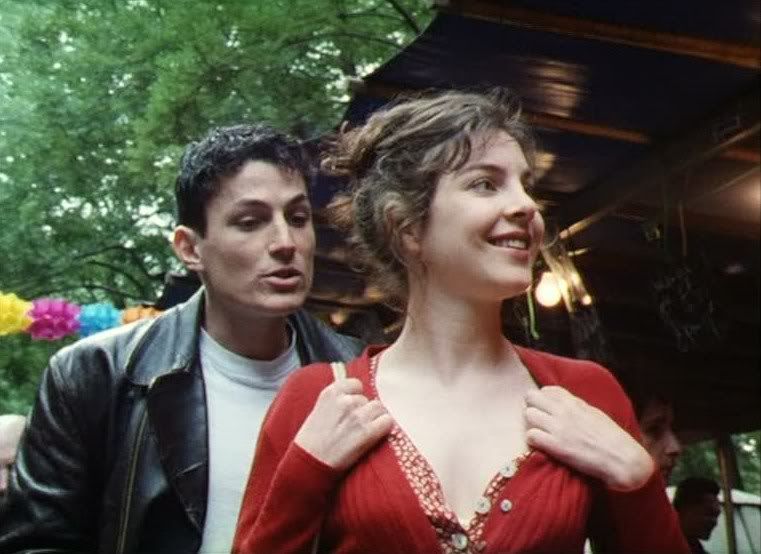
The scene where Esther flirts in the marketplace is a masterful piece of staging. As Esther walks along in the foreground of the shot, turning her head this way and that to look at the various stalls in the market, the man trails along behind her, telling her that he has a dentist's appointment and wants to pass some pleasurable time with her beforehand. Rohmer's camera drifts along with the pair as they walk, capturing the delicate struggle between them as the man flirts and tries to charm her, while she maintains a pose of faux-aloofness, pretending to be absorbed by the sights of the market around her, hardly ever even looking directly at the man who's strolling just behind her. It's a game, and a fun game to watch, this jockeying for position within the frame, this struggle to get the upper hand in a game of romance and flirtation. Rohmer captures the little details — Esther's studied air of casualness offset by a charmingly genuine smile, the way she keeps subtly cutting off her would-be suitor, preventing him from walking exactly next to her — that characterize these games between men and women, the games that are the subject of so many of Rohmer's films.
The games continue as Esther sets a fake date for the same café that Horace is rumored to frequent, a date she really has no intention of keeping. But when her wallet is stolen and then returned by a stranger named Aricie (Judith Chancel), who also has a date at that same café, it becomes obvious that Esther is meant to be at that meeting at 7:00, just as it becomes obvious to the audience what the ironic twist is going to be. The denouement is no less delightful for its obviousness and contrivance, though. It's a cutesy twist, a pat irony, but Rohmer uses it as a way of probing how the seemingly light games that men and women play with each other in love disguise deeper reservoirs of feeling. Esther plays off her confrontation with Horace as a game at first, acting as though she doesn't know him, letting herself be introduced as an old friend by Aricie, hiding bits of coded malice in her superficially playful patter. But it's obvious how much she's hurt, how shaken she is by this betrayal, and finally she can't hide behind the games anymore, and storms away. It's fitting that the final irony is also hurtful: she leaves without fulfilling her date with the man from the market, who shows up just after the drama has played out, looking around expectantly and hesitantly, already fearing the disappointment of the girl not showing up. These games of love, Rohmer suggests, are not the laughing matter that we sometimes pretend they are.
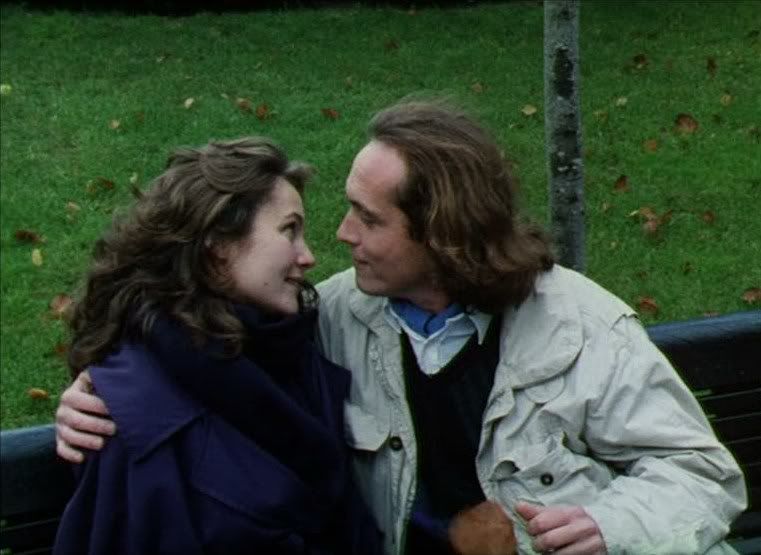
The middle story of this triptych also deals with unfaithful lovers, although from the opposite perspective: a woman (Aurore Rauscher) meets with a somewhat older man (Serge Renko) in parks around Paris, cheating on a longtime boyfriend who she almost thinks of as her husband. Rohmer's sense of geography, his attention to the nuances of place, is on full display here, as the two lovers meet in one park after another, always searching for novelty and "poetry" as they get to know one another and try to negotiate their clandestine relationship. They always meet in public, because the woman doesn't want to risk going too far by visiting his apartment, and as a result their relationship exists only in public, in parks where they walk with arms wrapped around each other, or kiss on benches in secluded areas, or playfully trot from place to place. Their conversation is at times banal, just idle chit-chat, at times touching on the deeper issues of love and intimacy that concern their relationship and the woman's continuing but increasingly loveless relationship with her other boyfriend.
The two lovers are unnamed, credited only as "elle" and "lui," suggesting that they are archetypes, paradigms of the dueling negotiations between men and women as they try to form relationships. They lie to one another, in small ways, telling each other conflicting stories about their desires and their feelings, never quite forming a solid bond: she's leading him on, keeping him at a distance, while he wants more but seems disappointed when she finally offers it. It's as though their relationship is perfect within the limited confines they set for it, and outside of that narrow purview it will inevitably collapse. As they slowly work towards discovering this truth, Rohmer revels in the beauty of the Parisian parks they visit, surrounding these hesitant lovers in rich, vibrant green hues that seem to enfold them at first, and which are increasingly replaced by bare trees and paths strewn with browning leaves as fall leads into the winter chill. Rohmer has always had a great feel for the seasons, around which he built a four-film series late in his career, and here he manages to film the chilly air, the coldness that makes these lovers want to cuddle closer on damp benches.
In the end, for their last tryst, the lovers play at being tourists in Paris, pretending that they've arrived for a sightseeing trip, and the metaphor of tourism in a subtle way comments on their own relationship. There's a sense of the temporary, of the scenic and superficial, in this relationship that exists only in parks. The ending is another ironic twist worthy of O. Henry, but as in the first segment, it's also an opportunity for the playfulness and games to give way to stark honesty. The woman, dropping her tourist act and dropping, too, the flirty charm with which she'd strung along her lover, finally tells him her true feelings, in blunt and painfully honest terms. It's yet another reminder that the charm and surface lightness of much of Rohmer's work can be deceptive, that the emotions at stake in these seemingly trifling stories can in fact be quite profound.
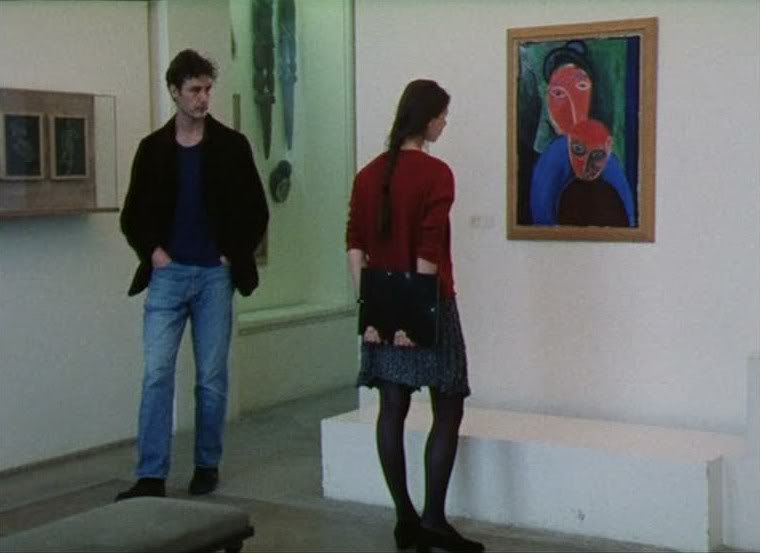
The third and final segment of
Rendezvous In Paris, though, concerns much more frivolous and transient relationships than the more enduring ones in the first two stories. A painter (Michael Kraft) gets a visit from a friend of a friend, a Swedish woman (Veronika Johansson) who's visiting Paris and needs someone to show her around. He's not too interested in her, and she seems indifferent to him, and he takes her to a museum where he becomes fascinated by another woman (Bénédicte Loyen), who turns out to be married. There's a more subtle irony at work in this story than in the first two, with their broadly telegraphed twist endings. Throughout this story, the painter uses his work as an excuse, as a pretext, as a prop for conversation: when he doesn't want to do something, he says he's engaged in painting, and when he wants to impress a girl he talks about painting, pompously lecturing on form and color and history to seem intelligent. He's kind of a fraud and an arrogant jerk, like so many of Rohmer's male protagonists, absorbed in himself and so insecure as an artist that his art hardly seems as important to him as meeting girls. The irony arises because, at the end of the film, having passed an afternoon with the married girl who makes it clear that she's not interested, and having been stood up by the Swedish girl who he'd earlier intended to stand up himself, he's finally left alone with his painting, and the events of the day send him off in a new and potentially fruitful direction, injecting some life and vigor into his previously dull work.
This is, perhaps, another not-so-complex ironic twist, if a more subtly communicated one than in the first two segments. But it's Rohmer's sensitivity and wit that allows this point to resonate, as he patiently observes this cad at work and play. "I thought you were an artist, not a pick-up artist," the newly married girl observes wryly as he trots along behind her, much as the stranger in the market had behind Esther in the film's first segment. Like Esther, she seems playfully receptive, committed to her new husband but not so much that she won't indulge in a little harmless banter with this stranger, and even visit his apartment to see his paintings. And as in the first segment, Rohmer's fluency with body language is compelling to watch: the conversation in the painter's studio is a study in distance and intimacy, as the two slowly drift together only for her to abruptly break away, shattering the intimacy that occasionally threatens to develop between them. Their conversation, about art and the importance of searching for one's aesthetic, is a kind of mask for their innocent flirtation, but it's also the first time in the film, one senses, that when the painter talks about his art, he's doing so genuinely, rather than using his painting as an excuse or a tool or a symbol for his identity.
This kind of multi-leveled conversation, where surface meanings and subtexts intertwine and words are both revealing and deceptive, is typical of Rohmer. Even in such a simple, essentially light-hearted film, with its jaunty illustrated titles and interludes of street singers to introduce each tale, Rohmer is dealing with complicated emotions, with the question of how we discover what's important to us and what we want from our lives and relationships. This is, as with so many of the films Rohmer made in his later career, a youthful film made by an older man, with its cute young actresses and handsome leading men, their vibrancy and vitality bringing Rohmer's agile dialogue to exciting life. It's a fun film where even its humor and its playfulness contribute to its deeper themes.